Appy Pie Pricing 2026: Which Plan Is Best for Small Businesses, Startups & Beginners?
Appy Pie Pricing 2026: Which Plan Is Best for Small Businesses, Startups & Beginners?
The Hidden Cost of Choosing the Wrong No-Code Platform
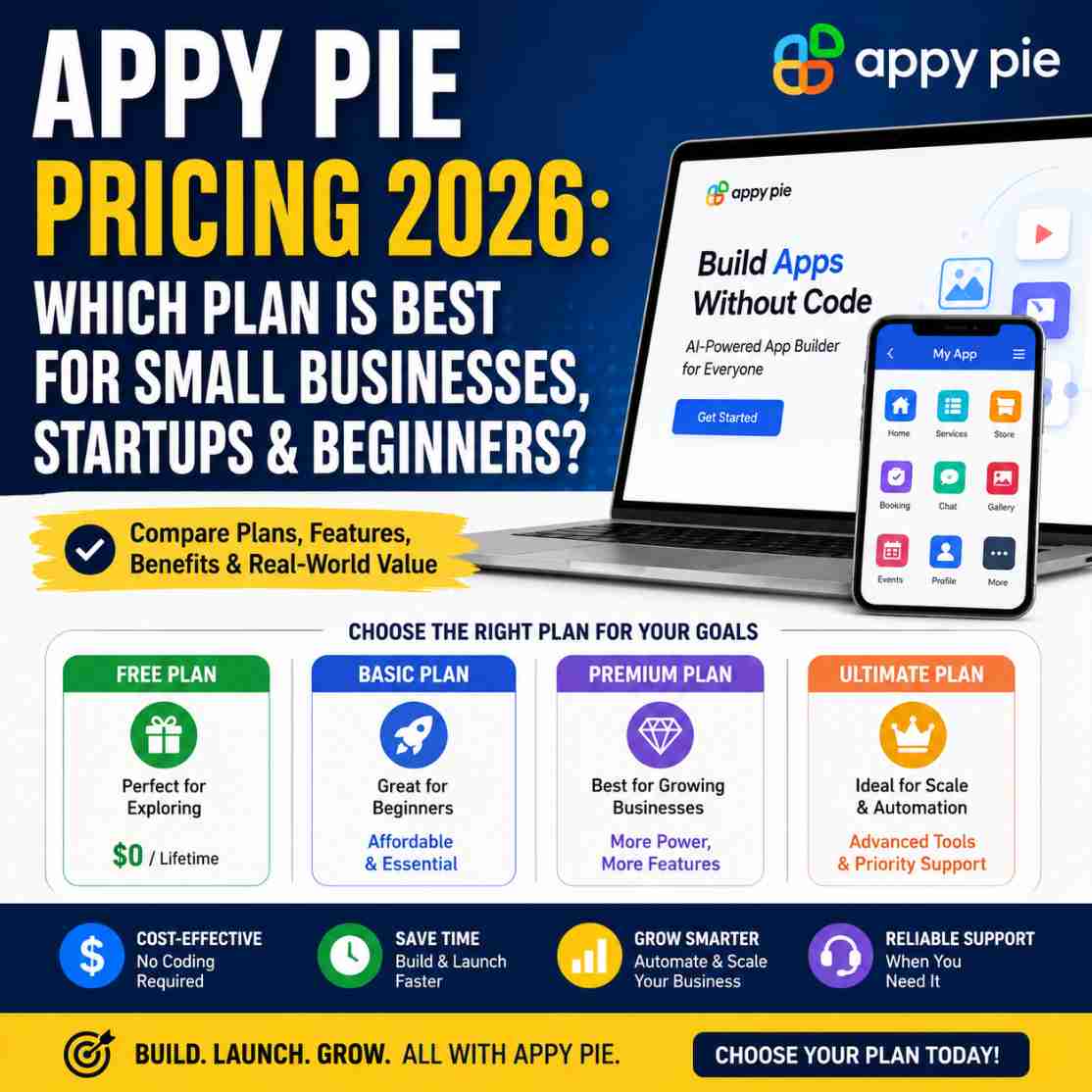
Appy Pie Pricing 2026 offers multiple plans designed for beginners, startups, and small businesses looking to build apps without traditional development costs. The best plan depends on your goals, team size, automation needs, and growth expectations. For most small businesses, Appy Pie provides a lower-cost entry point than hiring developers, though advanced users may eventually require more customization than the platform currently offers.
Many founders don't fail because of bad ideas.
They fail because they spend months building the wrong infrastructure.
A common pattern appears repeatedly among startups, creators, consultants, healthcare professionals, and local businesses:
- They need an app.
- They cannot justify hiring a development team.
- They try multiple tools.
- They lose weeks evaluating platforms.
- Costs quietly increase as requirements grow.
The challenge isn't finding a no-code platform.
The challenge is selecting a platform that remains practical after the initial excitement wears off.
This is where Appy Pie enters the conversation.
The platform has built a reputation around helping non-technical users launch apps, automate workflows, create websites, and experiment with AI-powered business tools without touching code.
The bigger question in 2026 is not whether Appy Pie works.
The real question is whether the pricing delivers enough operational value to justify long-term adoption.
If you're serious about launching an app without the cost and complexity of traditional development, take a closer look at Appy Pie's latest plans and features. Seeing what's included in each tier can make it much easier to match your budget with your business goals.
What Appy Pie Is Really Selling
Most people assume Appy Pie sells app-building software.
That's only partially true.
From an operational perspective, Appy Pie sells something much more valuable:
Reduced dependency on technical resources.
For small businesses, this means:
- Faster experimentation
- Lower development risk
- Reduced upfront investment
- Shorter deployment cycles
Instead of spending months coordinating freelancers, agencies, designers, and developers, users can create functional applications through visual workflows.
That shift fundamentally changes how small organizations approach software projects.
Before comparing pricing plans, it's worth understanding how the platform performs in real-world scenarios. Our detailed Appy Pie Review 2026 explores the user experience, AI capabilities, strengths, limitations, and who is most likely to benefit from the platform.
Understanding Appy Pie Pricing in 2026
Before comparing plans, it's important to understand what you're actually paying for.
You're not simply paying for storage, features, or publishing rights.
You're paying for:
- Development speed
- Reduced technical complexity
- Faster validation cycles
- Maintenance simplification
- Lower project risk
Businesses often compare Appy Pie pricing against other no-code platforms.
A more realistic comparison is:
Appy Pie vs hiring developers.
Even a modest custom app project can cost thousands of dollars before reaching production.
For many early-stage businesses, Appy Pie exists to avoid that initial expense.
Who Should Evaluate Appy Pie?
Small Businesses
Local service providers, clinics, educational organizations, membership communities, and retailers often need customer-facing apps without enterprise budgets.
Appy Pie can significantly shorten deployment timelines for these users.
Startups Building MVPs
For founders testing market demand, speed matters more than perfection.
Launching an MVP within days rather than months can provide invaluable customer feedback.
Solo Creators
Coaches, consultants, trainers, educators, and content creators can create branded mobile experiences without maintaining a software team.
Internal Operations Teams
Some organizations use Appy Pie internally for:
- Employee communication
- Internal process tracking
- Training resources
- Basic workflow management
Operator Perspective: What Changes After Implementation?
The biggest change isn't technical.It's operational.
Instead of asking:
"Can we build this?"
Teams start asking:
"Should we build this?"
That shift accelerates decision-making.
Simple projects become feasible because implementation barriers shrink dramatically.
A founder can test ideas that previously seemed too expensive.
A consultant can launch a client portal.
A clinic can create appointment workflows.
A training company can distribute learning content through a branded app.
The reduction in technical friction often creates more value than the software itself.
Where Appy Pie Performs Well
Fast Deployment
This remains one of Appy Pie's strongest advantages.
Many users can move from concept to functioning prototype within days.
For businesses operating with limited resources, this speed matters.
Beginner-Friendly Environment
Some no-code platforms assume users understand databases, workflows, APIs, and application architecture.
Appy Pie generally aims for accessibility first.
This lowers the learning curve significantly.
Broad Feature Coverage
Many organizations prefer platform consolidation.
Instead of managing multiple tools, they want one ecosystem that handles:
- Apps
- Automation
- AI functionality
- Website creation
Appy Pie attempts to cover multiple operational needs under one umbrella.
Lower Technical Maintenance
Traditional software projects create long-term maintenance obligations.
No-code platforms transfer much of that responsibility to the vendor.
This can reduce operational overhead considerably.
Where Friction Still Exists
No platform is perfect.
Appy Pie has limitations that buyers should understand before committing.
Customization Limits
As projects become more sophisticated, customization constraints become more visible.
Businesses with unique requirements may eventually encounter platform boundaries.
Scaling Complexity
An MVP and a mature business application are very different things.
While Appy Pie works well for many early-stage projects, scaling highly customized workflows can become challenging.
Dependency on Platform Ecosystem
When building on any no-code platform, you inherit its strengths and limitations.
Migration later may require additional effort.
Advanced Technical Users May Feel Restricted
Developers and technically experienced founders often prefer deeper control over architecture, integrations, and performance optimization.
Those users may outgrow the platform faster.
Appy Pie vs Traditional Development
This comparison is often overlooked.
Traditional Development
Advantages:
- Complete customization
- Unlimited flexibility
- Full ownership
Challenges:
- Higher cost
- Longer timelines
- Greater maintenance burden
- Increased project risk
Appy Pie
Advantages:
- Faster deployment
- Lower entry cost
- Reduced complexity
- Easier experimentation
Challenges:
- Less customization
- Platform dependency
- Scaling limitations
For most startups validating ideas, Appy Pie often wins.
For highly specialized applications, traditional development eventually becomes more attractive.
Appy Pie vs Other No-Code Platforms
Appy Pie vs Bubble
Bubble generally offers deeper customization.
Appy Pie usually provides a gentler learning experience.Choose Bubble if flexibility is your priority.
Choose Appy Pie if speed and simplicity matter more.
Appy Pie vs Glide
Glide excels for lightweight internal tools and database-driven applications.
Appy Pie often feels more approachable for broader business use cases.
Appy Pie vs Softr
Softr works particularly well for portals and membership systems.
Appy Pie offers a broader collection of business-building capabilities.
The right choice depends more on workflow requirements than feature lists.
Businesses evaluating Appy Pie should also consider how newer AI-powered no-code platforms compare. Our analysis of Hostinger Horizons highlights an alternative approach to building and deploying web applications without traditional development resources.
Productivity Impact: The Metric That Matters
Most software reviews focus on features.
Operators focus on outcomes.
Questions worth asking include:
- How many hours does this save?
- How quickly can ideas be tested?
- Does it reduce dependency on outside contractors?
- Can non-technical staff manage it?
When evaluated through this lens, Appy Pie becomes more compelling.
The value often comes from reducing friction rather than delivering sophisticated functionality.
App builders rarely operate in isolation. They work best as part of a larger business system. Our guide to the Creator Business Stack 2026 explores how AI tools, automation platforms, and digital infrastructure can work together to improve operational efficiency.
Sustainability and Long-Term Operations
At Kuruntha Smarket, we often evaluate software through a sustainability lens.Not environmental sustainability alone.Operational sustainability.
Can a small team realistically maintain this system two years from now?
Appy Pie scores reasonably well because:
- Technical maintenance remains relatively low.
- Infrastructure management is simplified.
- Updates are largely handled by the platform.
Organizations with limited technical capacity may find this particularly valuable.
Recommended Plan Selection Strategy
Beginners
Choose the lowest plan that allows publishing and testing.
Focus on validating your concept before upgrading.
Small Businesses
Select a plan that supports customer-facing deployment and essential integrations.
This is often where Appy Pie delivers the strongest value.
Startups
Prioritize scalability requirements.
If your product roadmap includes extensive customization, evaluate future migration paths early.
Agencies and Consultants
Consider plans that allow client deployment and ongoing management.
Time savings often justify the higher tiers.
For many small businesses, the biggest question isn't whether they can build an app—it's whether they can do it affordably. Explore Appy Pie's current pricing options and compare the available plans to see which one fits your growth stage before making a long-term commitment.
9. FAQ Section
Is Appy Pie worth it in 2026?
For beginners, startups, consultants, and small businesses seeking rapid deployment without hiring developers, Appy Pie remains a practical option. Its value comes primarily from reduced development costs and faster implementation.
Which Appy Pie plan is best for small businesses?
Most small businesses should choose a plan that includes publishing capabilities, integrations, and customer-facing deployment features. The ideal plan depends on expected growth and workflow complexity.
Is Appy Pie cheaper than hiring developers?
In most cases, yes. Even basic custom development projects often cost significantly more than a no-code subscription, especially during the MVP stage.
Can startups build MVPs using Appy Pie?
Yes. MVP development is one of the strongest use cases for Appy Pie. Founders can validate concepts faster before investing in custom development.
Does Appy Pie require coding knowledge?
No. The platform is designed primarily for non-technical users and beginners.
What are Appy Pie's biggest limitations?
Customization constraints, platform dependency, and scalability challenges for highly specialized applications are the most common concerns.
How does Appy Pie compare to Bubble?
Bubble generally offers greater flexibility and customization, while Appy Pie focuses more heavily on accessibility and faster onboarding.
Can Appy Pie replace traditional software development?
For simple and moderately complex business applications, it often can. For highly customized enterprise-grade software, traditional development remains the better option.
10. Final Verdict
Appy Pie's pricing in 2026 makes the most sense for organizations trying to reduce development costs, shorten deployment timelines, and validate ideas quickly.
Its greatest strength is not advanced technology.
Its greatest strength is reducing operational friction.
Small businesses, creators, consultants, educators, healthcare professionals, and startup founders can often launch meaningful digital products without building technical teams.
However, businesses expecting deep customization, complex architecture, or enterprise-level flexibility should evaluate long-term scalability carefully before committing.
For beginners and small organizations, Appy Pie remains one of the most accessible entry points into no-code development.
For advanced builders, it works best as a rapid experimentation platform rather than a permanent replacement for custom software development.
That distinction is what separates successful Appy Pie users from frustrated ones.
Disclosure:
This article may contain affiliate links. If you choose a service through our links, we may earn a commission at no extra cost to you.
This article was created with AI-assisted research and carefully reviewed by our in-house team before publication