What Is the ChatGPT Marketplace? Everything Businesses Need to Know in 2026
The ChatGPT Marketplace is the broader term businesses use for the ecosystem where users can discover and connect specialized apps and workflow capabilities inside ChatGPT. These integrations can bring information from external business services into a conversation and, depending on the app, allow users to search data, analyze information or perform supported actions without constantly switching between applications. OpenAI currently refers to the primary discovery experience as the Plugins Directory, while individual companies such as Text continue to describe their listings as being on the ChatGPT marketplace.
Everything Businesses Need to Know in 2026
For years, businesses have treated ChatGPT as a powerful place to ask questions, create content and analyze information.
That model is changing.
ChatGPT is increasingly becoming a business interface, where people can bring information from the tools they already use into a conversation and work with it through natural language.
That matters because business software has traditionally forced employees to jump between dashboards.
Open a helpdesk.
Check the CRM.
Search customer conversations.
Review sales data.
Return to the chatbot.
Then repeat the process.
The emerging ChatGPT app ecosystem changes that workflow.
Instead of asking employees to learn another dashboard for every task, businesses can increasingly bring relevant tools and data into the conversation.
OpenAI says apps can connect ChatGPT with external services, allowing users to search, reference information and, for supported integrations, take actions within connected services. Availability depends on factors such as the app, plan, workspace, role, model and region.
And this is where the opportunity becomes particularly interesting for businesses.
ChatGPT is moving closer to the place where research, decision-making and software workflows meet.
Want to see what this looks like in a real customer-support workflow? Take a closer look at Text and see how its ChatGPT integration can help teams work with customer conversations and support data without constantly jumping between tools. If it fits the way your team works, you can explore the platform and decide whether it is worth adding to your stack.
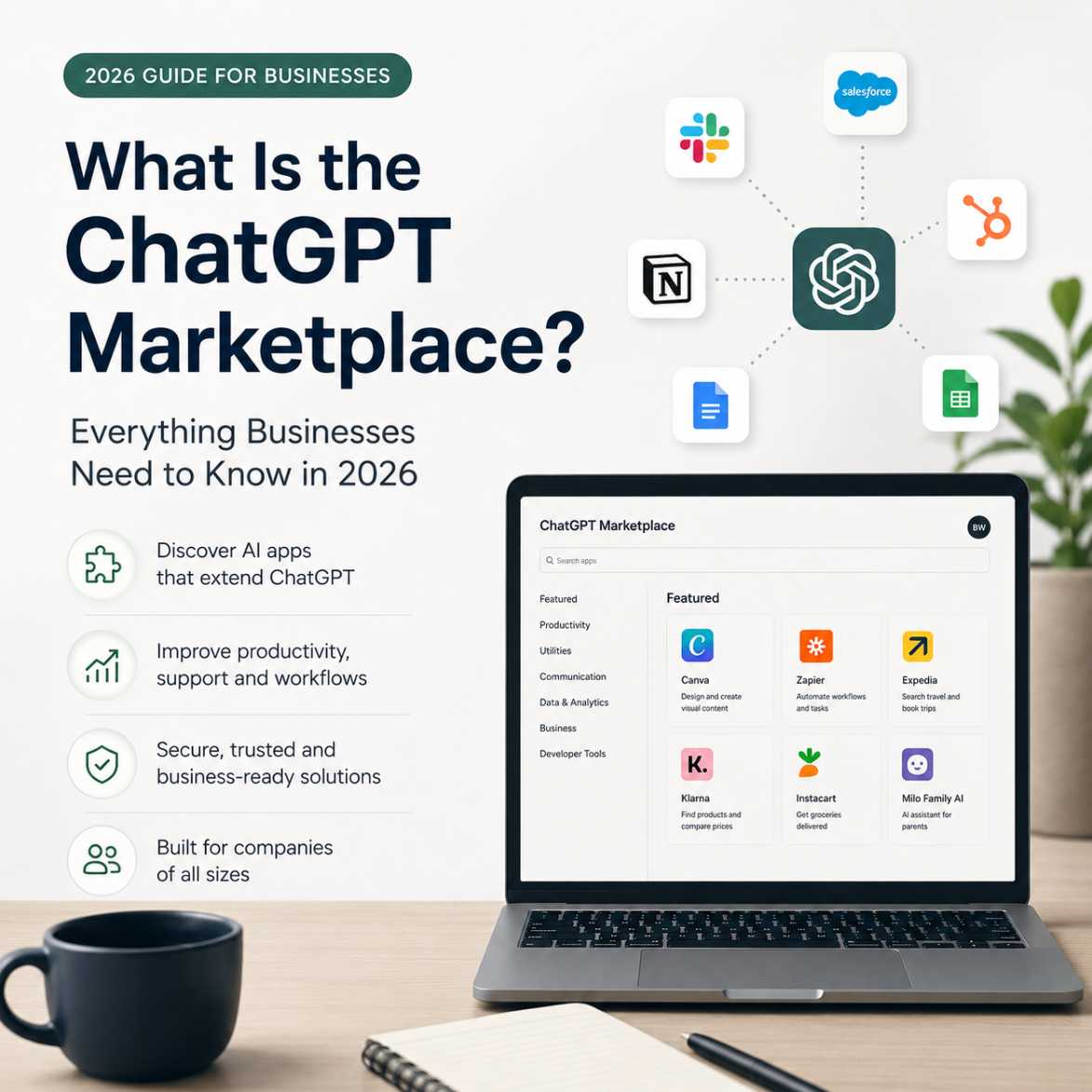
What Is the ChatGPT Marketplace?
The term "ChatGPT Marketplace" is commonly used to describe the ecosystem where users discover specialized capabilities that work with ChatGPT.
However, businesses should understand the terminology carefully.
OpenAI's current documentation says that, as of July 9, 2026, the app directory was migrated to the Plugin Directory, which is now the primary place for discovering workflow capabilities across ChatGPT and Codex. A plugin can package apps, skills and other capabilities into a workflow.
So when someone searches for:
- ChatGPT Marketplace
- ChatGPT Marketplace apps
- ChatGPT plugins
- ChatGPT business apps
- ChatGPT integrations
they are generally looking for ways to extend what ChatGPT can do beyond ordinary conversation.
For businesses, that distinction is important.
The value isn't simply having another chatbot.
The value is connecting conversation with useful business context and workflows.
How Does the ChatGPT Marketplace Work for Businesses?
The basic idea is straightforward.
A business chooses an available app or plugin, connects the relevant account when required, and then uses the capability through ChatGPT.
Depending on the integration, ChatGPT may be able to:
- search information from a connected service
- reference business data
- summarize documents or conversations
- analyze information
- provide interactive experiences
- perform supported actions
- assist with repeatable workflows
OpenAI notes that app capabilities vary and that permissions determine what information and actions are available. Workspace administrators can also control app availability and access.
That means businesses shouldn't think of ChatGPT apps as a replacement for every system they already use.
Think of them as a new access layer.
Your CRM can remain your CRM.
Your helpdesk can remain your helpdesk.
Your customer conversation platform can remain your customer conversation platform.
ChatGPT becomes another way to interact with information and workflows from those systems.
Why the ChatGPT Marketplace Matters to Business Buyers
There is a practical reason this trend deserves attention.
Employees don't work in neat software silos.
A customer support manager might need information from:
- support tickets
- customer conversations
- CRM records
- product documentation
- sales history
- internal knowledge
- ecommerce data
The information exists.
The problem is accessing and connecting it quickly.
That is where conversational interfaces become commercially interesting.
Instead of asking:
"Which dashboard contains this information?"
the employee can increasingly ask:
"What are customers complaining about most before checkout this month?"
That is a fundamentally different way of interacting with business software.
The best integrations therefore aren't simply adding AI to an existing product.
They are reducing the distance between a business question and a business answer.
ChatGPT Marketplace vs Traditional Business Software
Traditional SaaS isn't disappearing.
That would be the wrong conclusion.
Dashboards, reports, CRM systems and helpdesks remain essential because they provide structured environments for managing operations.
The ChatGPT app ecosystem adds another layer.
| Traditional Software | ChatGPT App Ecosystem |
|---|---|
| Navigate menus | Ask questions naturally |
| Open separate dashboards | Bring information into conversation |
| Learn individual interfaces | Use conversational instructions |
| Manually locate information | Search connected information |
| Work system by system | Potentially combine context across workflows |
| Primarily interface-driven | Increasingly conversation-driven |
The strongest business strategy isn't necessarily ChatGPT instead of SaaS.
It is often ChatGPT + the SaaS tools the business already depends on.
If you're moving beyond simple question-and-answer tools, our guide to AI agents for business automation explains how businesses are using more execution-focused systems to handle sales, support and operational workflows.
Why Text on the ChatGPT Marketplace Is Important
This is where the current Text development becomes particularly relevant.
Text announced in August 2026 that its platform is live as a plugin on the ChatGPT marketplace.
The integration is designed around a straightforward business problem:
How can teams ask questions about their customer conversations without constantly exporting data or switching tools?
According to Text, its ChatGPT integration can work with:
- chat transcripts
- archived chats
- support tickets
- ticket status
- assignees
- timestamps
- conversation tags
- ticket labels
Text also says each teammate connects their own Text account and that the integration inherits that user's permissions.
That is considerably more interesting than simply saying "Text now has a ChatGPT plugin."
The real value is the workflow.
What Can Businesses Ask Text Through ChatGPT?
The most useful applications aren't necessarily simple questions such as:
"Summarize this conversation."
The more valuable questions are the ones that require information across multiple conversations.
For example:
Customer Support
- Which customer issues appeared most frequently this week?
- Which tickets are still unresolved?
- What complaints are appearing repeatedly?
- Which support topics are generating the most friction?
Sales
- What objections are prospects raising before purchasing?
- Which questions repeatedly appear before checkout?
- What concerns are preventing customers from moving forward?
Product Teams
- Are customers reporting the same problem with one product?
- Which feature requests appear most frequently?
- Are complaints concentrated around one product or multiple products?
Management
- What changed in customer sentiment?
- Which issues are increasing?
- What should the support team prioritize?
This is where customer conversation analytics becomes more commercially valuable than simple chatbot automation.
You are not just answering customers.
You are learning from what customers are already saying.
Why Customer Conversations Are a Business Asset
Every customer conversation contains information.
A customer might reveal:
- what they wanted to buy
- why they hesitated
- what confused them
- what they disliked
- what they expected
- what almost stopped the purchase
- what ultimately convinced them
Traditionally, much of that information stays buried inside individual conversations.
A support agent sees it.
A manager might see a report.
But the business often doesn't systematically analyze the entire conversation history.
AI changes the economics of that analysis.
Instead of manually reviewing hundreds of conversations, teams can ask higher-level questions and identify patterns.
That creates a bridge between customer support and business intelligence.
And that is one of the strongest commercial reasons to pay attention to the ChatGPT app ecosystem.
ChatGPT Marketplace and AI Customer Support
Businesses have already moved through several generations of customer communication technology.
Generation 1: Email
Customers sent messages.Teams responded manually.
Generation 2: Live Chat
Customers received faster responses through real-time conversations.
Generation 3: Helpdesk Automation
Tickets became structured, routed and measured.
Generation 4: AI Chatbots
Businesses automated common questions and repetitive conversations.
Generation 5: Connected AI Workflows
AI can increasingly work with information from existing business systems.
The fifth stage is where ChatGPT apps become interesting.
The goal is no longer simply:
"Can AI answer the customer?"
The better question is:
"Can AI help the business understand and act on everything customers are saying?"
That is a much bigger opportunity.
ChatGPT Marketplace and AI Shopping
There is another reason businesses should pay attention.
ChatGPT is becoming increasingly important in product discovery.
OpenAI's March 2026 product-discovery update describes a richer shopping experience where users can browse products visually, compare options and refine results conversationally. OpenAI also says the experience is designed to help shoppers move from exploration to purchasing decisions with less tab switching.
This creates an important shift for ecommerce businesses.
Search traditionally looked like:
Google → product page → comparison → checkout
Conversational shopping increasingly looks more like:
Question → discussion → product discovery → comparison → decision
That changes what businesses need to think about.
Being discoverable online is no longer only about ranking a webpage.
Businesses increasingly need their products, services and information to be understandable in AI-driven discovery environments.
What Does AI Shopping Mean for Online Businesses?
Imagine a customer asking:
"I need a secure cloud storage service for a small remote team. Which options offer strong privacy and reasonable long-term value?"
The customer isn't necessarily looking for one keyword.
They are expressing:
- a business requirement
- a budget constraint
- a preference
- a problem
- a buying intention
AI can interpret those requirements conversationally.
OpenAI says its product-discovery experience can help users refine products based on budget, preferences and constraints, while comparing information such as price, reviews and features.
For merchants, this means product information quality matters.
Clear specifications, accurate product information, useful content and trustworthy brand signals become increasingly important in AI-mediated discovery.
Who Should Care About the ChatGPT Marketplace?
The opportunity isn't limited to large enterprises.
1. Small Businesses
Small businesses can use connected AI tools to reduce repetitive work without building large internal technology teams.
Potential use cases include:
- customer support
- sales research
- document analysis
- CRM information retrieval
- internal knowledge
- reporting
- workflow automation
2. Ecommerce Businesses
Online retailers should pay attention to AI shopping and product discovery.
Potential opportunities include:
- product visibility
- conversational shopping
- customer-service automation
- product comparisons
- purchase assistance
- customer feedback analysis
3. SaaS Companies
SaaS businesses can use AI integrations to make their products easier to interact with.
Instead of forcing users to learn every feature, businesses can expose useful workflows through natural language.
4. Customer Support Teams
Support teams can potentially reduce the time required to search for information and analyze large volumes of conversations.
5. Sales Teams
Sales professionals can use connected tools to research accounts, understand customer history and identify buying signals where the relevant integrations support those workflows.
6. Founders and Operations Managers
For smaller teams, the biggest advantage may be reducing software friction.
Instead of adding another employee to handle repetitive information work, a business may be able to automate or accelerate parts of the workflow.
If you're building a practical AI stack rather than buying tools one at a time, our guide to the best AI productivity tools in 2026 can help you compare where automation, learning and business workflows actually fit together.
Is the ChatGPT Marketplace Worth It for Small Businesses?
Yes—but only when there is a genuine workflow problem to solve.
This is where businesses need to be disciplined.
Don't install an AI app because it is fashionable.
Start with a business problem.
For example:
Problem: Support managers spend hours reviewing conversations.
Potential solution: Connect a customer conversation platform that can be queried through ChatGPT.
Or:
Problem: Employees repeatedly search several systems for information.
Potential solution: Use connected apps that allow ChatGPT to retrieve relevant information from authorized services.
Or:
Problem: Customers struggle to find the right product.
Potential solution: Improve product information and explore AI-driven product discovery channels.
The principle is simple:
Buy software to eliminate friction, not to collect subscriptions.
ChatGPT Apps, Plugins and Business Integrations: What's the Difference?
The terminology can be confusing in 2026.
Apps
Apps connect ChatGPT to external services and can provide capabilities such as search, reference, interactive experiences or supported actions.
Plugins
OpenAI currently uses plugins as a broader way of packaging workflow capabilities. A plugin can contain apps, skills or both.
Marketplace
"ChatGPT Marketplace" remains a common search term and is also how some vendors describe the discovery ecosystem.
Text, for example, currently describes its own listing as a plugin on the ChatGPT marketplace.
For SEO purposes, this terminology overlap is actually useful.
People may search for ChatGPT Marketplace, while OpenAI's current documentation uses Plugins Directory.
A strong business guide should address both terms instead of pretending they are unrelated concepts.
Are ChatGPT Marketplace Apps Safe for Business Data?
Security should be part of the buying decision.
Businesses should never assume that an integration automatically has access to everything.
OpenAI states that app access is controlled through permissions, and organizations can manage which apps are available to users. For eligible Business, Enterprise and Edu environments, administrators can configure access and controls.
OpenAI also says plugins are designed to access information users are already authorized to view in the connected service.
However, businesses should still perform their own due diligence.
Before connecting an app, evaluate:
- What information can it access?
- What actions can it perform?
- Which employees can use it?
- Can administrators control access?
- What permissions does the provider request?
- What happens to connected data?
- What compliance requirements apply?
- Can access be revoked easily?
For customer support and sales data, these questions are not optional.
They are part of responsible procurement.
What Businesses Should Check Before Buying an AI Integration
A good AI tool should survive a practical buying test.
1. Does It Solve a Real Problem?
If the answer is no, don't buy it.
2. Does It Fit Existing Workflows?
A tool that requires employees to completely redesign their processes may create more friction than it removes.
3. Can It Scale?
Consider:
- users
- conversations
- data volume
- integrations
- permissions
- reporting
4. Is the Pricing Model Sustainable?
Don't evaluate the introductory price alone.
Calculate what the platform will cost after your business grows.
5. Does It Protect Business Data?
Review permissions and privacy documentation before connecting sensitive systems.
6. Can Your Team Actually Use It?
A sophisticated platform nobody adopts is an expensive dashboard.
Usability matters.
7. Does It Produce Measurable Value?
Track:
- time saved
- response time
- support productivity
- conversion rate
- customer satisfaction
- operational cost
- revenue impact
Those are the numbers management should care about.
ChatGPT Marketplace vs Traditional Chatbots
These technologies overlap, but they aren't identical.
| Capability | Traditional Chatbot | Connected ChatGPT App |
|---|---|---|
| Answer customer questions | Yes | Potentially |
| Use predefined knowledge | Yes | Potentially |
| Access external business data | Limited/depends on integration | Yes, where supported |
| Analyze connected information | Limited | Potentially |
| Work through natural language | Yes | Yes |
| Perform supported actions | Sometimes | Depends on app |
| Connect to existing SaaS | Depends on platform | Depends on app |
| Cross-conversation analysis | Often limited | Possible with suitable integration |
The important point is that a ChatGPT app is not automatically better than a chatbot.
They solve different problems.
A website chatbot is designed primarily to interact with website visitors.
A connected ChatGPT app may be designed to help an employee interact with business information or workflows.
The right choice depends on the use case.
Where Text Fits Into the Bigger AI Customer Support Stack
If your business needs customer-facing conversations, Text is one category of solution.
If your business needs live website engagement, a live-chat platform may be more appropriate.
If your business needs structured ticket management, a helpdesk may be the better fit.
If your primary requirement is automated answers, a chatbot can make more sense.
And if the problem is understanding patterns across large numbers of customer conversations, the new Text + ChatGPT workflow becomes particularly interesting.
This is why businesses should stop asking:
"Which AI tool is the best?"
The better question is:
"Which tool solves the bottleneck that is costing my business the most?"
That approach produces better technology decisions.
How to Build a Practical ChatGPT Business Stack
A sensible AI stack doesn't need to be complicated.
Step 1: Identify the bottleneck
Find the repetitive task that consumes disproportionate employee time.
Step 2: Identify the system holding the data
Is the information inside:
- CRM
- helpdesk
- chat platform
- cloud storage
- project management software
- ecommerce platform?
Step 3: Look for a compatible integration
Don't force a tool into your workflow.
Find an integration that fits the system you already use.
Step 4: Test one workflow
Start small.
For example:
Customer conversations → ChatGPT → recurring complaint analysis
Step 5: Measure the result
Track the difference before and after implementation.
Step 6: Expand only when the first workflow works
This avoids the classic SaaS mistake of buying five tools and using none of them properly.
What the ChatGPT Marketplace Means for the Future of SaaS
The long-term implication is bigger than one directory.
Software interfaces are changing.
For decades, businesses built software around menus, buttons, dashboards and forms.
Those interfaces aren't disappearing.
But conversational interfaces are becoming another layer.
Instead of learning where a report lives, employees may increasingly ask for the report.
Instead of manually searching hundreds of conversations, managers may ask for recurring patterns.
Instead of opening multiple product pages, shoppers may explain what they need and refine the answer through conversation.
That creates a new category of software competition.
The winners may not simply be the companies with the most features.
They may be the companies whose data and workflows are easiest to access when a user has a specific intent.
Why This Matters for Your AI Strategy in 2026
Businesses should watch three developments closely.
1. Conversational Business Software
Employees increasingly expect software to understand natural-language instructions.
2. AI-Native Shopping
Consumers are increasingly using conversational AI to research products and compare options. OpenAI's product-discovery work is a clear signal of this direction.
3. Connected Business Data
AI becomes more useful when it can work with the information a company already owns.
That means integrations may become as important as the AI model itself.
A powerful model with no useful business context has limited operational value.
A capable model connected to the right business systems can become much more useful.
What Businesses Should Do Now
Don't rush to rebuild your entire technology stack around ChatGPT.
That would be premature.
Instead:
Audit your workflows.
Find where employees repeatedly:
- search for information
- copy data
- summarize conversations
- answer repetitive questions
- compare records
- create reports
- switch between applications
Then ask whether a connected AI workflow could reduce that friction.
That is a much better starting point than chasing every new AI announcement.
If you're still mapping out which parts of your business are worth automating first, our guide to AI business automation tools for 2026 breaks down practical options by sales, support, productivity and operational needs.
Final Verdict: Is the ChatGPT Marketplace Worth Watching in 2026?
Absolutely.
But businesses should look beyond the hype.
The ChatGPT Marketplace—or, using OpenAI's current terminology, the Plugins Directory and connected app ecosystem—is becoming another route for software to meet users inside an AI conversation.
For businesses, the biggest opportunity isn't simply adding another chatbot.
It is connecting:
AI + business data + existing software + human decision-making.
Text's arrival provides a useful example.
Its ChatGPT integration allows authorized users to ask questions about chats, tickets, labels and other customer-conversation information without exporting those conversations first.
That turns customer conversations from isolated support records into information that can potentially support broader business decisions.
At the same time, ChatGPT's increasingly sophisticated shopping experience suggests that conversational AI is also becoming part of the product-discovery journey.
For ecommerce companies, SaaS businesses, customer-support teams and digital entrepreneurs, this creates a new strategic question:
If customers and employees increasingly ask AI what to buy, what to do and what matters, can your business information be found and used when those questions are asked?
That is the question worth answering in 2026.
And businesses that start preparing now have a better chance of adapting before conversational AI becomes another standard layer of the software stack.
Frequently Asked Questions
What is the ChatGPT Marketplace?
The ChatGPT Marketplace is a commonly used term for the ecosystem where users can discover apps and workflow capabilities that extend ChatGPT. OpenAI currently identifies the primary discovery experience as the Plugins Directory.
Is the ChatGPT Marketplace available for businesses?
Yes. Business users can access supported apps and plugins depending on their plan, workspace configuration, role, region and the capabilities of the individual integration.
What are ChatGPT Marketplace apps used for?
They can connect ChatGPT with external services and, depending on the integration, support searching, referencing information, analysis, interactive experiences or approved actions.
Is Text available on the ChatGPT Marketplace?
Text announced in August 2026 that it is live as a plugin on the ChatGPT marketplace. Its integration allows users to work with customer chats and tickets through ChatGPT.
What can Text do with ChatGPT?
According to Text, users can query chat transcripts, archived chats and ticket information, including status, assignee, timestamps, tags and labels, without first exporting the data.
Can ChatGPT apps help customer support teams?
Yes, where the relevant integration supports the required capabilities. Potential uses include retrieving customer information, analyzing conversations, summarizing support issues and identifying recurring patterns.
Can ChatGPT replace a helpdesk?
Not necessarily.A helpdesk remains the operational system for managing tickets, assignments, workflows and support processes. A ChatGPT integration can provide another conversational way to interact with information from those systems.
Can ChatGPT help ecommerce businesses sell more?
It can potentially support product discovery and comparison. OpenAI has been expanding conversational shopping features so users can explore products, compare options and refine results according to preferences and constraints.
However, no AI integration should be assumed to automatically increase sales. Product quality, pricing, customer experience, trust and conversion optimization still matter.
Are ChatGPT Marketplace apps secure?
Security depends on the specific integration and its permissions. Businesses should review the provider's privacy documentation, requested permissions, workspace controls and compliance requirements before connecting business data. OpenAI provides administrative controls for eligible business environments.
Should a small business use ChatGPT apps?
Potentially, especially when a connected workflow can remove repetitive work. Small businesses should start with one measurable problem instead of subscribing to multiple AI tools simultaneously.
What is the difference between ChatGPT apps and plugins?
An app connects ChatGPT with an external service and can provide capabilities such as search or actions. A plugin is a broader workflow package that can include apps, skills or both.
Is the ChatGPT Marketplace the future of SaaS?
It is too early to say that traditional SaaS will disappear. A more realistic view is that conversational AI will become another interface through which people interact with SaaS products.
The businesses that make their information and workflows useful through these interfaces may gain an advantage.
Ready to see whether AI-powered customer conversations can actually make a difference for your business? Explore Text, compare it with the customer-support tools you already use, and see whether its ChatGPT integration can save your team time while turning everyday conversations into useful business insights. If the fit is right, this is the point to give it a closer look.
Related Kuruntha Smarket Resources
If you're evaluating AI tools for business, don't stop with the Marketplace itself.
You can continue your research through Kuruntha Smarket's existing coverage of:
- AI customer support
- Text and conversational customer engagement
- Live chat platforms
- Helpdesk software
- AI chatbots
- AI agents and business automation
- AI productivity tools
- business software buying decisions
Our existing AI Customer Support That Converts case study examines Text from a more conversion-focused perspective, including customer-support performance and business outcomes.
Our AI Agents for Business Automation coverage explores the broader shift from AI that simply answers questions toward systems designed to execute workflows.
And our Best AI Productivity Tools in 2026 guide looks at how different AI platforms can fit into a broader business technology stack.
Buyer Takeaway
Before purchasing any AI business tool, ask five questions:
1. What problem does it solve?
2. What existing system does it connect to?
3. What data can it access?
4. How will I measure ROI?
5. Will my team actually use it?
If a product cannot answer those questions clearly, don't buy it simply because it has "AI" in the product description.
The best technology investment is the one that removes measurable friction.
#ChatGPTMarketplace #ChatGPTForBusiness #AIBusinessTools #AIForBusiness #ChatGPTApps #BusinessAutomation #AICustomerSupport #CustomerSupportAutomation #AIShopping #ConversationalAI #AICommerce #EcommerceAI #SaaSTools #AIProductivity #DigitalBusiness
Disclosure:
This article is intended for informational and educational purposes. This article may contain affiliate links. If you choose a service through our links, we may earn a commission at no extra cost to you.
Product capabilities, availability, pricing, plans and integrations can change. Always verify current details with the provider before purchasing.
This article was created with AI-assisted research and carefully reviewed by our in-house team before publication