Circle Community Platform Review 2026: Features, Pricing & Is It Worth It for Digital Businesses?
Circle Community Platform Review 2026: Features, Pricing & Is It Worth It for Digital Businesses?
Circle is an all-in-one community platform for creators, coaches, educators, and digital businesses that want to bring communities, courses, events, memberships, websites, payments, and engagement tools together under one branded environment. In 2026, Circle starts at $89/month for its Professional plan and $199/month for Business, with a 14-day free trial and transaction fees that vary by plan. It is particularly compelling for businesses where community is central to the customer experience, while creators focused primarily on simple digital products or advanced learning management may find platforms such as Podia or LearnWorlds a better fit.
Circle Community Platform Review 2026: Features, Pricing & Is It Worth It for Digital Businesses?
Building a digital business used to mean stitching together a website, course platform, email service, membership system, event software, payment processor, and community tool.
That approach still works.But it can also create a mess.Every additional tool means another subscription, another login, another integration, another system to maintain, and another potential point of failure.
That is the problem Circle is trying to solve.Circle has evolved beyond being simply an online community platform. Its current platform combines community discussions, courses, events, live experiences, websites, memberships, payments, analytics, gamification, and AI-powered capabilities inside one ecosystem.
The bigger question for a digital business is not whether Circle has an impressive feature list.It does.
The real question is:
Does Circle actually make financial and operational sense for your business?
This Circle Community Platform Review 2026 looks at the platform from that perspective.
We will examine its features, pricing, monetization options, AI capabilities, advantages, limitations, ideal users, alternatives, and whether Circle is worth paying for in 2026.
If you’re considering building a paid community, course business, or membership around your audience, it’s worth seeing what Circle can actually bring under one roof before you commit to another collection of separate tools. Explore Circle’s 14-day free trial and see whether it fits your business model.
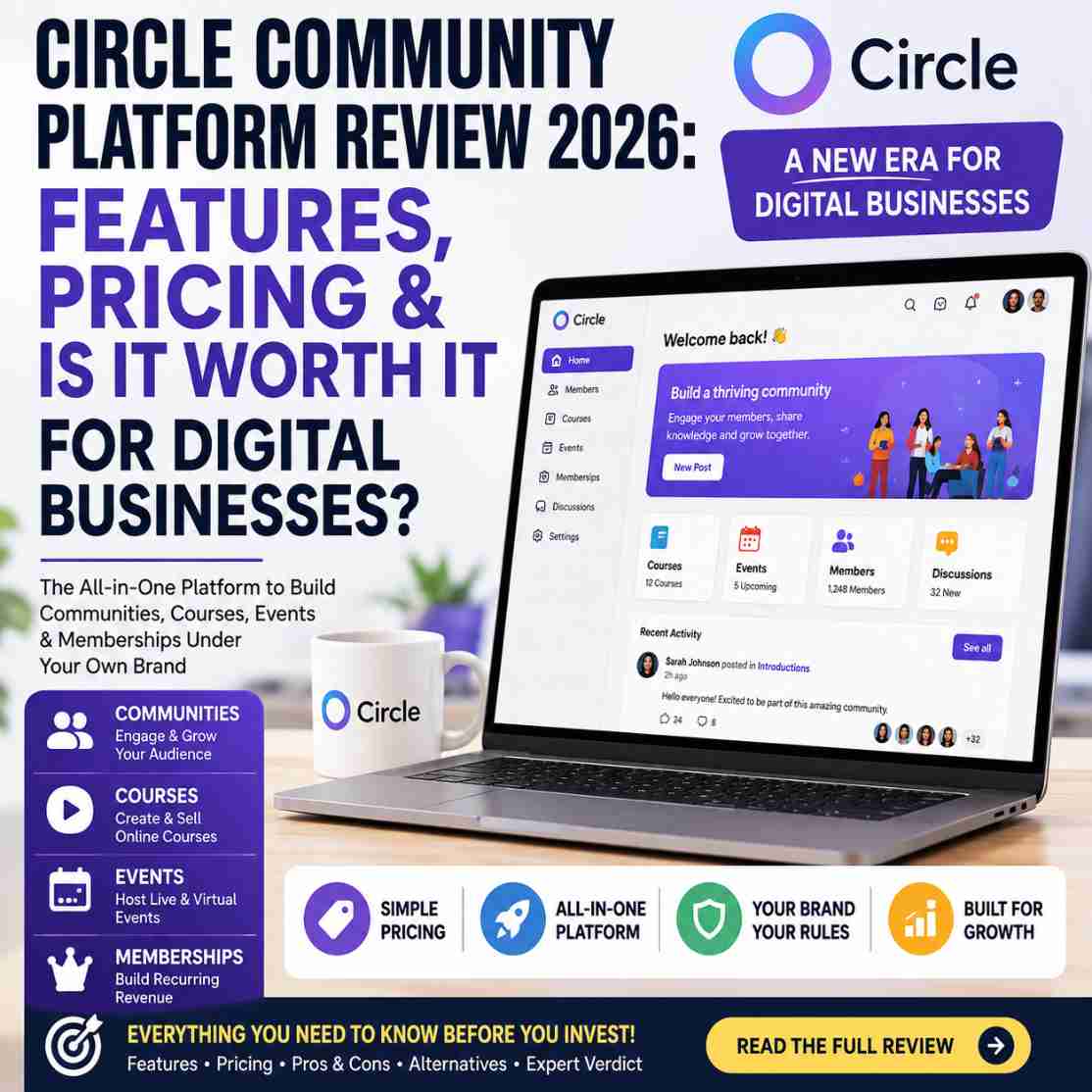
What Is Circle?
Circle is a community-first digital business platform designed to help creators and organizations build branded online communities and monetize their audiences.
Instead of sending customers between multiple disconnected services, Circle aims to give them one place to:
- Join a community
- Access courses
- Attend events
- Participate in discussions
- Watch live sessions
- Purchase memberships
- Communicate with other members
- Access branded content
- Interact with the business
- Receive automated communications
Circle also provides website-building capabilities, custom domains, paid memberships, analytics, gamification, member directories, live streams, live rooms, and mobile applications.
That makes Circle particularly interesting for businesses where the audience itself is part of the product.
Think about:
- Coaching businesses
- Professional communities
- Paid membership businesses
- Course creators
- Consultants
- Training companies
- Creator-led brands
- Expert communities
- Professional associations
- Subscription-based education businesses
The distinction is important.Circle is not simply trying to help you sell a PDF or upload a video course.
It is trying to become the digital home around which your business operates.
Why Circle Matters for Digital Businesses in 2026
The digital business model is changing.People can buy information almost anywhere.What becomes harder to replicate is:
Access + expertise + relationships + accountability + community.
A standalone course can teach.
A community can keep customers engaged.
An event can create interaction.
A membership can create recurring revenue.
A branded environment can bring all of these experiences together.
That is where Circle has its strongest strategic advantage.
Circle's current platform positioning explicitly brings community, courses, events, content, payments, subscriptions, website functionality and email-related capabilities into one connected environment.
For a business that wants to build recurring revenue around an audience, that integration can be considerably more valuable than simply having another course-hosting platform.
Circle Build Summit 2026: A Free Way to See Circle in Action
If you're seriously considering Circle for your community, courses, or membership business, there's another timely opportunity worth knowing about: Circle's free Build Summit takes place August 25–26, 2026. Instead of making a platform decision from a feature list alone, the Summit gives you a chance to see how Circle approaches building and growing digital businesses.
Reserve your free Build Summit seat now and get a closer look at what you could build with Circle before deciding whether the platform is right for your business.

Circle Features 2026: What Do You Actually Get?
Circle's feature list is extensive, but not every feature has the same commercial value.
Here are the capabilities that matter most.
1. Online Community
Community is Circle's foundation.You can organize conversations into spaces, provide member profiles, facilitate discussions, create private areas, and build different experiences for different groups.
This matters because a paid community should not feel like a random chat room.
It needs structure.You may want separate areas for:
- Announcements
- General discussion
- Course support
- Premium members
- Coaching clients
- Events
- Resources
- Networking
- Customer feedback
Circle is designed around this type of structured community experience.
2. Online Courses
Circle also allows businesses to deliver courses inside the same environment as their community.
That creates an important advantage.
A customer can purchase a course and immediately become part of the surrounding community instead of being sent to a completely different platform.
This creates opportunities for:
- Course + community bundles
- Membership + courses
- Cohort programs
- Coaching + education
- Premium learning communities
- Recurring education memberships
For creators, this can change the business model from:
Sell a course onceto:
Sell access to an ongoing ecosystem.
That is a much more interesting commercial model.
3. Events and Live Experiences
Circle includes events, live streams, and live rooms. Professional currently includes live streams for up to 100 attendees and live rooms for up to 15 participants, while Business increases those limits.
This makes Circle suitable for businesses that rely on interaction rather than passive content alone.
For example:
Free content → community → webinar → paid course → membership → coaching
That type of customer journey can be managed inside a single ecosystem.
4. Paid Memberships
This is one of Circle's strongest commercial features.
You can build paid access around:
- Monthly memberships
- Recurring subscriptions
- Courses
- Communities
- Coaching programs
- Events
- Premium content
This gives creators a path toward recurring revenue rather than relying exclusively on one-time purchases.
And recurring revenue is where a community platform becomes much more interesting financially.
If your community generates $5,000 in monthly recurring revenue, paying $89 or $199 for the infrastructure becomes a very different decision from paying that amount for a hobby project.
That is the distinction buyers need to understand.
5. Website Builder and Custom Branding
Circle is designed to help businesses maintain a branded experience rather than forcing customers into a generic third-party environment.
Professional includes a website builder, custom branding, and custom domains. Business adds the ability to remove Circle branding.
For businesses building long-term brand equity, this matters.
Your community should look like an extension of your business.
Not like a temporary group you rented from somebody else.
6. Analytics and Member Insights
Circle includes reporting and analytics, while higher plans provide additional capabilities such as activity scores.
These features can help businesses understand:
- Member engagement
- Participation
- Content performance
- Community activity
- Customer behavior
That information becomes useful when deciding what to improve, what to promote, and where members are losing interest.
A community without measurement can quickly become a very expensive content archive.
7. Gamification
Circle includes gamification features designed to encourage participation.
This can be useful for:
- Learning communities
- Professional networks
- Membership businesses
- Coaching programs
- Creator communities
The objective isn't simply to make the platform look more entertaining.
The commercial objective is retention.
If members participate regularly, they are more likely to recognize the value of their membership.
Circle AI in 2026
This is one of the biggest reasons Circle deserves attention now.
Circle's current platform includes Circle AI, and its higher-tier positioning expands into AI agents and AI-powered workflows. Circle says its AI is based on hundreds of community best practices and analyzes data from thousands of communities.
Circle's Business plan also includes capabilities such as Content Co-Pilot and automated transcriptions.
The strategic direction is clear:
Circle is trying to become more than software for hosting a community.
It wants AI to help businesses build, operate, analyze, and grow those communities.
For a small digital business, that could eventually reduce the amount of repetitive operational work required to manage a growing membership.However, buyers should keep one principle in mind:
AI features are valuable only when they save meaningful time or improve revenue.
Don't pay more simply because a platform has an AI label.
Circle Pricing 2026
Circle's current pricing is straightforward at the headline level, but buyers need to look beyond the monthly subscription.
Circle Professional — $89/month
Professional includes core community-building capabilities such as:
- Unlimited members
- Courses
- Discussions
- Events
- Website builder
- Live streams
- Live rooms
- Custom branding
- Reporting and analytics
- Paid memberships
- Gamification
- Custom domain
- Circle AI
Circle currently offers a 14-day free trial and states that no credit card is required to start.
Circle Business — $199/month
Business includes everything in Professional plus additional business-oriented functionality such as:
- Workflows
- Custom profile fields
- Headless Member API
- Admin API
- Branded email notifications
- Content Co-Pilot
- Automated transcriptions
- Activity scores
- Additional migration services
- Removal of Circle branding
Circle Plus — Custom Pricing
Circle Plus is aimed at larger or more demanding businesses.
It includes custom pricing, AI-agent capabilities, hands-on strategy, and optional branded apps.
Don't Ignore Transaction Fees
This is where buyers need to pay attention.
Circle currently lists transaction fees of:
- Professional: 2%
- Business: 1%
- Circle Plus: 0.5%
So don't evaluate Circle only by looking at the $89 or $199 headline.
Your actual cost depends partly on how much revenue you process through the platform.
For a small community with little revenue, the difference may be minor.
For a successful membership business processing significant volume, it can become a meaningful operating expense.
Circle Email Marketing: Another Cost to Consider
Circle also offers Email Hub as an optional add-on.
The current pricing page shows Email Hub starting at $99/month for 10,000 contacts, with capabilities including broadcasts, forms, automated marketing workflows, contact management, segmentation, campaign scheduling, analytics, and behavioral personalization.
This is important when calculating your true software budget.
If you need:
Community + courses + memberships + email marketing
don't assume that every capability is included in the basic subscription.
Always calculate the complete stack before choosing your plan.
Is Circle Worth It in 2026?
Yes — but only for the right business model.
Circle is worth serious consideration if your business depends on community, recurring memberships, education, events, or customer relationships.
It becomes particularly compelling when your audience is not simply buying a product but joining an ongoing experience.
For example:
Course + Community + Events + Coaching + Membership
Circle can bring these components together.
But if you only want to sell ebooks, templates, basic digital downloads, or a small number of standalone courses, Circle may be more platform than you actually need.
That distinction can save you money.
Who Should Buy Circle?
Circle is a strong fit for:
Coaches
If your coaching program needs discussion, resources, live sessions, courses, and ongoing member support, Circle can create a central client environment.
Course Creators
Circle makes particular sense when community is an important part of the learning experience.
Membership Businesses
If recurring subscriptions are central to your business model, Circle deserves serious consideration.
Professional Communities
Associations, expert groups, networking communities, and professional development organizations can benefit from structured member spaces.
Consultants
Consultants can use Circle to combine education, resources, client interaction, events, and premium access.
Creator Businesses
Creators who have already built an audience can use Circle to turn that audience into a more structured paid ecosystem.
Who Should Not Buy Circle?
This is equally important.
Don't buy Circle simply because it is popular.
You may want another platform if:
- You have a very small budget.
- You only sell occasional digital downloads.
- You don't need a community.
- You primarily need an advanced LMS.
- You want the lowest possible transaction costs.
- You only need a basic website and checkout.
- Your audience isn't large enough to justify recurring platform costs.
Software should fit your business model.Your business model should not be redesigned just to justify software.
Circle vs Podia: Which Is Better?
This isn't really a question of which platform is universally better.
They solve different priorities.
The existing Podia Review 2026 examines Podia as an all-in-one platform for courses, digital products, memberships, coaching, webinars and email marketing.
Choose Circle when:
- Community is central to your business.
- You want a premium member experience.
- Events and interaction matter.
- You want courses and community together.
- You are building recurring membership revenue.
Consider Podia when:
- Simplicity is your top priority.
- You mainly sell digital products and courses.
- You want a straightforward creator-commerce system.
- You don't need a sophisticated community-first environment.
The practical rule is simple:
Circle = community-first business
Podia = creator-commerce simplicity
Neither wins every situation.
If you're weighing Circle against a simpler creator-commerce platform, our Podia Review 2026 takes a closer look at its courses, memberships, digital products, coaching, pricing, and overall value—useful if you want to compare the two before committing to a platform.
Circle vs LearnWorlds: Which Should Course Creators Choose?
The existing LearnWorlds Review 2026 vs Podia provides a useful comparison point for creators who are more focused on structured online learning.
Circle is particularly attractive when the course is part of a wider community experience.
LearnWorlds makes more sense when advanced learning functionality and course delivery are the primary priorities.
Choose Circle when:
Community → engagement → membership → recurring relationship
is your business model.
Consider LearnWorlds when:
Course → structured learning → advanced education experience
is your primary model.
If you are building a professional learning business where community is an important extension of the course, Circle deserves a closer look.
If your priority is a more structured and scalable online learning business rather than a community-first model, our LearnWorlds Review 2026 breaks down its pricing, advanced course features, branding, analytics, and long-term value against Podia.
Circle vs Mighty Networks
Mighty Networks is one of the most obvious comparisons because both platforms target community-driven businesses.
The better choice depends on the exact combination of:
- Community experience
- Courses
- Events
- Monetization
- Branding
- Automation
- Integrations
- Pricing
- Business scale
Don't choose based on a feature checklist alone.
Build your requirements first.Then compare platforms against the business model.
Circle Pros and Cons
Circle Pros
- Strong community experience
- Courses and community in one ecosystem
- Built-in events
- Paid memberships
- Custom domain
- Branded experience
- Website builder
- Gamification
- Live experiences
- Analytics
- AI capabilities
- Strong fit for recurring-revenue businesses
- 14-day free trial
Circle Cons
- $89/month is not a trivial entry price
- Transaction fees apply
- Advanced capabilities require higher plans
- Email Hub costs extra
- May be excessive for simple digital-product sellers
- Advanced learning requirements may justify a dedicated LMS instead
- Higher-volume businesses need to calculate transaction costs carefully
These aren't necessarily weaknesses in Circle's product.
They are business-fit considerations.
A $199/month platform can be cheap if it helps you generate $20,000 in recurring revenue.
It can be expensive if you're still trying to make your first $500.
How to Use Circle to Build a Revenue-Generating Digital Business
The strongest way to use Circle isn't to simply create a community and wait for members.
Build a revenue system around it.
A simple model could look like this:
Step 1: Build an audience
Use:
- Blog content
- Search traffic
- Social media
- YouTube
- Partnerships
Step 2: Offer a free entry point
Give people a reason to join your ecosystem.
For example:
- Free workshop
- Free community
- Free mini-course
- Resource library
- Expert session
Step 3: Create the paid offer
Turn the most valuable part of your ecosystem into:
- Premium membership
- Paid course
- Coaching program
- Professional community
- Mastermind
- Certification program
- Paid events
Step 4: Increase retention
Use:
- Live events
- Discussions
- New content
- Member networking
- Expert sessions
- Challenges
- Community recognition
Step 5: Measure what works
Track:
- Signups
- Activation
- Engagement
- Conversion
- Retention
- Revenue
That's how Circle should be viewed.
Not as another SaaS subscription.
As infrastructure for a digital business.
A platform can host excellent content, but retention depends on whether people actually engage with it; our guide on creating more engaging online courses explores the learning and community factors that can keep customers participating instead of simply signing up and disappearing.
What Makes Circle Different From a Facebook Group or Discord Server?
This is one of the most important distinctions.
A free social community can help you build an audience.
But a serious digital business needs more control over:
- Branding
- Monetization
- Courses
- Membership access
- Customer experience
- Events
- Analytics
- Content
- Business workflows
Circle is designed around those business requirements.
That is why the platform can justify a much higher price than a basic social group.
You're not merely paying for chat.
You're paying for a business environment.
Is Circle Good for Beginners?
Yes, but with a qualification.
Circle is relatively approachable from a usability perspective, but that doesn't mean every beginner should buy it.
If you're brand new and haven't validated your business idea, $89/month plus transaction costs may be unnecessary overhead.
If you've already validated your audience and know that community will be part of your business model, the equation changes.
My recommendation:
Validate the business first. Then invest in infrastructure.
Don't build an expensive community nobody asked for.
Is Circle Worth the Money for a Small Business?
It depends on revenue potential.
Consider two businesses.
Business A
Revenue: $200/month
Circle cost: $89/month before transaction-related costs and optional extras.
That is difficult to justify.
Business B
Recurring revenue: $10,000/month
Circle cost: $89–$199/month depending on requirements.
That becomes much easier to justify.
The lesson is simple:
Evaluate software against revenue, not against the monthly price in isolation.
Circle Community Platform: Our Verdict for 2026
Circle is one of the more compelling options for businesses that want to combine community, courses, events, memberships, content, and monetization under a branded environment.It is not the cheapest option.
It isn't supposed to be.
Circle is positioned for businesses that want their community to become part of the product itself.
The $89/month Professional plan is a reasonable starting point for businesses that can already see a commercial use case. Business at $199/month becomes more relevant when workflows, APIs, advanced customization, branded notifications, and additional operational features matter. Circle Plus is designed for businesses requiring a more hands-on and customized setup.
Our overall assessment:
Circle is worth it if community is part of your revenue engine.
If you're building:
Audience → Community → Course → Membership → Events → Recurring Revenue
Circle is a strong platform to investigate.
If you're simply looking for a cheap place to sell a few digital products, there are simpler options.
That's the honest answer.
Should You Try Circle in 2026?
If your business model depends on community, this is a good time to evaluate Circle because its platform now extends well beyond traditional community discussions.
The current product combines community, courses, events, websites, paid memberships, analytics, AI and business-oriented capabilities.
Circle also offers a 14-day free trial without requiring a credit card, giving prospective customers an opportunity to evaluate the platform before committing.
👉 Explore Circle and start the 14-day free trial
Before subscribing, calculate your expected member revenue, transaction costs, email requirements, and any higher-tier features you actually need.
That five-minute calculation is worth doing before committing to any platform.
Want to see Circle in action first? Reserve your free Build Summit seat. Already know Circle is the right direction for your business? Start the 14-day free trial.
Frequently Asked Questions About Circle
What is Circle community platform?
Circle is an online community and digital business platform that combines communities, courses, events, memberships, websites, payments, engagement tools, and AI capabilities in one branded environment.
Is Circle worth it in 2026?
Circle can be worth it for creators, coaches, educators, and businesses where community and recurring revenue are central to the business model. It may be excessive for simple digital-product sellers.
How much does Circle cost in 2026?
Circle currently lists Professional at $89/month, Business at $199/month, and Circle Plus at custom pricing. A 14-day free trial is available.
Does Circle have a free plan?
Circle's current pricing page lists paid plans rather than a permanent free plan. It does offer a 14-day free trial without requiring a credit card.
Does Circle support online courses?
Yes. Courses are included in Circle's Professional plan and can be delivered alongside community content, events, and memberships.
Can you sell memberships with Circle?
Yes. Circle supports paid memberships and subscription-based access, making it suitable for recurring-revenue community businesses.
Does Circle have AI?
Yes. Circle currently includes Circle AI, while higher-tier plans add additional AI-oriented capabilities such as Content Co-Pilot and Circle AI agents.
Does Circle charge transaction fees?
Yes. Circle currently lists transaction fees of 2% for Professional, 1% for Business, and 0.5% for Circle Plus.
Is Circle good for course creators?
Circle is particularly attractive for course creators who want to combine learning with community, events, discussions, and recurring memberships. If advanced learning-management functionality is the main priority, a dedicated LMS may be a better fit.
Is Circle better than Podia?
Neither is universally better. Circle is stronger when community is central to the business, while Podia is attractive for creators who prioritize straightforward selling of courses, digital products, memberships, and related creator-commerce features. See our Podia Review 2026 for a deeper look.
Is Circle better than LearnWorlds?
It depends on your business model. Circle is particularly strong for community-led businesses, while LearnWorlds is better suited to businesses where structured online learning is the primary product. Our LearnWorlds Review 2026 provides additional context on the course-platform side of the comparison.
Who should use Circle?
Circle is a strong candidate for creators, coaches, consultants, educators, membership businesses, professional communities, and digital brands that want community to become a meaningful part of their customer experience and revenue model.
Who should avoid Circle?
Businesses with very small budgets, businesses that don't need community functionality, and sellers who only need basic digital-product delivery may find Circle unnecessarily expensive or feature-heavy.
If Circle sounds like the right fit for the way you want to build your digital business, now is a good time to test it for yourself. Start Circle’s 14-day free trial, explore the community, courses, events and membership features, and decide based on your own business—not just another software comparison.
Final Takeaway
The biggest mistake would be to think of Circle as simply another community platform.
Its real value is the possibility of turning a scattered collection of:
community + courses + events + memberships + content + payments
into one connected digital business environment.
That's powerful.
But it comes with a price.
So the right question isn't:
“Is Circle expensive?”
The better question is:
“Can Circle help my business generate more recurring revenue than the platform costs?”
If the answer is yes, Circle deserves serious consideration.
If the answer is no, start simpler, validate your business model, and upgrade when the economics make sense.
👉 Explore Circle's current plans and start the 14-day trial
#CircleCommunityPlatform #CircleReview2026 #CircleSo #CommunityPlatform #OnlineCommunity #CreatorBusiness #DigitalBusiness #CreatorEconomy #PaidCommunity #MembershipBusiness #OnlineCoursePlatform #CourseCreators #CommunityLedBusiness #DigitalProducts #OnlineBusinessTools #CreatorTools #NoCodeBusiness #CommunityManagement #MembershipPlatform #OnlineCourses #CoachingBusiness #DigitalEntrepreneur #SaaSReview #BusinessGrowth #AIForBusiness #CircleAI
Disclosure:
This article may contain affiliate links. If you choose a service through our links, we may earn a commission at no extra cost to you.
This article was created with AI-assisted research and carefully reviewed by our in-house team before publication