Circular Ring 2 Blood Pressure: Free Monitoring & Calibration Guide
Circular Ring 2 Blood Pressure: Free Monitoring & Calibration Guide
Does Circular Ring 2 Measure Blood Pressure?
Yes. Circular Ring 2 now offers blood-pressure estimation through the Circular app. The feature combines ECG and PPG signals to estimate systolic and diastolic blood pressure after the ring has been calibrated with a standard blood-pressure cuff. Circular says the core measurement is available to Ring 2 owners at no extra cost, with unlimited measurements and no subscription required for the core feature. The readings are intended for wellness tracking and trend awareness, not as a replacement for a clinically validated blood-pressure cuff or medical advice.
Blood pressure is one of those health numbers that many people only encounter during an annual check-up, a pharmacy visit, or a doctor's appointment.
But blood pressure isn't static.
Sleep, stress, physical activity, caffeine, posture, recovery and everyday routines can all influence readings. That makes occasional measurements useful, but they don't necessarily show how your blood pressure behaves throughout normal life.
Circular Ring 2 now gives owners another way to observe those patterns.
Circular has launched Blood Pressure in the Circular app, allowing Ring 2 users to take blood-pressure measurements from the finger. The core measurement feature is available without an additional subscription and without a limit on the number of core measurements.
For people already considering a smart ring for health tracking, this makes the Circular Ring 2 considerably more interesting.
But there is an important distinction.
This is a wellness-tracking feature, not a replacement for a clinically validated blood-pressure monitor.
So how does it work, what does calibration involve, and is the Circular Ring 2 worth considering if blood-pressure tracking is one of your priorities?
Let's break it down.
If you’re already looking for a smarter way to keep track of your health throughout the day, Circular Ring 2 is worth a closer look. With Blood Pressure now available alongside its broader health-tracking features, it offers a convenient way to keep more of your personal wellness data in one place. Explore the Circular Ring 2 and see whether it fits your health-tracking needs.
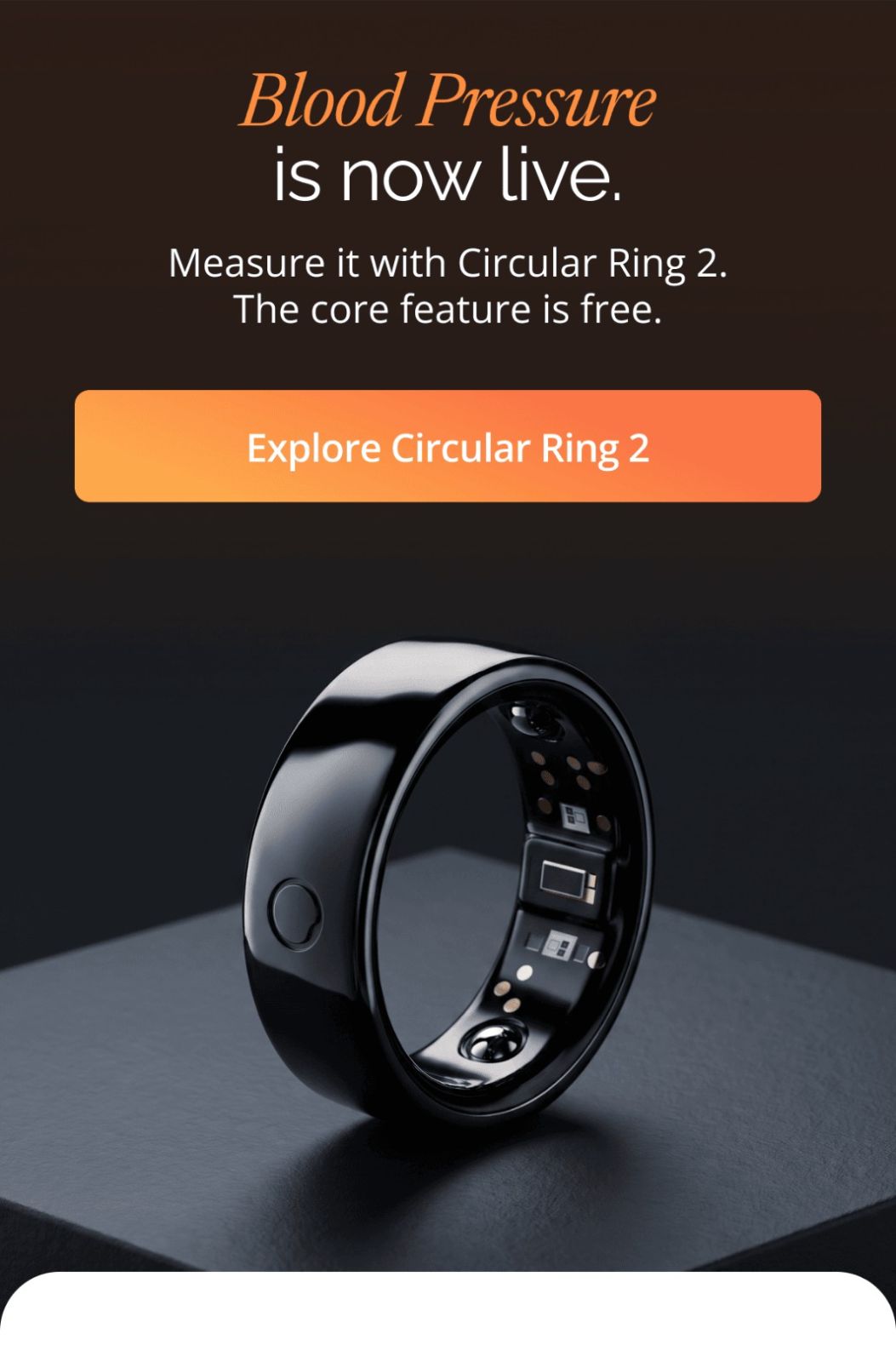
What Is Circular Ring 2 Blood Pressure Monitoring?
Circular Ring 2 uses signals collected by the ring to estimate your blood pressure through the Circular app.
Instead of squeezing your upper arm like a conventional cuff, the ring takes a different approach.
During measurement, Circular says the ring captures ECG and PPG signals simultaneously. The system examines the timing of the pulse wave produced by each heartbeat and uses that information to estimate blood pressure in combination with your personalized calibration.
The result is designed to provide:
- Systolic blood pressure
- Diastolic blood pressure
- Heart rate
- Blood-pressure classification
- Daily averages
- Measurement history
- Context around your results
That makes the feature more useful for tracking patterns over time rather than simply checking one isolated number.
How Does Circular Ring 2 Measure Blood Pressure?
A conventional blood-pressure cuff works by temporarily restricting blood flow around the arm and detecting changes as the pressure is released.
Circular Ring 2 does not use that method.
Instead, the ring uses its optical and electrical sensing capabilities.
ECG
ECG, or electrocardiography, records electrical activity associated with the heart.
PPG
PPG, or photoplethysmography, uses light-based sensing to observe changes associated with blood flow.
Circular combines these signals during the blood-pressure measurement process.
The relationship between the timing of the heartbeat and the arrival of the pulse wave can provide information that the system uses to estimate blood pressure.
This is important because the relationship between pulse-wave timing and blood pressure is not identical for every person.
That's why calibration matters.
Blood pressure is only one part of the Ring 2's health-tracking capabilities; if ECG-based monitoring is also important to you, explore our Circular Ring 2 ECG and health-tracking guide before making your decision.
Why Does Circular Ring 2 Need Blood Pressure Calibration?
Your blood pressure is personal.
Two people can have different relationships between pulse-wave characteristics and blood pressure. A wearable therefore needs an individual reference point rather than simply applying one universal conversion to everybody.
Circular's setup process addresses this by asking you to calibrate the feature with a standard blood-pressure cuff.
According to Circular's current explanation, the initial setup involves cuff measurements that establish your personal baseline. After that, the ring uses the relationship between your pulse-wave measurements and your individual baseline to estimate subsequent readings.
This is one of the most important things prospective buyers should understand:
The ring does not eliminate the need for a validated cuff altogether.
Instead, the cuff establishes the reference used to personalize the ring's estimates.
How to Calibrate Circular Ring 2 Blood Pressure
The basic process is straightforward.
Step 1: Open the Circular app
Make sure your Circular app and Ring 2 are updated so that the Blood Pressure feature is available.
Step 2: Start the calibration process
The app will guide you through the initial blood-pressure setup.
Step 3: Use a standard blood-pressure cuff
You need a conventional cuff measurement as the reference point.
Step 4: Enter your readings
The reference measurements are entered into the Circular app so the system can establish your individual baseline.
Step 5: Complete the calibration
Once the initial calibration is completed, Circular can use the personalized relationship between pulse-wave timing and your reference blood pressure for subsequent estimates.
Step 6: Maintain your calibration
Circular's current communication says users should take a cuff reading approximately every 30 days to keep the personal model anchored.
That makes the feature particularly interesting for people who want frequent trend tracking without taking a traditional cuff reading every time.
How Long Does a Circular Ring 2 Blood Pressure Measurement Take?
Circular says a blood-pressure measurement takes roughly 60 seconds while the system looks for a sequence of high-quality heartbeats.
That's an important practical advantage.
You don't need to build a lengthy measurement routine into your day.
Instead, you can take a reading when you want to observe your current pattern and then review the result through the app.
Is Circular Ring 2 Blood Pressure Free?
The core blood-pressure measurement is free for Circular Ring 2 owners.
Circular's current announcement specifically says the core feature has:
- No additional subscription
- Unlimited core measurements
- No limit on how many core measurements you can take
This distinction matters because Circular has previously communicated that some advanced or optional Ring 2 capabilities could involve Circular Coins or additional payments. Its Kickstarter documentation, for example, described future advanced features as potentially being offered through Circular Coins or optional microtransactions.
So don't interpret “free blood pressure” as meaning every future blood-pressure analysis or premium insight will necessarily remain free.
The key point is simpler:
You can take the core Blood Pressure measurement without paying an additional subscription.
What Information Does Circular Ring 2 Blood Pressure Provide?
A single blood-pressure result is useful.
A history of measurements can be much more informative.
The Circular app can provide information including:
- Systolic pressure
- Diastolic pressure
- Heart rate
- Result classification
- Daily average
- Measurement history
- Additional context around the numbers
That creates an opportunity to look for patterns.
For example, you may notice differences between:
- High-stress workdays and weekends
- Well-rested and poorly rested mornings
- Days with more physical activity
- Periods of disrupted sleep
- Different routines involving caffeine
- Travel or schedule changes
The important point is not to obsess over every individual measurement.
The value is in understanding your longer-term pattern.
Why Blood Pressure Trends Matter More Than One Reading
Imagine taking a blood-pressure measurement once every six months.
You get one number.
It may be perfectly normal.
But what happened during the other 179 days?
You don't know.
Now imagine having a consistent way to observe your readings over time.
You can begin asking better questions:
- Is my blood pressure generally stable?
- Does my routine appear to influence my readings?
- Are there repeated periods of elevated results?
- Do my readings change when my sleep or activity changes?
- What does my personal trend look like?
That is where wearable technology becomes genuinely interesting.
It turns health tracking from an occasional snapshot into a longitudinal view.
Circular Ring 2 Blood Pressure Accuracy: What Buyers Should Know
This is probably the most important question for anyone considering buying the ring specifically for blood-pressure tracking.
Do not treat Circular Ring 2 as a replacement for a clinically validated blood-pressure cuff.
Circular itself positions the readings as estimates for wellness tracking and trend awareness.
That means the sensible way to use the feature is to observe patterns and identify changes—not to make medical decisions based solely on a ring reading.
If readings remain consistently elevated, confirm them using an appropriate validated cuff and discuss the results with a healthcare professional.
That is also why the calibration process matters.
The ring's estimates are personalized against your cuff-based reference rather than operating independently of conventional blood-pressure measurement.
Can Circular Ring 2 Replace a Blood Pressure Cuff?
No.
At least, it should not be treated that way.
The strongest use case is complementary monitoring.
Think of the two technologies differently:
Blood-pressure cuff:
Your conventional reference measurement.
Circular Ring 2:
Convenient wellness tracking and trend awareness between calibration checks.
That distinction keeps expectations realistic and makes the technology more useful.
Circular Ring 2 Blood Pressure Without a Subscription
Subscription costs have become an important consideration when people compare smart rings.
A product may appear affordable initially but become significantly more expensive over several years if essential features require recurring payments.
The current Circular Blood Pressure announcement is therefore significant because the core blood-pressure measurement itself is available without an additional subscription.
For buyers who dislike recurring wearable subscriptions, that is a meaningful advantage.
However, prospective customers should always distinguish between:
Core measurement functionality
and
future premium analytics or advanced insights.
Circular says deeper blood-pressure analysis is being developed, including longer-term analysis, time-in-target-range information and shareable PDF summaries. Those advanced tools may form part of a premium experience.
The core measurement remains the key free feature.
What About Circular Ring 2 and Kira AI?
Blood pressure also fits into Circular's broader vision for health-data interpretation.
Kira is designed to help users understand information collected across areas such as:
- Sleep
- Recovery
- Activity
- Heart-related metrics
- Other wellness signals
Blood pressure adds another layer to that picture.
Instead of looking at blood pressure as an isolated number, future analysis could potentially put it into a broader wellness context alongside other tracked information.
That is where the Circular ecosystem becomes more interesting.
The goal isn't simply to collect more numbers.
It is to make the numbers easier to understand.
Why Buyers May Prefer Circular Ring 2 for Everyday Health Tracking
A blood-pressure feature alone shouldn't determine your smart-ring purchase.
The broader question is whether Circular Ring 2 fits the way you want to track your health.
The ring is particularly interesting for people who want:
- Discreet wearable health tracking
- Sleep and recovery monitoring
- Heart-related measurements
- ECG capabilities
- Activity and wellness insights
- AI-assisted interpretation through Kira
- Blood-pressure trend awareness
- Core blood-pressure measurements without an additional subscription
Your existing Circular Ring 2 buying research can help you look at the product from a broader perspective before making a purchase.
The new blood-pressure capability simply adds another reason to consider the ring.
If you're still comparing smart rings and want to understand where AI-powered wearables are heading, see our guide to AI smart rings and early health tracking for a broader look at this growing category.
Who Should Consider Circular Ring 2 for Blood Pressure Tracking?
Health-conscious buyers
If you like monitoring your personal wellness trends, blood-pressure tracking can add another useful data point.
Smart-ring enthusiasts
If you're already interested in advanced wearable technology, ECG, PPG and health analytics make the Ring 2 a particularly interesting option.
People who dislike constant smartwatch screen time
A ring provides a much more discreet form factor than a screen-based wearable.
Buyers who dislike recurring subscriptions
The free core blood-pressure measurement is particularly appealing if you want to avoid another mandatory monthly service.
People interested in long-term trends
If your goal is to understand how your readings change over time rather than simply capture one measurement, the history function can be useful.
If you're comparing the Circular Ring 2 before buying, take a closer look at our Circular Ring 2 review and health-tracking guide to see how its broader features fit into everyday wellness tracking.
Who Should Not Buy Circular Ring 2 Solely for Blood Pressure?
This is equally important.
You should think twice about buying the ring if your primary requirement is a medical-grade blood-pressure monitoring device.
Circular Ring 2 is a wellness wearable.
It should not replace professional medical care, a clinically validated cuff, or medical advice.
If you need blood-pressure measurements for diagnosis, treatment decisions or medication management, use the equipment and guidance recommended by your healthcare professional.
Buy the Ring 2 for its broader wellness ecosystem—not because you expect a smart ring to replace clinical equipment.
Circular Ring 2 Blood Pressure vs. Traditional Cuff
| Feature | Circular Ring 2 | Traditional Blood-Pressure Cuff |
|---|---|---|
| Measurement location | Finger | Arm |
| Measurement approach | ECG + PPG-based estimation | Pressure-based cuff measurement |
| Personal calibration | Yes | Not normally required in the same way |
| Convenient repeated tracking | Yes | Less convenient |
| Trend history | App-based | Depends on device/app |
| Core Circular feature | No additional subscription | Depends on device |
| Medical replacement | No | Use an appropriate validated device |
| Best use | Wellness and trend awareness | Conventional blood-pressure measurement |
The best approach isn't necessarily ring versus cuff.
For many users, the better approach is ring plus cuff.
The cuff provides the conventional reference.
The ring provides convenient everyday trend tracking.
What Makes This Circular Ring 2 Update Different?
The timing is particularly important.
Older reviews and articles about Circular Ring 2 were published before the Blood Pressure feature became available. Some still describe blood-pressure monitoring as a future capability.
That information is now outdated.
Circular's current announcement confirms that Blood Pressure is live in the Circular app.
For buyers researching Circular Ring 2 today, that changes the evaluation.
The ring is no longer simply promising future blood-pressure functionality.
The core feature is now available.
That is why this is an important update for anyone comparing smart rings in 2026.
Should You Buy Circular Ring 2 for Blood Pressure?
If blood-pressure tracking is the feature that first attracted your attention, don't make the purchase decision based on that feature alone.
Look at the complete package.
Circular Ring 2 makes more sense if you want a combination of:
Health tracking + sleep + recovery + heart-related metrics + ECG + AI-assisted insights + blood-pressure trend awareness.
The blood-pressure feature becomes another reason to wear the ring consistently.
And consistency is ultimately where wearable technology earns its value.
A device that stays in a drawer isn't useful.
A device you comfortably wear every day can build a much richer picture of your personal patterns.
How to Get More Value From Circular Ring 2 Blood Pressure
Wear the ring consistently
The more consistently you use your wearable, the more useful your personal history can become.
Follow the calibration instructions carefully
Calibration establishes the relationship between your ring measurements and your conventional cuff reference.
Keep your periodic cuff check
Circular recommends maintaining the personal model with periodic cuff readings.
Look for patterns instead of isolated numbers
One unusual result doesn't automatically define your health.
Repeated trends deserve more attention.
Consider your daily context
Sleep, stress, activity, caffeine and routine changes can all be useful context when reviewing personal trends.
Confirm concerning readings
If your readings remain elevated or you have health concerns, confirm them using an appropriate validated cuff and speak with a healthcare professional.
The Buying Question: Is Circular Ring 2 Worth It?
For buyers already interested in advanced health tracking, the addition of blood-pressure measurement strengthens the Circular Ring 2 proposition.
The biggest advantages are not simply the number of sensors.
They are convenience and continuity.
You can wear the ring throughout your routine, collect health-related information and review your history in the Circular ecosystem.
The addition of free core blood-pressure measurements makes the proposition more compelling for buyers who want to explore blood-pressure trends without adding another subscription.
But don't buy it simply because the feature sounds futuristic.
Buy it if the whole Circular Ring 2 ecosystem fits your needs.
Final Verdict
Circular Ring 2 Blood Pressure is a meaningful upgrade for people who want convenient wellness tracking and a longer-term view of their blood-pressure patterns.
The feature is now live, core measurements are available without an additional subscription, and users can take unlimited core measurements through the Circular app.
The calibration requirement is not a drawback—it is an important part of understanding how the feature works.
Your initial cuff readings establish the personal reference.
The ring then provides convenient measurements between those conventional checks.
That combination makes more sense than treating the ring as a standalone medical device.
For buyers considering Circular Ring 2 in 2026, the new feature gives the ring another strong selling point:
You get a discreet wearable that can now add blood-pressure trend awareness to an already broader health-tracking ecosystem—without requiring a subscription for the core measurement.
If you're ready to evaluate Circular Ring 2 as a complete health-tracking wearable, compare its current features and purchase options before making your decision.
If you're comparing wearable health technology beyond a single device, our 2026 health-tech and wellness guide brings together several options worth considering.
Frequently Asked Questions
Does Circular Ring 2 measure blood pressure?
Yes. Blood Pressure is now available through the Circular app for Circular Ring 2. The ring estimates blood pressure using ECG and PPG signals and requires initial calibration with a standard cuff.
Is Circular Ring 2 blood pressure free?
The core Blood Pressure measurement is currently available at no extra cost, with unlimited core measurements and no subscription required for that functionality.
How does Circular Ring 2 measure blood pressure?
Circular uses ECG and PPG signals to examine pulse-wave timing and combines that information with your personalized calibration to estimate systolic and diastolic blood pressure.
Does Circular Ring 2 need a blood-pressure cuff?
Yes, calibration requires a standard blood-pressure cuff. Circular also says periodic cuff readings are used to keep the personal model anchored.
How often does Circular Ring 2 need blood-pressure calibration?
Circular's current guidance says users need a cuff reading approximately every 30 days to keep the personal blood-pressure model anchored.
How long does a Circular Ring 2 blood-pressure measurement take?
Circular says a measurement takes roughly 60 seconds while the system looks for a sequence of high-quality heartbeats.
Can Circular Ring 2 replace a blood-pressure monitor?
No. Circular Ring 2 should not be treated as a replacement for a clinically validated blood-pressure cuff. Its readings are intended for wellness tracking and trend awareness.
Is Circular Ring 2 blood pressure accurate?
The ring provides estimated blood-pressure values rather than replacing clinically validated measurement equipment. Users should interpret the feature as a wellness-tracking tool and confirm concerning or consistently elevated readings with an appropriate validated cuff and healthcare professional.
What are systolic and diastolic blood pressure?
Systolic pressure refers to the pressure associated with the heart contracting, while diastolic pressure refers to the pressure when the heart relaxes between beats. Both values are included in a conventional blood-pressure reading.
Does Circular Ring 2 track heart rate as part of blood-pressure measurement?
Yes. Circular's Blood Pressure experience provides heart rate alongside the blood-pressure result.
Does Circular Ring 2 use ECG for blood pressure?
Yes. Circular says its blood-pressure measurement uses ECG together with PPG signals to estimate blood pressure.
What happens if my blood-pressure readings remain elevated?
Do not rely solely on the ring's estimate. Confirm the reading using an appropriate validated cuff and speak with a healthcare professional, particularly if elevated readings persist or you have symptoms.
Is Circular Ring 2 a medical device?
Circular Ring 2 is positioned as a wellness device. Its blood-pressure values are estimates intended for wellness tracking and trend awareness, not diagnosis or replacement of medical advice.
Is Circular Ring 2 worth buying for blood-pressure tracking?
It can be worth considering if blood-pressure trend awareness is one part of a broader interest in sleep, recovery, heart-related metrics and everyday wellness tracking. It should not be purchased as a substitute for clinical blood-pressure equipment.
If Blood Pressure tracking is one of the features you’ve been waiting for in a smart ring, now is a good time to take a closer look at Circular Ring 2. The core Blood Pressure measurement is available without an additional subscription, while the ring also brings ECG, sleep, recovery and other wellness insights into the same ecosystem. Check the current Circular Ring 2 option and decide if it’s the right fit for your everyday health tracking.
A Smarter Way to Look at Blood Pressure Tracking
Blood pressure doesn't exist in isolation.
It changes as your routine changes.
Sleep changes.
Stress changes.
Activity changes.
Caffeine changes.
Life changes.
The real value of wearable tracking is therefore not simply producing another number.It is helping you see your own patterns.
Circular Ring 2 now brings blood-pressure estimation into that broader picture, while keeping the core measurement available without a subscription.
If you're considering a smart ring for more comprehensive everyday health tracking, this is one feature worth putting on your comparison list.
Explore Circular Ring 2 and decide whether its combination of health tracking, ECG, recovery insights and blood-pressure trend awareness fits your needs.
#CircularRing2 #CircularRing2BloodPressure #BloodPressureMonitoring #SmartRing #SmartRingHealthTracking #BloodPressureTracking #WearableHealth #HealthTech #DigitalHealth #ECG #PPG #HeartHealth #WellnessTechnology #HealthMonitoring #SmartWearables #WearableTechnology #HealthTracking #NoSubscription #CircularRing #KiraAI
Medical & Wellness Disclaimer: Circular Ring 2 is a wellness device. Blood-pressure values generated through the Circular app are estimates intended for wellness tracking and trend awareness and should not replace a clinically validated blood-pressure cuff, medical examination or professional medical advice. If you have concerns about your blood pressure or consistently elevated readings, consult a qualified healthcare professional.
Affiliate Disclosure: This article may contain affiliate links. If you purchase through an eligible link, Kuruntha Smarket may earn a commission at no additional cost to you. Our content is created to help readers make informed purchasing decisions, and affiliate relationships do not change our editorial evaluation.2026 health-tech and wellness guide