CogniFit Pricing 2026: Plans, 50% Off Deal & Is It Worth It?
CogniFit Pricing 2026: Plans, 50% Off Deal & Is It Worth It?
CogniFit pricing varies by plan, country and platform. For U.S. web users, CogniFit currently lists Basic at $19.99 per month or $119.99 per year, while Premium is $29.99 per month, $169.99 per year or $249.99 for three years. A partner-provided World Mental Health Day promotion offers 50% off from October 8–12, 2026 with code WMH26; buyers should confirm the final eligible price and terms at checkout.
If you are comparing CogniFit before paying for a subscription, the headline discount is only part of the decision.
The more useful questions are:
What does CogniFit cost, what do the plans include, which subscription makes sense, and is the current discount actually worth using?
CogniFit combines cognitive assessments, brain-training activities, personalized training and progress information. Its individual subscription structure includes Basic and Premium options, while separate products are available for families, healthcare professionals, researchers and other organizations.
For the latest World Mental Health Day campaign, CogniFit has provided Kuruntha with information about a 50% discount running October 8 through October 12, 2026, using promo code WMH26.
That makes this a timely opportunity to evaluate the platform—but the promotion should not be the only reason to subscribe.
If CogniFit fits the way you want to approach cognitive training, it is worth checking the current 50% World Mental Health Day offer and confirming the final price and eligibility at checkout.
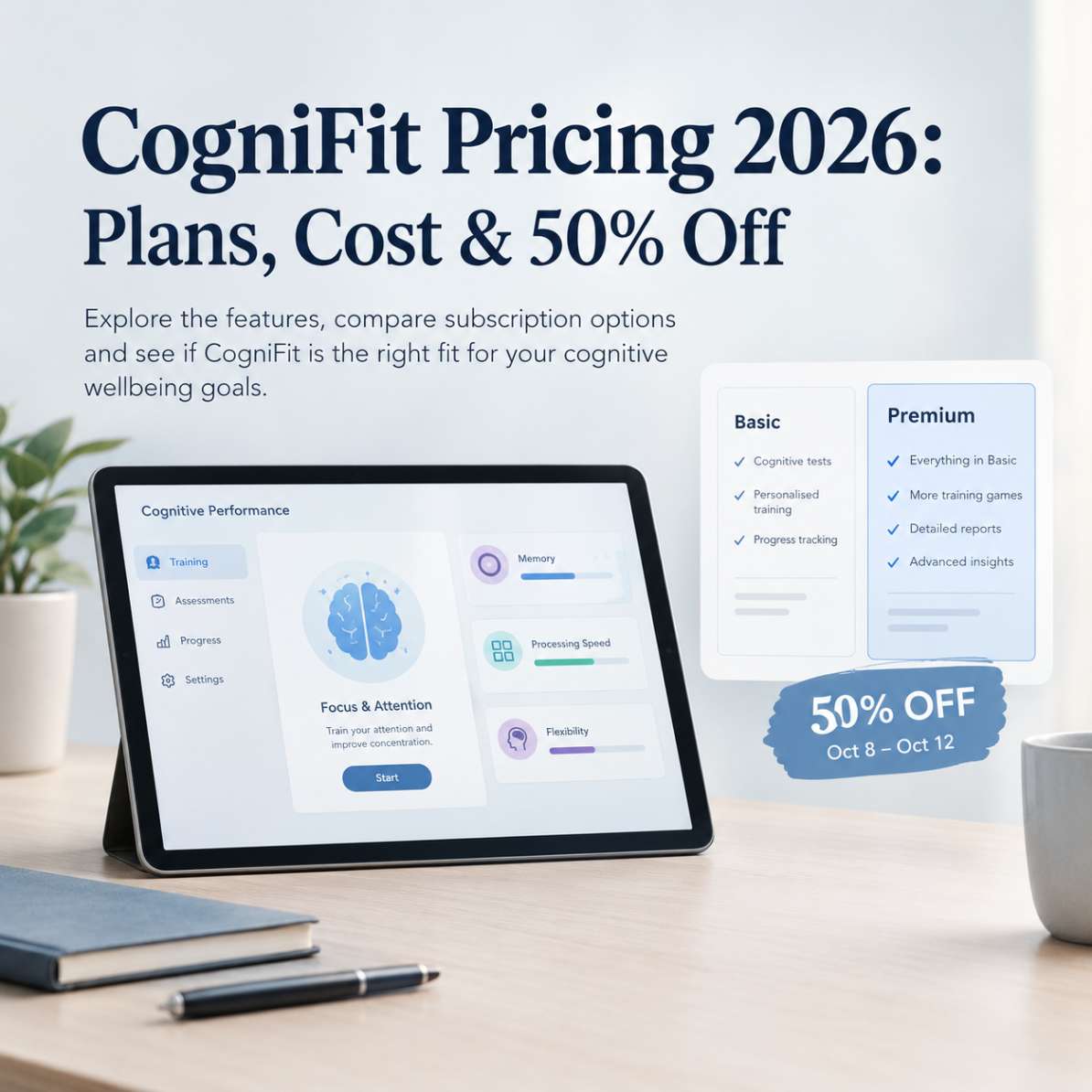
Current CogniFit 50% Off Offer
According to the current partner promotion supplied to Kuruntha, CogniFit's World Mental Health Day offer runs:
- Discount: 50% off
- Promotion: World Mental Health Day
- Start: October 8, 2026
- End: October 12, 2026
- Promo code: WMH26
- Products: CogniFit cognitive tests and training
- Offer source: Current partner communication
There is an important caveat.The promotion details above were supplied directly to Kuruntha by the partner. I could verify that CogniFit has previously run an official World Mental Health Day promotion offering 50% off with a campaign-specific code, but the publicly indexed official page I found uses the previous campaign's WMH25 code rather than WMH26.
So, rather than presenting WMH26 as independently confirmed on CogniFit's public website, Kuruntha is treating the October 2026 promotion as a partner-provided current offer.
That is the more responsible way to handle a short promotional campaign.
CogniFit Pricing 2026
CogniFit's official Help Center currently lists the following individual web subscription prices for the United States:
| Plan | Monthly | Annual | 3-Year |
|---|---|---|---|
| Basic | $19.99 | $119.99 | — |
| Premium | $29.99 | $169.99 | $249.99 |
These are U.S. web prices, not universal global prices. CogniFit explicitly says prices can vary according to the user's country and currency.
Taxes may also be applied depending on location.
That distinction matters for international buyers, particularly anyone purchasing from India or another market where the final checkout price may not match the U.S. figures above.
Before paying, check the price displayed for your own country and currency.
If you want the full breakdown before deciding whether the October promotion changes the value equation, see our guide to CogniFit pricing and plans.
What Does CogniFit Basic Include?
Basic is the more focused individual option.
According to CogniFit's current subscription documentation, Basic includes:
- A training program of your choice
- More than 20 games and tasks
- Access to cognitive assessments
- Cognitive profile and ranking
- Evaluation during training sessions
- Progress and results information
- Customer and technical support
The important limitation is that Basic is built around a selected training program, rather than the complete CogniFit training catalogue.
That makes it more suitable for someone who already knows what they want from the platform.
For example, you may be primarily interested in:
- Memory training
- Attention
- Concentration
- Reasoning
- A particular cognitive training program
- Regular cognitive assessments
If you do not expect to use multiple training programs, paying for broader access may not make financial sense.
What Does CogniFit Premium Include?
Premium is the broader individual subscription.
CogniFit currently describes Premium as providing:
- Access to all available training programs
- More than 60 games and tasks
- Cognitive assessments
- Cognitive profile and ranking
- Evaluation during training sessions
- Progress and results information
The practical difference is flexibility.
Basic is appropriate when you have a defined training requirement.
Premium makes more sense when you want to explore different cognitive areas and use a wider portion of the platform.
My view
I would not automatically recommend Premium simply because it has more features.
The better question is whether you will actually use those additional features.
If your answer is yes, Premium has the stronger overall individual package.
If your needs are narrow, Basic is the more disciplined purchase.
Does CogniFit Have Free Access?
Yes, but there is an important distinction between limited free access and having the complete platform for free.
CogniFit says users can create an account and access some free functionality, including an initial cognitive test and opportunities to try cognitive games.
A paid subscription is required for more complete access.
This makes the free functionality useful for evaluating whether you actually enjoy the training experience before committing to a longer subscription.
That is especially important when a promotion encourages you to make a purchase quickly.
A discount does not make an unused subscription good value.
Is CogniFit Monthly or Annual Better?
The current U.S. web pricing makes annual billing substantially cheaper than paying the monthly rate for twelve months.
Basic
Monthly:
$19.99 × 12 = $239.88
Annual:
$119.99
Premium
Monthly:
$29.99 × 12 = $359.88
Annual:
$169.99
So, for someone who already knows they will use CogniFit throughout the year, the annual plans have a clear price advantage at the currently listed U.S. rates.
But there is a catch.You should not buy an annual subscription simply because the annual price looks attractive.
If you are unsure whether you will use CogniFit consistently, the lower-commitment route can be more sensible.
This is also where the current 50% promotion becomes interesting: a temporary discount can make a longer subscription more attractive, but only if the underlying product fits your needs.
What Does CogniFit Actually Do?
CogniFit is more structured than a basic collection of casual puzzle games.
The platform combines several components:
Cognitive assessments
CogniFit provides cognitive assessments intended as an aid to understanding cognitive wellbeing and performance.
The company states that subscribers can access its cognitive assessments, with the same assessment available again after 30 days when the subscription remains active.
Personalized training
Training is designed around individual performance rather than giving every user exactly the same sequence of activities.
Brain-training games
The platform uses games and tasks to exercise different cognitive abilities.
CogniFit's official materials describe areas including memory, attention, concentration, reasoning, perception and coordination.
Progress information
Users can review their results and cognitive profile over time.
This is an important part of the product because it gives the training a more structured purpose than simply playing a puzzle when you have a few spare minutes.
If you are evaluating CogniFit as part of a broader approach to cognitive wellbeing, our guide to understanding cognitive health and wellbeing provides useful context beyond the app itself.
CogniFit's Current Product Structure Is Broader Than Two Consumer Plans
One thing buyers should not overlook is that CogniFit is not simply a Basic-versus-Premium consumer app.
Its current platform also has separate routes for:
- Families
- Healthcare professionals
- Researchers
- Education
- Employee wellbeing
- Sports professionals
- Organizations
CogniFit's current pricing page also distinguishes professional subscriptions from individual use.
For example, its professional offering includes capabilities such as team management and custom training, while its consumer subscription is intended for personal cognitive training.
This distinction matters.
If you are a consumer
Compare Basic and Premium.
If you are a family
Look at the family plans rather than automatically purchasing separate individual subscriptions.
If you are a clinician or organization
Investigate the professional platform instead of assuming that the consumer subscription provides the tools you need.
That separation can prevent a common buying mistake: comparing products designed for completely different users.
Is CogniFit Worth It?
It can be—but consistency is the deciding factor.
CogniFit makes more sense for someone who wants a structured cognitive-training routine rather than occasional entertainment.
It is potentially a better fit if you value:
- Cognitive assessments
- Structured training
- Personalized exercises
- Progress tracking
- Multiple cognitive training areas
- A repeatable mental-fitness routine
It is less compelling if you simply want a few casual brain games.There is another important consideration.
CogniFit should not be treated as a guaranteed method for fixing memory problems, concentration difficulties or cognitive decline.
The company itself states that its assessments are intended as an aid to assessing cognitive wellbeing and that its brain training is intended to promote general cognitive health. It does not provide medical diagnosis or treatment of disease.
That is an important boundary.
If you are experiencing significant or sudden cognitive changes, a brain-training subscription is not a substitute for appropriate medical evaluation.
CogniFit Basic vs Premium: Which Should You Choose?
Here is the practical comparison.
| If you want... | Better fit |
|---|---|
| One specific training program | Basic |
| Lower annual subscription cost | Basic |
| Cognitive assessments | Both |
| More than 20 games | Both |
| All available training programs | Premium |
| More than 60 games and tasks | Premium |
| Broader training flexibility | Premium |
| Occasional casual games | Neither may justify a subscription |
Choose Basic if...
You have a specific objective and do not need access to the entire CogniFit training catalogue.
It is the more financially conservative choice.
Choose Premium if...
You want the broader CogniFit experience and expect to use multiple training programs regularly.
The additional cost is easier to justify when you will actually use the additional access.
Wait before buying if...
You are attracted mainly by the 50% discount but are not sure whether you will use the platform.
In that situation, explore the available free functionality first.
Is the October 2026 50% Discount Worth Using?
This is where the current World Mental Health Day promotion becomes relevant.
A 50% discount is meaningful if you were already considering CogniFit.
It is much less meaningful if the promotion is the only reason you are considering the product.
My buying rule is simple:
Do not let the discount decide whether you need the product. Let the product decide whether the discount is worth using.
If you already know that you want structured cognitive training and have compared the plans, the current promotion may improve the economics of the purchase.
If you are still asking what CogniFit actually does, take the time to evaluate the platform before committing.
For the partner-provided October promotion, the stated offer window is October 8–12, 2026, with code WMH26.
Because campaign terms can change, confirm the discount and final price at checkout.
How to Get More Value From a CogniFit Subscription
A subscription only becomes useful when it becomes part of a realistic routine.
1. Start with the assessment
Use the available cognitive assessment functionality to establish a baseline.
2. Identify what you want to train
Do not attempt to use every feature simply because it is available.
Choose the cognitive areas that are most relevant to your personal objective.
3. Keep the routine realistic
A short routine that you actually maintain is more useful than an ambitious schedule you abandon.
4. Review your progress
Look at patterns over time rather than becoming fixated on a single score.
5. Reassess the subscription
After you have used the platform for a while, ask a simple question:
Am I using enough of the features to justify what I am paying?
If the answer is no, the problem is not necessarily CogniFit. You may simply be paying for more access than you need.
CogniFit and Mental Health: What Buyers Should Understand
World Mental Health Day is an appropriate context for discussing cognitive wellbeing, but buyers should avoid conflating cognitive training with mental-health treatment.
CogniFit is a digital cognitive training and assessment platform.
That does not make it a treatment for depression, anxiety, dementia or another medical condition.
The sensible way to position it is as one potential component of a broader cognitive-wellness routine.
Sleep, physical activity, stress management, social connection, nutrition and appropriate healthcare remain important parts of overall wellbeing.
A cognitive-training application should complement those habits rather than replace them.
Cognitive training is only one part of digital wellbeing; our digital health guide to reducing screen time looks at the wider relationship between technology, sleep, focus and everyday health.
What Happens After the 50% Promotion Ends?
This is one reason I recommend keeping the article's main focus on CogniFit pricing and buying decisions, rather than turning it into a disposable sale announcement.
The October promotion will eventually expire.
The underlying questions will not:
- How much does CogniFit cost?
- What is included?
- Is Basic enough?
- Is Premium worth paying for?
- Does CogniFit have free access?
- Is annual billing better?
- What is CogniFit used for?
- Is CogniFit suitable for my needs?
Those evergreen questions give this article value long after October 12.
When the promotion ends, the temporary offer section should simply be replaced with the next verified promotion—or removed if there is no active offer.
The core pricing and buying guidance can remain.
My CogniFit Buying Verdict
CogniFit is best understood as a structured cognitive-training platform, not simply a collection of brain games.
The individual Basic plan is the better fit for someone who wants a specific training program without paying for the entire catalogue.
Premium is more attractive for regular users who want broader access to CogniFit's training programs and larger game library.
The current World Mental Health Day promotion adds another reason to evaluate the platform now, with the partner-provided 50% discount running October 8–12, 2026 using code WMH26.
But I would not make the discount the deciding factor.
If you already want structured cognitive training, the promotion can improve the value equation. If you are not sure you will use CogniFit, 50% off an unused subscription is still wasted money.
That is the more useful way to evaluate the offer.
If you have decided that CogniFit's training approach and subscription level match your needs, you can check the available CogniFit plans and current offer before completing your subscription.
Frequently Asked Questions
How much does CogniFit cost in 2026?
For U.S. web users, CogniFit currently lists Basic at $19.99 per month or $119.99 annually. Premium is listed at $29.99 per month, $169.99 annually or $249.99 for three years. Prices may vary by country and currency.
Is CogniFit 50% off right now?
According to the current partner promotion supplied to Kuruntha, CogniFit is offering 50% off for World Mental Health Day from October 8 through October 12, 2026, using code WMH26. Confirm the discount and final price at checkout.
What is the CogniFit promo code for October 2026?
The promo code supplied by the partner is WMH26 for the October 8–12, 2026 World Mental Health Day campaign.
Is CogniFit Basic worth it?
Basic can make sense if you want one specific training program, cognitive assessments and access to a smaller selection of games without paying for the complete Premium catalogue.
Is CogniFit Premium worth it?
Premium is more suitable for users who expect to use multiple training programs and want broader access to CogniFit's games and training system.
Does CogniFit have a free option?
CogniFit provides some free functionality after account creation, including an initial cognitive test and opportunities to try cognitive games. More complete platform access requires a subscription.
Is CogniFit available in India?
CogniFit operates internationally, and its official site provides an India-specific pricing route. However, the company states that prices vary by country and currency, so Indian buyers should confirm the final price displayed during checkout.
Does CogniFit work on mobile?
Yes. CogniFit provides mobile applications. However, its documentation states that mobile subscription plans are different from the web subscription plans, so buyers should compare the relevant pricing before subscribing.
Can I cancel CogniFit?
CogniFit's current subscription documentation states that users can change or cancel their subscription. Buyers should follow the cancellation process applicable to the platform through which they subscribed.
Is CogniFit a medical treatment?
No. CogniFit states that its cognitive assessments are intended as an aid for assessing cognitive wellbeing and that its brain training is designed to promote general cognitive health. It does not provide medical diagnosis or treatment.
Should I choose CogniFit Basic or Premium?
Choose Basic if you want a focused training program. Choose Premium if you expect to use multiple training programs and want broader access to the platform.
Is the 50% CogniFit discount a good reason to subscribe?
Only if CogniFit already fits your needs. A discount can improve the economics of a product you will use, but it does not make an unsuitable or unused subscription good value.
Disclosure: Kuruntha may earn a commission if you purchase CogniFit through our partner link.

This does not change our editorial assessment or the information we provide about the product.

This article was created with AI-assisted research and carefully reviewed by our in-house team before publication
#CogniFit #CogniFitPricing #BrainTraining #CognitiveHealth #MentalWellbeing #DigitalHealth #WorldMentalHealthDay #HealthTech