Curiosity Box Fall 2026 Review: Ruler of the Universe, Snowflake Game & Everything Inside
Curiosity Box Fall 2026 Review: Ruler of the Universe, Snowflake Game & Everything Inside
The Curiosity Box Fall 2026 is a science subscription box built around unusual experiments, puzzles, scientific history, and exclusive collectibles. The Fall 2026 collection includes the Ruler of the Universe, a 42-tile snowflake matching game featuring photographs by Wilson Bentley, an Art Deco Rutherford scattering shirt, a 60-puzzle hexagram challenge, a Curiosity Box edition of Leonardo da Vinci’s Thoughts on Art and Life, and Leonardo-inspired stickers. For science enthusiasts, lifelong learners, puzzle lovers, collectors, and people looking for distinctive STEM gifts, the Fall 2026 box offers a combination of learning and collectible value that goes well beyond an ordinary subscription box.
What happens when a science subscription box stops trying to fill a package with ordinary “educational” products and instead builds every item around a story?
That is the interesting thing about the Curiosity Box Fall 2026 collection.
The new box brings together measurement, mathematics, photography, atomic physics, puzzles, art, scientific history, and Leonardo da Vinci in one collection.
And there is a particularly unusual centerpiece.
It is called the Ruler of the Universe.
Instead of limiting you to centimeters and inches, this ruler invites you to think about measurement itself — including unusual historical units and even a unit you can create yourself.
That immediately makes this Fall 2026 release different from a conventional STEM activity box.
But the ruler is only one part of the collection.
The box also explores the extraordinary beauty of snowflakes through historic photographs, turns Rutherford's groundbreaking atomic experiment into wearable art, challenges puzzle lovers with 60 increasingly difficult hexagonal puzzles, and brings Leonardo da Vinci's observations and sketches into a specially designed Curiosity Box edition.
So, is the Curiosity Box Fall 2026 worth buying?
Let's look at everything inside and, more importantly, what makes each item interesting.
Want to see what’s actually inside the Fall 2026 box? Take a look at the latest Curiosity Box collection and see whether the Ruler of the Universe, snowflake game, Rutherford design and other science-inspired items are a good fit for you or someone who loves discovering something new.
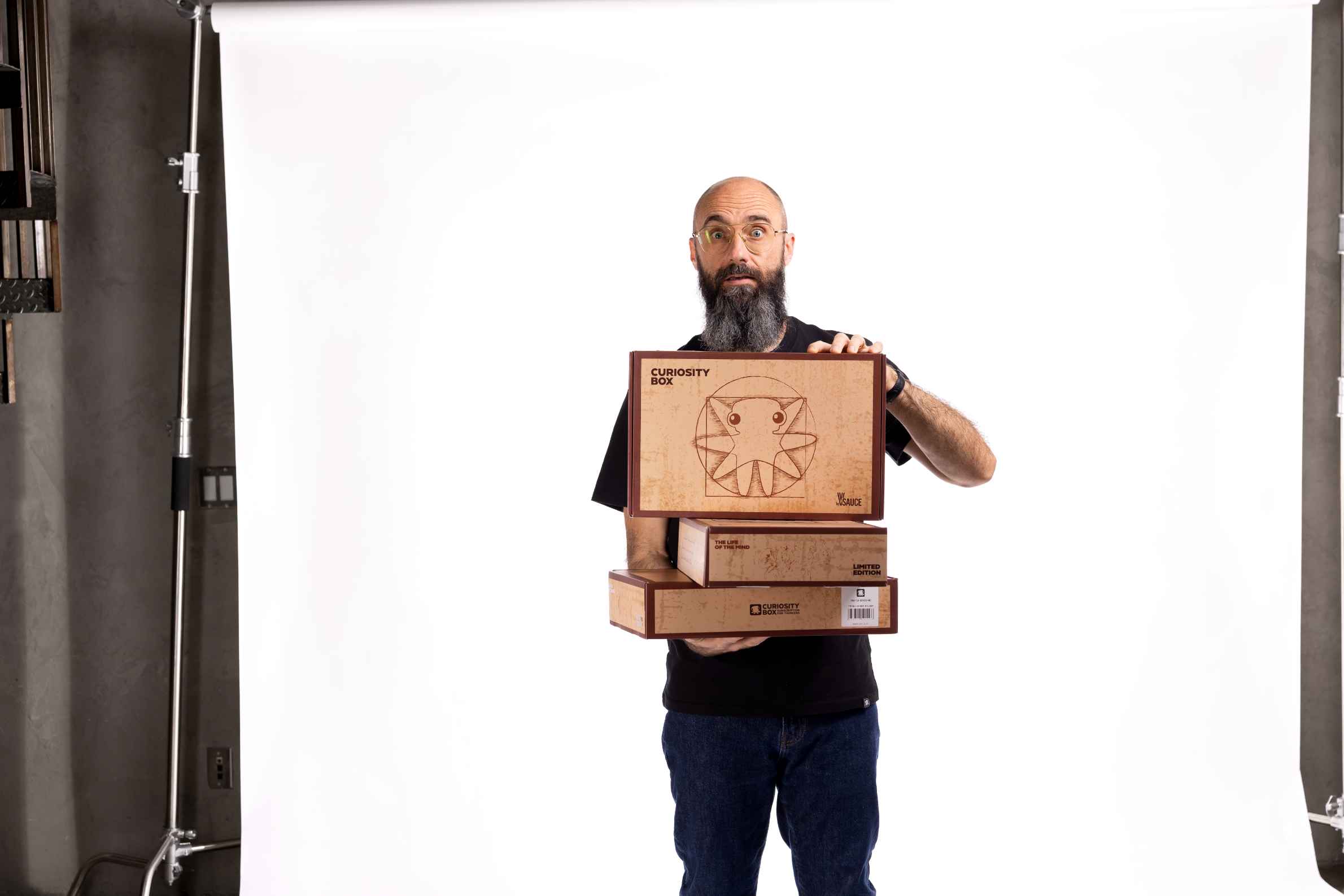
What Is the Curiosity Box Fall 2026?
The Curiosity Box is designed around a simple idea: curiosity becomes more powerful when you can interact with it.
Rather than simply reading about scientific concepts, subscribers receive objects, books, puzzles, and collectibles that provide different ways to explore an idea.
That approach is consistent with Curiosity Box's broader positioning around science, discovery, and exclusive collectibles. Your existing Curiosity Box review already explains the wider subscription model and the value proposition of its exclusive science items. The Fall 2026 collection takes that concept in a particularly broad direction.
Instead of focusing on just one scientific discipline, the box moves between:
- measurement
- mathematics
- physics
- scientific history
- photography
- visual perception
- logic
- art
- natural science
- creative thinking
That variety is one of the strongest reasons this release could appeal to both dedicated science enthusiasts and people simply looking for an unusual educational gift.
What's Inside the Curiosity Box Fall 2026?
The Fall 2026 collection includes:
- Ruler of the Universe
- Snowflake Matching Game
- Rutherford Scattering Shirt
- 60-Puzzle Hexagram Challenge
- Leonardo da Vinci: Thoughts on Art and Life
- Leonardo da Vinci Stickers
What makes the collection work is that these aren't six versions of the same product.
Each item opens a different door into science, history, mathematics, or creative thinking.
Let's look at them individually.
1. Ruler of the Universe: A Measurement Tool You Can Make Your Own
The standout item in the Fall 2026 Curiosity Box is undoubtedly the Ruler of the Universe.
At first glance, a ruler doesn't sound particularly revolutionary.
Centimeters.
Inches.
Measure something.
Done.
Except this ruler takes the idea much further.
Alongside familiar measurements, it incorporates unusual units including barleycorns, digits, cun, sun, and hydrogen lines.
And then comes the genuinely clever part.
You can create your own unit of measurement.
That could be based on something as ordinary as:
- a penny
- a seashell
- your finger
- another everyday object
- or virtually anything that gives you a meaningful reference
Why Is the Ruler of the Universe Different?
The underlying concept uses exponential curves and a logarithmic spiral to connect different scales across the ruler.
That turns something most people regard as a basic measuring instrument into a conversation about mathematical relationships and how humans have historically defined measurement.
It also creates a wonderfully simple question:
What if your ruler could measure things using a unit you invented yourself?
That is exactly the kind of question that makes science memorable.
Instead of teaching measurement as a fixed system that students simply memorize, the ruler encourages people to think about why measurement systems exist in the first place.
Who Will Enjoy It?
The Ruler of the Universe should appeal particularly to:
- mathematics enthusiasts
- science teachers
- engineers
- designers
- makers
- collectors
- STEM students
- curious adults
- people who love unusual desk objects
It is also arguably the most distinctive item in this particular box.
2. Snowflake Matching Game: Can You Match Nature's Most Beautiful Patterns?
The second major highlight takes inspiration from something almost everyone recognizes:
snowflakes.
But this isn't a generic winter-themed memory game.
The cards use photographs associated with Wilson Bentley, the pioneering American snowflake photographer who spent decades documenting individual snowflakes.
Bentley's work is fascinating because he treated something extraordinarily short-lived as a serious subject of scientific observation.
The Fall 2026 game turns that scientific history into a playable experience.
How the Snowflake Game Works
The collection features 42 tiles forming 21 matching pairs.
Players need to find the corresponding snowflake photographs while becoming exposed to the remarkable variety of natural snowflake structures.
That creates two experiences at once:
Game:
Can you remember where the matching snowflake is?
Science:
Can you appreciate how much variation can occur in naturally formed ice crystals?
Why This Is More Than a Memory Game
The phrase “no two snowflakes are alike” has become part of popular culture.
But the deeper scientific story is far more interesting.
Snowflake formation depends on environmental conditions as ice crystals develop through the atmosphere. Small changes in temperature and moisture can influence the resulting structures.
Bentley's photographs helped preserve a visual record of that diversity long before modern digital photography.
So the game isn't simply about matching pictures.
It creates an accessible introduction to:
- snowflake morphology
- crystallization
- observation
- photography
- natural variation
- scientific documentation
For families and educators, that's a particularly useful combination.
3. Rutherford Scattering Shirt: The Customer Request That Became Reality
This might be the most entertaining story in the box.
A Curiosity Box community member apparently kept requesting an Ernest Rutherford alpha-particle shirt for 91 consecutive days.
The team eventually gave in.
And the result is now part of the Fall 2026 collection.
That is a fantastic example of how a niche scientific interest can turn into an actual product.
What Does the Shirt Show?
The Art Deco-inspired design references the famous gold foil scattering experiment.
The experiment involved alpha particles being directed toward a thin sheet of gold foil.
Most passed through.
But some were deflected far more dramatically than expected.
Those surprising observations eventually contributed to the understanding that atoms have a tiny, dense central nucleus and are mostly empty space.
The experimental work involved Hans Geiger and Ernest Marsden, while Rutherford interpreted the results and developed the implications for atomic structure.
Why the Experiment Changed Physics
Before the nuclear model became accepted, scientists had very different ideas about how positive charge and mass were distributed inside atoms.
The scattering results challenged those assumptions.
That is what makes the shirt more interesting than ordinary science merchandise.
It represents a genuine turning point in the history of physics.
You aren't just wearing a Rutherford graphic.
You're wearing a conversation starter about how experimental evidence can overturn an accepted model of nature.
4. The Hexagram Puzzle: 60 Challenges That Get Harder
If the first three items appeal to your curiosity, history, and scientific imagination, the hexagram puzzle brings the hands-on challenge.
The collection includes 60 puzzles built around gem-like hexagonal pieces.
And they aren't all equally difficult.
The challenges progressively increase in difficulty through four stages inspired by the life cycle of an octopus:
- Egg
- Larva
- Juvenile
- Adult
That progression is important.
A puzzle set becomes much more engaging when there is a genuine sense of advancement.
Instead of solving one puzzle and putting the product aside, you have a reason to keep going.
What Skills Does It Encourage?
The hexagonal challenges can encourage:
- spatial reasoning
- pattern recognition
- problem solving
- patience
- visual analysis
- logical thinking
- persistence
This makes the puzzle particularly interesting for people who enjoy brain games but don't necessarily want another screen-based activity.
It also fits naturally into the wider STEM-learning philosophy of the Curiosity Box.
5. Leonardo da Vinci: Thoughts on Art and Life
The Fall 2026 box then takes a dramatic turn.
From snowflakes and atomic physics, it moves into the notebooks and ideas of Leonardo da Vinci.
The box includes a Curiosity Box exclusive edition of Thoughts on Art and Life.
Leonardo's observations covered an extraordinary range of subjects.
His interests extended across areas including:
- painting
- anatomy
- nature
- fossils
- scientific observation
- art
- philosophy
- unusual subjects and beliefs
The edition has been redesigned to make Leonardo's ideas easier to explore, with additional illustrations, improved organization, clearer references, and a new introduction by Michael Stevens.
That last point is particularly relevant for Curiosity Box fans because it connects historical scientific curiosity with modern science communication.
Why Leonardo Fits a Science Subscription Box
Leonardo is often remembered primarily as an artist.
hat's only part of the story.
His notebooks demonstrate a much broader habit:
Observe → question → investigate → draw → rethink.
That mindset fits the philosophy of Curiosity Box remarkably well.
Curiosity doesn't always respect academic boundaries.
A question about painting can lead to anatomy.
A question about anatomy can lead to mechanics.
A question about nature can lead to engineering.
Leonardo's work demonstrates exactly that kind of interdisciplinary thinking.
6. Leonardo da Vinci Stickers
The Leonardo theme continues outside the book with a collection of stickers featuring recognizable imagery including Leonardo's grotesques and the Vitruvian Man.
At first, stickers might seem like the least substantial inclusion.
But they serve a different purpose.
They allow the historical and artistic theme to move beyond the book itself.
You can place them on:
- notebooks
- laptops
- journals
- folders
- study spaces
- creative projects
For collectors, small extras like these also contribute to the personality of a seasonal box.
What Makes the Fall 2026 Curiosity Box Different?
The strongest argument for this particular collection isn't any single item.
It is the range of ideas connected by curiosity.
Think about the journey:
Measurement → Mathematics → Natural Science → Photography → Atomic Physics → Puzzles → Art → Leonardo da Vinci
That is a surprisingly broad intellectual journey for one box.
And that's where Curiosity Box differentiates itself from a conventional STEM kit.
A typical science kit might focus on building a circuit, growing crystals, programming a device, or completing a series of experiments.
The Fall 2026 collection takes another route.
It asks:
What can we learn when ordinary objects become starting points for bigger questions?
A ruler becomes mathematics.
Snowflakes become crystallography and photography.
A shirt becomes atomic history.
A puzzle becomes spatial reasoning.
A book becomes a window into Renaissance thinking.
That is a much more interesting proposition for lifelong learners.
Curiosity Box Fall 2026 vs. the Summer 2026 Box
If you're already familiar with the Curiosity Box Summer 2026, the Fall release takes a noticeably different direction.
The Summer 2026 collection focused heavily on perception, optical effects, observation, and visual cognition, including the Camera Lucida, Spectropia, Ambigram/Zoetrope Coin, Numeral Puzzle, Dog Safety Shirt, and related stickers. The Fall 2026 box feels broader.
| Summer 2026 | Fall 2026 |
|---|---|
| Optical perception | Measurement |
| Camera Lucida | Ruler of the Universe |
| Afterimages | Snowflake photography |
| Ambigrams | Atomic physics |
| Visual cognition | Spatial puzzles |
| Dog vision | Leonardo da Vinci |
| Perception | Art + science |
That distinction is useful for existing subscribers.
If Summer was about how we see, Fall is more about how humans measure, observe, investigate, solve, and create.
If you haven't read the previous seasonal review, your Curiosity Box Summer 2026 review can provide useful context before comparing the two editions.
Wondering whether the Fall collection is more interesting than the previous release? Compare it with our Curiosity Box Summer 2026 review to see how the two boxes differ in themes, collectibles and the kind of curiosity-driven experience they offer.
Is the Curiosity Box Fall 2026 Worth It?
For the right buyer, yes — particularly if you value ideas as much as physical products.
But it is important to understand what you're buying.
This isn't primarily a box of practical household tools.
It's not designed to compete with a conventional electronics kit.
And it isn't simply a children's toy subscription.
Its appeal comes from the combination of:
- exclusive collectibles
- scientific stories
- puzzles
- historical material
- hands-on interaction
- unusual design
- educational value
- conversation-starting objects
Your existing Curiosity Box review makes the broader case for the subscription's exclusive science collectibles and its positioning as a science-focused subscription rather than an ordinary lifestyle box. The Fall 2026 edition strengthens that positioning because several items have an unusually strong story behind them.
Who Should Buy the Curiosity Box Fall 2026?
Science Enthusiasts
If you enjoy physics, mathematics, natural science, scientific history, or unusual scientific objects, this collection offers plenty to explore.
Puzzle Lovers
The 60-piece hexagram challenge gives the box a genuine interactive component rather than making it purely collectible.
Lifelong Learners
This is arguably one of the strongest audiences for the box.
You don't need to be enrolled in school to enjoy learning.
STEM Educators
Several items could become conversation starters or demonstration pieces for classrooms, science clubs, or informal learning.
Gift Buyers
If you're tired of buying generic gifts for someone who already owns everything, a science subscription is considerably more distinctive.
Curiosity Box Collectors
For existing subscribers, seasonal releases provide another opportunity to add limited-run items to a growing collection.
Not sure whether Curiosity Box is the right science subscription for you? Before choosing, compare it with other options in our guide to the best science subscription boxes for adults and kids, especially if you're shopping for a STEM-focused gift or a hands-on learning experience.
Who Might Want to Skip It?
No product is right for everybody.
You may want to skip the Fall 2026 Curiosity Box if you are primarily looking for:
- high-tech electronics
- conventional laboratory equipment
- purely practical household products
- a subscription focused exclusively on children's experiments
- products with immediate everyday utility
The value here is intellectual and experiential as much as functional.
That's an important distinction before purchasing.
Is the Curiosity Box Good for Adults?
Absolutely.
In fact, adults are one of the audiences most likely to appreciate the Fall 2026 collection.
The combination of scientific history, design, puzzles, books, collectibles, and unusual objects makes it particularly suitable for adults who still enjoy learning outside a formal classroom.
Your broader guide to science subscription boxes for adults and kids already positions Curiosity Box within this larger category, so the new Fall article can naturally send readers there when they want comparisons.
Is the Curiosity Box a Good Gift?
Yes, especially for someone who is difficult to shop for.
Consider it for:
- science lovers
- engineers
- mathematicians
- teachers
- students
- puzzle enthusiasts
- lifelong learners
- collectors
- STEM professionals
- curious teenagers and adults
The strongest gift advantage is that the recipient doesn't simply receive another object.
They receive several reasons to explore something new.
That gives the box a longer shelf life than many novelty gifts.
Curiosity Box Fall 2026: My Verdict
The Fall 2026 Curiosity Box succeeds because it doesn't try to make science look like homework.
Instead, it turns scientific ideas into things you can hold, play with, wear, read, compare, and discuss.
The Ruler of the Universe is arguably the headline attraction because it takes the familiar idea of measurement and makes it unexpectedly philosophical.
The Snowflake Matching Game connects play with scientific photography and natural history.
The Rutherford shirt turns one of physics' most important experiments into wearable storytelling.
The 60-puzzle hexagram challenge adds genuine hands-on problem solving.
And the Leonardo da Vinci book and stickers broaden the collection from modern science into the history of interdisciplinary thinking.
That makes this more than a box of miscellaneous science merchandise.
It is a curated collection of questions disguised as objects.
And that's precisely why I think the Fall 2026 release deserves attention from anyone who enjoys science, puzzles, design, history, or simply learning something unexpected.
Where to Learn More About Curiosity Box
If you're discovering Curiosity Box for the first time, start with the current subscription options and Fall 2026 availability before deciding whether this season's collection fits your interests.
For a broader look at the service, our Curiosity Box subscription review covers the overall concept, pricing structure, exclusive collectibles, and who the subscription is designed for. If you're comparing seasonal releases, our Summer 2026 Curiosity Box review is the natural next article to read. And if you're shopping specifically for educational gifts, our guide to the best science subscription boxes for adults and kids can help you compare Curiosity Box with other STEM-focused options.
Frequently Asked Questions
What is the Curiosity Box Fall 2026?
The Curiosity Box Fall 2026 is a seasonal science-focused collection featuring exclusive items inspired by measurement, snowflakes, atomic physics, puzzles, art, and scientific history.
What is inside the Curiosity Box Fall 2026?
The Fall 2026 collection includes the Ruler of the Universe, a 42-tile snowflake matching game, Rutherford scattering shirt, 60-puzzle hexagram challenge, Leonardo da Vinci's Thoughts on Art and Life, and Leonardo-inspired stickers.
What is the Ruler of the Universe?
The Ruler of the Universe is a specially designed measuring tool that combines familiar measurements with unusual units and allows users to create their own custom unit of measurement.
Can you create your own measurement unit with the Ruler of the Universe?
Yes. One of the central ideas behind the ruler is that users can define a personal measurement reference using an object or body measurement of their choice.
Who was Wilson Bentley?
Wilson Bentley was an American photographer and pioneer of snowflake photography who spent decades photographing individual snowflakes and documenting their remarkable structures.
How many pairs are in the Curiosity Box Snowflake Matching Game?
The game contains 42 tiles arranged into 21 matching pairs featuring snowflake photographs.
What is the Rutherford scattering experiment?
The Rutherford scattering experiment involved directing alpha particles toward thin gold foil and studying how they were deflected. The unexpected results contributed to the development of the nuclear model of the atom.
Who performed the gold foil experiment?
The experimental work was performed by Hans Geiger and Ernest Marsden, while Ernest Rutherford interpreted the results and developed their implications for atomic structure.
What is the hexagram puzzle in the Fall 2026 Curiosity Box?
It is a collection of 60 increasingly challenging puzzles using hexagonal pieces, with four stages of difficulty inspired by an octopus's life cycle.
Is the Curiosity Box Fall 2026 good for adults?
Yes. Its combination of science, puzzles, scientific history, art, and collectibles makes it particularly appealing to curious adults and lifelong learners.
Is Curiosity Box a good STEM gift?
It can be an excellent STEM gift for people who prefer exploration, puzzles, science history, and unusual educational objects over conventional toys or gadgets.
Is the Curiosity Box Fall 2026 worth buying?
For science enthusiasts, collectors, puzzle lovers, educators, and lifelong learners, the Fall 2026 collection offers a compelling mix of educational and collectible value. Buyers looking primarily for practical gadgets may prefer a different type of STEM product.
If you're considering Curiosity Box for the first time, don't judge the subscription on one seasonal release alone. Our Curiosity Box subscription review takes a broader look at the subscription experience, exclusive collectibles, pricing and overall value, so you can make a more informed decision before subscribing.
How does Fall 2026 compare with Curiosity Box Summer 2026?
Summer 2026 concentrated more heavily on visual perception, optical effects, and observation, while Fall 2026 expands into measurement, snowflake science, atomic physics, puzzles, and Leonardo da Vinci.
Still curious about the Fall 2026 box? If you're looking for a science subscription that feels more thoughtful than another generic gift or activity kit, explore the Curiosity Box subscription options and decide whether this season's collection belongs on your desk, bookshelf or gift list.
Final Takeaway
The best thing about the Curiosity Box Fall 2026 isn't that it contains six interesting products.
It's that each product gives you a different reason to ask a question.
How should we measure something?
Why are snowflakes so different?
What happens inside an atom?
Can I solve this puzzle?
How did Leonardo da Vinci think about the world?
That is a much stronger proposition than simply buying another subscription box.
If you're looking for a science subscription box for adults, a distinctive STEM gift, an unusual gift for a science lover, or a collection that encourages genuine curiosity, the Fall 2026 edition deserves a serious look.
The box isn't just selling things. It's selling reasons to keep wondering.
Curious enough to see what made the Fall 2026 box special? Explore the latest Curiosity Box subscription options and check the current Fall 2026 availability before this seasonal collection moves on to the next release..
#CuriosityBox #CuriosityBoxFall2026 #ScienceSubscriptionBox #STEMGifts #ScienceGifts #ScienceLovers #STEMLearning #ScienceForAdults #EducationalGifts #ScienceCollectibles #CuriousMinds #PuzzleLovers #UniqueGiftsForAdults #ScienceGiftIdeas #STEMEducation #LifelongLearning #GeekGifts #ScienceAndTechnology #EducationalSubscription #GiftForScienceLovers
Disclosure:
This article is intended for informational and educational purposes. This article may contain affiliate links. If you choose a service through our links, we may earn a commission at no extra cost to you.
Product capabilities, availability, pricing, plans and integrations can change. Always verify current details with the provider before purchasing
This article was created with AI-assisted research and carefully reviewed by our in-house team before publication