Deel AI Policy Summit 2026: Why AI and the Future of Work Should Matter to Every Global Employer
Deel AI Policy Summit 2026: Why AI and the Future of Work Should Matter to Every Global Employer
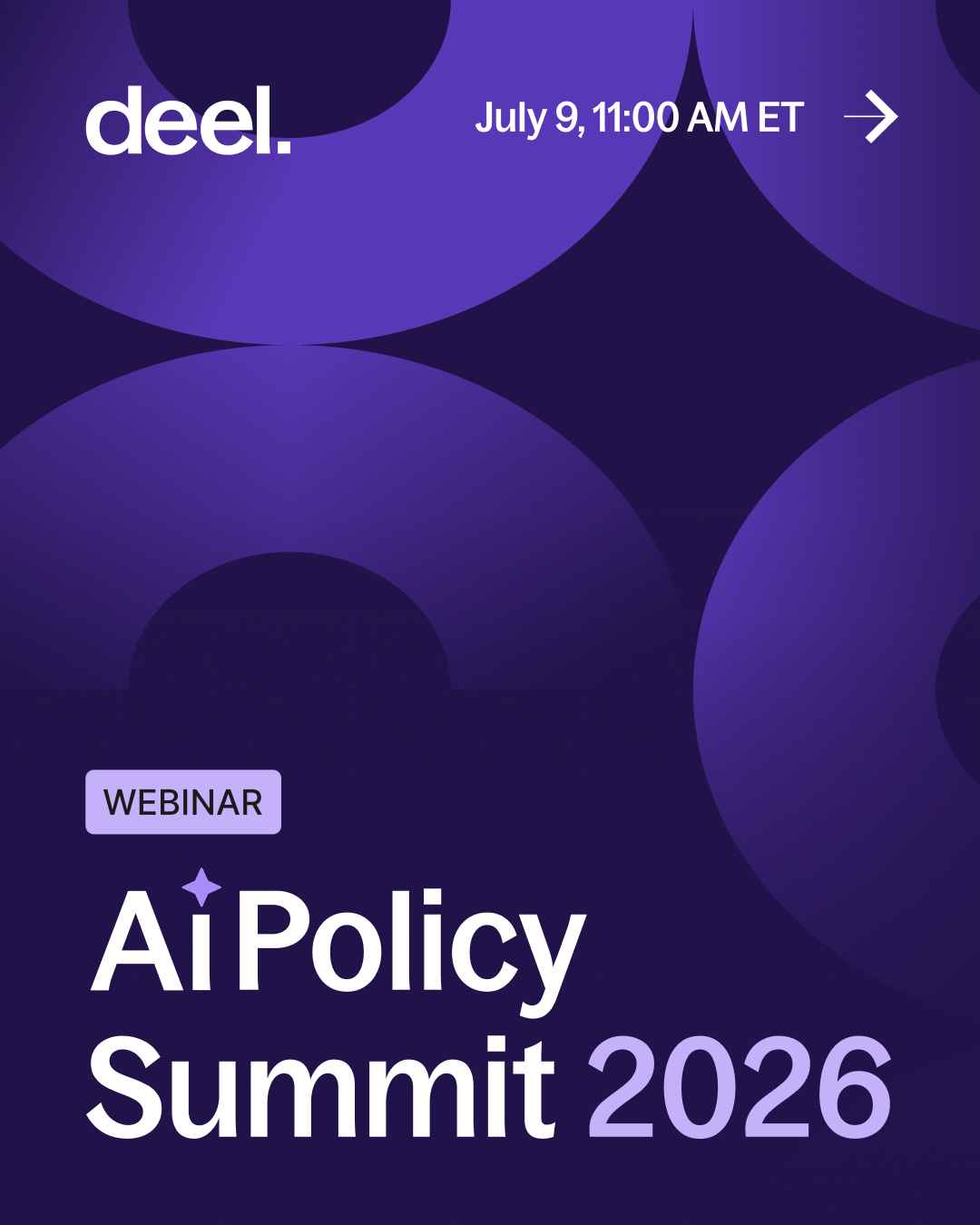
The Deel AI Policy Summit 2026 brings together government leaders, policymakers, and business experts to discuss how artificial intelligence is reshaping the future of work. Covering AI regulation, workforce transformation, global hiring, and compliance, the summit offers valuable insights that help employers prepare for an AI-driven workplace while remaining competitive in an evolving global economy.
Artificial intelligence is no longer a futuristic concept—it's becoming an essential part of how organizations recruit, manage, support, and grow their workforce. From automating repetitive HR tasks to improving workforce planning and strengthening compliance, AI is changing how businesses operate across borders. At the same time, governments around the world are racing to establish policies that encourage innovation while protecting workers and ensuring responsible AI adoption.
Against this backdrop, the Deel AI Policy Summit 2026 arrives at a critical moment. Bringing together policymakers, business leaders, labor experts, and AI specialists from the United States, the United Kingdom, and the European Union, the summit provides a rare opportunity to hear how the world's leading economies are approaching AI regulation and what those decisions mean for employers managing international teams.
For organizations hiring globally, staying informed is no longer optional. The conversations happening today will influence hiring strategies, compliance requirements, employee rights, and business competitiveness for years to come.
Whether you're a startup founder, HR leader, compliance manager, or business owner expanding internationally, understanding the relationship between AI, workforce policy, and global employment can help you make better decisions before regulations change.
Want to hear directly from the policymakers and workforce experts shaping tomorrow's AI regulations? Register for the Deel AI Policy Summit 2026 to learn how emerging AI policies could influence global hiring, compliance, and the future of work—and secure your place before the live session begins.
Why the Deel AI Policy Summit 2026 Matters
Artificial intelligence has become one of the most significant drivers of workplace transformation in recent decades. Businesses are adopting AI to improve productivity, reduce administrative workloads, enhance customer service, and make faster, data-informed decisions. However, with these opportunities come important questions about ethics, transparency, employee rights, and legal responsibility.
The Deel AI Policy Summit 2026 stands out because it doesn't focus solely on technology. Instead, it explores the broader impact of AI on people, businesses, and governments.
Unlike many AI conferences that emphasize software demonstrations or product launches, this summit centers on practical discussions around:
- How governments are responding to rapid AI innovation.
- The future of employment in an AI-driven economy.
- Balancing innovation with worker protections.
- International cooperation on AI governance.
- Preparing businesses for evolving compliance requirements.
By bringing together former U.S. Secretaries of Labor, senior officials from the European Commission, Members of the European Parliament, the UK's Minister for AI and Online Safety, and labor policy experts, the summit offers perspectives that are rarely available in one event.
For employers operating across multiple countries, these discussions provide valuable context for anticipating regulatory changes before they affect hiring practices, payroll, and workforce management.
AI and the Future of Work: A Turning Point for Global Employers
Artificial intelligence is changing far more than individual job roles—it is reshaping how organizations think about work itself.
Routine administrative tasks that once required hours of manual effort can now be completed in minutes using AI-powered tools. Recruitment teams can screen applications more efficiently, payroll departments can automate repetitive processes, and customer support teams can respond faster through intelligent assistants.
However, the future of work extends beyond automation.
Organizations must also consider how AI affects:
- Employee trust.
- Data privacy.
- Workplace transparency.
- Skills development.
- Workforce resilience.
- Human oversight in AI-assisted decision-making.
Successful organizations will be those that treat AI as a tool to enhance human capabilities rather than replace them entirely.
The discussion is no longer about whether businesses should adopt AI—it is about adopting it responsibly while maintaining fairness, accountability, and compliance across global operations.
This shift makes events like the Deel AI Policy Summit increasingly valuable because they help employers understand both the opportunities and the responsibilities that come with AI adoption.
US vs EU AI Policy: Different Paths Toward the Same Goal
One of the most anticipated discussions during the summit is how different governments are approaching AI regulation.
Although both the United States and the European Union recognize AI's potential to drive economic growth, their regulatory philosophies differ significantly.
The United States: Encouraging Innovation
The United States has generally prioritized rapid innovation and private-sector leadership. Policymakers often focus on creating an environment where businesses can experiment, develop new technologies, and remain globally competitive.
Rather than imposing broad restrictions early, U.S. policymakers have largely emphasized:
- Encouraging AI research.
- Supporting innovation.
- Promoting economic competitiveness.
- Developing sector-specific guidance where appropriate.
This approach aims to ensure that American companies continue leading global AI development while allowing regulations to evolve alongside technological progress.
The European Union: Building Trust Through Regulation
The European Union has taken a more structured approach by developing comprehensive AI regulations designed to protect consumers, workers, and fundamental rights.
Its strategy emphasizes:
- Transparency in AI systems.
- Risk-based oversight.
- Accountability.
- Human supervision.
- Ethical AI deployment.
For businesses operating internationally, understanding these differences is essential because compliance obligations may vary depending on where employees, customers, or operations are located.
Organizations expanding globally will increasingly need strategies that satisfy multiple regulatory environments simultaneously.
Finding the Right Balance
Neither innovation nor regulation alone is sufficient.
Businesses benefit from innovation that improves productivity, while employees benefit from safeguards that promote fairness, transparency, and responsible AI use.
One of the summit's most valuable contributions is bringing together policymakers from different regions to discuss how governments can encourage innovation without sacrificing public trust.
These conversations will help shape the future of international AI policy and provide valuable insights for organizations preparing long-term workforce strategies.
Business Implications: What Every Global Employer Should Consider
Artificial intelligence is becoming deeply integrated into modern business operations. As adoption accelerates, leaders must think beyond technology implementation and consider how AI affects governance, compliance, and organizational resilience.
Key areas employers should evaluate include:
Workforce Planning
AI can help forecast hiring needs, identify skills gaps, and improve workforce allocation. However, organizations should ensure that AI-generated recommendations remain subject to human review, especially when making employment-related decisions.
Recruitment and Hiring
AI-assisted recruitment can improve efficiency, but employers must monitor these systems to reduce unintended bias and maintain fair hiring practices. Transparency and accountability will become increasingly important as AI regulations evolve.
Compliance Across Borders
Companies managing international teams face varying labor laws and regulatory expectations. Staying informed about AI-related policy developments can help organizations adapt their compliance strategies before new requirements take effect.
Employee Training
As AI becomes part of everyday workflows, businesses should invest in continuous learning. Equipping employees with AI literacy and digital skills helps organizations remain competitive while supporting workforce confidence during periods of technological change.
Risk Management
Responsible AI governance includes establishing clear internal policies, monitoring AI outputs, protecting sensitive data, and maintaining human oversight for high-impact decisions.Organizations that proactively address these areas are more likely to build trust with employees, customers, and regulators.
Curious how AI is already improving global HR operations? Discover how Deel AI helps optimize international payroll processes and why automation is becoming an essential advantage for globally distributed teams.
Discover practical ways AI can simplify international payroll →
Why Employers Should Pay Attention
The conversations taking place at the Deel AI Policy Summit extend well beyond policy debates. They offer practical insights that can help employers prepare for the next phase of workforce transformation.
Business leaders who understand emerging AI regulations today will be better positioned to:
- Develop sustainable AI strategies.
- Strengthen global compliance programs.
- Build resilient international teams.
- Improve operational efficiency through responsible AI adoption.
- Reduce regulatory uncertainty.
- Create workplaces that balance innovation with employee trust.
As AI continues reshaping industries, organizations that stay informed and adapt early will be better equipped to navigate future challenges while maintaining a competitive edge.
For employers operating across borders, the future of work will be shaped not only by technological innovation but also by the policies and partnerships that guide its responsible use. The Deel AI Policy Summit 2026 provides an important opportunity to better understand that evolving landscape and prepare for what comes next.
Recommended for Global Employers:
Managing international teams involves more than hiring—it requires staying compliant across payroll, contracts, taxes, and local labor laws. If you're evaluating platforms that simplify global employment while supporting long-term workforce growth, explore Deel's global hiring and payroll solutions to see how businesses scale internationally with greater confidence.
Speaker Highlights: Leaders Shaping the Conversation on AI and Work
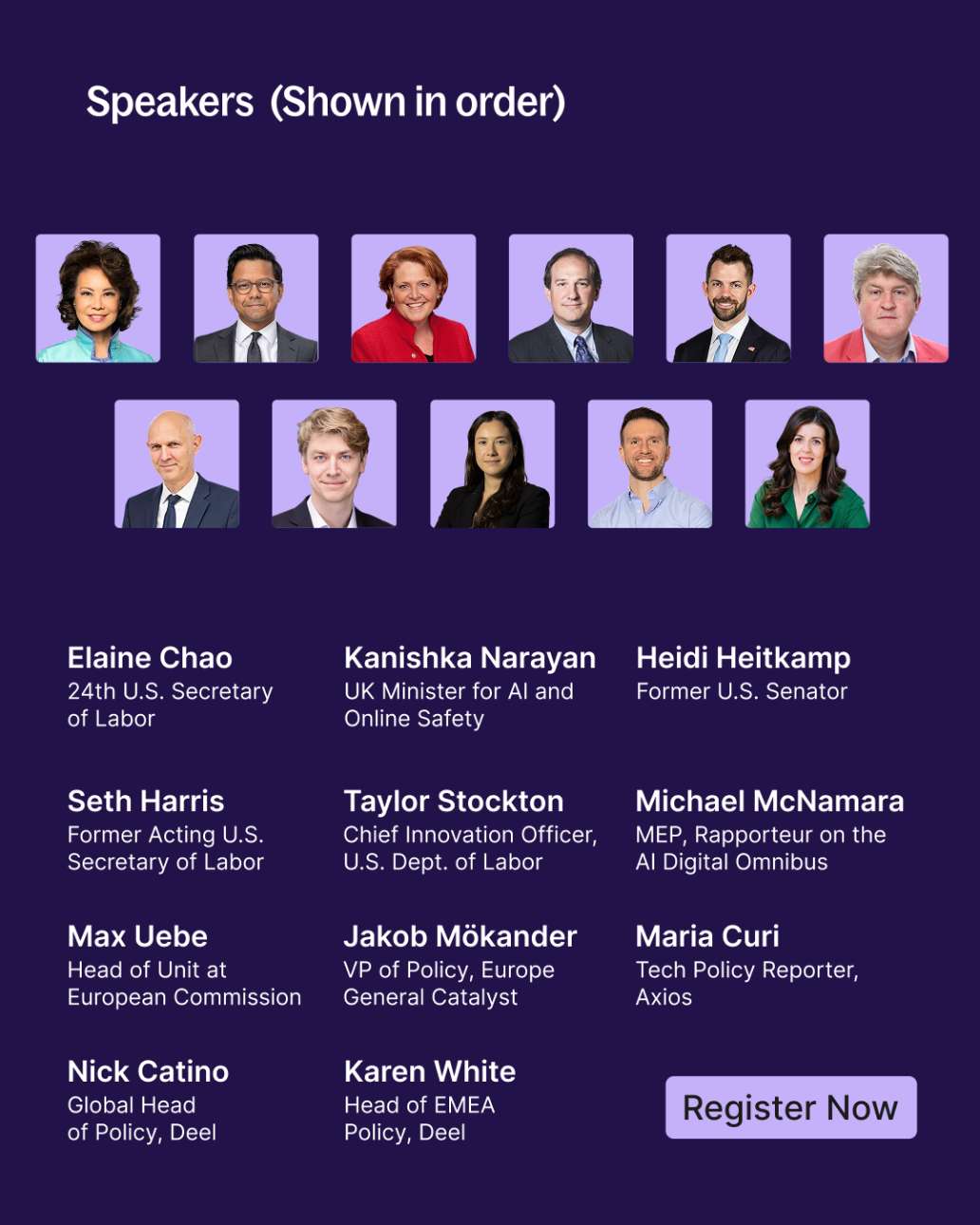
One of the biggest strengths of the Deel AI Policy Summit 2026 is the diversity of voices participating in the discussion. Instead of presenting AI from only a technology perspective, the summit brings together experienced policymakers, labor experts, regulators, and business leaders who understand both the opportunities and responsibilities that AI introduces into today's workforce.
Opening Remarks: Setting the Stage
The summit begins with opening remarks from Nick Catino, Deel's Global Head of Policy. His introduction sets the tone by highlighting why AI governance has become a business priority and why employers should pay close attention to evolving regulations.
As organizations increasingly adopt AI-powered solutions for hiring, payroll, compliance, and workforce management, understanding the policy landscape becomes just as important as understanding the technology itself.
Panel Discussion: AI and the Future of Work
The first panel explores one of today's most important questions:
Can governments encourage AI innovation without slowing economic growth?
This discussion features respected leaders including former U.S. Secretary of Labor Elaine Chao, Michael McNamara, Rapporteur on the AI Digital Omnibus in the European Parliament, and Max Uebe from the European Commission.
Together, they examine topics such as:
- AI regulation and innovation
- Global competitiveness
- Workforce transformation
- Responsible AI governance
- Cross-border collaboration
For business leaders, this discussion offers valuable insight into how different regions are approaching AI policy and what those choices may mean for employers operating internationally.
Panel Discussion: What Comes Next for Workers?
Artificial intelligence is changing jobs across nearly every industry. While automation creates new opportunities, it also raises important questions about employee training, workplace protections, and long-term workforce development.
Former U.S. Senator Heidi Heitkamp joins former Acting U.S. Secretary of Labor Seth Harris to discuss how workers and employers can prepare for these changes.
Key topics are expected to include:
- Workforce reskilling
- Employee adaptation
- AI-assisted workplaces
- Labor market transformation
- Human-centered AI adoption
Rather than focusing only on technology, this conversation highlights the importance of helping employees succeed alongside AI.
Panel Discussion: The Geopolitics of the AI Race
Artificial intelligence has become more than a business issue—it's also a global strategic priority.
This session brings together Kanishka Narayan, the UK's Minister for AI and Online Safety, alongside Taylor Stockton, Chief Innovation Officer at the U.S. Department of Labor, moderated by Maria Curi, Senior Tech Policy Reporter at Axios.
Discussion points are expected to include:
- International AI competition
- Global AI standards
- National innovation strategies
- Public-private collaboration
- Building trustworthy AI ecosystems
These discussions are particularly valuable for multinational companies because future AI regulations may increasingly depend on international cooperation.
Still deciding whether Deel fits your business? Explore our hands-on Deel Review for Remote Teams to see how the platform performs for international hiring, payroll, Employer of Record (EOR), and contractor management.
Find out whether Deel is the right fit for your global team →
What Attendees Will Learn
Whether you're an HR professional, startup founder, operations executive, or compliance leader, the summit offers practical insights that extend well beyond government policy.
Attendees can expect to gain a deeper understanding of:
The Direction of AI Regulation
Regulations continue evolving rapidly across major economies.
Understanding where governments are headed helps businesses prepare before new requirements become mandatory.
Responsible AI Adoption
Deploying AI successfully involves more than selecting the right tools.
Organizations must establish governance frameworks that prioritize:
- Transparency
- Accountability
- Privacy
- Human oversight
- Ethical decision-making
These principles increasingly influence customer trust, employee confidence, and regulatory compliance.
Future Workforce Strategies
Businesses must rethink workforce planning as AI reshapes job responsibilities.
Successful organizations will focus on:
- Continuous employee learning
- Digital skill development
- AI literacy
- Cross-functional collaboration
- Change management
Preparing employees for AI-enabled workplaces creates long-term resilience rather than short-term disruption.
Global Compliance Readiness
International employers face unique challenges because labor laws differ across jurisdictions.
Understanding how AI intersects with employment law, data protection, and compliance helps organizations reduce legal risk while supporting sustainable growth.
Actionable Takeaways for Global Employers
The conversations at the summit are valuable, but the real advantage comes from applying those lessons within your own organization.
Here are several practical actions employers can begin implementing today.
1. Review Your AI Governance Strategy
Establish clear internal guidelines that define:
- Acceptable AI usage
- Human review requirements
- Data protection standards
- Accountability processes
Governance should evolve alongside technology.
2. Invest in Employee AI Skills
AI should complement employees—not replace them.
Provide training that helps teams:
- Use AI responsibly
- Interpret AI-generated recommendations
- Protect sensitive information
- Identify potential risks
Organizations with AI-literate employees are better prepared for future workplace transformation.
3. Monitor Regulatory Developments
AI legislation is changing quickly across multiple regions.
Employers operating internationally should monitor developments affecting:
- Recruitment
- Payroll
- Employee data
- Workplace surveillance
- Automated decision-making
Early preparation often reduces compliance costs later.
4. Build Responsible AI Practices
Responsible AI is becoming a competitive advantage.
Organizations that prioritize fairness, transparency, and accountability often strengthen trust among:
- Employees
- Customers
- Investors
- Regulators
Trust remains one of the most valuable business assets in an AI-driven economy.
5. Evaluate Workforce Technology Regularly
Technology continues evolving rapidly.
Regularly reviewing HR systems, payroll platforms, compliance tools, and workforce management solutions helps ensure they continue meeting both operational and regulatory requirements.
Why Deel Is Positioned to Lead This Conversation
Managing a global workforce has never been more complex.
Organizations today face evolving employment regulations, international payroll requirements, contractor management challenges, and increasing compliance expectations across multiple jurisdictions.
These challenges become even more significant as AI transforms workforce operations.
This is where Deel has established itself as more than a payroll platform.Its ecosystem supports businesses through solutions designed for:
- Global hiring
- International payroll
- Employer of Record (EOR) services
- Contractor management
- Workforce compliance
- HR operations across multiple countries
By hosting the AI Policy Summit 2026, Deel demonstrates that successful workforce management is no longer limited to payroll and HR software. It also requires thoughtful engagement with policymakers, regulators, and business leaders who are helping shape the future of work.
For organizations expanding internationally, understanding both the technology and the regulatory landscape can lead to more informed, sustainable business decisions.
Understanding AI policy is only one part of building a future-ready workforce. If you're also evaluating the technology behind international hiring, our in-depth guide on how Deel became the leading global hiring platform explains how businesses simplify cross-border employment, payroll, and compliance through a single platform.
See how growing companies are expanding internationally with fewer compliance hurdles →
FAQs
1. What is the Deel AI Policy Summit 2026?
The Deel AI Policy Summit 2026 is a virtual event that brings together policymakers, labor experts, business leaders, and AI specialists to discuss how artificial intelligence is reshaping the future of work. The summit focuses on AI regulation, workforce transformation, global employment, and responsible AI adoption.
2. Who should attend the Deel AI Policy Summit 2026?
The summit is valuable for HR professionals, business owners, startup founders, compliance managers, operations leaders, policymakers, and anyone responsible for hiring or managing global teams. It is especially relevant for organizations preparing for the impact of AI on international workforce management.
3. Why is AI policy important for global employers?
AI policy influences how businesses use artificial intelligence in hiring, employee management, data privacy, compliance, and workplace decision-making. Understanding evolving regulations helps employers reduce legal risks while building responsible and transparent AI practices.
4. How is artificial intelligence changing the future of work?
Artificial intelligence is automating repetitive tasks, improving business productivity, supporting data-driven decision-making, and transforming recruitment, payroll, and workforce management. At the same time, it is creating new opportunities for employees to develop skills that complement AI technologies.
5. What topics are covered during the Deel AI Policy Summit 2026?
The summit explores AI regulation, workforce transformation, responsible AI governance, global employment trends, international compliance, labor policy, AI innovation, and the future relationship between governments, businesses, and workers.
6. How can businesses prepare for AI-driven workplace changes?
Businesses can prepare by developing AI governance policies, investing in employee training, reviewing compliance processes, monitoring AI regulations, and adopting workforce technologies that balance innovation with transparency and human oversight.
7. What are the differences between US and EU approaches to AI regulation?
The United States generally focuses on encouraging innovation and economic competitiveness, while the European Union emphasizes risk-based regulation, transparency, accountability, and protecting individual rights. Global employers should understand both approaches to maintain compliance across different regions.
8. Why is responsible AI becoming a business priority?
Responsible AI helps organizations build trust with employees, customers, and regulators by ensuring AI systems are fair, transparent, secure, and subject to appropriate human oversight. These practices also reduce operational and compliance risks as AI adoption continues to grow.
9. How does Deel support businesses managing global teams?
Deel provides solutions for international hiring, global payroll, Employer of Record (EOR) services, contractor management, HR administration, and compliance. These services help organizations simplify workforce operations while expanding into new markets.
10. Where can I register for the Deel AI Policy Summit 2026?
Registration is available through Deel's official event page. If you cannot attend the live session, check whether a recording is offered so you can access the discussions and insights at a later time.
If the summit has convinced you to evaluate Deel for your organization, it's worth understanding the investment first. Our detailed guide on Deel Pricing 2026 breaks down plans, pricing, and hidden costs to help you choose the right option.
Compare Deel's pricing before choosing the right plan →
Final Thoughts: Preparing Today for Tomorrow's Workforce
Artificial intelligence is already influencing how organizations recruit, manage, and support employees. The pace of innovation shows no signs of slowing, while governments around the world continue developing policies that will define how AI is used responsibly in the workplace.
The Deel AI Policy Summit 2026 offers more than a discussion about technology—it provides an opportunity to understand the broader forces shaping the future of work.For business leaders, HR professionals, compliance specialists, and founders managing distributed teams, staying informed today can make future transitions significantly smoother.
Organizations that combine responsible AI adoption with strong governance, continuous employee development, and proactive compliance planning will be better positioned to compete in an increasingly global economy.
If your business is hiring internationally or preparing for the next generation of workforce management, now is the ideal time to evaluate whether your current HR, payroll, and compliance processes are equipped for an AI-driven future.
Interested in building a future-ready global workforce?
Explore how Deel helps businesses simplify international hiring, payroll, compliance, and workforce management while supporting organizations as the future of work continues to evolve. Whether you're hiring your first international employee or managing teams across dozens of countries, choosing the right global workforce platform can help you stay compliant, improve operational efficiency, and scale with confidence.
If your organization is preparing for the next generation of global hiring, AI-powered workforce management, and evolving compliance requirements, now is an excellent time to explore how Deel can help simplify international employment. You can also reserve your spot for the Deel AI Policy Summit 2026 to gain practical insights from policymakers and industry leaders before implementing your own AI workforce strategy.
Key Takeaways
- AI is transforming workforce management, hiring, and compliance worldwide.
- Governments are actively shaping new AI regulations that employers need to monitor.
- The Deel AI Policy Summit 2026 brings together leading policymakers and business experts to discuss the future of work.
- Responsible AI adoption requires governance, transparency, and ongoing employee development.
- Global employers that prepare early will be better positioned to adapt to changing regulations and workforce expectations.
- Modern workforce platforms can help simplify international hiring, payroll, compliance, and HR operations in an increasingly AI-enabled business environment.
#DeelAIPolicySummit2026 #FutureOfWork #ArtificialIntelligence #AIPolicy #AIGovernance #GlobalHiring #GlobalWorkforce #HRTechnology #FutureOfHR #WorkforceInnovation
Disclosure:
This article may contain affiliate links. If you choose a service through our links, we may earn a commission at no extra cost to you.
This article was created with AI-assisted research and carefully reviewed by our in-house team before publication