Healthy Movement Program for Screen-Related Pain, Mindset Growth & Family Wellness in 2026
Healthy Movement Program for Screen-Related Pain, Mindset Growth & Family Wellness in 2026
The Modern Wellness Problem Few People Talk About
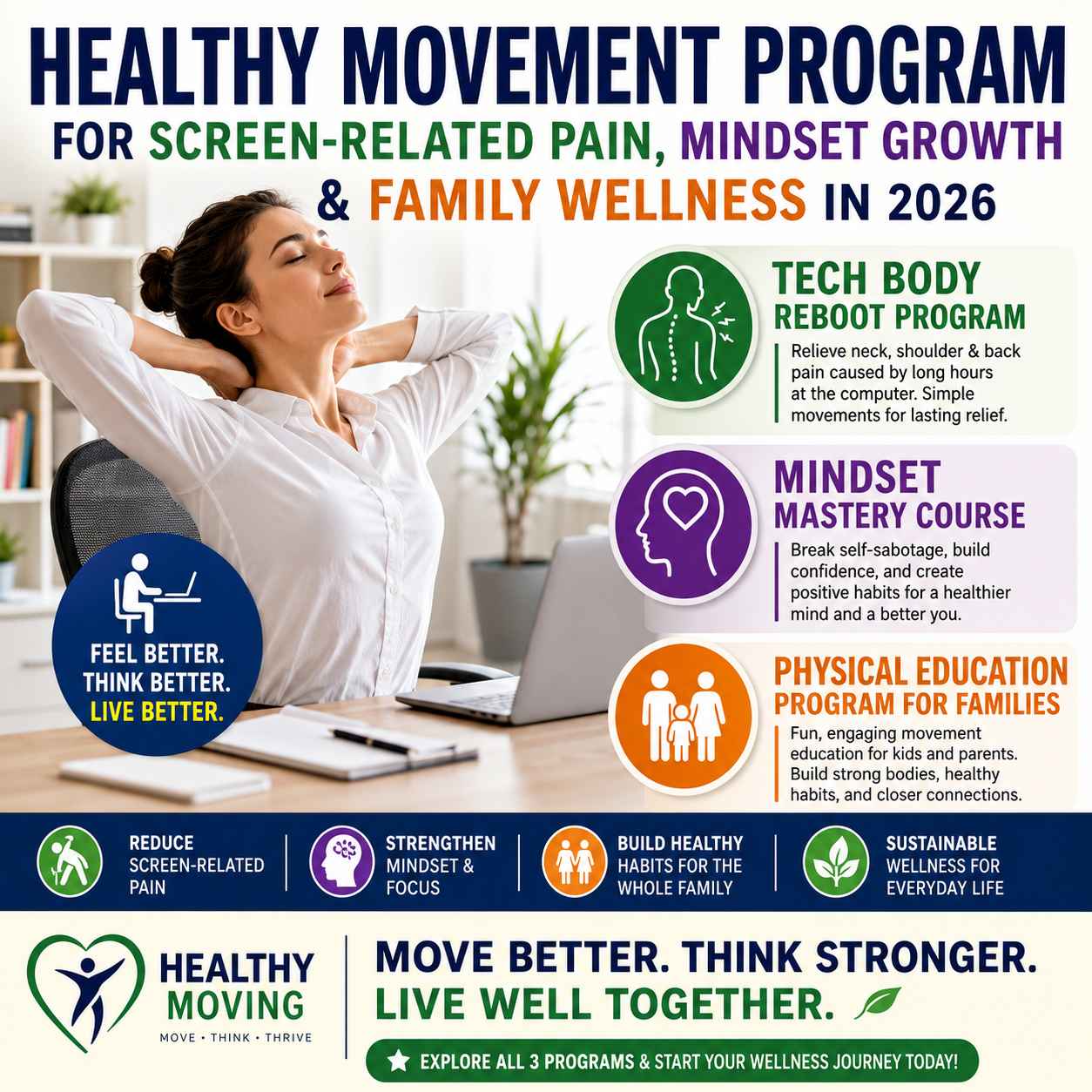
Healthy Moving offers a structured wellness ecosystem designed to address screen-related pain, mindset development, and family wellness education. Through the Tech Body Reboot Program, Mindset Mastery Course, and Physical Education Program for Families, participants gain practical tools to improve movement habits, build healthier thought patterns, and create sustainable wellness routines for everyday life.
Many people invest heavily in productivity systems, AI tools, ergonomic equipment, and digital workflows. Yet one operational bottleneck continues to grow quietly in the background.
The human body.
Remote workers spend hours in front of screens. Creators edit content late into the night. Business owners move from one meeting to another without standing up. Families increasingly rely on digital devices for education, entertainment, and communication.
The result is predictable.
Neck stiffness becomes normal.
Shoulder tension becomes routine.
Energy levels decline.
Mental resilience weakens.
Movement becomes something we plan to do later.
Most wellness products address only one part of the problem. Some focus on exercise. Others focus on mindset. Very few attempt to connect physical movement, mental conditioning, and family wellness into a single framework.
Healthy Moving takes a different approach.
Instead of treating symptoms separately, it organizes wellness into three interconnected programs:
- The Tech Body Reboot Program
- Mindset Mastery Course
- Physical Education Program for Families
After evaluating the structure and intended implementation of these programs, it becomes clear that the real value is not individual lessons. It is the creation of repeatable wellness systems that can fit into modern lifestyles.
If long hours at a desk, recurring neck tension, or declining energy levels sound familiar, it may be worth exploring how the Tech Body Reboot Program approaches movement and recovery for today's screen-heavy lifestyles. Sometimes the biggest productivity upgrade isn't another app—it's a healthier body that can sustain your work.
Understanding the Healthy Moving Ecosystem
Many wellness platforms operate as isolated courses.
You complete a program, consume the content, and move on.
Healthy Moving appears to be designed around behavioral sustainability rather than temporary motivation.
Each division addresses a different layer of long-term wellness:
Tech Body Reboot
Targets physical strain created by screen-heavy lifestyles.
Mindset Mastery
Addresses thought patterns, self-sabotage, and personal development.
Physical Education Program for Families
Introduces movement education and wellness habits within family environments.
Together, they form a framework that tackles physical, mental, and lifestyle factors simultaneously.
The Tech Body Reboot Program: Rebuilding the Digital Worker
Why Screen-Related Pain Has Become an Operational Problem
Most productivity discussions focus on software.
Few discuss the physical cost of digital work.
Yet many professionals experience:
- Neck pain
- Shoulder tightness
- Lower back discomfort
- Poor posture
- Reduced mobility
- Fatigue from prolonged sitting
These issues often reduce performance long before people recognize the cause.
The Tech Body Reboot Program focuses directly on these challenges.
Instead of promoting extreme fitness routines, the program appears to emphasize movement correction, awareness, and body restoration.
Workflow Impact
The strongest use case is for:
- Remote workers
- Entrepreneurs
- Developers
- Content creators
- Virtual assistants
- Digital marketers
- Online educators
These individuals often spend more than eight hours daily in static positions.
Small movement interventions can create noticeable improvements in:
- Energy levels
- Focus duration
- Comfort during work sessions
- Recovery after intensive screen use
The operational benefit is not necessarily athletic performance.
It is sustainability.
Maintaining physical capacity while continuing digital work.
While movement remains the foundation of long-term physical wellbeing, wearable recovery technologies are also helping people understand how stress, sleep quality, and recovery patterns influence overall health. Our analysis of AI-powered smart rings explores how modern wellness tracking is moving beyond simple fitness metrics into proactive health awareness.
Where Friction May Exist
Like many wellness programs, consistency remains the biggest challenge.
The effectiveness of movement education depends heavily on implementation.
People looking for quick fixes may become frustrated.
Those willing to build daily habits are more likely to experience meaningful results.
Mindset Mastery Course: The Often-Ignored Layer of Performance
Most productivity systems eventually encounter the same obstacle.
The user.
People know what they should do.
They simply do not do it consistently.
This gap between knowledge and action is often driven by mindset challenges rather than information shortages.
The Mindset Mastery Course focuses on helping individuals examine:
- Self-limiting beliefs
- Goal alignment
- Personal responsibility
- Emotional awareness
- Habit formation
- Self-image development
Why This Matters Operationally
Business growth often stalls because of decision-making patterns.
Creators abandon projects too early.
Entrepreneurs delay important actions.
Professionals avoid difficult conversations.
These are rarely technology problems.
They are mindset problems.
The course appears designed to help participants recognize these internal barriers and develop healthier behavioral patterns.
Mental performance is often overlooked when discussing personal growth. Beyond mindset development, cognitive health also influences focus, decision-making, and learning capacity. Our deep dive into brain fitness and cognitive training explores why mental sharpness deserves the same attention as physical wellness.
Practical Applications
The strongest use cases include:
- Solopreneurs
- Freelancers
- Coaches
- Creators
- Professionals navigating career transitions
For these groups, improved mindset often produces greater returns than another productivity app.
Honest Assessment
Mindset training can be polarizing.
Some learners expect immediate transformation.
Others dismiss mindset work entirely.
The reality usually falls somewhere in between.
Courses can provide frameworks.
Participants must still do the internal work.
No mindset program can replace consistent action.
Physical Education Program for Families: Building Wellness at Home
Many wellness systems fail because they focus only on individuals.
Families operate differently.
Children observe habits more than instructions.
Parents influence behavior through daily routines rather than occasional lessons.
The Physical Education Program for Families attempts to address this reality.
Instead of separating education and wellness, it combines them.
Why This Approach Is Interesting
Traditional physical education often exists only within institutional settings.Homeschooling families and wellness-focused households frequently need alternative resources.
This program provides a structured approach to:
- Physical activity
- Movement education
- Wellness awareness
- Family participation
- Healthy habit development
Long-Term Value
The strongest advantage is sustainability.
When movement becomes part of family culture, adoption barriers decrease significantly.
Children grow up viewing physical activity as normal rather than optional.
This creates long-term benefits that extend far beyond exercise.
Family wellness extends far beyond exercise alone. Sleep quality, stress management, recovery habits, and learning environments all contribute to healthier households. Our Modern Mother Wellness Stack guide explores how families are building sustainable wellness systems that support long-term wellbeing.
Potential Limitations
Family implementation requires participation from multiple individuals.
Busy schedules can create resistance.
Some families may need time to establish routines before seeing meaningful results.
As with any educational framework, consistency determines outcomes.
How Healthy Moving Compares to Traditional Wellness Approaches
Many wellness solutions focus on a single dimension.
Gym memberships focus on exercise.
Productivity books focus on performance.
Mindset courses focus on psychology.
Physical education programs focus on movement.
Healthy Moving stands out because it combines multiple dimensions within one ecosystem.
Traditional Approach
- Separate solutions
- Multiple subscriptions
- Fragmented learning
- Difficult habit integration
Healthy Moving Approach
- Connected wellness framework
- Physical and mental development
- Family participation opportunities
- Greater emphasis on sustainable routines
This integrated structure may appeal to people seeking long-term lifestyle improvements rather than isolated interventions.
Who Should Consider These Programs?
The strongest fit includes:
Remote Workers
Especially those experiencing screen-related pain and posture issues.
Entrepreneurs
Individuals seeking better energy management and sustainable performance.
Content Creators
People spending extended hours on computers and mobile devices.
Homeschool Families
Parents looking for structured physical education resources.
Wellness-Focused Households
Families interested in developing healthier daily routines.
Who May Not Benefit as Much?
These programs may not be ideal for:
- People seeking rapid physical transformation
- Individuals unwilling to build habits
- Users expecting passive results
- Those looking exclusively for advanced athletic training
Healthy Moving appears more focused on lifestyle sustainability than intensive performance optimization.
Healthy habits rarely come from a single workout, motivational video, or productivity hack. They come from systems that support how you move, think, and live every day. If you're looking for a more structured approach to physical wellness, mindset development, or family health education, exploring Healthy Moving's programs can help you determine which path best aligns with your goals.
FAQ Section
What is the Tech Body Reboot Program?
The Tech Body Reboot Program is designed to help individuals address screen-related pain, posture issues, movement limitations, and physical strain associated with prolonged computer use.
Is the Mindset Mastery Course suitable for entrepreneurs?
Yes. Entrepreneurs, creators, freelancers, and professionals may benefit from the course's focus on self-awareness, behavioral patterns, and personal growth.
Who is the Physical Education Program for Families designed for?
The program is particularly relevant for homeschooling families, wellness-conscious parents, and households seeking structured movement education.
Can these programs replace professional medical advice?
No. Wellness education programs support healthy habits but should not replace medical diagnosis, treatment, or professional healthcare guidance.
How long does it take to see results?
Results vary depending on participation, consistency, existing habits, and personal goals. Sustainable wellness improvements generally develop over time rather than immediately.
Are these programs beginner-friendly?
Based on their educational focus, they appear suitable for beginners interested in improving movement, mindset, and family wellness habits.
Do remote workers benefit most from Healthy Moving?
Remote workers are among the strongest target audiences because prolonged screen exposure often contributes to physical discomfort, reduced mobility, and wellness challenges.
Final Verdict
Healthy Moving is not trying to be another fitness platform, productivity system, or motivational course.
Its strength lies in connecting movement, mindset, and family wellness into a broader lifestyle framework.
The Tech Body Reboot Program addresses a growing problem affecting digital professionals. The Mindset Mastery Course tackles behavioral barriers that often limit progress. The Physical Education Program for Families extends wellness beyond the individual and into daily household routines.
The biggest challenge is the same challenge faced by nearly every wellness program: implementation.
The content can provide direction.
The participant must provide consistency.
For remote workers, creators, entrepreneurs, and families seeking sustainable wellness habits rather than temporary motivation, Healthy Moving presents a thoughtful and practical approach worth exploring in 2026.
From an operator's perspective, the value is not in quick wins. It is in creating repeatable wellness systems that remain effective long after initial enthusiasm fades.
Disclosure:
This article may contain affiliate links. If you choose a service through our links, we may earn a commission at no extra cost to you.
This article was created with AI-assisted research and carefully reviewed by our in-house team before publication