Jotform AI Data Assistant for Healthcare: How Teams Can Analyze Patient Intake Data Faster in 2026
Jotform AI Data Assistant for Healthcare: How Teams Can Analyze Patient Intake Data Faster in 2026
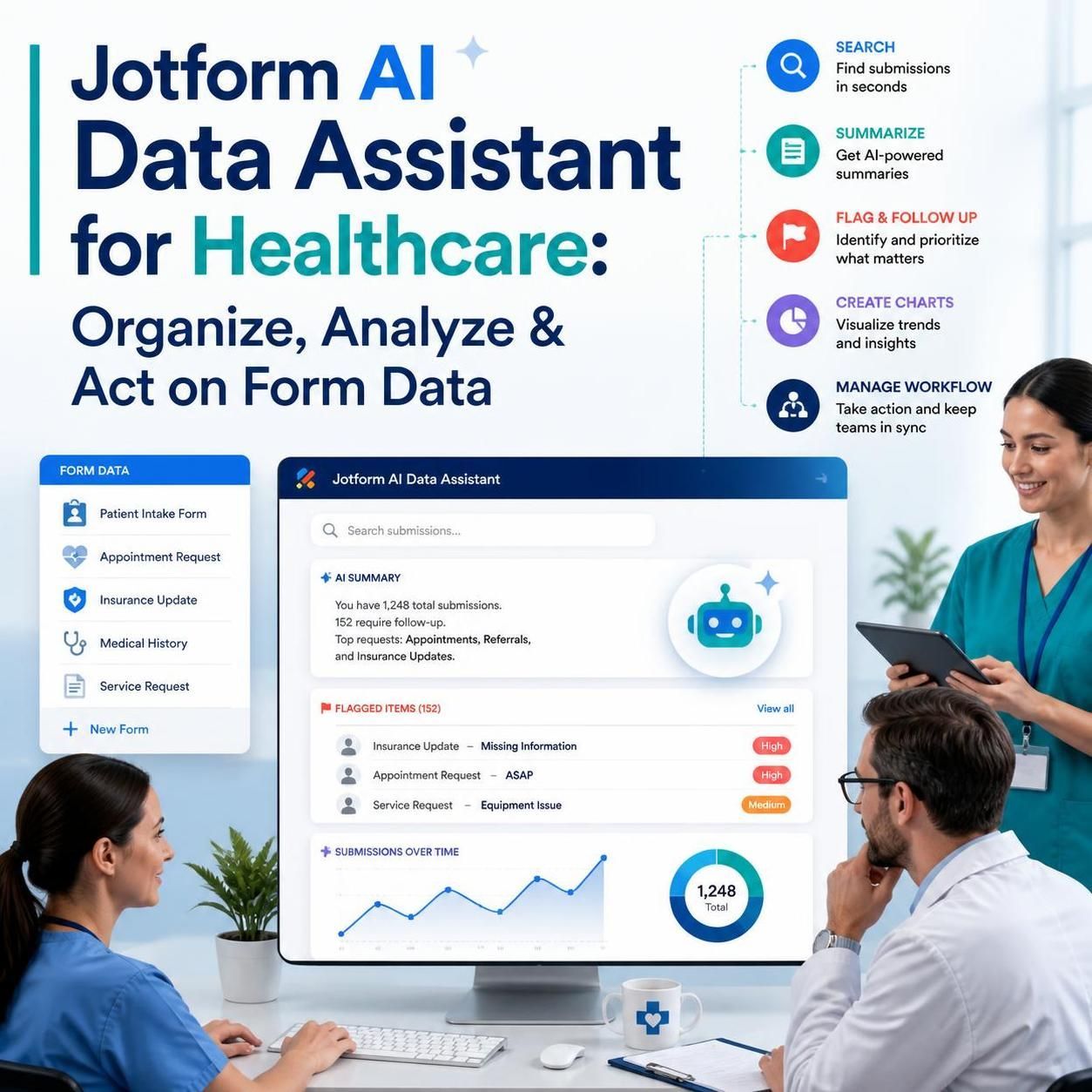
Jotform AI Data Assistant for Healthcare is an AI-powered feature within Jotform that helps healthcare and service teams organize, search, analyze, summarize, visualize, and manage information collected through forms and submissions. Instead of manually reviewing large numbers of records, teams can use natural-language prompts to find relevant submissions, identify information requiring attention, summarize responses, create charts, and support follow-up workflows. It is particularly useful for administrative and operational tasks such as reviewing patient intake forms, service requests, and feedback.
Healthcare organizations collect enormous amounts of information every day.
Patient intake forms. Appointment requests. Service inquiries. Feedback forms. Registration information. Follow-up requests. Internal assessments.
The problem isn't always collecting the information.
The real problem is finding what matters inside all that information.
A healthcare team can have hundreds or thousands of form submissions sitting in a system while staff members manually search, filter, summarize, categorize, and follow up on individual records.
That is where Jotform AI Data Assistant becomes interesting.
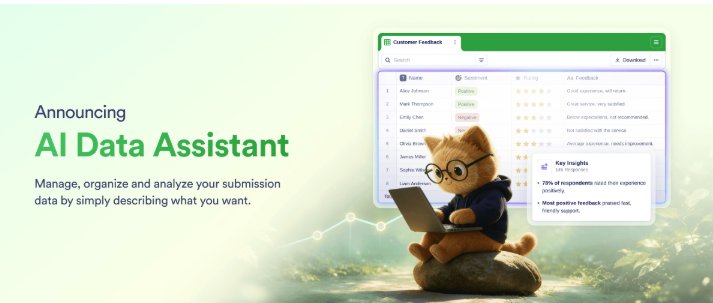
Jotform recently introduced its AI Data Assistant as a conversational way to create, organize, analyze, visualize, and act on data across Jotform Tables and Jotform Inbox. Instead of manually configuring filters, tables, formulas, or charts, users can describe what they need in natural language.
For healthcare teams, that creates a particularly useful opportunity:
Turn collected form data into information that can be reviewed and acted upon faster.
If your healthcare team is already collecting information through online forms, the next question is what you can actually do with all those responses. See how Jotform AI can help you build smarter forms and turn collected data into a more efficient workflow.
What Is Jotform AI Data Assistant?
Jotform AI Data Assistant is designed to let users work with submission data using conversational prompts rather than traditional manual data-management steps.
Depending on the workflow, it can help users:
- Search and filter submissions
- Summarize responses
- Analyze form data
- Identify patterns and trends
- Generate charts and tables
- Organize records
- Create and modify tables
- Categorize information
- Export selected data
- Work with Jotform Inbox submissions
- Prepare replies and follow-up communications
Jotform's current documentation describes the assistant as a way to manage, organize, and analyze submission data through written or spoken prompts.
The important point for healthcare teams is that the value isn't simply "AI."
The value is reducing the amount of manual work required after information has already been collected.
Why Healthcare Teams Should Care About AI Data Analysis
Healthcare workflows are often built around forms.
A patient may complete an intake form before an appointment. A prospective patient may submit a service request. A patient may complete a satisfaction survey after receiving care. A healthcare organization may collect administrative information through multiple forms.
Each submission becomes another record that somebody eventually has to review.
At a small scale, that may be manageable.
At a larger scale, manual review becomes expensive.
Staff may need to:
- Open submissions.
- Search for specific information.
- Filter records.
- Compare responses.
- Identify incomplete information.
- Summarize recurring themes.
- Prepare reports.
- Contact people who require follow-up.
AI-assisted data analysis can reduce the amount of repetitive work involved in these steps.
Jotform's own healthcare example for the Data Assistant is straightforward: identify intake submissions that still need review.
That is exactly the type of operational problem where conversational data analysis can make sense.
This is part of a much bigger shift toward AI that removes repetitive work rather than simply adding another layer of technology; our 2026 guide to the tools and strategies that actually work explores that approach in greater detail.
See which AI tools are actually reducing manual work in 2026 →
How Jotform AI Data Assistant Can Help With Patient Intake Data
Patient intake is one of the clearest use cases for an AI data assistant.
Imagine a clinic receiving hundreds of intake submissions.
Instead of manually scanning every record, a team member could ask the assistant to find records matching a particular operational requirement.
For example:
"Show me intake submissions that still need review."
Or:
"Find submissions with missing information."
Or:
"Group these intake submissions by appointment type."
Or:
"Summarize the most common concerns mentioned in these responses."
These examples illustrate the basic idea: ask the data question instead of manually constructing every filter.
Jotform says its Data Assistant can search and filter submissions using natural-language instructions and can also generate visualizations from submission data.
That can be valuable for administrative teams dealing with large volumes of structured and open-ended responses.
7 Practical Healthcare Use Cases for Jotform AI Data Assistant
1. Review Patient Intake Submissions
One of the most straightforward applications is finding intake submissions that require human attention.
Instead of manually checking every record, a team can use natural-language prompts to identify submissions matching defined criteria.
This doesn't eliminate professional review.
It makes it easier to find the records that need professional review.
That distinction matters in healthcare.
2. Find Incomplete Information
Incomplete forms create additional administrative work.
A staff member may have to identify which submissions are missing required information and then contact the appropriate person.
AI-assisted filtering can make this process more efficient by helping teams surface records requiring additional attention.
For example:
"Find intake submissions where required information is missing."
The team can then review the results and decide what action is appropriate.
3. Summarize Patient Feedback
Healthcare organizations frequently collect feedback through forms.
Reading every open-ended response individually can become tedious when response volumes increase.
Jotform AI Data Assistant can summarize submission data and help identify recurring themes. Jotform also documents capabilities for summarizing and categorizing responses through AI-powered data tools.
This could help an administrative team answer questions such as:
- What issues are appearing repeatedly?
- Which service areas receive the most comments?
- What themes appear in recent feedback?
- Are there recurring operational complaints?
The AI provides an analysis layer; the organization still decides what the findings mean and what action should follow.
4. Organize Service Requests
Healthcare organizations don't only collect patient information.
They also manage requests.
These might include administrative inquiries, service requests, appointment-related questions, or other operational submissions.
Jotform's AI Data Assistant can work with submission records and help teams search, organize, categorize, and manage them.
That can help reduce the amount of manual sorting required before a request reaches the right person.
5. Create Visual Reports
Sometimes the problem isn't finding the information.
It is communicating it.
A spreadsheet full of submissions isn't necessarily useful to a manager who needs to understand the overall picture quickly.
Jotform AI Data Assistant can generate charts, tables, and other visual summaries from submission data.
For example, a healthcare operations team could use a suitable prompt to examine submission volumes or categorize responses into operational groups.
Visual summaries can make patterns easier to communicate during internal reviews.
6. Categorize Open-Ended Responses
Healthcare forms can contain both structured fields and written responses.
Open-ended responses are valuable, but they are harder to process at scale.
Jotform's AI Columns can summarize, translate, categorize, classify, and extract information from responses, while the Data Assistant can help teams manage and analyze the resulting data.
This creates a useful workflow for organizations that need to turn large collections of written responses into more manageable categories.
7. Prepare Follow-Up Work
Data analysis is only useful if it leads to action.
Jotform AI Data Assistant can work with Jotform Inbox as well as Jotform Tables. Jotform documents capabilities for generating replies, confirmations, reminders, and follow-up emails based on submission information.
For healthcare organizations, this can help with administrative communication.
However, healthcare teams should maintain appropriate human oversight, particularly where communications involve sensitive information or decisions affecting patient care.
Jotform AI Data Assistant vs Manually Reviewing Healthcare Forms
The difference is not simply "manual versus AI."
It is manual searching versus conversational data operations.
| Task | Traditional approach | AI-assisted approach |
|---|---|---|
| Find specific submissions | Build filters manually | Describe what you want |
| Summarize responses | Read records individually | Ask for a summary |
| Identify patterns | Review spreadsheets | Ask AI to analyze data |
| Create visual reports | Configure charts manually | Request a visualization |
| Categorize responses | Sort manually | Use AI-assisted categorization |
| Export selected records | Filter and export | Describe the records and format |
| Prepare follow-up | Review context and draft manually | Generate draft responses with AI assistance |
Jotform's documentation confirms that the Data Assistant can perform many of these operations through natural-language prompts.
The biggest potential benefit is therefore time saved on repetitive data-management work.
Is Jotform AI Data Assistant a Good Fit for Healthcare Teams?
It can be a strong fit when the primary problem is managing and analyzing information collected through forms.
The best candidates are likely to be healthcare organizations that already use Jotform and regularly deal with:
- Patient intake forms
- Service request forms
- Feedback forms
- Registration forms
- Administrative submissions
- High submission volumes
- Repetitive data-review tasks
- Internal reporting
It is less appropriate to think of the tool as a replacement for clinical expertise.
The stronger use case is operational:
Collect → organize → analyze → identify what needs attention → let qualified staff decide what happens next.
That is a much more realistic and defensible healthcare workflow.
What About Healthcare Data Security and HIPAA?
This is where healthcare buyers need to slow down and evaluate the details.
Healthcare data can contain highly sensitive information, so organizations should never choose an AI tool based solely on convenience.
Jotform currently publishes security information for its AI Data Assistant ecosystem and provides a specific "HIPAA Ready Jotform AI" resource.
However, healthcare organizations should verify the specific plan, configuration, features, contractual requirements, data-handling terms, and compliance responsibilities applicable to their workflow before putting regulated information into any system.
"An AI tool has healthcare features" is not the same thing as "every possible healthcare workflow is automatically compliant."
For organizations handling protected health information, involve the appropriate compliance, privacy, security, and IT stakeholders before deployment.
That is not bureaucracy for its own sake.
It is good healthcare technology governance.
Does Jotform AI Data Assistant Make Clinical Decisions?
No healthcare organization should treat a general-purpose data assistant as a substitute for qualified clinical judgment.
The strongest use cases are administrative and analytical:
- Finding records
- Organizing submissions
- Summarizing information
- Identifying patterns
- Creating reports
- Preparing administrative communications
A healthcare professional should remain responsible for interpreting information and making clinical decisions where professional judgment is required.
This is one of the most important distinctions buyers should understand before adopting any AI-enabled healthcare workflow.
How to Get Better Results From Jotform AI Data Assistant
The quality of the request matters.
Instead of asking:
"Analyze this."
Give the assistant a specific objective.
For example:
"Find intake submissions from this month that are missing required information and group them by submission status."
Or:
"Summarize the most common themes in the patient feedback responses and separate positive and negative themes."
Or:
"Create a table showing the number of submissions by service category."
Specific prompts produce more useful operational outcomes because the team has already defined what it wants to learn.
A good rule is:
Don't ask AI to "do something with the data." Ask it to answer a specific operational question.
Jotform AI Data Assistant and the Wider Jotform Ecosystem
The Data Assistant becomes more interesting when viewed as part of Jotform rather than as an isolated AI feature.
Jotform forms collect information.
Jotform Tables helps organize that information.
Jotform Inbox provides a place to work with submissions.
The AI Data Assistant adds a conversational layer for analyzing and managing that information.
Jotform describes this ecosystem as a workflow that can move from data collection to organization, analysis, visualization, and action.
This is important because healthcare organizations generally don't need another disconnected dashboard.
They need fewer disconnected steps.
If you're still deciding how to build smarter forms before analyzing the responses, our guide to Jotform ChatGPT Integration shows how AI can help create, edit, and analyze forms without starting from scratch.
See how Jotform AI can simplify the entire form workflow →
How This Differs From Jotform's Earlier AI Capabilities
Kuruntha Smarket has previously covered Jotform's AI capabilities, including how Jotform works with ChatGPT to create, edit, and analyze forms.
That earlier article is still useful if you're interested in the form-building and AI-assisted creation side of Jotform.
This article focuses on something different:
What happens after healthcare data has already been collected?
That makes the Jotform AI Data Assistant a natural next step in the workflow.
For readers interested in the broader AI form-building workflow, see our previous guide: Jotform ChatGPT Integration: Create, Edit, and Analyze Forms Using AI in Minutes
You can also explore our broader coverage of Jotform's business automation capabilities, including the Jotform Salesforce integration, if your organization needs to connect collected information with CRM workflows. Jotform Salesforce Integration: Capture Leads & Close Faster
Jotform AI Data Assistant: Who Should Consider It?
Consider it if your team:
- Already uses Jotform for data collection
- Handles significant numbers of submissions
- Spends too much time manually searching records
- Needs faster summaries of form responses
- Wants easier data visualization
- Frequently categorizes or filters submissions
- Needs to identify records requiring follow-up
- Wants a no-code approach to data analysis
- Wants AI assistance without building a separate data-analysis workflow
Think carefully before adopting it if:
- Your primary requirement is clinical decision-making
- Your workflow requires specialized clinical AI rather than administrative automation
- Your organization has not reviewed privacy and compliance requirements
- You expect AI to operate without human oversight
- Your team rarely handles enough data for automation to create meaningful value
The best technology investment is not necessarily the tool with the most AI features.
It is the tool that removes a genuine bottleneck.
Is Jotform AI Data Assistant Worth Considering for Healthcare in 2026?
For healthcare teams already using Jotform, yes, it is worth evaluating.
The reason isn't that AI sounds impressive.
The reason is much simpler.
Healthcare teams collect information constantly, but reviewing and organizing that information can consume valuable staff time.
Jotform AI Data Assistant provides a conversational way to search, summarize, analyze, visualize, organize, and act on form submission data. Jotform's current healthcare use cases specifically include reviewing intake forms, service requests, patient feedback, and submission details.
That makes the tool particularly relevant for healthcare administration and operations, where repetitive information management can become a significant burden.
The real question isn't:
"Does my healthcare organization need AI?"
The better question is:
"How much staff time are we currently spending finding, organizing, and interpreting information that we already collected?"
If the answer is "a lot," Jotform AI Data Assistant deserves a closer look.
If Jotform looks like a practical fit for your healthcare workflow, the next step is to compare the available plans and current savings before committing to a subscription. Our Jotform Annual Plan Discount 2026 guide breaks down the pricing options and who is most likely to benefit from upgrading.
Compare Jotform plans and current savings before you upgrade →
Ready to Explore Jotform AI?
If your healthcare team already uses Jotform or is considering Jotform for digital forms and AI-powered workflows, this is a sensible time to explore what the platform can do.
Jotform AI Data Assistant is particularly interesting because it extends the value of collected form data beyond simple storage.
Instead of letting submissions sit in a database or spreadsheet, teams can interact with that information using natural-language requests.
Explore Jotform AI and evaluate whether its AI-powered data capabilities fit your healthcare workflow.
Disclosure: This article may contain affiliate links. If you purchase a service through our affiliate link, Kuruntha Smarket may earn a commission at no additional cost to you. Our recommendations are based on the usefulness of the product and its relevance to the topic.
Frequently Asked Questions
What is Jotform AI Data Assistant?
Jotform AI Data Assistant is an AI-powered feature that lets users manage, organize, search, analyze, summarize, visualize, and work with Jotform submission data using natural-language prompts.
Can Jotform AI Data Assistant analyze patient intake data?
It can help healthcare and service teams review intake forms, submission details, and related data. Jotform specifically lists identifying intake submissions that still need review as a healthcare use case.
Can Jotform AI Data Assistant summarize healthcare form submissions?
Yes. Jotform documents AI-powered capabilities for summarizing submission data and using AI Columns to summarize, categorize, classify, translate, and extract information from responses.
Can Jotform AI Data Assistant create charts from form data?
Yes. The Data Assistant can generate charts, tables, and other visual summaries from submission data based on natural-language requests.
Does Jotform AI Data Assistant require coding?
No. Jotform's Data Assistant is designed around natural-language prompts, so users can describe what they want rather than manually configuring every data operation.
Can healthcare teams use Jotform AI Data Assistant to find incomplete submissions?
The Data Assistant can search and filter submission data, making it possible to identify records based on specified criteria. Healthcare teams can use this capability to surface submissions that require additional review or information.
Is Jotform AI Data Assistant HIPAA compliant?
Jotform publishes HIPAA-related information for Jotform AI and identifies a "HIPAA Ready Jotform AI" capability. Healthcare organizations should still verify the applicable plan, configuration, contractual terms, security controls, and compliance requirements for their specific use case before processing protected health information.
Can Jotform AI Data Assistant make medical decisions?
It should not be treated as a replacement for qualified clinical judgment. Its more appropriate role is assisting with administrative data organization, analysis, summaries, visualization, and workflow support.
Is Jotform AI Data Assistant useful for small clinics?
It can be, particularly when a clinic receives enough form submissions that manual searching, sorting, summarizing, or follow-up becomes time-consuming. The business case depends on the clinic's submission volume and workflow complexity.
Is Jotform AI Data Assistant worth trying in 2026?
For teams already collecting significant amounts of information through Jotform, it is worth evaluating. Its ability to interact with submission data through natural-language prompts can reduce repetitive data-management work and help teams move from collected information to actionable insights faster.
If Jotform AI Data Assistant looks like a practical fit for your healthcare workflow, this is a good time to evaluate the platform for yourself. Explore Jotform AI, compare what it can do for your team, and decide whether it can take repetitive data work off your staff's plate.
Final Verdict
Jotform AI Data Assistant is not a replacement for healthcare professionals. It is a productivity layer for the data surrounding their work.
That is precisely why it deserves attention.
When healthcare teams spend less time hunting through submissions, manually creating summaries, sorting records, and preparing routine follow-up, they can spend more time on the work that actually requires human expertise.
For organizations already using Jotform, the Data Assistant is one of the more practical AI developments to evaluate in 2026.
Collect the information. Organize it. Ask better questions. Find what needs attention. Let qualified people make the decisions.
That is where AI-assisted healthcare administration starts becoming genuinely useful.
#JotformAI #Jotform #HealthcareTechnology #HealthcareAI #HealthcareAutomation #HealthTech #PatientIntake #HealthcareWorkflow #AIDataAnalysis #HealthcareData #NoCodeHealthcare #DigitalHealthcare #HealthcareInnovation #AIForHealthcare #HealthcareOperations