Best AI Medical Scribe Software for Healthcare Providers (2026): Features, Workflow & Independent Comparison
Best AI Medical Scribe Software for Healthcare Providers (2026): Features, Workflow & Independent Comparison
Clinical Documentation Should Support Patient Care—Not Compete With It
The best AI medical scribe software helps healthcare providers reduce documentation time by automatically generating structured clinical notes from patient conversations. While each platform approaches documentation differently, the right choice depends on workflow compatibility, ease of adoption, clinical flexibility, and how well it supports everyday healthcare operations.
Every healthcare organization invests in technology to improve patient outcomes, streamline operations, and increase efficiency. Yet one of the biggest operational challenges remains surprisingly consistent across hospitals, clinics, and private practices: clinical documentation.
Electronic Health Records (EHRs) have made patient information more accessible than ever, but they have also introduced a significant administrative burden. Many healthcare professionals now spend hours each day documenting consultations, completing clinical notes, and updating records—often extending well beyond scheduled clinic hours.
For physicians, this means less face-to-face interaction with patients and more time at a keyboard. For practice managers, it affects productivity, staffing, and operational costs. For healthcare organizations, documentation inefficiencies can contribute to clinician burnout, delayed workflows, and inconsistent record keeping.
Artificial intelligence is beginning to reshape this process.
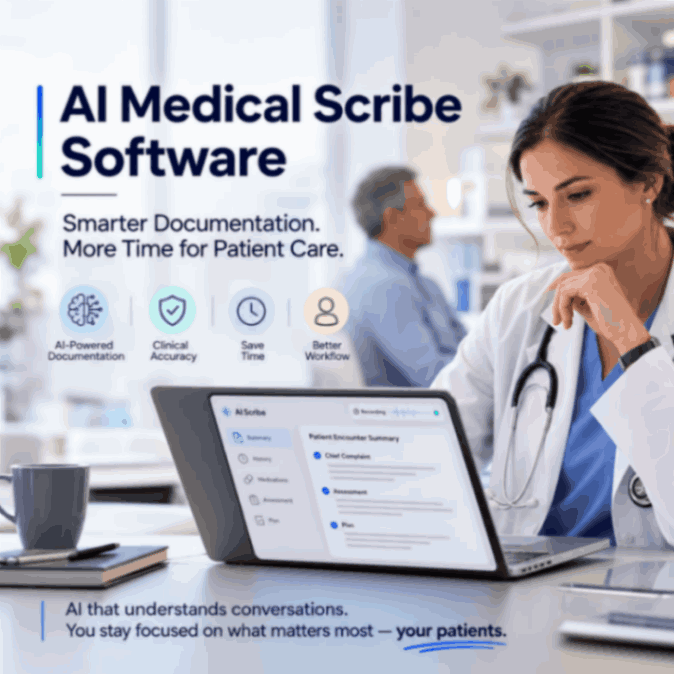
Instead of replacing clinicians, AI medical scribe software is designed to reduce repetitive documentation tasks by listening to patient conversations, identifying clinically relevant information, and preparing structured notes for provider review. The objective is not to automate medical decision-making but to make documentation more efficient while keeping clinicians firmly in control of the final record.
However, choosing an AI medical scribe is not as straightforward as comparing feature lists. Some platforms prioritize ambient listening during consultations, while others focus on documentation accuracy, specialty support, enterprise deployments, or workflow flexibility.
For healthcare providers evaluating these tools, the real question is not "Which platform has the most features?" but rather "Which platform fits the way our organization delivers care?"
This guide answers that question from an operational perspective.
Rather than repeating vendor marketing material, we examine how these platforms fit into real clinical workflows, where they add value, where they introduce new challenges, and which types of healthcare organizations are most likely to benefit from each solution.
Our Editorial Approach
At Kuruntha Smarket, software comparisons are written independently with the goal of helping readers make informed technology decisions.
We evaluate platforms based on practical workflow considerations, usability, implementation experience, operational efficiency, and long-term value—not on commercial relationships or promotional claims. If affiliate partnerships exist now or in the future, they will never determine which platforms are included or how they are assessed.
Healthcare technology directly affects patient care, clinician productivity, and organizational operations. For that reason, we believe balanced analysis—including strengths, limitations, and realistic implementation considerations—is more valuable than promotional rankings.
At Kuruntha Smarket, we evaluate healthcare technology as part of a broader digital health ecosystem. While this guide focuses on AI clinical documentation, we also examine wearable health technology, preventive wellness platforms, and AI-powered health monitoring to help readers understand how these innovations work together across modern healthcare.
Why AI Medical Scribes Are Becoming Part of Modern Healthcare Workflows
Clinical documentation has always been a necessary part of patient care, but its complexity has grown alongside digital healthcare systems.
Today's providers must document patient histories, symptoms, diagnoses, treatment plans, medications, follow-up recommendations, and compliance requirements while navigating increasingly sophisticated EHR systems. Although these systems improve access to information, they also require clinicians to spend substantial time entering data.
This creates an operational imbalance.
Instead of concentrating fully on patient conversations, clinicians often divide their attention between listening, asking questions, and documenting information. Even after appointments end, additional charting frequently continues into evenings or weekends.
AI medical scribe software addresses this challenge by shifting documentation from a manual process to an assisted workflow.
Rather than replacing professional judgment, these platforms typically capture patient conversations—with appropriate consent—identify clinically relevant details, organize them into structured documentation, and present draft notes for provider review.
The clinician remains responsible for verifying, editing where necessary, and approving the final documentation before it becomes part of the patient's medical record.
This distinction is important.AI medical scribes are designed to reduce administrative workload, not clinical accountability.
Who Should Read This Guide?
This guide is written for healthcare professionals and organizations evaluating AI documentation software as part of their clinical operations, including:
- Independent physicians seeking to reduce after-hours documentation.
- Multi-provider clinics looking to improve workflow efficiency.
- Hospital administrators exploring scalable documentation technologies.
- Practice managers evaluating operational improvements.
- Telehealth providers managing high consultation volumes.
- Healthcare IT teams responsible for technology implementation and integration.
Whether you are adopting AI documentation for the first time or comparing alternatives to an existing solution, this guide focuses on practical implementation rather than promotional messaging.
How We Evaluated These Platforms
No single AI medical scribe is ideal for every healthcare environment.
A solution that works well for a solo practitioner may not meet the needs of a multi-specialty hospital, while enterprise-focused platforms may introduce unnecessary complexity for smaller clinics.
Instead of scoring products based on the length of their feature lists, we evaluated them using operational criteria that remain relevant over time.
| Evaluation Area | Why It Matters |
|---|---|
| Documentation Quality | AI-generated notes should reduce editing time while preserving clinical accuracy. |
| Workflow Integration | The software should fit naturally into existing consultation and documentation processes rather than creating additional administrative work. |
| Clinical Flexibility | Different healthcare specialties require different documentation styles, terminology, and workflows. |
| EHR Compatibility | Smooth integration with widely used electronic health record systems minimizes manual data transfer. |
| Ease of Adoption | Healthcare teams benefit from software that can be implemented with minimal disruption and a manageable learning curve. |
| Commercial Accessibility | Some platforms are designed for individual practitioners, while others focus on clinics, hospitals, or enterprise healthcare organizations. |
| Scalability | Organizations should consider whether the platform can continue supporting operational growth without requiring major workflow changes. |
| Privacy and Compliance | Healthcare documentation involves sensitive patient information, making strong security practices and regulatory compliance essential considerations. |
These criteria reflect how healthcare providers actually evaluate software—not simply how vendors promote it.
What You'll Learn in This Guide
By the end of this article, you'll understand:
- What differentiates today's leading AI medical scribe platforms.
- Which solutions are best suited for different healthcare environments.
- How AI documentation changes day-to-day clinical workflows.
- Common implementation challenges to expect.
- Where human oversight remains essential.
- How to choose software that aligns with your organization's operational needs instead of chasing the longest feature list.
AI Medical Scribe Software Comparison at a Glance
Choosing an AI medical scribe isn't simply about selecting the most recognizable brand. The right platform depends on your practice size, documentation workflow, existing technology stack, and how much change your team is prepared to manage.
Some solutions prioritize rapid adoption for independent physicians, while others are designed to support large healthcare systems with more complex operational requirements.
The table below summarizes where each platform generally fits within today's healthcare landscape.
| Platform | Best Suited For | Workflow Style | Ease of Adoption | Operational Strength | Consider Before Choosing |
|---|---|---|---|---|---|
| Suki AI | Large clinics and health systems | Ambient documentation integrated into clinical workflows | Moderate | Mature workflow design and broad organizational scalability | May be more than smaller practices require |
| Nabla | Multi-specialty clinics and outpatient providers | AI-assisted documentation with clinician oversight | Moderate | Balanced usability and documentation flexibility | Organizations should evaluate specialty-specific workflow compatibility |
| Abridge | Hospitals and enterprise healthcare organizations | Conversation-first documentation | Moderate | Strong focus on clinical communication and documentation efficiency | Best value is often realized in larger deployments |
| Freed AI | Independent physicians and smaller practices | Simplicity-first documentation | Easy | Quick implementation with minimal operational disruption | May not provide the enterprise controls larger organizations expect |
| DeepScribe | Busy outpatient practices | Ambient AI documentation | Easy to Moderate | Designed to reduce repetitive charting while preserving clinician review | Success depends on clinician adoption and documentation preferences |
Although every platform aims to reduce documentation burden, they approach the problem differently. The following sections examine how those differences affect daily clinical operations.
Suki AI
Best for Healthcare Organizations Looking for Long-Term Workflow Integration
Suki AI is often viewed as a platform built with organizational scalability in mind rather than simply providing faster note generation.
Instead of treating documentation as an isolated task, the platform is designed to become part of the clinician's normal consultation process. Conversations are captured naturally, documentation is prepared in the background, and providers review the resulting notes before they become part of the patient's record.
From an operational perspective, this approach helps reduce the amount of time clinicians spend switching between patient interaction and documentation.
Where Suki AI Fits Best
Healthcare organizations with multiple providers often struggle to standardize documentation practices while maintaining clinician flexibility. Suki AI attempts to support this balance by integrating documentation into everyday workflows rather than requiring clinicians to change how consultations are conducted.
For organizations already investing in digital transformation, this approach can feel like a natural progression rather than an entirely new process.
Operational Strengths
- Encourages documentation during the natural flow of patient consultations.
- Supports healthcare organizations seeking consistency across multiple providers.
- Well suited for practices that view AI documentation as part of broader workflow modernization.
- Designed with scalability in mind as organizations expand.
Practical Considerations
Implementation still requires thoughtful planning.
Even intuitive software changes established habits, and clinicians may need time to become comfortable reviewing AI-generated documentation rather than creating notes manually.
Healthcare organizations should also consider how documentation workflows align with existing governance, compliance, and quality assurance processes.
Editorial Assessment
Suki AI appears particularly well suited for healthcare organizations treating AI documentation as a long-term operational investment rather than a short-term productivity tool.
Smaller independent practices may find the platform more comprehensive than their immediate needs require, whereas larger organizations are likely to appreciate its broader workflow orientation.
Nabla
Best for Practices Seeking Flexibility Without Excessive Complexity
Nabla takes a balanced approach to AI-assisted documentation.
Rather than emphasizing enterprise-scale transformation, it focuses on helping clinicians document encounters more efficiently while maintaining oversight of the final clinical record.
This makes it attractive to practices that want meaningful workflow improvements without dramatically changing existing documentation processes.
Where Nabla Fits Best
Healthcare environments vary considerably.
A family practice, behavioral health clinic, and specialist practice often document patient encounters differently. Nabla's flexibility makes it a practical option for organizations where documentation styles differ across providers or specialties.
Instead of enforcing a rigid workflow, the platform generally adapts to established clinical routines.
Operational Strengths
- Comfortable learning curve for many clinical teams.
- Supports gradual adoption rather than disruptive workflow redesign.
- Appropriate for organizations balancing efficiency with clinician autonomy.
- Encourages provider review before documentation is finalized.
Practical Considerations
No AI documentation platform eliminates the need for clinical review.
Organizations should establish clear expectations around documentation verification to ensure providers remain responsible for the accuracy and completeness of medical records.
Editorial Assessment
Nabla strikes a practical balance between automation and clinical oversight.Organizations looking for measured workflow improvements without introducing unnecessary complexity may find this approach particularly appealing.
Abridge
Best for Large Healthcare Systems Prioritizing Clinical Communication
Abridge approaches documentation from the perspective of clinical conversations rather than simple transcription.
Instead of focusing exclusively on producing notes, the platform emphasizes capturing meaningful patient interactions and transforming them into structured clinical documentation that providers can review and approve.
This philosophy aligns particularly well with healthcare organizations seeking to improve documentation quality alongside operational efficiency.
Where Abridge Fits Best
Large healthcare organizations frequently face documentation consistency challenges across multiple departments and provider groups.
Abridge's workflow is generally better suited to organizations that can integrate AI documentation into broader clinical operations rather than deploying it as an isolated productivity tool.
Operational Strengths
- Conversation-focused documentation workflow.
- Supports organizational consistency across clinical teams.
- Well aligned with larger healthcare environments.
- Designed for ongoing operational adoption rather than one-off implementation.
Practical Considerations
Organizations considering Abridge should evaluate change management alongside technology.
Successful implementation depends not only on software capabilities but also on clinician acceptance, documentation governance, and internal workflow alignment.
Editorial Assessment
Abridge appears strongest in healthcare systems viewing AI documentation as part of a wider operational strategy.
Independent providers may find the platform exceeds their operational requirements, while larger organizations are more likely to benefit from its broader clinical focus.
Freed AI
Best for Independent Physicians and Smaller Practices
Not every healthcare organization needs enterprise-level complexity.
Freed AI stands out by focusing on accessibility and simplicity, making it an attractive option for physicians who primarily want to spend less time completing documentation after clinic hours.
Instead of requiring extensive organizational planning, the platform emphasizes getting clinicians productive quickly.
Where Freed AI Fits Best
Independent physicians, small clinics, and practices beginning their AI documentation journey often prioritize ease of use over extensive administrative controls.
Freed AI aligns well with this audience by reducing implementation barriers and encouraging rapid adoption.
Operational Strengths
- Straightforward onboarding experience.
- Lower organizational complexity.
- Well suited to individual clinicians.
- Allows providers to evaluate AI documentation without significant workflow disruption.
Practical Considerations
As organizations grow, documentation requirements often become more sophisticated.
Healthcare providers anticipating substantial expansion should consider whether the platform will continue supporting evolving operational needs over time.
Editorial Assessment
Freed AI represents a practical starting point for clinicians exploring AI-assisted documentation.
Its greatest strength lies in reducing friction during adoption rather than providing every enterprise capability available in the market.
DeepScribe
Best for Busy Outpatient Practices Managing High Patient Volumes
High-volume outpatient clinics often face continuous documentation pressure.
Providers move rapidly between appointments, leaving little opportunity to complete detailed notes before the next consultation begins.
DeepScribe is designed to reduce this pressure by supporting documentation throughout the clinical day rather than allowing unfinished notes to accumulate.
Where DeepScribe Fits Best
Organizations managing frequent patient encounters may benefit from workflows that minimize repetitive manual documentation while preserving clinician review before records are finalized.
This can contribute to more consistent documentation habits across busy schedules.
Operational Strengths
- Supports clinicians managing continuous patient appointments.
- Helps reduce documentation backlogs.
- Encourages documentation as part of the clinical workflow rather than an after-hours activity.
- Appropriate for practices seeking incremental operational improvements.
Practical Considerations
Like every AI medical scribe, DeepScribe performs best when clinicians view it as a documentation assistant rather than a replacement for professional judgment.
Provider review remains essential before information is incorporated into the patient's permanent medical record.
Editorial Assessment
DeepScribe is particularly well aligned with outpatient environments where documentation efficiency directly affects daily operations.
Organizations expecting fully autonomous documentation should adjust their expectations. The greatest value comes from reducing repetitive administrative work while preserving clinician oversight.
AI Medical Scribes vs. Traditional Medical Scribes
One of the most common questions healthcare organizations ask is whether AI medical scribe software is intended to replace traditional medical scribes. In reality, the comparison is more nuanced.
Traditional medical scribes remain valuable in environments where documentation involves highly specialized workflows, complex clinical decision-making, or real-time collaboration with providers. They can adapt to unique situations, clarify ambiguous information, and understand context that current AI systems may not fully capture.
AI medical scribes, by contrast, excel at reducing repetitive documentation tasks. They listen, organize, and draft clinical notes, allowing clinicians to spend less time typing and more time engaging with patients. However, they still rely on provider oversight to ensure that the final documentation accurately reflects the clinical encounter.
Rather than viewing AI and human scribes as competing approaches, many healthcare organizations see them as different tools for different operational needs.
| AI Medical Scribes | Traditional Medical Scribes |
|---|---|
| Reduce repetitive documentation work. | Provide real-time human support during consultations. |
| Scale more easily across larger teams. | Require recruitment, onboarding, and ongoing scheduling. |
| Support documentation consistency. | Offer greater flexibility in complex or unusual clinical situations. |
| Require clinician review before finalization. | Can clarify details directly with providers during encounters. |
| Fit well into digital transformation initiatives. | May be preferable for practices with highly specialized documentation requirements. |
For many organizations, the decision is not whether AI is "better," but whether it aligns with their workflow, staffing model, and long-term operational goals.
What Changes After Implementing an AI Medical Scribe?
The biggest change is not the technology itself—it's how clinicians spend their time.
Without an AI scribe, a typical consultation often involves frequent interruptions as providers switch between patient interaction and documentation. Notes may be completed later in the day, extending administrative work into evenings or weekends.
With an AI medical scribe integrated into the workflow, the process shifts:
- The clinician focuses on the patient conversation.
- The AI captures clinically relevant information.
- A draft note is generated.
- The clinician reviews, edits where needed, and approves the documentation.
The administrative task changes from creating documentation to verifying documentation.
This shift reflects a broader pattern across industries, where AI increasingly assists professionals by reducing repetitive administrative work while allowing people to focus on higher-value decisions and expertise.
Discover how AI is transforming productivity beyond healthcare.
That distinction is significant because reviewing a structured draft generally requires less effort than building a clinical note from memory after several hours of patient appointments.
However, implementation does not eliminate documentation responsibilities. Healthcare providers remain accountable for ensuring that every note is complete, accurate, and appropriate before it becomes part of the patient's record.
Common Implementation Challenges
AI medical scribe software can improve efficiency, but successful adoption depends on more than installing new technology.
Healthcare organizations should plan for operational change rather than expecting immediate productivity gains.
Clinician Adoption
Even intuitive software changes established habits.
Some providers adapt quickly, while others prefer familiar documentation methods. Early training, realistic expectations, and opportunities for feedback often improve long-term adoption.
Documentation Review
AI-generated notes should be treated as clinical drafts, not final records.
Organizations should establish review processes that ensure providers remain responsible for verifying documentation before it is finalized.
Workflow Integration
Technology should complement existing clinical processes rather than forcing providers to redesign every consultation.
The most successful implementations are those where AI fits naturally into existing documentation routines instead of introducing unnecessary complexity.
Organizational Change Management
Introducing AI documentation often affects multiple teams, including clinicians, administrators, compliance officers, and IT departments.
Clear communication about goals, responsibilities, and expected outcomes helps reduce resistance during implementation.
Choosing the Right AI Medical Scribe
No single platform is the right choice for every healthcare organization.Instead of asking, "Which AI medical scribe is the best?" a more useful question is:
"Which platform best supports the way our organization delivers care?"
The following considerations can help guide that decision.
Independent Physicians
If your primary goal is reducing after-hours documentation without a lengthy implementation process, prioritize platforms that are easy to adopt and require minimal administrative overhead.
The ideal solution should reduce friction rather than introduce additional complexity.
Small Clinics
Practices with several providers often benefit from software that balances consistency with flexibility.
Look for platforms that support collaboration while allowing clinicians to maintain documentation styles appropriate for their specialties.
Multi-Specialty Organizations
Larger clinics should evaluate how well the software adapts across different medical disciplines.
Consistency becomes increasingly important as provider numbers grow, making workflow standardization a key consideration.
Hospitals and Health Systems
Enterprise healthcare organizations should focus on long-term operational fit.
Scalability, governance, integration capabilities, change management, and organizational support often matter more than individual productivity improvements.
Beyond Features: Questions Every Buyer Should Ask
Vendor demonstrations naturally highlight strengths, but purchasing decisions should also include operational questions.
Before selecting a platform, healthcare organizations should consider:
- Will this software reduce documentation effort without disrupting patient interactions?
- How much training will clinicians require?
- Does the workflow complement our existing documentation process?
- How will providers review and approve AI-generated notes?
- Can the platform support our organization as it grows?
- Does it align with our compliance and governance requirements?
- Will clinicians genuinely adopt it, or will they return to previous habits?
The answers to these questions often have a greater impact on long-term success than any individual feature.
The Future of AI Medical Scribes
AI medical scribes are likely to become more capable over the coming years, but the direction of development appears to be evolutionary rather than revolutionary.
Future improvements are expected to focus on better contextual understanding, smoother EHR integration, specialty-specific documentation, multilingual support, and more intelligent workflow automation.
The broader trend extends beyond clinical documentation. AI is increasingly helping healthcare professionals and consumers interpret health data more intelligently, as demonstrated by our exploration of how AI-powered wearables recognize early wellness patterns before symptoms become noticeable.
Explore how AI is moving from documentation assistance to proactive health intelligence.
At the same time, healthcare organizations are likely to place even greater emphasis on transparency, security, clinician oversight, and responsible AI governance.
Rather than replacing healthcare professionals, AI documentation tools will continue to evolve as collaborative assistants that reduce administrative burden while leaving clinical responsibility with qualified providers.
This distinction will remain essential as healthcare increasingly adopts AI-supported workflows.
AI-assisted documentation represents one side of healthcare's digital transformation. Wearable technologies are also becoming more intelligent, giving clinicians and individuals richer health insights that complement better documentation and decision-making.
See how AI-powered wearables are expanding preventive healthcare beyond the clinic.
Building an AI-Ready Clinical Workflow
Organizations considering AI medical scribe software should view implementation as part of a broader operational strategy rather than an isolated technology purchase.
Successful adoption depends on balancing efficiency with clinical quality, ensuring providers remain confident in the documentation process while reducing repetitive administrative work.
The most effective deployments are those where technology becomes almost invisible—supporting clinicians in the background without distracting from patient care.
For healthcare leaders, the question is no longer whether AI documentation will influence clinical workflows. The question is how to introduce it responsibly, sustainably, and in a way that genuinely benefits both providers and patients.
Frequently Asked Questions (FAQ)
What is AI medical scribe software?
AI medical scribe software uses artificial intelligence to assist healthcare providers with clinical documentation. By capturing patient conversations and generating structured draft notes, these platforms reduce the amount of manual documentation clinicians need to complete. Providers remain responsible for reviewing and approving all documentation before it becomes part of the patient's medical record.
How does an AI medical scribe differ from traditional medical transcription?
Traditional medical transcription generally converts dictated recordings into written documents after a consultation. AI medical scribes work differently by capturing conversations during patient encounters, identifying clinically relevant information, and organizing it into structured documentation such as SOAP notes or other clinical formats. The focus is on supporting the entire documentation workflow rather than simply producing transcripts.
Can AI medical scribes replace human medical scribes?
Not entirely.
AI medical scribes are designed to reduce repetitive administrative work, but they do not replace clinical judgment or provider accountability. Human scribes continue to provide value in highly specialized workflows and situations requiring real-time clarification. Many healthcare organizations view AI as a documentation assistant rather than a direct replacement for experienced medical scribes.
Are AI-generated clinical notes accurate?
Modern AI medical scribes can produce high-quality draft documentation, but accuracy depends on factors such as audio quality, conversation complexity, specialty terminology, and clinician review.
Healthcare providers should always verify AI-generated notes before they become part of the patient's permanent medical record.
Which healthcare providers benefit most from AI medical scribes?
AI medical scribe software can support a wide range of healthcare environments, including:
- Independent physicians
- Primary care clinics
- Multi-specialty practices
- Outpatient facilities
- Telehealth providers
- Hospitals and health systems
The most appropriate platform depends on organizational size, documentation workflows, and implementation goals rather than the number of available features.
How should healthcare organizations evaluate AI medical scribe software?
Instead of focusing solely on feature lists, organizations should evaluate:
- Workflow compatibility
- Ease of adoption
- Documentation quality
- Clinical flexibility
- Integration with existing systems
- Scalability
- Security and compliance practices
- Provider acceptance
The best solution is the one that complements existing clinical operations without creating unnecessary complexity.
Does implementing AI medical scribe software eliminate documentation responsibilities?
No.AI can significantly reduce documentation effort, but clinicians remain responsible for ensuring that patient records are accurate, complete, and clinically appropriate. AI-generated documentation should always be reviewed before it is finalized.
What challenges should organizations expect during implementation?
Common challenges include:
- Helping clinicians adapt to new documentation workflows.
- Establishing review and quality assurance processes.
- Integrating the platform into existing clinical operations.
- Managing organizational change across multiple departments.
- Building confidence in AI-assisted documentation while maintaining professional oversight.
Organizations that invest in planning and change management generally achieve smoother adoption than those expecting technology alone to solve documentation challenges.
Is AI medical scribe software suitable for small clinics?
Yes, provided the chosen platform matches the clinic's operational requirements.
Smaller practices often benefit from solutions that emphasize simplicity, rapid onboarding, and minimal workflow disruption, while larger healthcare organizations may require more advanced administrative controls and broader organizational support.
What is the future of AI medical documentation?
AI documentation is expected to become more context-aware, more integrated with electronic health record systems, and better suited to specialty-specific workflows. However, clinician oversight will remain essential.
Rather than replacing healthcare professionals, AI is likely to continue evolving as a tool that reduces administrative burden while supporting higher-quality patient interactions.
Final Verdict
Selecting an AI medical scribe is less about finding the platform with the longest feature list and more about choosing software that fits the way your organization delivers care.
Throughout this guide, one pattern becomes clear: the strongest platforms are not necessarily those with the most capabilities—they are the ones that reduce documentation burden without introducing unnecessary operational complexity.
For independent physicians and smaller practices, ease of adoption and minimal workflow disruption are often the deciding factors. Multi-provider clinics benefit from solutions that balance flexibility with consistency, while hospitals and larger healthcare systems should prioritize scalability, governance, and long-term integration into clinical operations.
No AI medical scribe should be viewed as a replacement for professional judgment. These platforms are most valuable when they handle repetitive administrative work, allowing clinicians to focus more of their attention on patient care while maintaining full responsibility for reviewing and approving clinical documentation.
As AI continues to mature, healthcare organizations should resist the temptation to chase the newest features or the boldest marketing claims. Sustainable success comes from selecting technology that integrates naturally into existing workflows, supports clinicians rather than distracting them, and remains adaptable as organizational needs evolve.
From Kuruntha Smarket's perspective, AI medical scribe software represents one of the most practical applications of artificial intelligence in healthcare today—not because it replaces clinicians, but because it helps restore one of healthcare's most valuable resources: time.
Organizations that approach adoption thoughtfully, invest in clinician engagement, and prioritize workflow fit over feature count are likely to realize the greatest long-term value.
Evaluating AI Medical Scribe Software?
Use this guide as your starting point, then compare platforms based on your organization's workflow, implementation readiness, and long-term operational goals. As Kuruntha Smarket expands its healthcare technology coverage, we'll continue updating this resource with new platforms, implementation insights, and independent reviews to help healthcare providers make informed decisions.
Editorial Note
At Kuruntha Smarket, we evaluate healthcare technology independently with a focus on operational workflows, long-term usability, and practical implementation. Our goal is to help healthcare professionals make informed technology decisions by presenting balanced assessments that consider both strengths and limitations. If affiliate relationships exist now or in the future, they do not influence our editorial conclusions or product recommendations. This article was created with AI-assisted research and carefully reviewed by our in-house team before publication