RingConn Gen 3 Vascular Health Review (2026): Advanced Health Insights vs Gen 2 Deep Sleep Tracking
RingConn Gen 3 Vascular Health Review (2026): Advanced Health Insights vs Gen 2 Deep Sleep Tracking
The Shift from Tracking Sleep to Understanding Health Trends
RingConn Gen 3 introduces vascular health monitoring alongside the sleep, recovery, and activity tracking features that made RingConn Gen 2 popular. For users seeking broader health insights, Gen 3 expands the wearable experience beyond sleep optimization, while Gen 2 remains a strong choice for deep sleep analysis, recovery tracking, and long-term wellness monitoring without subscription fees.
Most wearable users eventually hit the same wall.
The first few weeks are exciting. Sleep scores improve. Daily activity becomes more consistent. Recovery metrics start influencing workout decisions.
Then something changes.
The data becomes repetitive.
You know your sleep patterns. You understand your recovery habits. What you begin wanting is context—signals that help identify emerging health trends before they become obvious problems.
That is where RingConn appears to be evolving its strategy.
While RingConn Gen 2 focused heavily on sleep quality, recovery monitoring, and activity tracking, RingConn Gen 3 expands the conversation toward vascular health insights and broader wellness visibility.
For users building a long-term personal health stack, this shift is significant.
The question is whether it creates practical value or simply adds another dashboard full of numbers.
After evaluating both generations through an operator-focused lens, the answer is more nuanced than most marketing pages suggest.
Curious how the latest generation compares in real-world health tracking? Explore the RingConn Gen 3 and see how its vascular health insights, sleep monitoring, and recovery features fit into a modern wellness routine.
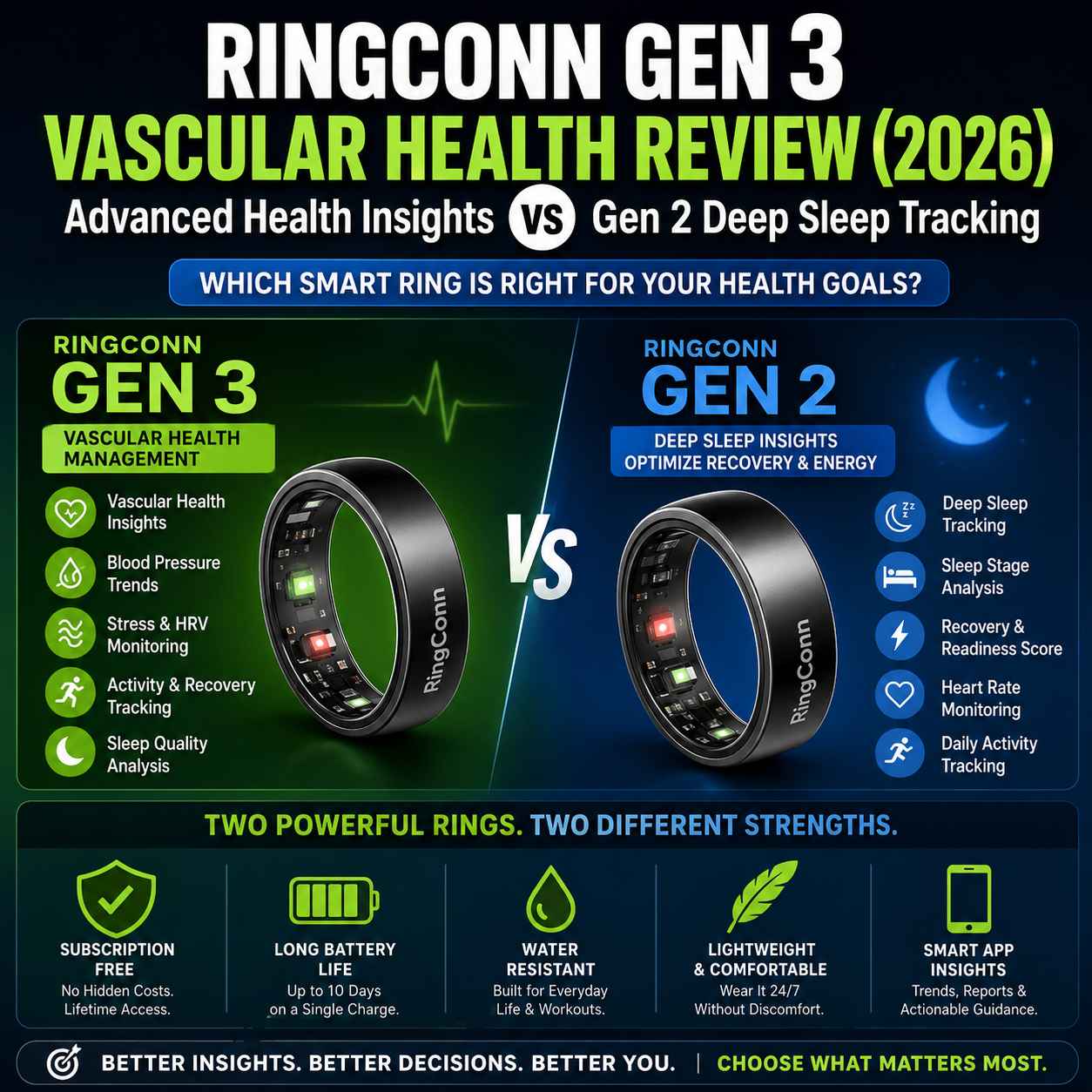
Understanding the Difference Between Gen 2 and Gen 3
At a high level, both devices share the same philosophy.
RingConn continues focusing on:
- 24/7 health monitoring
- Sleep analysis
- Recovery insights
- Activity tracking
- Comfortable form factor
- Subscription-free ownership
However, the emphasis changes considerably.
RingConn Gen 2 Focus
Gen 2 excels at:
- Deep sleep analysis
- Sleep stage tracking
- Recovery monitoring
- Readiness evaluation
- Sleep apnea monitoring support
- Long battery life
Its primary value proposition revolves around helping users improve sleep quality and recovery consistency.
RingConn Gen 3 Focus
Gen 3 extends beyond recovery.
The headline addition is vascular health monitoring and trend analysis.
Instead of asking:
"How well did I sleep?"
Gen 3 increasingly attempts to answer:
"How is my overall cardiovascular wellness trending over time?"
That broader perspective makes the device more relevant to users interested in preventive health monitoring.
While Gen 3 expands into vascular health insights, many users primarily focused on sleep optimization may find that RingConn Gen 2 still offers exceptional value, particularly for monitoring recovery patterns, sleep quality, and sleep-related breathing disruptions explored in our comprehensive guide to RingConn Gen 2 sleep apnea tracking.
Why Vascular Health Matters More Than Many Users Realize
Most people notice health issues after symptoms appear.
Wearable technology is gradually shifting toward identifying patterns before symptoms become disruptive.
Vascular health is particularly interesting because it influences:
- Cardiovascular wellness
- Recovery quality
- Stress response
- Long-term health resilience
- Physical performance
- Sleep quality itself
Understanding your health is one thing. Spotting meaningful trends before they affect your energy, recovery, or daily performance is another. If you're exploring wearable technology that goes beyond basic activity tracking, take a closer look at the latest RingConn Gen 3 features and see how its health insights fit into a long-term wellness strategy.
For professionals, creators, founders, and knowledge workers, declining health rarely arrives suddenly.
It usually appears as:
- Reduced energy
- Slower recovery
- Elevated stress
- Poor sleep quality
- Inconsistent productivity
The appeal of RingConn Gen 3 is not that it diagnoses conditions.
Its value comes from trend awareness.
The ring becomes an early-warning system that helps users notice changes in their overall health trajectory.
That distinction is important.Health tracking is useful.
Health trend recognition is often more useful.
Vascular health monitoring becomes even more valuable when viewed as part of a broader wellness ecosystem rather than a standalone metric, which is why many professionals are now building a complete personal health stack that combines sleep, recovery, stress management, and wearable-driven health awareness.
Real-World Workflow Impact
Most wearable reviews focus on features.
The more important question is what changes in daily behavior.
With RingConn Gen 2
Users typically develop workflows around:
- Sleep optimization
- Workout scheduling
- Recovery planning
- Fatigue management
The device becomes a decision-support tool.
Instead of guessing whether you are recovered, you consult the data.
This works especially well for:
- Athletes
- Remote workers
- Founders
- Frequent travelers
With RingConn Gen 3
The workflow expands.
Health monitoring becomes less reactive and more strategic.
Users begin looking for:
- Long-term patterns
- Stress accumulation
- Recovery consistency
- Cardiovascular trends
- Lifestyle impact indicators
This creates a more complete wellness dashboard.
Rather than focusing exclusively on yesterday's sleep score, users can evaluate broader health trends over weeks and months.
Onboarding Experience and Daily Use
One area where RingConn continues performing well is simplicity.
Many wearables suffer from setup fatigue.
Users spend hours configuring dashboards, notifications, permissions, integrations, and personalization settings.
RingConn remains relatively straightforward.
The onboarding process is manageable for non-technical users.
The learning curve is moderate rather than overwhelming.
This matters because health devices only create value when they become daily habits.
The ring succeeds largely because it disappears into everyday life.
There is no charging anxiety every night.
There is no smartwatch-sized distraction on the wrist.
The passive nature of the experience remains one of RingConn's strongest competitive advantages.
Comparing RingConn Against Other Smart Rings
The obvious comparison remains Oura.
Oura arguably maintains stronger brand recognition and a more mature ecosystem.
However, RingConn continues competing aggressively in two areas.
Subscription Costs
Many users underestimate the impact of recurring subscriptions.
A wearable purchased today often becomes significantly more expensive over three to five years.
RingConn's subscription-free approach remains attractive for budget-conscious buyers.
The long-term ownership cost is easier to justify.
Battery Efficiency
Battery performance remains one of RingConn's strongest operational advantages.
Less charging means:
- More consistent tracking
- Better data continuity
- Lower maintenance effort
For busy professionals, convenience often determines whether a device remains in use after six months.
Buyers still deciding between different smart ring ecosystems may benefit from exploring our detailed comparison of Circular and RingConn smart rings, where we break down differences in sleep tracking, recovery monitoring, comfort, and long-term ownership costs.
Where RingConn Gen 3 Still Has Limitations
No wearable is perfect.
Gen 3 introduces new capabilities, but several limitations remain.
Health Data Can Be Misinterpreted
More metrics do not automatically create better decisions.
Users unfamiliar with health data may overanalyze fluctuations that are completely normal.
Context remains essential.
Not a Medical Device Replacement
Health-conscious users should remember that wearable insights support awareness.
They do not replace professional medical evaluation.
This becomes especially important when discussing cardiovascular or vascular trends.
Ecosystem Depth
While RingConn continues improving, some competitors still offer:
- More advanced analytics
- Larger research communities
- Broader third-party integrations
Users heavily invested in health data ecosystems may find certain limitations.
Sustainability and Long-Term Ownership
One aspect rarely discussed in wearable reviews is sustainability.
Many devices become electronic waste after short ownership cycles.
RingConn's model is more sustainable because:
- No recurring subscription pressure
- Long battery life
- Lower maintenance burden
- Multi-year usability potential
For users attempting to build a durable personal health stack, longevity matters.
Technology should accumulate value over time rather than constantly requiring replacement.
Who Should Choose RingConn Gen 3?
Gen 3 makes the most sense for:
- Health-conscious professionals
- Founders managing stress and recovery
- Biohacking enthusiasts
- Long-term wellness planners
- Users interested in vascular health trends
The broader health perspective creates additional value beyond sleep tracking.
For women focused on long-term wellness, recovery, stress management, and sleep quality, wearable insights become significantly more useful when integrated into a structured wellness system similar to the modern wellness stack many health-conscious mothers are adopting today.
Who Should Stay with Gen 2?
Gen 2 remains highly relevant.
It is particularly attractive for:
- Sleep optimization enthusiasts
- Recovery-focused users
- Budget-conscious buyers
- First-time smart ring users
If your primary goal is improving sleep quality and recovery, Gen 2 still delivers substantial value.
FAQ Section
Is RingConn Gen 3 worth upgrading to from Gen 2?
For users interested in broader health monitoring and vascular health insights, the upgrade can be justified. Users focused primarily on sleep tracking may find Gen 2 remains sufficient.
Does RingConn Gen 3 replace medical monitoring?
No. It provides wellness insights and trend awareness but should not replace professional medical advice or diagnostic tools.
Is RingConn Gen 3 better than Oura Ring?
The answer depends on priorities. Oura offers a mature ecosystem, while RingConn remains attractive due to subscription-free ownership and strong battery performance.
Does RingConn Gen 3 track sleep?
Yes. Sleep tracking remains a core capability alongside recovery monitoring, activity tracking, and health insights.
Is RingConn Gen 2 still worth buying in 2026?
Absolutely. It remains one of the strongest options for users primarily interested in sleep quality, recovery tracking, and long battery life.
How accurate are RingConn health insights?
Wearable accuracy continues improving, but health metrics should be viewed as trend indicators rather than clinical measurements.
If you're building a long-term health stack and want meaningful insights without recurring subscription costs, the RingConn Gen 3 is worth a closer look. Review the latest features, pricing, and availability to determine whether it aligns with your health and recovery goals.
Final Verdict
RingConn Gen 3 represents a logical evolution rather than a dramatic reinvention.
The biggest change is not the hardware.
It is the shift in philosophy.
Gen 2 focused on helping users understand sleep and recovery.
Gen 3 aims to help users understand broader health patterns, particularly vascular health trends and long-term wellness indicators.
For professionals building a comprehensive personal health stack, that expansion is meaningful.
For users interested mainly in sleep optimization, Gen 2 remains an excellent and often more cost-effective choice.
If your goal is operational awareness of long-term health, Gen 3 is the more compelling device.
If your goal is simply sleeping better and recovering faster, Gen 2 still delivers outstanding value.
Disclaimer
This content is for informational purposes only and does not constitute medical advice. Always consult a qualified healthcare professional before making decisions related to your health, fertility, or treatment options.This article was created with AI-assisted research and carefully reviewed by our in-house team before publication
This article may contain affiliate links. If you choose to purchase through these links, we may earn a commission at no additional cost to you.