Bouncer Review 2026: Pricing, Features & October Deal
Bouncer Review 2026: Pricing, Features & October Deal
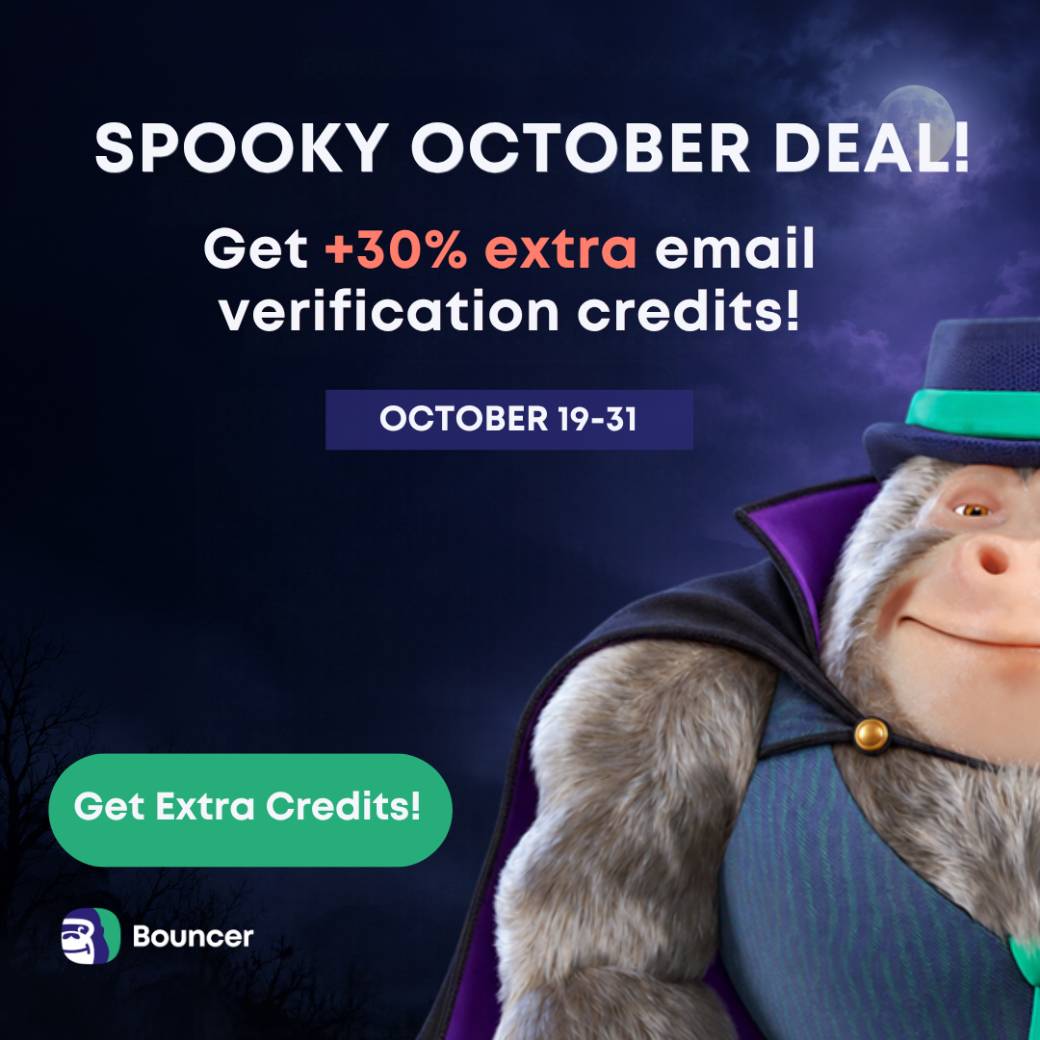
Bouncer is an email verification service that helps businesses identify invalid and potentially risky email addresses before sending campaigns. Its Pay-As-You-Go model lets customers purchase verification credits as needed, and its official pricing page lists credit packages starting at $8 for 1,000 credits. For October 19–31, 2026, Bouncer's partner-provided offer adds 30% extra credits to eligible Pay-As-You-Go purchases, with no promo code required. The bonus is additional usage credit, not a discount on the purchase price.
If you use email to generate leads, send newsletters, nurture customers or promote products, the quality of your contact list deserves attention. Invalid and outdated email addresses can create avoidable bounces and waste campaign resources.
Bouncer is an email verification platform designed to help businesses assess email addresses before sending campaigns. It offers a credit-based approach to verification, making it worth evaluating for companies that need to clean an existing list or validate addresses as part of their marketing workflow.
There is also a time-sensitive reason to consider it this October. According to information supplied by Bouncer, eligible Pay-As-You-Go purchases made between October 19 and October 31, 2026, receive 30% extra email verification credits without a promo code.
But is the offer worth acting on? That depends on your verification needs, the amount you plan to purchase and whether Bouncer fits your existing email operations.
This review covers Bouncer's pricing, its core use cases, the October offer's conditions and the practical considerations worth checking before buying.
If you're planning to clean your email list before your next campaign, explore Bouncer’s email verification options and check whether the October offer gives your business the additional credits it needs.

Bouncer at a Glance
- Product: Email verification and list hygiene
- Best suited to: Email marketers, agencies, SaaS businesses, newsletter publishers and sales teams
- Pricing model: Pay-As-You-Go verification credits, alongside other separately offered products and subscription options
- Published entry-level verification price: $8 for 1,000 credits, according to Bouncer's pricing page
- October 2026 promotion: 30% extra verification credits on eligible Pay-As-You-Go purchases
- Promotion dates: October 19–31, 2026, inclusive
- Promo code: Not required, according to the partner communication
- Credit expiry: The partner says bonus credits never expire; Bouncer's pricing page also states that purchased verification credits do not expire
- Main limitation: Email verification cannot guarantee inbox placement or replace sound sending practices
Check the official Bouncer pricing page for current prices and the Bouncer website to explore the service.
What Is Bouncer Email Verification?
Bouncer helps businesses evaluate email addresses before using them in marketing, sales or customer communication.
For example, an organisation might have thousands of contacts collected through newsletter subscriptions, lead forms, events or customer registrations. Some addresses may contain typing errors, belong to inactive mailboxes or no longer be valid.
Sending campaigns without reviewing list quality can lead to unnecessary bounces and complicate sender-reputation management.
Email verification helps identify addresses that need attention before a campaign is sent. Depending on the service and the result returned, a business can decide whether to retain, remove, suppress or investigate an address.
Bouncer offers bulk email verification and API-based verification, along with other products associated with email protection and deliverability.
The right option depends on whether you need to clean an existing database, validate new addresses during signup or manage a more continuous data-quality process.
Bouncer Pricing: What Do Verification Credits Cost?
Bouncer uses a credit-based pricing model for email verification. Its published Pay-As-You-Go pricing provides a starting point for estimating the cost of cleaning a contact list.
The following prices were listed on Bouncer's official pricing page when researched for this article.
| Verification credits | Published price | Approximate cost per 1,000 credits |
|---|---|---|
| 1,000 | $8 | $8.00 |
| 5,000 | $35 | $7.00 |
| 10,000 | $60 | $6.00 |
| 50,000 | $250 | $5.00 |
| 100,000 | $400 | $4.00 |
Prices are in USD. They are reference prices, not a guarantee of the amount you will pay at checkout. Confirm the current price, applicable taxes, currency and any other charges before purchasing.
How should you choose a credit package?
The most sensible package depends on your actual workload.
- Small mailing list: If you need to verify a few hundred or around 1,000 addresses, a smaller package may be sufficient.
- Growing business: A list containing several thousand contacts may justify comparing the 5,000- and 10,000-credit tiers.
- Agency or larger marketing team: Higher-volume packages may reduce the cost per credit, but only if you expect to use the purchased capacity.
- Ongoing verification: If new addresses arrive every day, assess whether a recurring workflow or automated verification is more practical than occasional manual purchases.
Do not buy more credits simply because the unit price looks attractive. A cheaper unused credit is still an expense.
Do Bouncer's credits expire?
Bouncer's pricing page states that email verification credits do not expire. The partner communication also confirms that the additional October promotional credits never expire.
This can be useful for businesses that verify lists periodically instead of every month. You can purchase capacity for a planned campaign without automatically committing to a recurring verification-credit subscription.
Before completing an order, check the applicable product and checkout terms to confirm that the selected credits are covered by the stated policy.
Bouncer October 2026 Deal: Get 30% Extra Credits
Bouncer's partner-provided October promotion offers additional email verification credits to eligible Pay-As-You-Go purchasers.
Offer details
| Detail | Promotion terms |
|---|---|
| Promotion period | October 19–31, 2026, inclusive |
| Bonus | 30% extra email verification credits |
| Eligible purchase | Pay-As-You-Go purchases of any amount |
| Minimum purchase specified in the offer | No additional minimum stated beyond Bouncer's normal purchase requirements |
| Promo code | Not required |
| Bonus-credit expiry | Never expires, according to the partner |
| Combining discounts | Cannot be combined with other discounts |
Important: The promotion is a credit bonus, not a 30% reduction in the price you pay.
What does 30% extra credit mean in practice?
Suppose you buy a package worth 1,000 verification credits. If the full 30% bonus is applied to that package, you receive 300 additional credits, giving you 1,300 credits in total.
The purchase price remains the same. The benefit is additional verification capacity.
Here is how the bonus works for different purchase sizes:
| Purchased credits | 30% bonus | Total credits |
|---|---|---|
| 1,000 | 300 | 1,300 |
| 5,000 | 1,500 | 6,500 |
| 10,000 | 3,000 | 13,000 |
| 50,000 | 15,000 | 65,000 |
These are illustrative calculations based on the advertised 30% bonus. Actual credit allocation and rounding, if applicable, should be confirmed at checkout.
Is the October deal worth considering?
It can be worthwhile if you already intend to verify an email list and can use the additional credits.
Consider a business planning to verify 5,000 addresses before its next newsletter campaign. If the advertised bonus is applied to a 5,000-credit purchase, the business would receive 6,500 credits rather than 5,000.
That provides capacity for additional verification without increasing the package's stated base price.
The offer is less compelling if you do not have a genuine verification need, are unsure whether Bouncer fits your workflow or would be purchasing credits simply to take advantage of a promotion.
The bonus should support a planned purchase, not create one.
Explore Bouncer: Visit the Bouncer website to review the service and check the available purchase options.
Promotion note: The October offer details in this article come from partner-supplied information. Verify the promotion's availability and terms at checkout before purchasing. No independent checkout test confirming automatic application of the bonus has been conducted for this article.Which Bouncer Features Matter to Buyers?
Bouncer's value depends on the job you need it to do. The following capabilities are particularly relevant when evaluating an email verification service.
1. Bulk email verification
Bulk verification is useful when you already have a contact list and want to assess its quality before sending a campaign.
Potential use cases include cleaning an older newsletter database, reviewing contacts collected through lead-generation activities and checking a list before a seasonal promotion.
For agencies, the same process can form part of a client's email marketing preparation.
The practical benefit is straightforward: identify addresses that may create delivery problems before using them in a campaign.
To explore the broader service beyond this October offer, see our guide to Bouncer's email verification platform.
2. API-based verification
An email verification API can support automated workflows by allowing an application to request verification programmatically.
For example, a SaaS company might evaluate new email addresses during registration instead of waiting until a later marketing campaign to identify invalid entries.
However, API access is only useful if it fits your technical requirements. Review the documentation, implementation effort, rate limits and integration costs before deciding that automated verification is necessary.
3. Email list hygiene
List hygiene involves more than running a verification report once.
Businesses should also maintain appropriate consent records, process unsubscribes, suppress hard bounces and review older contacts according to their engagement and collection history.
Bouncer can contribute to this process by helping assess email addresses. It should be considered one part of a wider list-management routine rather than a substitute for it.
4. Related email protection and deliverability products
Bouncer's wider product range includes tools associated with real-time email protection and deliverability monitoring.
These may be relevant to organisations that need more than one-off list cleaning. However, do not assume every product is included with Pay-As-You-Go verification credits.
Check each product's pricing, subscription terms, feature availability and integration requirements separately.
If your priority is preventing invalid or abusive addresses from entering signup forms, read our guide to Bouncer Shield for real-time email protection.
Who Should Consider Bouncer?
Email marketers and newsletter publishers
Bouncer may be worth evaluating if you maintain a sizeable contact list and want to assess its quality before sending campaigns.
The October credit bonus may be relevant if you have a list-cleaning task already scheduled.
Digital marketing agencies
Agencies managing email campaigns for several clients may value the ability to verify contact lists as part of campaign preparation.
Before purchasing, establish how the service fits your client workflows, data-handling policies and budget allocation.
SaaS businesses
Businesses collecting email addresses through registration forms can investigate API-based verification for relevant signup workflows.
The important question is whether verification can be integrated reliably without introducing unnecessary friction for legitimate users.
Sales and lead-generation teams
Teams using business contact databases may find verification useful when assessing list quality before outreach.
Verification is not permission to contact someone. Continue to follow applicable privacy laws, consent requirements, platform rules and responsible outreach practices.
Small businesses
Smaller organisations may benefit from a credit-based model if their verification needs are occasional.
The key is to compare the minimum purchase, expected usage and alternatives rather than assuming that a dedicated tool is automatically necessary.
What Bouncer Cannot Guarantee
An honest buying decision needs to account for the limits of email verification.
Verification is not an inbox-placement guarantee. A valid address may still send your message to spam or fail to receive it for other reasons.
A verification result can also become outdated as mailboxes change. Catch-all configurations, temporary server behaviour and other technical conditions may complicate classification.
A clean list alone cannot repair poor domain authentication, weak consent practices, irrelevant messaging or a damaged sender reputation.
Google's official email sender guidelines explain the importance of authentication, responsible sending and spam-rate monitoring.
Before relying on verification to improve campaign performance, make sure your organisation also has appropriate SPF, DKIM and DMARC configurations where applicable, valid consent practices, working unsubscribe mechanisms and a process for monitoring delivery problems.
Bouncer vs Emailable: What Should You Compare?
Bouncer and Emailable are both options worth evaluating when you need email verification.
Rather than choosing based on a promotional percentage or a single advertised accuracy figure, compare the products against the requirements of your workflow.
| Buying consideration | What to check |
|---|---|
| Cost | Total price for your expected volume, not just the entry-level package |
| Credit policy | Expiry rules, treatment of duplicate entries and uncertain results |
| Verification workflow | Bulk uploads, individual checks and API access |
| Automation | Supported integrations, implementation effort and ongoing maintenance |
| Data handling | Retention, security documentation, processing arrangements and applicable privacy obligations |
| Support | Documentation, troubleshooting and assistance available for your plan |
| Commercial fit | Whether the service solves a recurring problem or an occasional one |
For Bouncer, the October bonus may make a planned Pay-As-You-Go purchase more attractive during the offer window.
Emailable may also be worth comparing if its credit model and workflow better suit your needs. Read Kuruntha's Emailable Review: Pricing, Features & Email Verification for a more detailed look at the alternative.
This is a purchasing framework, not a controlled head-to-head accuracy test. No independent comparative test has been conducted for this article.
How to Decide Whether Bouncer Is Worth the Cost
Before buying, work through five practical questions.
1. How many addresses do you actually need to verify?
Estimate your current list size and the number of new contacts you expect to process. Avoid purchasing a larger package based solely on volume discounts.
2. How frequently will you use it?
Occasional list cleaning and continuous verification are different requirements. Your usage pattern should influence your purchasing decision.
3. Do you need automation?
If you only need to review a list before a campaign, bulk verification may be sufficient. If you need checks within an application or signup process, investigate the API and integration requirements.
4. Have you reviewed the data-handling terms?
Before uploading customer or prospect information, review the provider's security documentation, privacy terms, retention practices and any obligations relevant to your business.
5. Does the October offer change the economics?
Calculate the effective additional capacity, check the final checkout terms and decide whether you will use the credits. A genuine operational need is a stronger reason to purchase than a countdown or seasonal theme.
Frequently Asked Questions
What is Bouncer email verification?
Bouncer is a service that helps businesses assess email addresses before sending campaigns. It offers email verification through credit-based purchases and supports bulk and API-based workflows.
What is Bouncer's October 2026 deal?
According to the partner communication, Bouncer offers 30% extra email verification credits on eligible Pay-As-You-Go purchases from October 19 through October 31, 2026, inclusive. No promo code is required, and the extra credits never expire.
Is the Bouncer October offer a 30% discount?
No. It is a bonus-credit offer, not a 30% reduction in the purchase price. You pay for the selected package and receive additional verification credits if the offer applies.
How much does Bouncer email verification cost?
Bouncer's published pricing page lists Pay-As-You-Go packages starting at $8 for 1,000 credits, $35 for 5,000 credits and $60 for 10,000 credits. Check the official page for current prices before buying.
Do Bouncer email verification credits expire?
Bouncer's pricing page states that email verification credits do not expire. The October partner offer also says the bonus credits never expire. Confirm the terms for the specific product and purchase you select.
Is Bouncer suitable for small businesses?
It may be suitable for a small business that maintains a meaningful email list, needs occasional list cleaning or wants to validate new addresses. Compare the minimum purchase and expected usage with your actual requirements.
Does Bouncer guarantee better inbox placement?
No email verification service should be assumed to guarantee inbox placement. Verification can help identify invalid or risky addresses, but authentication, sender reputation, recipient engagement and responsible sending practices also matter.
Is Bouncer better than Emailable?
There is no universal winner. Compare current prices, verification classifications, credit policies, integrations, privacy terms and the workflows you need. A controlled test using representative data can provide more useful evidence than promotional claims alone.
What happens after the October 2026 offer ends?
The partner states that the promotion ends on October 31, 2026. Unless Bouncer announces an extension or another promotion, readers should not assume the 30% bonus remains available. The underlying service and its regular pricing can still be evaluated independently.
If Bouncer fits your verification needs and you've confirmed the pricing and promotional terms, review Bouncer’s available verification plans to decide whether purchasing credits before October 31, 2026, makes financial sense for your business.
Final Verdict: Should You Consider Bouncer?
Bouncer is worth evaluating if your business needs to assess email-list quality, clean existing contact databases or explore API-based verification.
Its credit-based pricing gives buyers a way to match purchases to expected verification volume, while the stated non-expiry policy can suit businesses with occasional list-cleaning needs.
The October 2026 offer adds a clear commercial incentive for customers who already intend to purchase Pay-As-You-Go credits. Thirty per cent extra capacity can be useful, but it is not a price discount and should not be mistaken for proof that the service is the best choice for every business.
My recommendation is to estimate your verification needs, compare the available tools, review the data-handling terms and confirm the final price before purchasing.
If Bouncer fits your workflow and you plan to verify a list during the promotional period, review the offer before October 31. If you have no immediate need, evaluate the service on its regular merits rather than buying credits simply because a campaign is running.
Explore Bouncer: Visit the official Bouncer website and review the current email verification pricing.
#Bouncer #EmailVerification #EmailMarketing #EmailDeliverability #MarketingAutomation #SmallBusinessMarketing #HalloweenDeals
Disclosure: This article contains affiliate links. Kuruntha Smarket may earn a commission if you purchase through qualifying links, at no additional cost to you.Our recommendations are intended to help readers assess product suitability, pricing and limitations.This article was created with AI-assisted research and carefully reviewed by our in-house team before publicationEditorial note: Promotional terms were supplied by the partner. Regular pricing was checked against Bouncer's published pricing page. Prices, availability, product features and offer terms may change; verify them before purchasing.