Circle Community Platform for Digital Businesses: Courses, Events & Community in One Place
Circle Community Platform for Digital Businesses: Courses, Events & Community in One Place
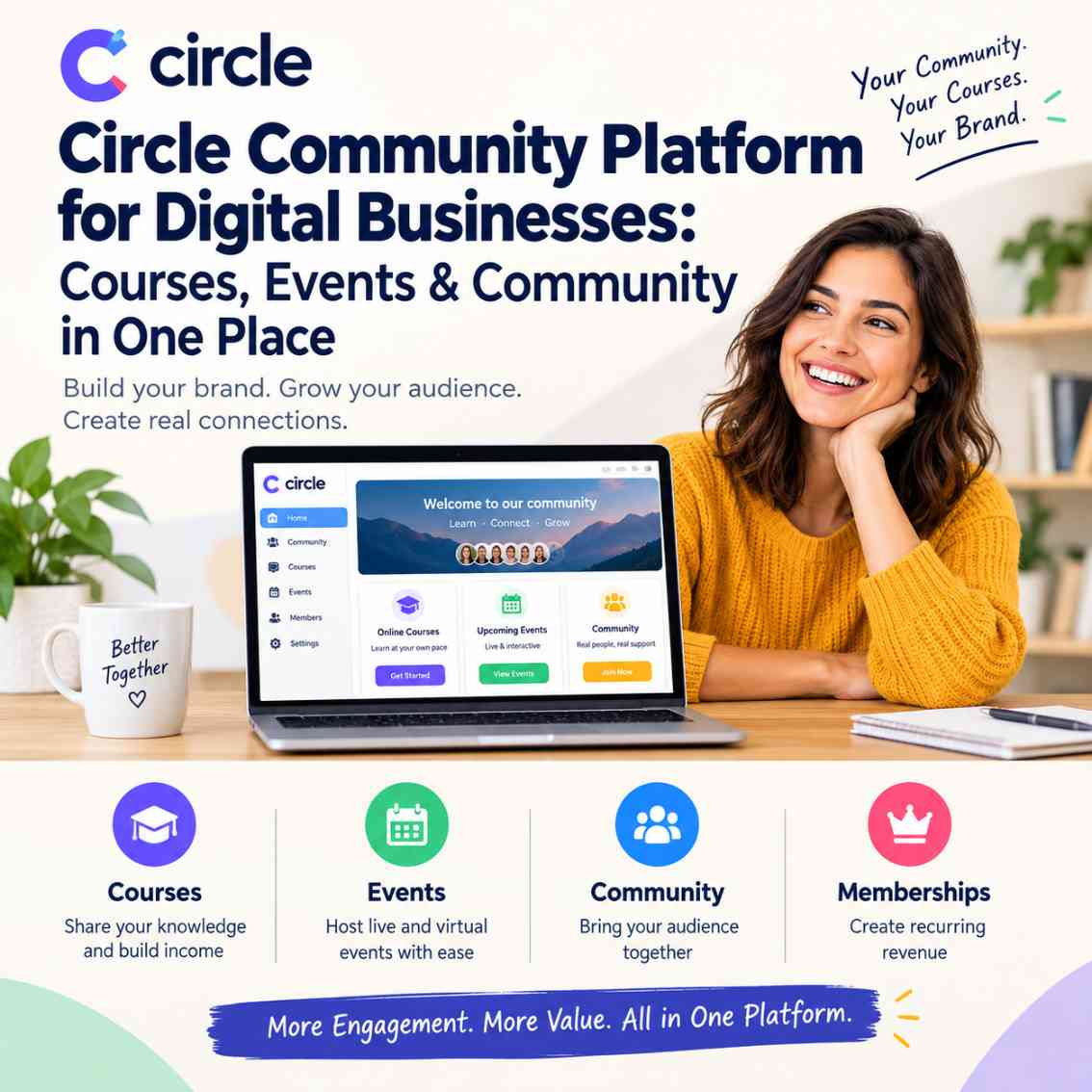
Circle is a community platform for digital businesses that brings online communities, courses, events, memberships, and audience engagement together under one branded experience. It is designed for creators, coaches, educators, and membership-based businesses that want to build and monetize an online audience without managing multiple disconnected platforms.
Building a digital business used to mean stitching together a website builder, course platform, email service, community tool, event software, checkout system and several automation tools. That approach can work, but as the business grows, so does the operational complexity.
Circle takes a different approach.
Circle is a community platform designed to bring communities, courses, events, content, memberships and business operations into a more connected environment. For creators, coaches, educators, consultants and digital entrepreneurs, the bigger question is no longer simply whether Circle can host a community. The more useful question is whether Circle can become the central platform for a digital business.
That distinction matters.
If you are looking for a platform where your audience can learn, participate, attend events, access premium content and become paying members without constantly moving between different systems, Circle deserves serious consideration.
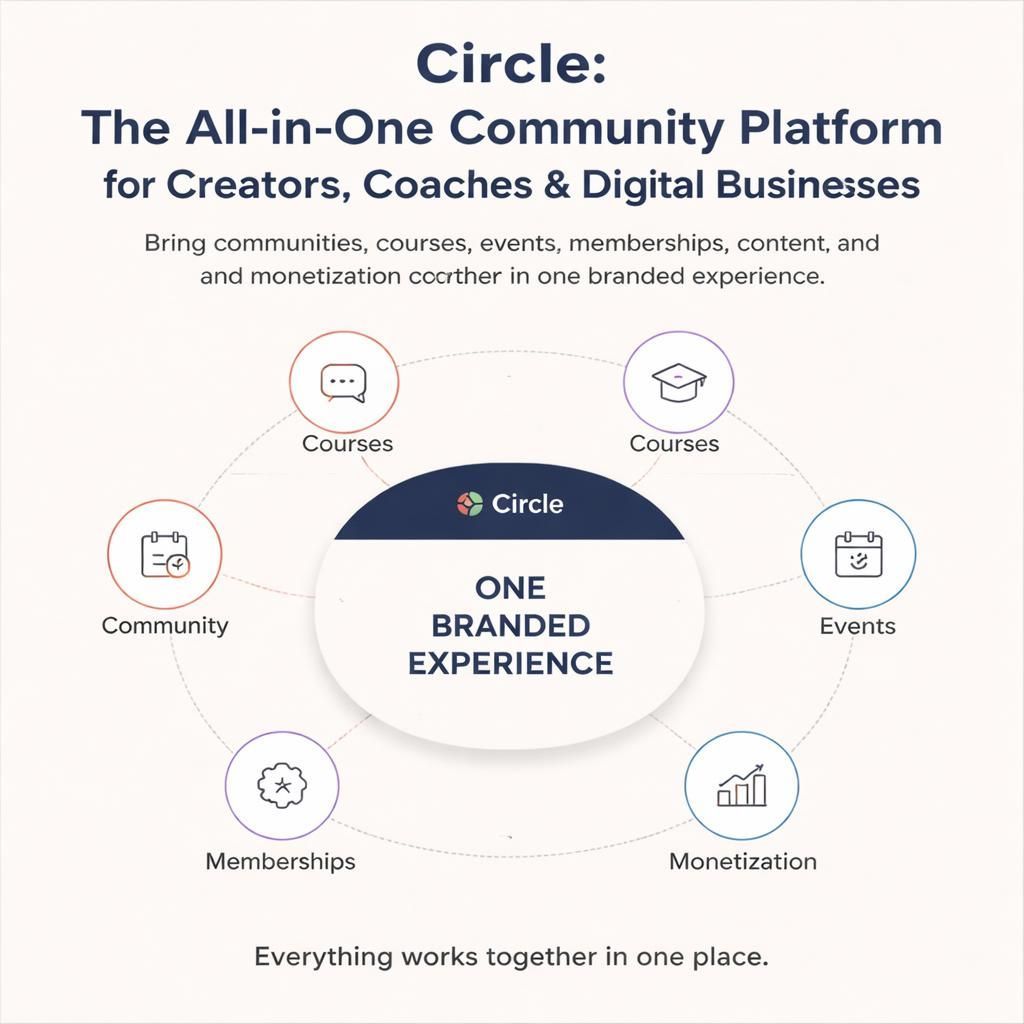
Quick answer: Circle is an all-in-one community platform for creators, educators, coaches and digital businesses that want to combine online communities, courses, events, memberships, content and monetization under one branded experience. Its strongest advantage is the way these functions work together rather than existing as completely separate tools.
See What Circle Could Do for Your Business
If you're tired of piecing together separate tools for your community, courses and events, it may be worth seeing how Circle brings those experiences together. Explore Circle and start the 14-day trial to build a private space for your audience and see whether it fits the way you want to run your digital business.
Why Digital Businesses Are Moving Beyond Fragmented Tools
The problem with using several specialized platforms is not necessarily that any individual tool is bad.
The problem is what happens between them.
A typical digital business might use:
- One platform for its website
- Another for online courses
- Another for community discussions
- Another for email marketing
- Another for webinars and events
- Another for checkout
- Another for memberships
- Additional automation software to connect everything
At first, that looks flexible.Over time, it becomes expensive and difficult to manage.
Customers may have multiple logins. Data can become fragmented. Automations need maintenance. Branding can feel inconsistent. And every additional integration creates another point where something can break.
This is where an all-in-one platform becomes attractive.
The objective is not to use fewer tools simply for the sake of using fewer tools. The objective is to create a simpler customer journey and a more manageable business operation.
That is where Circle stands out.
What Is Circle?
Circle is a digital community platform that brings together the infrastructure needed to build and monetize an online community.
Depending on the business model, creators can use Circle for:
- Online communities
- Courses
- Memberships
- Events
- Live sessions
- Discussions
- Content
- Websites
- Paid subscriptions
- Audience management
- Email communication
- Automation
- Community engagement
- AI-assisted business operations
The important point is that these aren't necessarily isolated products.
Circle is designed around the idea that a digital business can bring its audience, content and monetization model into one connected environment.
That makes it particularly interesting for businesses that have already moved beyond simply selling individual digital products.
If you want to look beyond the platform's headline features, our Circle Community Platform Review 2026 breaks down its pricing, core features, strengths, limitations, and overall value before you make a buying decision.
Circle for Digital Businesses: What Can You Actually Build?
Circle can make sense for several types of digital businesses.
1. Online Course Businesses
A traditional course platform often focuses primarily on delivering lessons.
Circle adds another dimension: the community around the learning experience.
Instead of selling a course and leaving students alone with a video library, you can create an environment where learners can:
- Discuss lessons
- Ask questions
- Attend live sessions
- Participate in events
- Connect with other students
- Access additional content
- Join challenges
- Continue participating after completing the course
That can be valuable for course creators who want to build recurring relationships rather than relying entirely on one-time course sales.
2. Paid Membership Communities
Circle is particularly relevant when the community itself is the product.
For example, a creator could offer:
- A professional membership
- Business networking
- Coaching communities
- Educational memberships
- Industry-specific communities
- Personal development groups
- Premium learning communities
Instead of treating community as an add-on, the community becomes the core customer experience.
3. Coaching Businesses
Coaches often begin with one-to-one sessions.
That model can work well, but it has a natural capacity limit.
A coaching business can use a platform such as Circle to expand beyond individual sessions by combining:
- Group coaching
- Courses
- Community discussions
- Live Q&As
- Events
- Exclusive resources
- Memberships
This gives a coach more ways to package expertise without making every dollar of revenue dependent on another one-hour appointment.
4. Creator Businesses
Creators increasingly need more than an audience on social media.
Social platforms are excellent for discovery, but they do not necessarily give creators the same level of control over their customer experience.
Circle allows creators to build a more owned environment where the audience can move from:
content → community → course → event → membership → recurring relationship
That is a much more valuable business journey than relying exclusively on social-media reach.
Circle Courses and Community: A Strong Combination
One of Circle's most compelling use cases is combining courses and community.
A course can provide structured knowledge.
A community can provide accountability, discussion and relationships.
Put them together and the experience can become considerably more engaging.
For example, imagine a six-week business course.
Instead of:
Week 1 video → Week 2 video → Week 3 video → finish
the experience can become:
Lesson → discussion → live session → peer interaction → assignment → feedback → next lesson
That creates more opportunities for members to participate.
For premium education businesses, that difference can matter.
The platform itself does not magically create engagement. The creator still needs a good curriculum, useful discussions and a reason for members to return. But having these functions in one environment makes the experience easier to structure.
Circle Events Can Turn Content Into Experiences
Events are another important part of the Circle model.
Digital businesses can use events for:
- Webinars
- Workshops
- Live Q&As
- Course launches
- Coaching sessions
- Community meetups
- Expert sessions
- Member-only events
- Cohort activities
This matters because recurring events can give members a reason to return.
A static content library can eventually become something customers visit less frequently.
A living community with regular events gives people a reason to come back.
That can support retention.
Can Circle Replace Multiple Business Tools?
Sometimes.
But don't buy an all-in-one platform simply because the word “all-in-one” sounds attractive.
The correct question is:
How many separate systems does my business actually need?
For a creator running a paid community, course, events and memberships, Circle may consolidate a significant portion of the technology stack.
For a business that requires highly specialized ecommerce, advanced CRM functionality or unusual workflows, additional software may still be necessary.
Circle is strongest when your business revolves around people, content, learning, community and recurring engagement.
It is not automatically the best choice for every digital business.
That distinction is important.
Circle Pricing in 2026
Circle's current public pricing makes it a serious business software investment rather than a lightweight free community tool.
The publicly listed plans include:
Professional — $89/month
The Professional plan includes core capabilities such as:
- Unlimited members
- Courses
- Discussions
- Events
- Website builder
- Live streams
- Live rooms
- Custom branding
- Analytics
- Member directory
- Paid memberships
- Gamification
- Custom domain
- Circle AI
Business — $199/month
Business adds capabilities aimed at growing communities and more advanced operations, including:
- Workflows
- Custom profile fields
- Circle MCP
- Headless Member API
- Admin API
- Branded email notifications
- Content co-pilot
- Automated transcriptions
- Activity scores
- Additional migration capabilities
- Removal of Circle branding
Circle also offers a higher-tier Circle Plus option with custom pricing for businesses requiring more advanced AI, SSO, higher limits, lower transaction fees and additional enterprise-style capabilities.
A 14-day free trial is available on the public plans.
The important takeaway: don't evaluate Circle only by its monthly subscription.
Evaluate the cost against the tools you might otherwise need for community, courses, events, memberships, website infrastructure and related operations.
That is where the real value calculation begins.
Is Circle Worth It for Digital Businesses?
For the right business, yes.
But “right business” is the important part.
Circle becomes more compelling when your revenue depends on:
- Recurring memberships
- Courses
- Community participation
- Coaching
- Events
- Paid content
- Customer retention
- Audience relationships
Suppose a creator currently pays separately for a course platform, community software, event solution, website tools and several integrations.
The headline subscription price of Circle may initially look high.
But the smarter calculation is:
Circle cost vs. total technology cost + maintenance + integration complexity + customer friction.
That is the comparison that serious buyers should make.
Who Should Consider Circle?
Circle is particularly worth considering if you are:
A course creator
Especially if you want the course to become part of a broader community rather than remaining a standalone video library.
A coach
Circle can support a transition from purely one-to-one coaching toward group programs, courses and memberships.
A consultant
Consultants can use community-based models to package expertise into recurring programs and professional networks.
A membership business
If recurring community access is central to your revenue model, Circle deserves a closer look.
A creator building a premium brand
Circle's branding and customization options can help create a more controlled customer experience than relying entirely on third-party social platforms.
A digital entrepreneur tired of tool overload
If your current business involves too many disconnected subscriptions and integrations, consolidating selected functions could reduce operational friction.
Who Should Probably Look Elsewhere?
Circle isn't automatically the right platform for everyone.
You may want another solution if:
- You only sell simple downloadable products
- You need a very inexpensive starting point
- Community isn't important to your business
- You primarily need advanced ecommerce
- You need highly specialized enterprise CRM functionality
- You don't expect recurring customer engagement
- Your business model does not justify an all-in-one platform
A creator selling occasional PDFs probably doesn't need Circle.
A creator building a paid community around courses, coaching and recurring memberships is a very different story.
Circle vs. a Fragmented Creator Stack
This is where Circle's proposition becomes more interesting.
Consider two approaches.
Approach A: Separate Tools
Website + course platform + community + events + email + payments + automation.
Advantages:
- Maximum specialization
- Ability to choose best-of-breed tools
- Easier to replace individual components
Disadvantages:
- More subscriptions
- More integrations
- More administration
- More potential points of failure
- Potentially fragmented customer experience
Approach B: Circle-Centered Stack
Community + courses + events + website + memberships + content + selected business functions.
Advantages:
- More centralized experience
- Fewer systems to manage
- Better connection between community and content
- Easier member journey
- Stronger branded environment
Disadvantages:
- Higher platform commitment
- You may pay for features you don't use
- Specialized tools may still be necessary
- Switching platforms later can require migration work
There is no universal winner.
But if community is at the center of your business, the second approach becomes considerably more attractive.
Circle AI and the Next Stage of Community Businesses
Circle's 2026 direction is particularly interesting because the platform is moving beyond conventional community software.
Its newer AI capabilities are designed around helping creators build, operate and grow community businesses.
That could include areas such as:
- Community creation
- Content support
- Member engagement
- Workflows
- Analysis
- Onboarding
- Communication
- Business operations
This is an important shift.AI isn't particularly valuable simply because a platform has an AI button.
The better question is whether AI can remove repetitive operational work while allowing the business owner to spend more time on customers, content and growth.
Circle is clearly moving in that direction.
The Real Business Advantage: Customer Experience
Technology buyers often focus too much on feature lists.
Customers don't care how many integrations your business has.
They care whether the experience works.
A member doesn't want to think:
“Which platform do I log into for this course?”
or:
“Where is the event link?”
or:
“Which subscription gives me access to this community?”
A connected experience reduces those questions.
That can create a cleaner customer journey from the first interaction to long-term membership.
And better customer experience can support retention, referrals and recurring revenue.
How Circle Fits Into a Modern Creator Business Stack
Circle shouldn't necessarily be viewed in isolation.
It can become one part of a broader digital-business infrastructure.
For a deeper look at how creators can structure their technology ecosystem, see our Creator Business Stack 2026 guide.
That broader strategy is important because no single platform solves every business problem.
Circle can potentially become the central community and customer-experience layer while specialized tools continue handling other functions where necessary.
The objective should be a smart stack, not simply a large stack.
If you're deciding whether Circle should become the center of your technology stack, it helps to first understand how the wider creator business stack fits together—from courses and memberships to payments, marketing, and automation.
Circle vs. Other Digital Business Platforms
Circle isn't the only platform available to creators.
Depending on your priorities, you may also encounter:
- Podia
- LearnWorlds
- Thinkific
- Kajabi
- Payhip
- ThriveCart
- Other community and membership platforms
The right choice depends on the business model.
For example, a creator primarily selling downloadable products may prefer a simpler digital-commerce platform.
An education business may prioritize sophisticated learning features.
A sales-focused business may prioritize checkout and funnel optimization.
A community-led business may put member engagement first.
That is why comparing platforms by feature count alone is a mistake.
If your priority is primarily structured online education rather than community-led growth, compare the alternatives first—our LearnWorlds vs Gumroad comparison looks at the different approaches to courses, digital products, memberships, and creator growth.
What Should You Check Before Buying Circle?
Before starting a paid plan, ask these questions:
1. Is community central to my business?
If the answer is no, Circle may be unnecessary.
2. Will I sell courses or structured learning?
If yes, Circle's course-community combination becomes more relevant.
3. Do I need recurring memberships?
If recurring revenue is part of your strategy, evaluate Circle's membership and payment capabilities carefully.
4. How many tools am I currently paying for?
Add the actual monthly costs.
Don't guess.
5. How much integration work am I doing?
Your time has a cost.
6. Does my brand need its own digital home?
If you want to move customers away from rented social platforms into a more controlled environment, Circle becomes more attractive.
7. Am I building for the next 12 months or the next five years?
A cheap tool can become expensive if you outgrow it quickly.
Our Verdict: Is Circle a Good Platform for Digital Businesses?
Circle is one of the more compelling options for digital businesses where community, courses, events and recurring customer relationships are central to the business model.
Its biggest strength isn't any single feature.
It is the way several important parts of a digital business can operate together.
That makes Circle particularly interesting for:
- Course creators
- Coaches
- Consultants
- Membership businesses
- Professional communities
- Knowledge businesses
- Creators building premium brands
However, Circle isn't the cheapest or simplest answer for every creator.
If you only need a basic storefront, there are simpler options.
If you need a highly specialized ecommerce or enterprise system, you may need additional software.
But if your vision is to build a branded digital home where people can learn, connect, participate, attend events and pay for ongoing access, Circle is a platform worth evaluating seriously.
Ready to see whether Circle fits your business?
The best next step isn't blindly buying another subscription.
Start by comparing your current technology stack, calculate what you are already spending on separate tools, and then see whether Circle can consolidate enough of that infrastructure to justify the investment.
If the numbers and business model make sense, take advantage of Circle's free trial and test the actual member experience before committing.
Frequently Asked Questions About Circle
What is Circle community platform?
Circle is an online community and digital-business platform that combines community discussions, courses, events, memberships, content, website capabilities and monetization features in one environment.
Is Circle good for digital businesses?
Circle can be a strong option for digital businesses built around communities, courses, coaching, memberships, events and recurring customer relationships. It is less compelling for businesses that only need basic digital-product checkout or simple file delivery.
Can you sell courses on Circle?
Yes. Circle supports online courses and allows creators to combine course content with community discussions, events and other member experiences.
Can Circle be used for paid memberships?
Yes. Circle supports paid memberships and subscriptions, making it suitable for businesses that want recurring revenue from community access, courses or premium content.
Can Circle host events?
Yes. Events and live experiences are part of Circle's platform, allowing businesses to integrate events into their broader community and content strategy.
Is Circle an all-in-one platform?
Circle is positioned as an all-in-one platform for community businesses, bringing together functions such as community, courses, events, website capabilities, memberships, payments, content and AI-assisted operations.
How much does Circle cost in 2026?
Circle's publicly listed Professional plan is $89 per month and its Business plan is $199 per month. Higher-tier Circle Plus pricing is customized. Circle also offers a 14-day trial on its public plans.
Is Circle worth the money?
Circle can be worth the investment when a business would otherwise pay for several separate tools covering community, courses, events, memberships and related functions. The value depends on how many of those capabilities you actually need and how much operational complexity Circle can remove.
Who is Circle best for?
Circle is particularly suited to creators, coaches, educators, consultants, membership businesses and professional communities that want to combine content, learning and community engagement under one brand.
Is Circle better than using several separate tools?
That depends on your priorities. Separate tools provide flexibility and specialization, while Circle's advantage is consolidation. Businesses should compare the total cost, integration workload, customer experience and scalability rather than comparing subscription prices alone.
Does Circle replace a website?
Circle includes website-building capabilities, but whether it should replace your existing website depends on your branding, SEO, ecommerce and technical requirements.
Can Circle help build recurring revenue?
Yes. Memberships, subscriptions, courses, paid content and events can form part of a recurring-revenue strategy. However, the platform itself does not guarantee revenue; the offer, audience, pricing and retention strategy still determine business performance.
Ready to Build Your Digital Business Around One Platform?
If Circle's combination of community, courses, events and memberships matches the way you want to grow, now is a good time to put it to the test. Start your Circle trial and experience the platform for yourself before deciding whether it deserves a place at the center of your digital business.
Final Takeaway
The biggest change happening in digital businesses is not simply the arrival of another community platform.
It is the move from selling isolated products to building connected customer ecosystems.
Courses can lead to communities.
Communities can lead to memberships.
Events can increase engagement.
Memberships can create recurring revenue.
And a strong digital platform can bring those experiences together.
That is the case for Circle.
If your business is ready to move beyond scattered tools and build a more connected home for your audience, Circle is worth putting on your shortlist.
For a detailed breakdown of its features, pricing, strengths, limitations and overall value, continue with our Circle Community Platform Review 2026 before making your final purchasing decision.
Disclosure: Some links in this article may be affiliate links. If you purchase through an eligible link, Kuruntha Smarket may earn a commission at no additional cost to you. Our recommendations are based on product research and business-use considerations. This article was created with AI-assisted research and carefully reviewed by our in-house team before publication
#Circle #CircleCommunity #CirclePlatform #DigitalBusiness #CreatorBusiness #OnlineCommunity #CommunityPlatform #OnlineCourses #MembershipBusiness #CreatorEconomy #DigitalCreators #CourseCreators #CommunityLedBusiness #OnlineBusinessTools #SaaSTools