EOR vs Independent Contractor: How to Stay Compliant When Hiring Globally (2026 Guide)
EOR vs Independent Contractor: How to Stay Compliant When Hiring Globally (2026 Guide)
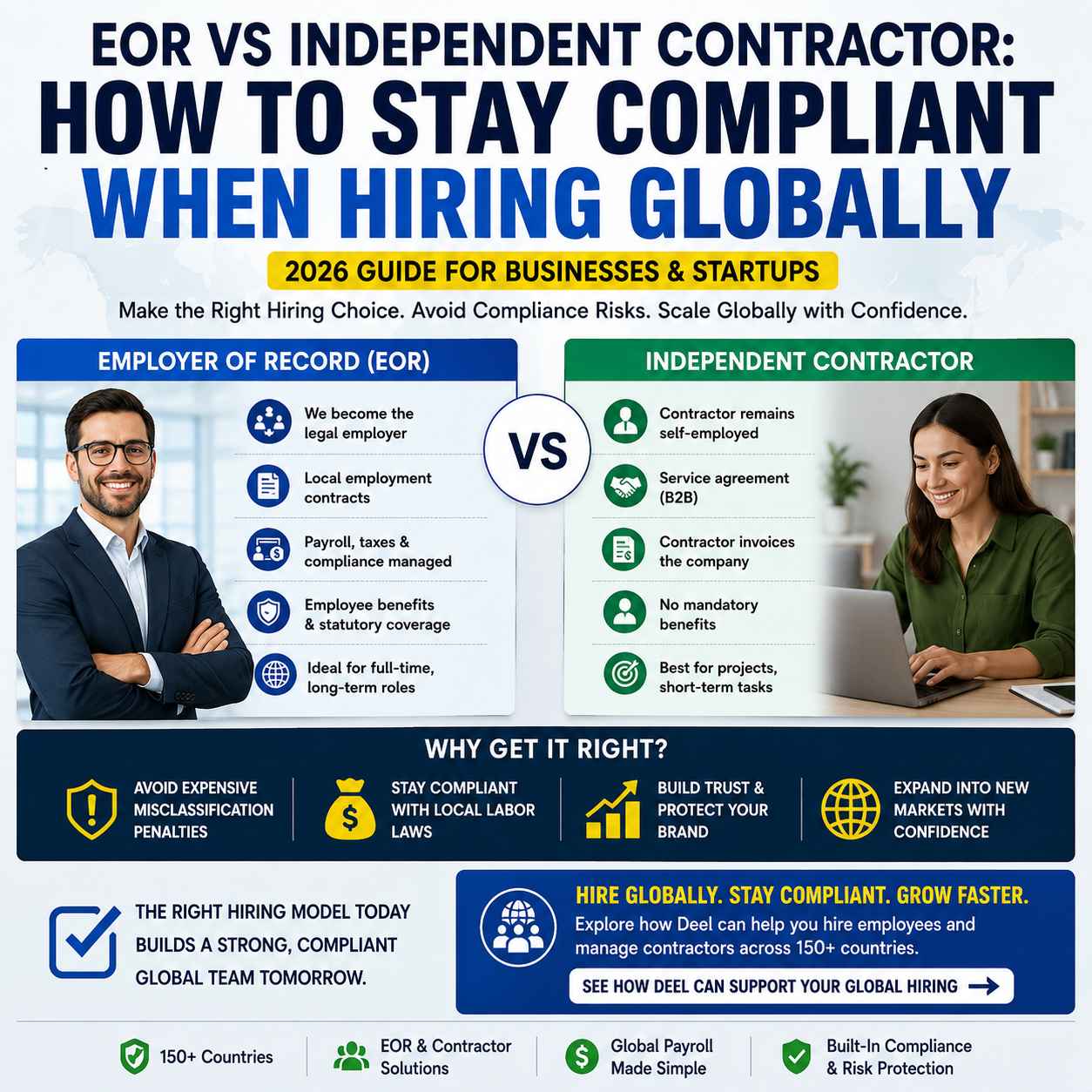
Choosing between an Employer of Record (EOR) and an independent contractor is one of the most important decisions when hiring internationally. An EOR legally employs workers on your behalf and manages payroll, taxes, benefits, and local compliance, while independent contractors operate as self-employed professionals responsible for their own taxes and business obligations. Selecting the right model helps businesses reduce compliance risks, avoid worker misclassification penalties, and expand globally with greater confidence.
Global hiring has transformed how businesses find talent. A software startup in India can hire a designer in Canada, a healthcare company in Australia can recruit specialists from Europe, and a growing eCommerce business in the United States can build a customer support team across Asia—all without opening physical offices.
While technology has made international hiring easier than ever, compliance has become significantly more complex.
One of the first and most critical decisions every business must make is whether to engage someone as an independent contractor or hire them through an Employer of Record (EOR). Although both options allow businesses to access global talent, they carry very different legal, tax, payroll, and employment responsibilities.
Choosing the wrong model isn't just an administrative mistake—it can lead to financial penalties, back taxes, employment disputes, and reputational damage. Worker classification rules continue to evolve across many jurisdictions, making it essential for employers to understand the legal implications before expanding internationally.
This guide explains the key differences between an Employer of Record and an independent contractor, highlights the compliance risks associated with each approach, and provides practical guidance to help you determine which model best suits your hiring needs in 2026.
Planning to hire talent across borders? The right hiring model can help you avoid costly compliance mistakes before they happen. If you're exploring a simpler way to hire employees or manage international contractors, take a look at how Deel supports global hiring, payroll, and compliance across multiple countries.
Why Global Worker Classification Matters More Than Ever
Remote work has permanently changed the hiring landscape. Businesses are no longer limited by geography, allowing them to recruit highly skilled professionals from around the world.
However, every country has its own employment laws governing:
- Worker classification
- Income tax obligations
- Social security contributions
- Employee benefits
- Paid leave requirements
- Employment contracts
- Termination procedures
- Payroll reporting
Misunderstanding these obligations can expose businesses to significant compliance risks.
For example, if a company treats someone as an independent contractor when local law considers them an employee, authorities may require the business to pay unpaid payroll taxes, social security contributions, statutory benefits, and penalties. In some cases, organizations may also face legal disputes over wrongful termination or unpaid employment entitlements.
As governments continue strengthening enforcement around worker classification, understanding the correct hiring model has become a core part of responsible global expansion.
What Is an Employer of Record (EOR)?
An Employer of Record (EOR) is a company that legally employs workers on behalf of another business in a country where that business may not have a local legal entity.
Instead of establishing a subsidiary or branch office, companies partner with an EOR to hire employees while remaining compliant with local employment regulations.The EOR becomes the worker's legal employer for administrative and legal purposes, while your business continues to manage the employee's day-to-day responsibilities, performance, and business objectives.
Typically, an Employer of Record handles:
- Employment contracts aligned with local laws
- Payroll processing
- Income tax withholding
- Social security contributions
- Mandatory employee benefits
- Leave administration
- Local labor law compliance
- Employment documentation
- Offboarding and statutory termination requirements
This arrangement enables organizations to enter new markets more quickly while reducing the administrative burden associated with international employment.
New to Employer of Record services? Our in-depth Deel Review for Remote Teams explains how global payroll, contractor management, and EOR services work in real business scenarios, helping you decide whether it's the right fit for your organization.
Common situations where an EOR makes sense
An Employer of Record is often suitable when a business wants to:
- Expand into a new country without establishing a local entity.
- Hire full-time employees overseas.
- Test a new market before making long-term investments.
- Ensure compliance with local employment laws.
- Reduce administrative complexity related to payroll and statutory benefits.
For many growing companies, this approach provides a practical way to access international talent while minimizing compliance risks.
What Is an Independent Contractor?
An independent contractor is a self-employed individual or business that provides services under a commercial agreement rather than an employment relationship.
Unlike employees, independent contractors generally:
- Control how they perform their work.
- Use their own equipment and tools.
- Manage their own taxes and business expenses.
- Work with multiple clients.
- Invoice businesses for completed services.
- Do not receive statutory employee benefits in most jurisdictions.
Independent contractors are commonly engaged for specialized expertise, project-based work, consulting assignments, creative services, software development, marketing campaigns, and other short-term engagements.
This model offers businesses flexibility, especially when they require specialized skills for defined projects rather than ongoing employment.
However, simply calling someone a contractor does not automatically make the relationship legally compliant. Authorities typically assess the actual working relationship by considering factors such as the level of control, financial independence, exclusivity, and the nature of the work performed.
If the practical realities resemble an employment relationship, regulators may determine that the individual should have been classified as an employee regardless of the contract's wording.
Employer of Record vs Independent Contractor: Understanding the Fundamental Difference
At first glance, both models allow companies to hire talent across borders. The key distinction lies in the legal relationship between the worker and the business.
With an Employer of Record, the worker is employed through a legally compliant employment arrangement managed by the EOR, while your company directs the employee's daily work.
With an independent contractor, the relationship is based on a business-to-business service agreement, where the contractor operates independently and remains responsible for their own tax and legal obligations.
Before choosing either approach, consider the following questions:
- Is the role expected to be permanent or project-based?
- Will the worker follow company-defined schedules and policies?
- Does the country require statutory employee benefits for this type of work?
- Will the worker primarily serve your business or multiple clients?
- Are you prepared to establish a local legal entity if required?
Answering these questions early can help reduce compliance risks and support a smoother international hiring strategy.
Still evaluating different Employer of Record providers? Compare Deel and Remote side by side to understand their differences in compliance, payroll, contractor management, pricing, and international hiring support before making your decision.
Employer of Record (EOR) vs Independent Contractor: A Detailed Comparison
Selecting the right hiring model is not simply about reducing costs—it is about building a compliant, scalable, and sustainable global workforce. While both an Employer of Record (EOR) and an independent contractor can help you access international talent, each serves a different business purpose.
The following comparison highlights the most important differences that business owners, HR leaders, finance teams, and startups should understand before hiring internationally.
| Feature | Employer of Record (EOR) | Independent Contractor |
|---|---|---|
| Legal Employer | EOR becomes the legal employer | Contractor remains self-employed |
| Employment Relationship | Employee | Business-to-business agreement |
| Payroll | Managed by the EOR | Contractor invoices the company |
| Tax Withholding | Managed by the EOR | Contractor is generally responsible for their own taxes, subject to local laws |
| Employee Benefits | Managed according to local legal requirements | Typically not provided unless agreed contractually |
| Compliance Responsibility | Largely managed through the EOR's services | Company must ensure the engagement is correctly classified under applicable laws |
| Employment Contract | Local employment agreement | Service agreement or contractor contract |
| Long-term Employment | Well suited | May increase misclassification risk depending on the circumstances |
| Best For | Full-time international employees | Freelancers, consultants, project-based specialists |
| Business Risk | Generally lower when implemented correctly | Can be higher if the relationship resembles employment |
Key takeaway: If you intend to hire someone as a long-term member of your team, direct their daily work, require fixed working hours, and integrate them into your organization, an EOR is often the more appropriate solution.
If you need specialized expertise for a defined project with limited supervision, an independent contractor may be suitable, provided local legal requirements are met.
When Should You Choose an Employer of Record?
An Employer of Record is particularly valuable for businesses expanding internationally without establishing a legal entity in every country.
Consider using an EOR if your organization plans to:
1. Hire Full-Time Employees Abroad
Suppose a software company based in India wants to recruit sales professionals in Germany, Canada, and Australia. Rather than creating subsidiaries in each country, the company can work with an EOR to hire employees compliantly while focusing on business growth.
2. Expand Into New Markets Quickly
Setting up a local entity may take months and involve significant legal, accounting, and administrative costs. An EOR can simplify the hiring process and reduce the operational burden associated with international expansion.
3. Navigate Complex Employment Laws
Employment regulations vary widely between countries. An EOR helps manage employment contracts, payroll administration, statutory benefits, and compliance with local labor laws, reducing administrative complexity for the hiring company.
4. Support Long-Term Business Growth
If you expect team members to remain with your company for years and become integral to your operations, an employment relationship managed through an EOR is often more appropriate than a contractor arrangement.
When Is Hiring an Independent Contractor the Better Choice?
Independent contractors remain an excellent option for many business scenarios.
You may consider hiring a contractor when:
- You need a specialist for a defined project.
- The work has a clear start and end date.
- The professional serves multiple clients.
- The contractor controls how and when the work is completed.
- The engagement does not resemble a traditional employment relationship.
Examples include:
- Graphic designers
- Copywriters
- Digital marketing consultants
- Cybersecurity specialists
- Software consultants
- Video editors
- SEO professionals
- Business consultants
This approach provides flexibility while allowing businesses to access specialized expertise without committing to a permanent employment relationship.
Understanding Worker Misclassification
One of the biggest compliance risks facing global employers is worker misclassification.
Misclassification occurs when a business engages someone as an independent contractor even though, under applicable law, the working relationship is effectively that of an employee.
Regulators typically look beyond the contract itself. Instead, they examine how the relationship functions in practice.Common factors considered include:
- Who controls the individual's work?
- Who determines working hours?
- Is the worker economically dependent on one company?
- Does the worker use company equipment?
- Can the worker freely work for other clients?
- Is the engagement ongoing rather than project-based?
- Is the worker integrated into the company's daily operations?
If most answers indicate an employment relationship, authorities may determine that the worker has been misclassified.
What Can Misclassification Cost a Business?
The financial consequences can be substantial.
Depending on the jurisdiction, organizations may become responsible for:
- Back payroll taxes
- Social security contributions
- Interest on unpaid amounts
- Employment-related penalties
- Statutory employee benefits
- Paid leave entitlements
- Overtime obligations where applicable
- Severance or termination-related liabilities
- Legal expenses associated with disputes
Beyond financial costs, businesses may also experience:
- Delayed expansion plans
- Increased regulatory scrutiny
- Reputational damage
- Reduced employee trust
- Operational disruption
These risks underscore the importance of evaluating worker classification carefully before hiring internationally.
Compliance Checklist for Hiring International Workers
Before deciding whether to hire through an Employer of Record or engage an independent contractor, review the following checklist.
✔ Define the Nature of the Role
Ask yourself:
- Is the work ongoing?
- Is the position central to your business?
- Will the individual function like an employee?
If the answer is yes, an employment model may be more appropriate.
✔ Understand Local Employment Laws
Employment regulations differ from country to country.
Research:
- Worker classification rules
- Mandatory employee benefits
- Minimum wage requirements
- Working time regulations
- Paid leave obligations
- Termination procedures
When hiring in unfamiliar jurisdictions, obtaining local legal guidance or working with an experienced EOR can help reduce compliance risks.
✔ Review Tax Responsibilities
Consider:
- Income tax withholding obligations
- Social security contributions
- Employer payroll taxes
- Reporting requirements
- Local tax registration rules
Tax obligations vary by jurisdiction and should be confirmed before hiring.
✔ Prepare Appropriate Agreements
Ensure you have documentation that reflects the intended relationship.
Examples include:
- Employment agreements
- Contractor service agreements
- Confidentiality agreements
- Intellectual property provisions
- Data protection clauses
Contracts should align with applicable local laws.
✔ Protect Intellectual Property
For software development, product design, healthcare innovation, and creative work, clarify:
- Ownership of work products
- Copyright assignments
- Patent rights where relevant
- Confidential business information
- Trade secret protection
Clear contractual terms can help avoid disputes later.
✔ Maintain Accurate Records
Keep documentation relating to:
- Contracts
- Invoices
- Payroll records
- Tax documentation
- Time records where applicable
- Compliance documentation
Good recordkeeping supports compliance and simplifies audits.
✔ Review Classification Regularly
Business relationships evolve.
Someone hired as a contractor for a short-term project may gradually take on responsibilities similar to those of an employee.
Review worker classifications periodically, especially when:
- Projects become permanent
- Working hours increase
- Exclusivity develops
- Management responsibilities expand
Regular reviews can help identify potential compliance issues before they become larger problems.
Practical Examples
Understanding the theory is useful, but real-world scenarios make the decision much clearer.
Example 1: A SaaS Startup Expanding into Europe
A growing software company based in Singapore wants to hire three full-time Customer Success Managers in France.
The employees will:
- Work full time
- Report to the company's management
- Receive regular performance reviews
- Represent the company's brand
- Work indefinitely
Recommended approach: An Employer of Record is generally the more appropriate solution because the roles resemble standard employment and involve ongoing operational responsibilities.
Example 2: Hiring a Freelance UX Designer
An eCommerce business needs a UX designer to redesign its website over a three-month period.
The designer:
- Works with several clients
- Uses their own software and equipment
- Sets their own schedule
- Delivers agreed project milestones
Recommended approach: An independent contractor arrangement is typically appropriate because the engagement is project-based and the designer operates independently.
Example 3: Testing a New Market
A healthcare technology company wants to assess demand in Australia before establishing a local subsidiary.
Rather than incorporating immediately, it hires a Business Development Manager through an Employer of Record.
This allows the company to:
- Enter the market more quickly
- Employ the worker under local employment requirements
- Evaluate market opportunities before making a larger investment
If expansion proves successful, the company can later establish its own local entity.
Example 4: Scaling a Global Engineering Team
A fast-growing AI company plans to recruit engineers across India, Poland, Brazil, and Canada over the next 18 months.
Managing multiple payroll systems, employment contracts, and country-specific compliance requirements internally would require significant legal and administrative resources.
Using an Employer of Record can streamline onboarding, payroll administration, and compliance management across multiple jurisdictions, allowing leadership to focus on product development and business growth.
How Deel Can Help Support Compliant Global Hiring
Hiring internationally involves more than finding qualified talent. Businesses must also navigate local employment laws, payroll requirements, tax obligations, statutory benefits, and onboarding processes that vary from country to country.
Managing these responsibilities internally can become increasingly complex as organizations expand into multiple markets.
This is where a global workforce platform like Deel can add value.
Rather than replacing your HR strategy, Deel is designed to help businesses manage many of the administrative and compliance-related aspects of international hiring through a unified platform.
Depending on your hiring needs and the countries involved, Deel offers solutions for employing workers through an Employer of Record (EOR), managing independent contractors, running global payroll, and supporting HR operations.
Wondering what international hiring actually costs? Explore our detailed breakdown of Deel's pricing, including Employer of Record services, contractor management, and global payroll, to estimate the right solution for your business.
1. Hire Employees Without Setting Up a Local Entity
If your business wants to employ full-time workers in countries where you don't have a registered company, establishing a legal entity can be time-consuming and expensive.
An Employer of Record solution enables businesses to hire employees under local employment laws while avoiding the immediate need to create subsidiaries in every market.
This approach may be particularly useful for:
- Startups entering new markets
- Growing SaaS companies
- Healthcare technology firms
- Remote-first organizations
- Businesses testing international expansion
2. Manage International Contractors More Efficiently
Independent contractors remain an important part of many global teams.
However, managing dozens—or even hundreds—of contractor agreements, invoices, and payments across different countries can become operationally challenging.
Deel provides tools to help businesses:
- Onboard contractors
- Generate compliant contracts
- Process international payments
- Centralize contractor documentation
- Manage invoices in one location
Businesses should still ensure that contractor engagements comply with applicable local laws and worker classification requirements.
3. Simplify Global Payroll
Running payroll across multiple countries often requires coordination between local accountants, payroll providers, HR teams, and finance departments.
Deel offers a centralized platform designed to help organizations manage payroll for distributed teams while supporting country-specific requirements.
Depending on the jurisdiction, this may include:
- Payroll processing
- Tax administration
- Statutory deductions
- Employee payslips
- Benefits administration
- Payroll reporting
This can reduce administrative effort and improve visibility for finance and HR teams.
4. Support HR Teams Throughout the Employee Lifecycle
International hiring doesn't end after onboarding.
Businesses also need systems for:
- Employee documentation
- Leave management
- Employment records
- Contract updates
- Compliance documentation
- Offboarding processes
Having these activities managed within a single platform can help organizations maintain more consistent HR operations across countries.
5. Scale Internationally with Greater Confidence
Many businesses begin international hiring cautiously—perhaps recruiting one employee in another country.
As growth accelerates, those same organizations may need to hire dozens of employees across several regions.
Using a platform that supports international employment and contractor management can make scaling more structured and reduce the administrative burden associated with managing multiple vendors and country-specific processes.
Who Should Consider Deel?
While every organization has different requirements, Deel may be worth evaluating if you are:
- A startup hiring internationally for the first time
- A SaaS company building a remote workforce
- An HR team managing employees across multiple countries
- A finance leader looking to simplify global payroll operations
- A business expanding into new international markets
- A healthcare technology company recruiting global specialists
- An agency hiring international contractors
- A growing business seeking to centralize workforce management
The right solution ultimately depends on your hiring model, budget, target countries, and compliance requirements.
Should You Choose an Employer of Record or an Independent Contractor?
There isn't a universal answer because every business operates differently.
Instead of asking which option is "better," ask which option is more appropriate for the specific role.
An Employer of Record is generally the stronger choice when:
✅ You are hiring long-term employees.
✅ You want to expand into new countries.
✅ Workers will be integrated into your company.
✅ Compliance is a high priority.
✅ You want to avoid establishing a local entity.An independent contractor may be suitable when:
✅ The engagement is project-based.
✅ The professional operates an independent business.
✅ The contractor controls how work is completed.
✅ Multiple clients are involved.
✅ The work is temporary or specialized.Choosing the correct model from the outset helps reduce legal uncertainty and supports sustainable international growth.
Ready to Expand Your Global Team?
Whether you're hiring your first international employee or managing a distributed workforce across multiple countries, understanding worker classification is one of the most important compliance decisions your business will make.
An Employer of Record can simplify international hiring by helping businesses employ workers under local employment laws without establishing legal entities in every country. Independent contractors, meanwhile, remain a valuable option for specialized, project-based work when the working relationship aligns with local legal requirements.
As your organization grows, investing time in proper classification, accurate documentation, and compliant hiring processes can reduce administrative challenges and support long-term success.
If you're exploring global hiring solutions, Deel is one platform worth evaluating. It combines Employer of Record services, contractor management, global payroll, and HR tools into a single platform designed to support international workforce management.
👉 See how Deel can help simplify compliant global hiring and contractor management by exploring their platform
Frequently Asked Questions (FAQ)
What is the difference between an Employer of Record and an independent contractor?
An Employer of Record legally employs workers on behalf of another company and manages payroll, taxes, benefits, and local employment compliance. An independent contractor is self-employed, works under a service agreement, and is generally responsible for managing their own taxes and business obligations.
Is hiring an independent contractor always less expensive?
Not necessarily. While contractor engagements may involve fewer employment-related obligations, businesses must still consider project costs, tax implications, administrative overhead, and the potential risks of worker misclassification. The most suitable option depends on the nature of the role and applicable local laws.
Can an independent contractor become an employee later?
Yes. Many organizations begin working with contractors for specific projects and later transition them into employees as business needs evolve. When making this change, it is important to comply with local employment regulations and ensure appropriate employment documentation is in place.
What is worker misclassification?
Worker misclassification occurs when someone is treated as an independent contractor even though the actual working relationship meets the legal criteria for employment under applicable laws. This may result in obligations relating to payroll taxes, statutory benefits, social security contributions, or other employment-related requirements.
Do I need an Employer of Record if I hire someone in another country?
Not always. If you already have a legal entity and payroll infrastructure in the country where you are hiring, you may not require an Employer of Record. However, businesses expanding into countries where they lack a local entity often consider an EOR as one possible approach to managing international employment.
Is an Employer of Record legal?
Yes. Employer of Record services are a recognized way for businesses to employ workers in many jurisdictions, provided they operate in accordance with local employment laws and regulations.
Can startups use an Employer of Record?
Absolutely. Many startups use Employer of Record services to hire international employees, test new markets, and build remote teams without immediately establishing subsidiaries in every country where they recruit talent.
Does Deel support both employees and contractors?
Yes. Deel offers solutions designed to support Employer of Record hiring, contractor management, global payroll, and HR operations. Available features may vary depending on the country and service, so it's advisable to review the latest information on Deel's website before making a decision.
If you're serious about building a compliant global team, don't leave worker classification, payroll, and employment compliance to chance. Explore how Deel can help you hire internationally, manage contractors, and simplify global payroll—so you can focus on growing your business with confidence.
Final Thoughts
Global hiring creates exciting opportunities, but it also introduces new responsibilities. Understanding the distinction between an Employer of Record and an independent contractor is fundamental to building a compliant international workforce.
Rather than focusing solely on speed or cost, successful businesses prioritize the hiring model that aligns with the role, the level of control involved, and the employment laws of each country. Taking a thoughtful, compliance-first approach today can help reduce risk, support employee confidence, and create a stronger foundation for international growth.
If you're building a remote-first business, explore our curated collection of business tools covering global hiring, payroll, productivity, and business growth to support every stage of your expansion.
If you're evaluating solutions to simplify global hiring, payroll, and workforce management, take the time to compare available platforms, assess your business needs, and choose the approach that best supports your long-term goals.
#GlobalHiring #EmployerOfRecord #InternationalBusiness #HRCompliance #GlobalPayroll #RemoteWork #DistributedTeams #WorkforceManagement #InternationalExpansion #EmploymentLaw #HRTech #BusinessGrowth #StartupGrowth #Compliance #RemoteHiring #GlobalWorkforce #ContractorManagement #BusinessOperations #FutureOfWork #Deel
Disclosure:
This article may contain affiliate links. If you choose a service through our links, we may earn a commission at no extra cost to you.
This article was created with AI-assisted research and carefully reviewed by our in-house team before publication