Herbal Academy 28-Day Cycle Workshop: Is It Worth It?
Herbal Academy 28-Day Menstrual Cycle Workshop: What We Know
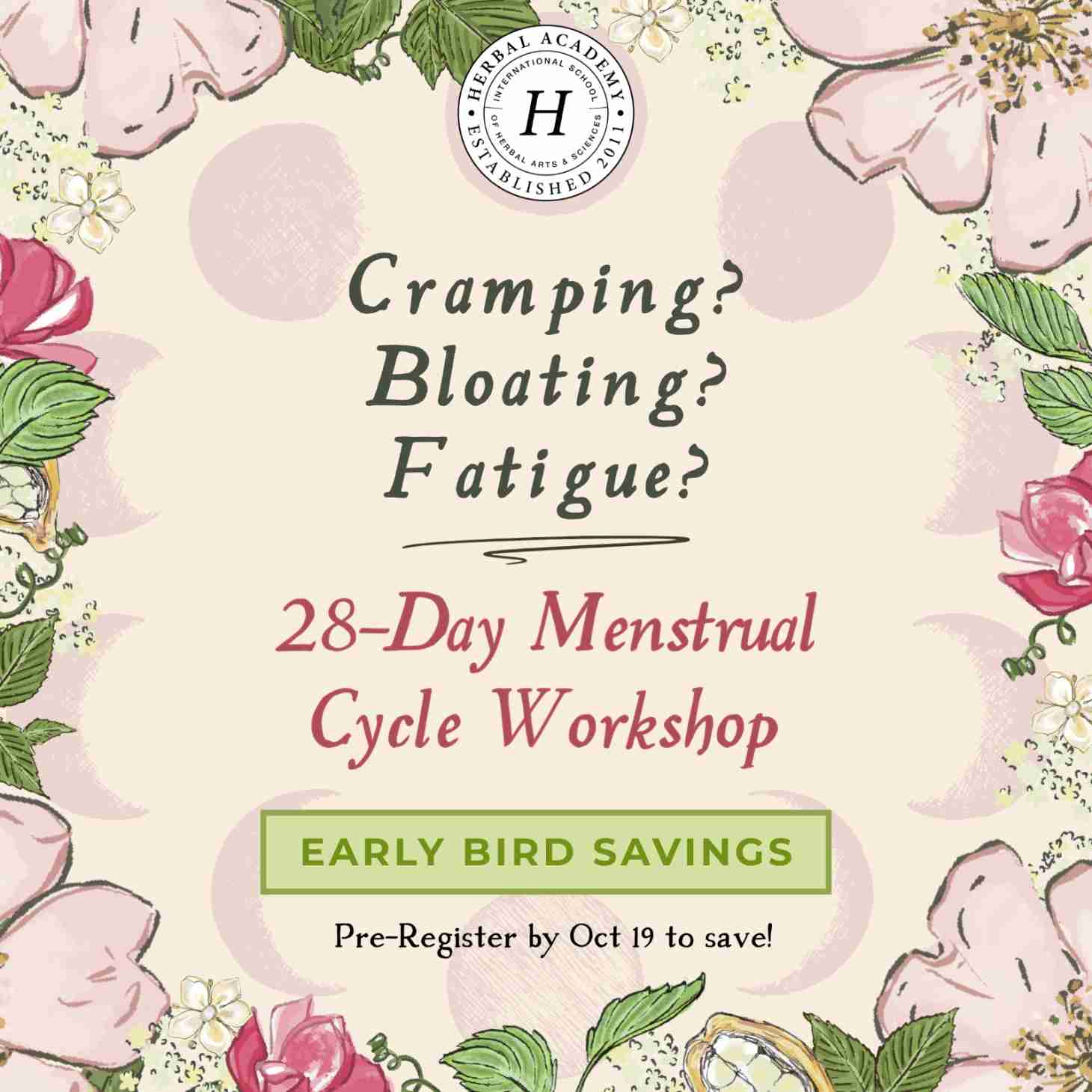
The Herbal Academy 28-Day Menstrual Cycle Workshop, promoted as Herbs for Your Moon Phases, is a focused herbalism workshop built around the four phases of the menstrual cycle. The current partner announcement says it covers daily cycle changes and herbal and lifestyle approaches, with early-bird pricing available through October 19, 2026.
There is a difference between searching for a quick PMS remedy and wanting to understand herbalism in the context of the menstrual cycle.
The new 28-Day Menstrual Cycle Workshop from Herbal Academy is aimed at the second group.
According to the latest partner announcement supplied to Kuruntha, the workshop is designed to guide learners through what happens during each day of the menstrual cycle and explore ways herbs and lifestyle practices can be used to support different phases.
That makes the workshop more educational than a single “period pain remedy” article or recipe.
The partner announcement says registration before October 19, 2026 qualifies for early-bird pricing, but it does not state the actual price. I would therefore treat the October 19 date as a campaign condition supplied by Herbal Academy and check the live registration page for the current price and availability before paying.
What Does the Workshop Appear to Cover?
The central idea is straightforward: instead of treating the menstrual cycle as one continuous period, the workshop looks at different phases and considers how herbal and lifestyle practices may fit into them.
The partner material describes four broad phases:
- Menstrual phase
- Follicular phase
- Ovulatory phase
- Luteal phase
The workshop is therefore positioned around cycle education and herbalism, rather than simply selling a collection of PMS recipes.
That distinction is important.
A reader searching for “how to stop period cramps” has a very different need from someone searching for “how can I learn more about herbs and the menstrual cycle?”
The latter is much closer to the workshop's commercial proposition.
The 28-Day Format
The 28-day structure also gives the workshop a practical framework.
Rather than presenting menstrual-cycle education as one long course module, the concept is built around following the cycle day by day.
That could appeal to learners who prefer short, structured learning experiences over a large herbalism course.
It also gives beginners an opportunity to connect educational material with their own observations.
However, the number 28 should not be interpreted as a requirement that every menstrual cycle lasts exactly 28 days.
Cycle length varies between individuals and can vary for the same person over time. The value of a cycle-based workshop is therefore better understood as a learning framework rather than a rigid calendar.
The Ginger Salve Recipe: What Is It?
One of the most practical pieces of the partner material is a warming ginger salve designed for massage around the abdomen.
The supplied recipe combines:
- 1 cup carrier oil, such as olive or coconut oil
- ¼ cup beeswax pastilles
- 1 tablespoon ginger root powder
- 1 tablespoon cayenne fruit powder
- 1 tablespoon turmeric powder
- Optional: 1 tablespoon arnica flowers
The oil is infused with the herbs and then strained. If making a salve, the infused oil is combined with beeswax using a double-boiler method before being poured into containers and allowed to cool.
The same infused oil can also be used as a massage oil by leaving out the beeswax.
A Practical Modification
Turmeric can stain skin and clothing.
The supplied recipe therefore suggests replacing the turmeric with another tablespoon of ginger if staining is a concern.
That is a practical modification, but it does not change the more important issue: this should be treated as a traditional or self-care preparation, not as a clinically proven treatment for menstrual cramps.
Does Ginger Actually Help With Period Pain?
This is where the marketing language needs to be separated from the evidence.
There is legitimate research interest in ginger and dysmenorrhea.
A 2024 systematic review and meta-analysis found that ginger was associated with reductions in menstrual-pain intensity and duration compared with placebo. However, the researchers also highlighted limitations including risk of bias and an unclear overall risk-benefit picture.
Earlier systematic reviews reached broadly similar conclusions, finding that oral ginger appeared promising for primary dysmenorrhea while emphasizing limitations in study quality and heterogeneity.
But there is an important qualification:
Most of that evidence concerns ginger taken orally, not this particular topical salve.
NCCIH says research suggests ginger dietary supplements may help reduce the severity of menstrual cramps, while evidence for topical ginger is a different question.
So Kuruntha's editorial verdict is simple:
Ginger has some evidence behind its use for menstrual pain, but that does not prove that a homemade ginger, cayenne and turmeric salve will relieve menstrual cramps.
That distinction is important for anyone publishing or using herbal wellness information.
Is the Warming Sensation the Same as Pain Relief?
Not necessarily.
Ginger and cayenne can create a warming sensation on the skin. That sensory effect may make a massage ritual feel comforting, but feeling warmth is not the same thing as demonstrating a treatment effect.
Topical capsaicin, the active component associated with the heat of chili peppers, can irritate skin and requires appropriate precautions. It should not be applied to broken or damaged skin or allowed to contact the eyes, mouth or other sensitive areas.
That makes a patch test and cautious application sensible considerations for anyone experimenting with a homemade preparation.
If the mixture causes significant burning, irritation or a rash, stop using it.
What About Arnica?
Arnica is optional in the supplied recipe.
If included, it should remain a topical ingredient rather than something to consume.
More importantly, adding more herbs does not automatically make a preparation more effective.
This is one of the reasons structured herbal education can be useful: it can teach learners to think about preparation methods, herb selection, dosage, contraindications and interactions rather than simply collecting increasingly complicated recipes.
How to Make the Warming Ginger Salve
If you want to explore the recipe as a DIY herbal preparation, the process is relatively straightforward.
1. Infuse the oil
Combine the carrier oil with ginger, cayenne and turmeric. Add arnica if you choose to use it.
Use an appropriate herbal oil-infusion method and allow the plant material to transfer its constituents into the carrier oil.
2. Strain carefully
Once the infusion is complete, strain the plant material from the oil using cheesecloth or another suitable filter.
Squeeze the strained material carefully to recover the remaining oil.
3. Make the massage oil
If you want an oil rather than a salve, transfer the strained infused oil into a clean container and allow it to cool.
4. Make the salve
For a salve, combine the infused oil with the beeswax in a double boiler.
Heat gently until the beeswax has melted.
5. Pour and cool
Transfer the mixture into clean jars or tins.
Allow it to cool and solidify before covering.
6. Store appropriately
Keep the finished preparation covered and stored in a cool, dark location.
Because this is a homemade preparation, cleanliness and proper storage matter. Do not assume that a homemade herbal product has the same stability, testing or quality controls as a commercially manufactured topical product.
Important Safety Considerations
This is the section that should not be skipped.
A homemade herbal salve is not automatically safer because its ingredients are familiar.
Ginger can cause skin irritation in some people, while cayenne can produce substantial heat and irritation. Topical preparations should not be applied to broken, irritated or infected skin.
Avoid contact with the eyes and mucous membranes and wash your hands after application.
If you are taking medication, have a medical condition, are pregnant or breastfeeding, or are unsure whether an herbal preparation is appropriate for you, discuss it with a qualified healthcare professional. NCCIH notes that herbs can interact with medicines and recommends discussing complementary approaches with healthcare providers.
And there is another important boundary.
If period pain is severe, worsening, or interfering with everyday activities, don't keep experimenting with home remedies indefinitely.
ACOG notes that painful periods can sometimes be associated with conditions such as endometriosis, adenomyosis or fibroids, while NHS guidance recommends seeking medical advice when period pain becomes severe, worsens, or interferes with normal activities.
What Does the Herbal Academy Workshop Add Beyond a Recipe?
This is arguably the strongest reason to consider the workshop.
A recipe teaches you how to make one preparation.
A structured workshop can potentially teach you how to think about the broader subject.
The partner announcement positions the 28-day workshop around the menstrual cycle rather than a single symptom.
That means the potential learning journey extends beyond cramps into questions such as:
- What changes throughout the menstrual cycle?
- How are the different phases described?
- Which herbs are traditionally associated with different stages?
- How might lifestyle practices change throughout the cycle?
- How can someone observe patterns rather than react to symptoms individually?
- How should herbal preparations be approached responsibly?
Those questions have more lasting educational value than one seasonal recipe.
If you want to explore Herbal Academy's menstrual-health resources before considering a paid workshop, our Herbal Academy PMS Portal guide covers the free resources currently available and how they fit into the broader learning journey.
Is This a Medical Course?
No.
Based on the supplied material, the workshop is an herbalism education product rather than a replacement for gynecological care.
That distinction is particularly important because PMS and menstrual pain exist on a spectrum.
The U.S. Office on Women's Health notes that PMS can involve physical and emotional symptoms including cramping, bloating, headaches, fatigue, sleep problems and mood changes. It also recommends medical discussion when symptoms interfere with daily life.
The workshop can therefore be viewed as herbal education and self-care learning, not diagnosis or treatment.
Who Is the Workshop Best Suited To?
The strongest fit is likely to be someone who already has an interest in herbalism and wants to apply that interest specifically to menstrual-cycle education.
It may suit:
- Herbalism beginners
- Home herbalists
- People interested in menstrual-cycle education
- Learners who enjoy practical recipes
- People interested in traditional herbal practices
- Existing Herbal Academy learners who want a focused topic
- Readers who prefer a short workshop to a large foundational course
It may be less appropriate for someone who simply wants a clinically established treatment for severe period pain.
That person should start with healthcare advice rather than a herbalism workshop.
If you are completely new to herbalism, a beginner herbalism course may make more sense than starting with a specialist menstrual-cycle workshop.
Herbal Academy 28-Day Workshop vs. a Full Herbalism Course
The distinction matters when deciding whether to buy.
Herbal Academy already offers broader educational programs.
Its current Advanced Herbal Course, for example, includes extensive material on reproductive health, the menstrual cycle, PMS, dysmenorrhea and other reproductive-health topics.
That means the 28-day workshop should not be viewed as a replacement for comprehensive herbal education.
Think of it more as a focused learning experience.
| If your goal is... | A sensible starting point |
|---|---|
| Learn about menstrual-cycle herbalism | 28-Day Menstrual Cycle Workshop |
| Explore herbalism generally | Introductory Herbal Course |
| Develop deeper herbal knowledge | Intermediate or Advanced study |
| Study reproductive health within a broader curriculum | Advanced Herbal Course |
| Find simple herbal self-care ideas | Free Herbal Academy resources |
The right choice depends on the learning objective.
If you're still deciding whether a specialist workshop is right for you, our guide to the best online herbalism courses for beginners compares broader learning options based on different interests and experience levels.
What Does It Cost?
The partner announcement says early-bird pricing is available for registrations made before October 19, 2026.
However, no actual early-bird dollar amount was supplied in the partner material.
More importantly, the live Herbal Academy product page currently displays the workshop as coming soon and out of stock.
Therefore, Kuruntha is deliberately not publishing an unverified price.
If the workshop becomes available before October 19, check:
- The actual listed price.
- Whether early-bird pricing is automatically applied.
- Whether the workshop is available in your country.
- What access period is included.
- Whether the workshop is self-paced.
- Whether recipes or downloadable resources are included.
- Whether the affiliate tracking link resolves correctly.
Verify current workshop availability and pricing at Herbal Academy
Is the Herbal Academy 28-Day Menstrual Cycle Workshop Worth It?
Potentially, if your goal is focused herbal education around the menstrual cycle.
I would not recommend buying it simply because you experience menstrual cramps.
That is the wrong buying criterion.
The stronger reason to consider the workshop is if you are already interested in herbalism and want a structured way to explore menstrual-cycle education, herbs and lifestyle practices.
The practical ginger salve makes the campaign more tangible, but the workshop itself is the more durable product.
There is also a sensible low-risk learning path.
Herbal Academy has free educational material available, and Kuruntha has already covered its PMS Portal and broader herbalism resources. You can start there, decide whether the subject genuinely interests you, and then consider a focused workshop.
For readers interested in the wider Herbal Academy ecosystem, Kuruntha's existing [Herbal Academy PMS Portal guide] and [Herbalism as a Hobby course guide] are useful companion resources.
Current Offer: What to Know Before October 19
Based on the partner information supplied to Kuruntha:
Workshop: Herbal Academy 28-Day Menstrual Cycle Workshop
Theme: Herbs for Your Moon Phases
Format: Focused workshop built around the menstrual cycle
Current promotion: Early-bird pricing
Early-bird deadline: October 19, 2026
Price: Not supplied in the partner announcement
Current public product-page status: Coming Soon / Out of Stock at the time of verification
Important: Verify the live price, availability and terms before publishing or purchasing.
The October 19 deadline should therefore be treated as a partner-provided campaign condition, not as a reason to manufacture urgency.
Frequently Asked Questions
What is the Herbal Academy 28-Day Menstrual Cycle Workshop?
It is a focused Herbal Academy workshop promoted as Herbs for Your Moon Phases, covering the menstrual cycle through an herbal and lifestyle-support perspective.
Is the Herbal Academy menstrual cycle workshop available now?
The product page checked by Kuruntha currently displays the workshop as coming soon and out of stock. The partner announcement indicates an upcoming launch and early-bird pricing, so availability should be verified on the live page before purchase.
How much does the 28-Day Menstrual Cycle Workshop cost?
The partner material supplied to Kuruntha does not state the early-bird price. The current product page does not provide a live purchase price at the time of verification.
When does the Herbal Academy early-bird offer end?
The partner announcement states that readers should register before October 19, 2026 for early-bird pricing.
Does ginger help menstrual cramps?
Research suggests oral ginger may reduce menstrual-pain severity, but evidence has limitations. That research should not be interpreted as proof that a particular topical ginger salve treats menstrual cramps.
Is the ginger salve clinically proven to treat period pain?
No. The supplied recipe is a traditional/self-care preparation. There is not sufficient clinical evidence establishing that this specific ginger, cayenne, turmeric and optional arnica salve treats menstrual cramps.
Can the ginger salve be used as massage oil?
The supplied recipe can be prepared as a massage oil by leaving out the beeswax. Use caution with topical herbal preparations, particularly those containing cayenne, and avoid damaged or irritated skin.
Is Herbal Academy suitable for beginners?
Herbal Academy offers education at several levels, including introductory and more advanced programs. A focused workshop may be more appropriate for someone who wants to explore one topic rather than commit immediately to a comprehensive herbalism curriculum.
Is the workshop a substitute for medical treatment?
No. Herbal education should not replace medical evaluation or treatment. Severe, worsening or disruptive menstrual pain warrants appropriate healthcare assessment.
What should I do if my period pain is severe?
Seek medical advice, particularly if pain is worsening, interfering with normal activities or accompanied by other concerning symptoms. Conditions such as endometriosis, adenomyosis and fibroids can cause significant menstrual pain.
Final Verdict
The Herbal Academy 28-Day Menstrual Cycle Workshop is more interesting as a focused herbalism learning experience than as a solution for period pain.
The ginger salve is a useful practical example, but the evidence does not justify presenting it as a proven treatment. If you are already curious about herbalism and want to explore menstrual-cycle education in a structured format, the workshop is worth investigating once the live product page confirms its price, availability and contents.
If you simply need help with severe menstrual pain, start with healthcare advice rather than a workshop.
Disclosure:
Our editorial analysis is based on the information available at the time of publication, and promotional terms can change. Kuruntha may earn a commission if you purchase through an affiliate link in this article, at no additional cost to you.

Product capabilities, availability, pricing, plans and integrations can change. Always verify current details with the provider before purchasing.  This content is for informational purposes only and does not constitute medical advice. Always consult a qualified healthcare professional before making decisions.This article was created with AI-assisted research and carefully reviewed by our in-house team before publication.
#HerbalAcademy #Herbalism #MenstrualHealth #MenstrualCycle #PMS #HerbalWellness #NaturalWellness #HerbalEducation