Herbalism as a Hobby: Best Online Courses for a Joyful, Hands-On Herbal Journey
Herbalism as a Hobby: Best Online Courses for a Joyful, Hands-On Herbal Journey
Herbalism as a hobby is the practice of learning about plants and exploring traditional herbal knowledge through activities such as gardening, tea blending, plant identification, botanical skincare, foraging and other hands-on projects. You do not need to become a professional herbalist to enjoy it. A structured online herbalism course can help beginners build foundational knowledge, develop practical skills and turn an interest in plants into a meaningful long-term hobby.
Not every hobby needs to make money.Not every spare hour needs to improve your productivity.
Sometimes the best use of an evening is simply learning something interesting, working with your hands and stepping away from another screen.
That is one reason herbalism can make such an appealing hobby.
You might begin with a curiosity about one plant. Then you discover herbal teas. That leads to gardening. Gardening introduces you to plant identification. Eventually, you may become interested in botanical skincare, herbal preparations, formulation or responsible foraging.
The learning can continue for years without becoming repetitive.And unlike many digital hobbies, herbalism can take you away from the computer and into the garden, kitchen, workshop or outdoors.
If you have been wondering how to learn herbalism as a hobby, an online course can provide the structure that random articles and videos often lack.
For readers who want a structured starting point, Herbal Academy offers a range of herbal education options covering beginner foundations and more specialized subjects.
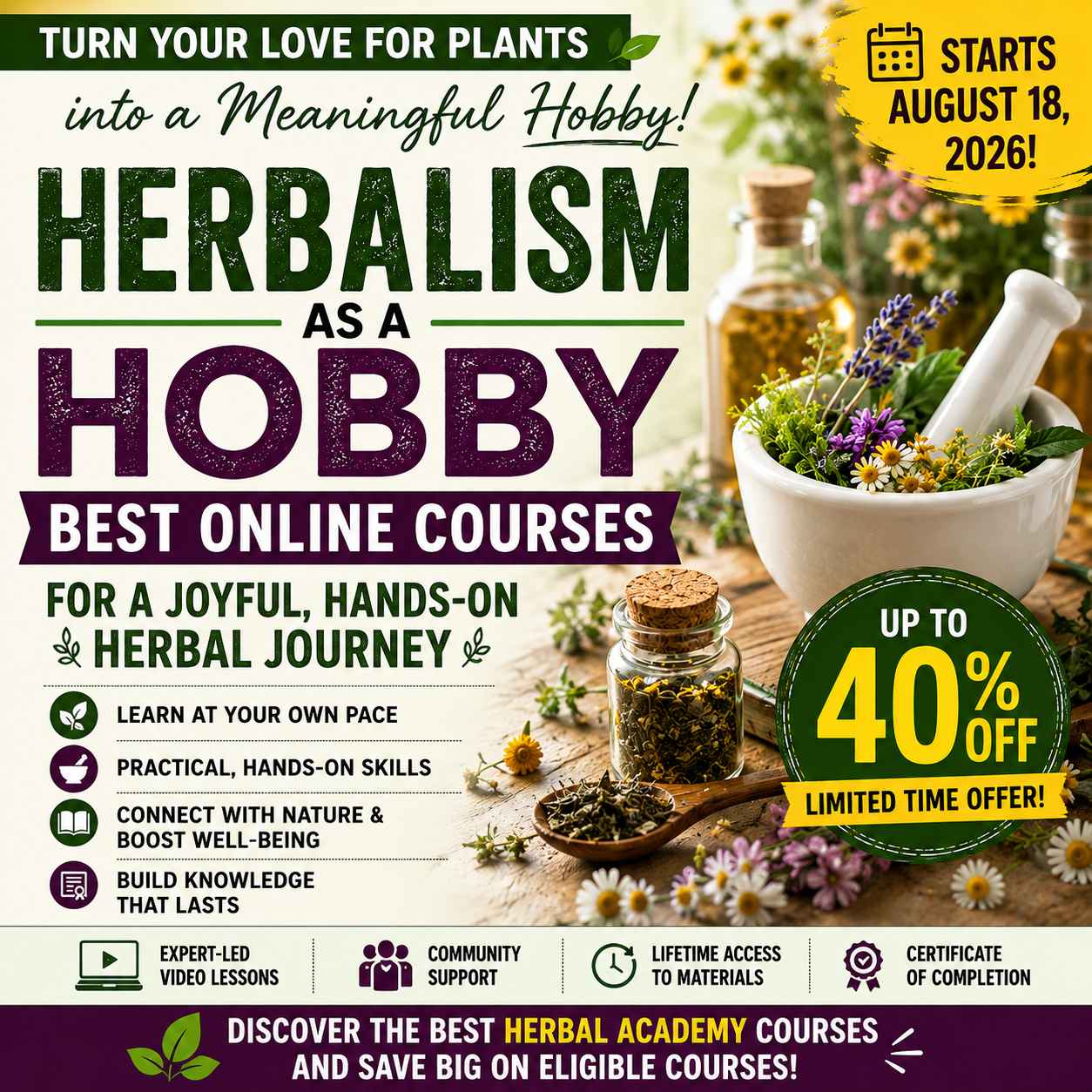
If you’ve been thinking about turning your interest in herbs into a real hobby, August 18 is a particularly good time to explore it—Herbal Academy’s courses are up to 40% off during the current promotion. Take a look at Herbal Academy’s online herbalism courses and see which one fits the kind of learning you’re looking for.
Why Choose Herbalism as a Hobby?
Herbalism sits at an interesting intersection of nature, education and creativity.
You can study it theoretically, but you can also turn what you learn into practical activities.
For example, someone learning about herbs might spend one weekend reading about plants and the next growing herbs in containers. Another learner may become fascinated by tea blending, while someone else might prefer studying wild plants or experimenting with botanical skincare.
The hobby can therefore adapt to your personality.
Herbalism can offer:
- A reason to spend more time with plants
- A screen-free activity
- An opportunity to learn at your own pace
- Creative projects involving herbs
- A deeper understanding of gardening
- An introduction to traditional herbal knowledge
- A structured way to explore plant-based interests
- A hobby that can become more advanced over time
You don't have to decide where the journey ends before you begin.
That is part of the appeal.
Is Herbalism a Good Hobby for Beginners?
Yes, particularly if you enjoy learning about nature and prefer practical hobbies.
The important thing is to start at an appropriate level.
A complete beginner does not need an advanced formulation program on day one. Similarly, someone who already understands basic herbal concepts may find an introductory course too basic.
The better approach is to ask:
What do I actually want to learn?
If you are mainly interested in growing herbs, your ideal learning path may look different from someone fascinated by skincare or wild plants.
This is why choosing an herbalism course based on your interests is more useful than simply choosing the course with the longest curriculum.
What Can You Do as a Hobbyist Herbalist?
Being a hobbyist herbalist does not mean following one fixed path.
Your interests can determine the direction.
1. Grow Herbs
Herbalism and gardening naturally complement each other.
You can learn about individual plants while growing them at home, observing their characteristics and keeping notes about your experience.
Even a small balcony or container garden can provide a starting point.
2. Explore Herbal Tea
If herbal tea is what first draws you toward herbalism, our guide to blending herbal teas for beginners is a practical next step before choosing a more structured course.
Instead of treating herbalism as something that exists only in books, you begin thinking about plants in terms of aroma, flavor, preparation and traditional use.
3. Study Plant Identification
Some people are naturally drawn to identifying plants.
Learning how to distinguish plants and understand their characteristics can turn an ordinary walk into a much more interesting experience.
4. Learn Botanical Skincare
For people who enjoy making things, botanical skincare can be an especially attractive branch of herbal learning.
It combines plant knowledge with practical formulation and crafting.
5. Explore Responsible Foraging
Foraging can bring herbalism outdoors.
However, this is an area where responsible education matters enormously. Correct plant identification, sustainable harvesting and appropriate safety knowledge should come before experimentation.
6. Keep an Herbal Notebook
You don't need expensive equipment.
A simple notebook can become your personal learning record.
Record plants you study, observations, questions, recipes you want to explore and concepts you want to revisit.
Over time, those notes become evidence of how much you have learned.
Why Take an Online Herbalism Course?
There is plenty of free herbal information online.
So why pay for a course?
The answer is structure.
Free information can be useful when you already know what you are looking for.
It becomes much less convenient when you are trying to figure out what to learn first, what to learn next and which information deserves your confidence.
A structured course can organize the learning process.
Depending on the program, you may receive lessons, educational resources, demonstrations, activities and other supporting materials.
The bigger advantage is that you are no longer building your entire curriculum from random search results.
For a hobbyist, that can make the difference between casually reading about herbalism and actually developing a sustained learning practice.
If you're comparing structured learning options rather than looking for just one introductory class, you may also want to see our Herbalism Collective Bundle review, where we take a closer look at the value of a broader herbal education bundle.
What Should You Look for in an Online Herbalism Course?
Don't choose a course simply because it has a large number of lessons.Instead, consider these factors.
Beginner-friendly structure
If you are new to herbalism, the course should explain fundamental concepts without assuming extensive prior knowledge.
Practical learning
Look for opportunities to apply what you learn rather than consuming lesson after lesson passively.
A subject you actually enjoy
A specialized course can be a better purchase than a broad program if it matches your interests.
Flexible study
Hobbies should fit around your life.
Self-paced learning can be particularly useful for people who don't want another rigid schedule.
Credible educational material
Herbalism involves plants that can have real biological effects. Educational resources should therefore treat responsible use and safety seriously.
A clear progression
If you expect your interest to grow, consider whether the provider offers further courses or learning paths.
Best Online Herbalism Courses for Different Types of Hobbyists
There is no single course that is automatically right for every learner.
The better question is:
Which course fits the hobby you want to develop?
Herbal Academy currently offers a range of courses that can suit different interests and experience levels.
Herbal Academy Introductory Herbal Course — Best Starting Point for Beginners
If you are starting from zero, an introductory course makes the most sense.
The Herbal Academy Introductory Herbal Course is designed as foundational education for people who want to begin studying herbalism without immediately committing to a more advanced specialization.
This makes it a sensible choice for someone asking:
“I am interested in herbs, but where should I start?”
You can use a foundation like this to discover which parts of herbalism interest you most before moving into more specialized subjects.
Consider this course if you:
- Have little or no previous herbal education
- Want a structured introduction
- Enjoy learning independently
- Want to explore herbalism before choosing a specialty
Best fit: The curious beginner.
Herbal Academy Botanical Skin Care Course — Best for Creative Hobbyists
If your favorite hobbies involve making things, botanical skincare deserves a closer look.
This type of learning combines plant knowledge with hands-on product creation.
Rather than simply reading about herbs, you explore how botanical ingredients can become part of skincare projects.
It may appeal particularly to people who already enjoy:
- DIY projects
- Handmade skincare
- Crafting
- Natural ingredients
- Creative experimentation
Best fit: The maker who wants herbalism to become a practical creative hobby.
Herbal Academy Foraging Course — Best for Outdoor Learners
Some people are attracted to herbalism because they want to understand the plants they encounter outside.
For them, foraging can be a natural extension of herbal education.
A structured foraging course can help organize learning around plant recognition, harvesting practices and responsible interaction with wild plants.
This is also an area where caution matters.
Never assume that a plant is safe to consume because it resembles an image online. Proper identification and responsible practices are essential.
Best fit: Hikers, gardeners, nature enthusiasts and people fascinated by wild plants.
Herbal Academy Mastering Herbal Formulation Course — Best for Advanced Hobby Learning
Some hobbyists eventually want to move beyond basic plant knowledge.
They want to understand how different ingredients can be brought together into thoughtful formulations.
That is where formulation-focused education becomes more relevant.
This is not necessarily the place for a complete beginner.If you are still learning the fundamentals, build that foundation first.
But if you already understand basic herbal concepts and enjoy the creative side of developing formulas, this type of course can take your hobby to another level.
Best fit: Experienced hobbyists who enjoy creating and experimenting.
Herbal Academy Family Herbalist Path — Best for Broader Household Learning
Some learners want their herbal education to extend beyond a single personal interest.
The Family Herbalist Path is designed for people looking for a broader progression through herbal education rather than one isolated subject.
This may make sense if you want to develop a more substantial foundation and expect herbalism to become a long-term part of your learning.
Best fit: Learners who want a broader herbal education rather than one specialized hobby.
Which Herbalism Course Should You Choose?
Use your interest—not somebody else's definition of the “best” course.
| If your main goal is... | A suitable direction |
|---|---|
| Starting from the beginning | Introductory Herbal Course |
| Learning through creative projects | Botanical Skin Care Course |
| Spending more time outdoors | Foraging Course |
| Developing formulation skills | Mastering Herbal Formulation |
| Building broader household knowledge | Family Herbalist Path |
This approach is better than buying the most expensive or advanced course simply because it appears more comprehensive.
Buy for the learner you are today, while keeping your future interests in mind.
If you're still weighing different learning levels and want a broader comparison beyond the hobbyist perspective, our guide to online herbalism courses for beginners and intermediate learners compares options in more detail.
Can You Learn Herbalism Without Becoming a Professional Herbalist?
Absolutely.
There is no requirement to turn every serious interest into a career.
A hobbyist can study herbalism simply because plants are fascinating.
You can learn:
- For personal interest
- As a companion to gardening
- As a creative outlet
- To understand traditional herbal practices
- To develop practical knowledge
- Because you enjoy nature
- Because you want a screen-free hobby
Professional herbalism is a different educational objective.
If your goal eventually changes toward professional practice, you can investigate more advanced education at that point.
For now, there is nothing wrong with simply being curious.
How to Start Herbalism as a Hobby
You don't need to purchase everything at once.
A sensible beginner approach is surprisingly simple.
Start with one subject
Pick the area that interests you most.
Don't try to learn gardening, formulation, foraging, skincare and dozens of herbs simultaneously.
Build a foundation
Learn basic concepts before experimenting with increasingly complicated preparations.
Make learning practical
Whenever appropriate, connect your study with an activity.
Grow something.
Observe something.
Write something down.
Create a simple project.
Keep records
An herbal notebook can become one of your most useful long-term resources.
Expand only when curiosity demands it
If you become fascinated by formulation, study formulation.If plants in the wild capture your attention, explore foraging.
Let the hobby develop organically.
Herbalism Can Be a Hobby Without Becoming Another Productivity Project
This is perhaps the most important reason to approach herbalism as a hobby.
We are surrounded by advice telling us how to optimize every minute.
Read more.
Exercise more.
Learn a new skill.
Build a side income.
Start another project.
Sometimes even hobbies are marketed as investments.
Herbalism doesn't need to be approached that way.
You can learn because you enjoy learning.
You can grow herbs because you like seeing them develop.
You can study a plant because its history interests you.
You can make something because you enjoy the process.
The value doesn't always have to be measured by an outcome.
Herbal Academy Courses: Up to 40% Off Starting August 18, 2026
If you have been considering an online herbalism course, August 18, 2026 is an important date to check.
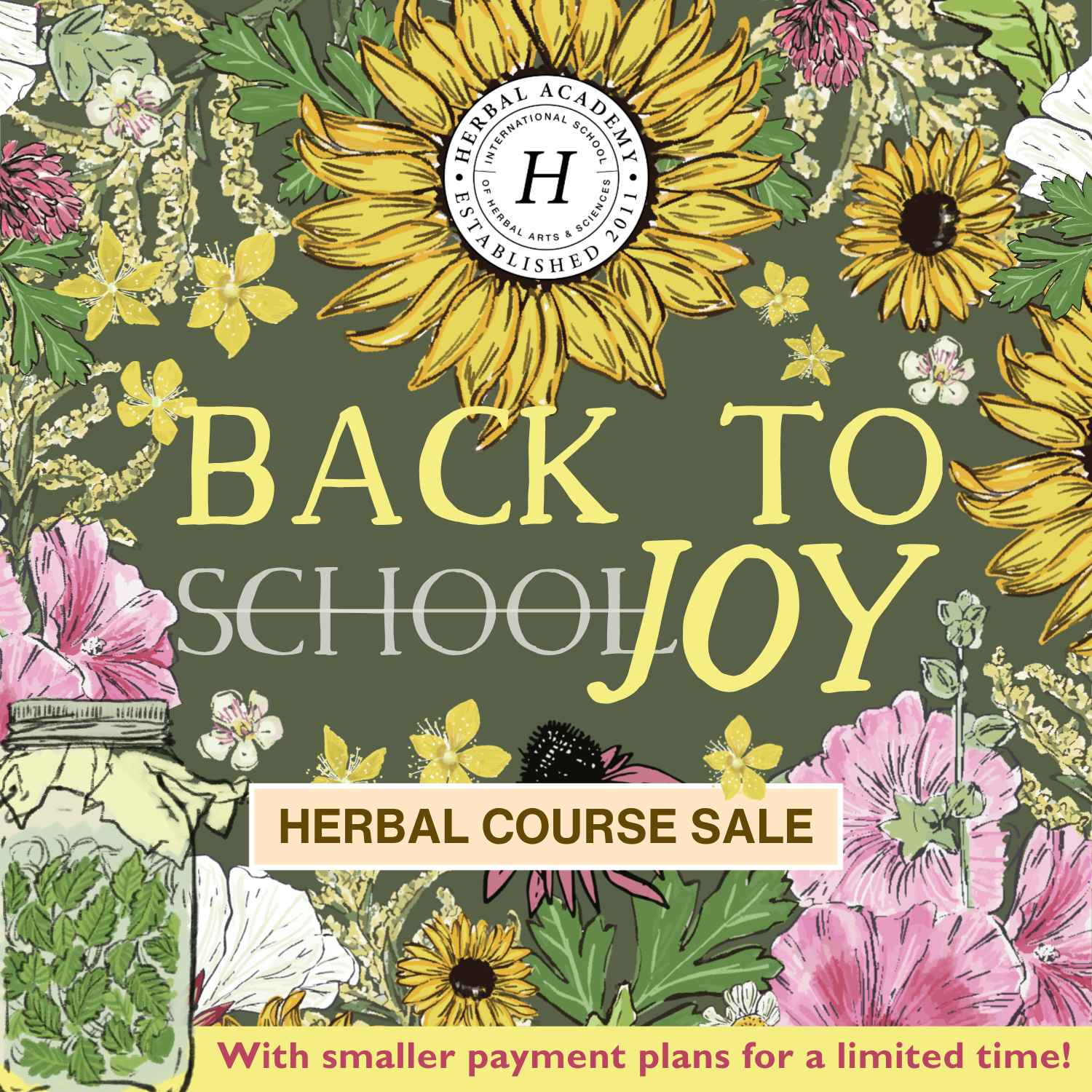
According to the promotional information provided for this campaign, Herbal Academy is offering up to 40% off eligible courses beginning August 18.
That makes the timing particularly relevant for anyone who has already decided that structured herbal education is worth exploring.
But don't let the discount make the decision for you.
Start with your goal.
New to herbalism? Look at the introductory option.
Interested in creating botanical products? Investigate botanical skincare.
Drawn to wild plants? Look at foraging education.
Already have foundational knowledge? Consider formulation.
Want broader learning? Investigate the Family Herbalist Path.
Then compare the current price with your chosen learning objective.
Promotional pricing, eligibility and availability can change. Confirm the live offer and terms before purchasing.
Is an Herbalism Course Worth Paying For?
That depends on how you learn.
If you are happy searching for individual pieces of information and creating your own curriculum, free resources may be sufficient for casual exploration.
But if you repeatedly find yourself asking:
- What should I learn first?
- Which information should I trust?
- What should I study next?
- How do I connect all these topics?
- How can I turn theory into practical learning?
then a structured course can be worth the investment.
You are not just paying for information.
You are paying for organization, direction and a defined learning path.
For someone who genuinely wants herbalism to become a long-term hobby, that can save considerable time and frustration.
Herbalism as a Hobby vs. Professional Herbalism
It is useful to understand the difference before purchasing a course.
| Hobbyist approach | Professional-focused approach |
| Learning for personal interest | Learning toward a career or practice |
| Flexible study | More structured progression |
| Focuses on selected interests | Often requires broader education |
| Practical personal projects | May involve professional competencies |
| No career objective required | Career objectives may guide course selection |
| Can remain casual | Usually requires a larger commitment |
Neither path is inherently better.
They simply serve different goals.
If you're looking for a joyful, hands-on hobby, you don't need to approach your first course as though you're preparing for a new profession.
Safety Matters When Learning Herbalism
Natural does not automatically mean harmless.
Herbs can have physiological effects, and some may interact with medications or be unsuitable in particular circumstances.
For that reason, educational content should not replace advice from an appropriately qualified healthcare professional.
Foraging requires additional caution because incorrect plant identification can lead to serious consequences.
Treat herbalism as a subject worthy of careful study.
The goal of a good education is not to make you overconfident.
It is to make you more informed.
Our Take: Is Herbalism a Good Hobby?
If you enjoy plants, nature, creativity and learning, herbalism is one of the more versatile hobbies you can explore.
It can begin with something as simple as wanting to know more about a plant.
From there, you can move into gardening, tea blending, botanical skincare, foraging, formulation or broader herbal education.
You decide how far you want to go.
And that is exactly why a structured online course can be useful.
It gives you somewhere to begin without forcing you to decide where the journey has to end.
For beginners, a foundational course is generally the most sensible starting point. Once you discover what interests you, specialized learning can follow.
If you're ready to explore your options, the August 18, 2026 Herbal Academy promotion offering up to 40% off eligible courses provides a timely opportunity to compare the available programs.
Explore the current Herbal Academy course options
A hobby doesn't have to make you more productive. Sometimes it simply needs to make your time feel better spent.
Frequently Asked Questions
What is herbalism as a hobby?
Herbalism as a hobby involves learning about plants and traditional herbal knowledge for personal interest and education. Depending on your interests, it can include gardening, plant identification, tea blending, botanical skincare, foraging and other practical activities.
Is herbalism suitable for complete beginners?
Yes. Beginners can start with basic plant knowledge and gradually develop their understanding. A structured introductory herbalism course can be useful when you want a clear starting point instead of assembling information from unrelated sources.
Can I learn herbalism online?
Yes. Online education can provide flexible access to lessons and supporting resources from home. It is particularly convenient for hobbyists who want to study around their existing schedule.
What is the best herbalism course for beginners?
For someone starting with little or no previous knowledge, an introductory program is usually the most appropriate choice. The right course should match your experience level and give you a foundation before you move into specialized subjects.
Which herbalism course is best for creative people?
A botanical skincare or formulation-focused course may suit creative learners particularly well because these subjects connect plant knowledge with practical making and experimentation.
Which herbalism course is best for nature lovers?
A foraging-focused course may be more appealing to someone whose primary interest is wild plants and outdoor learning. However, responsible plant identification and harvesting practices should always be treated seriously.
Do I need certification to enjoy herbalism?
No. You can study herbalism purely as a hobby. Certification or more advanced education becomes relevant if your goals eventually move toward professional work or another formal objective.
Is Herbal Academy suitable for hobbyists?
Herbal Academy offers courses at different levels and across several subjects, including foundational herbalism and specialized areas. That variety can make it useful for hobbyists who want to choose a learning path around a particular interest.
When does the Herbal Academy 40% off offer start?
The promotional information for this campaign states that the offer begins August 18, 2026, with savings of up to 40% on eligible courses. Check the live enrollment page for the current discount, participating courses and terms before purchasing.
Should I buy an herbalism course or start with free resources?
If you are only curious about herbalism, free resources can be a reasonable starting point. If you have decided that you want a structured, long-term learning experience, a paid course may provide more organization and direction.
Can herbalism become a career later?
It can become a deeper area of study and potentially a professional pursuit, depending on your goals and the education you undertake. However, you do not need to make that decision when starting herbalism as a hobby.
Found the course that feels like the right fit? Herbal Academy is offering up to 40% off eligible courses starting August 18, 2026, so this could be a good opportunity to begin without paying the regular price. Check the Herbal Academy August 18 offer to see the current savings and whether your chosen course is included.
Final Thoughts
A good hobby doesn't need to produce a certificate, a side business or another item on your résumé.
Sometimes its greatest value is that it gives you a reason to slow down and pay attention.
Herbalism offers plenty of room for that.
Start with one plant.
Learn one new concept.
Grow something.
Make something.
Keep notes.
Then see where your curiosity takes you.
If you want structured guidance rather than piecing everything together yourself, compare the Herbal Academy courses that match your interests. With the August 18, 2026 promotion offering up to 40% off eligible courses, the timing may be especially useful for anyone who has already been thinking about starting.
Related Kuruntha Resources
If you want to continue researching herbal education, these Kuruntha resources cover different stages of the learning journey:
- Herbalism Collective Bundle Review (2026) — useful for readers comparing broader herbal education bundles.
- Best Online Herbalism Courses for Beginners & Intermediate Learners — a broader course comparison for readers who want multiple options.
- Herbal Academy Clinical Herbalist Path Review — relevant for readers considering a more advanced professional direction.
- Herbalist Certification Online on a Budget — useful for readers researching formal herbal education.
- Free Herbalism Courses Online — suitable for readers who want to explore the subject before making a purchase.
#HerbalismAsAHobby #LearnHerbalism #HerbalismCourses #OnlineHerbalism #HerbalAcademy #HobbyistHerbalist #HerbalismForBeginners #LearnHerbalismOnline #HerbalEducation #HerbalLearning #HerbalGardening #HerbalTea #BotanicalSkincare #HerbalForaging #HerbalFormulation #PlantLovers #NaturalWellness #PlantBasedLearning #HerbalLifestyle #OnlineCourses