Is Internxt a Good Google Drive Alternative in 2026? Privacy, Security & Value
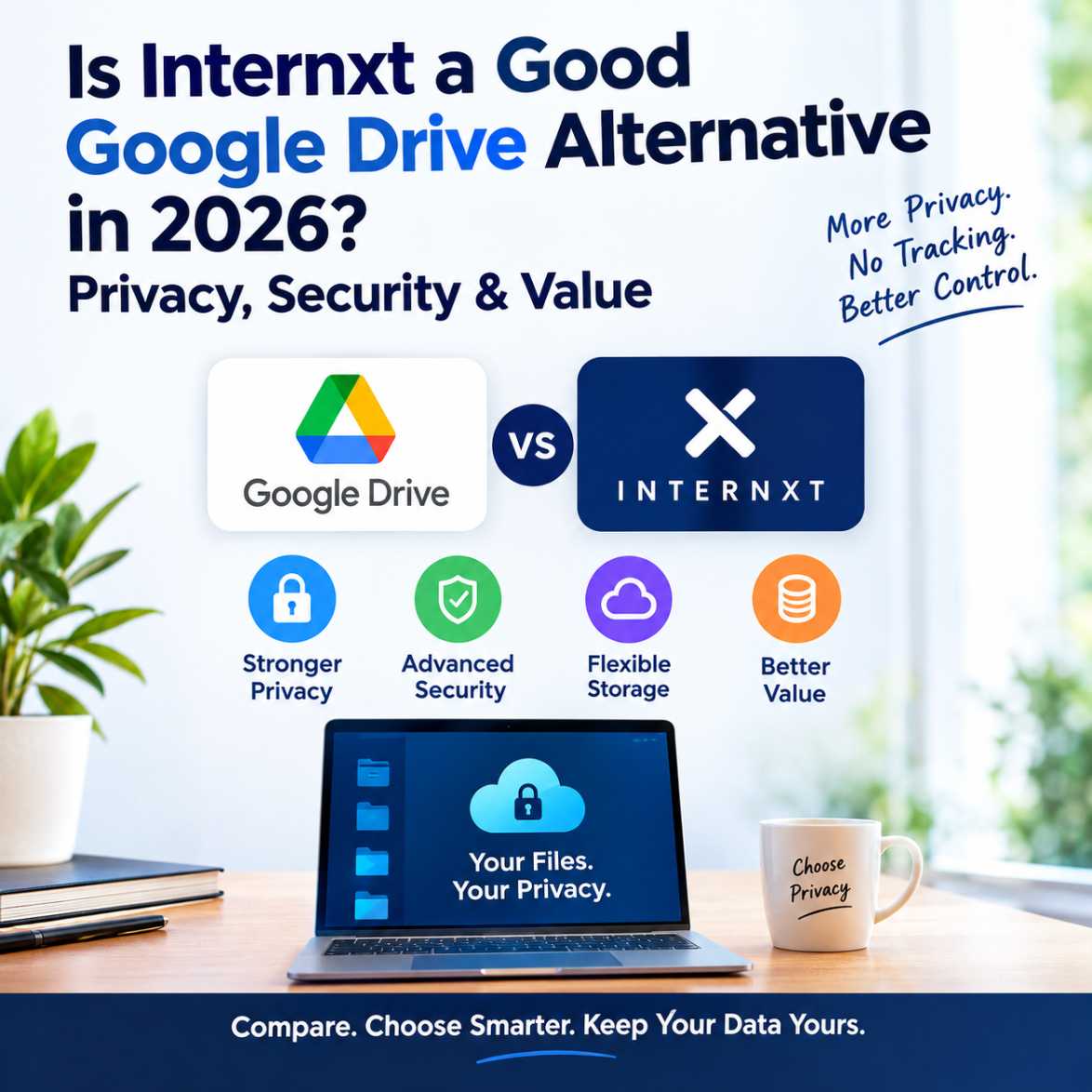
Is Internxt a Good Google Drive Alternative in 2026? Privacy, Security & Value
Internxt can be a strong Google Drive alternative for users who prioritize privacy, zero-knowledge encryption and control over their cloud-stored files. Internxt says its Drive service encrypts files before they leave the user's device and uses zero-knowledge and post-quantum encryption. Google Drive, meanwhile, offers strong encryption at rest and in transit plus extensive sharing and collaboration capabilities. The practical choice therefore depends on whether your priority is privacy-focused storage or Google's broader collaboration ecosystem.
Google Drive is convenient, familiar and deeply integrated into the Google ecosystem.
For many people, that convenience is enough.
But cloud storage has changed. Documents now contain financial records, business information, private photographs, customer files, intellectual property, personal backups and other data that users may not want unnecessarily exposed.
That raises a more important question than simply asking which service has more storage:
Who should have access to your files?
This is where Internxt as a Google Drive alternative becomes interesting.
Internxt Drive is positioned around privacy-first cloud storage, with the company stating that files are encrypted on the user's device and protected using zero-knowledge architecture. Internxt also says its Drive service uses AES-256 and Kyber 512 post-quantum encryption, publishes its code as open source and has undergone external security audits.
Google Drive takes a different approach. Google says files stored in Drive are encrypted in transit and at rest using AES-256, while additional client-side encryption is available for eligible Google Workspace environments.
So this isn't simply a question of whether Google Drive is "secure" and Internxt is "secure."
The real buying question is:
Do you want the convenience of Google's ecosystem, or a cloud-storage service designed around minimizing provider access to your files?
Let's break it down.
If you're looking for a cloud-storage service that puts privacy at the center rather than treating it as an afterthought, it’s worth taking a closer look at Internxt Drive. You can review its current storage plans, security features and available options before deciding whether it fits the way you store and share your files.
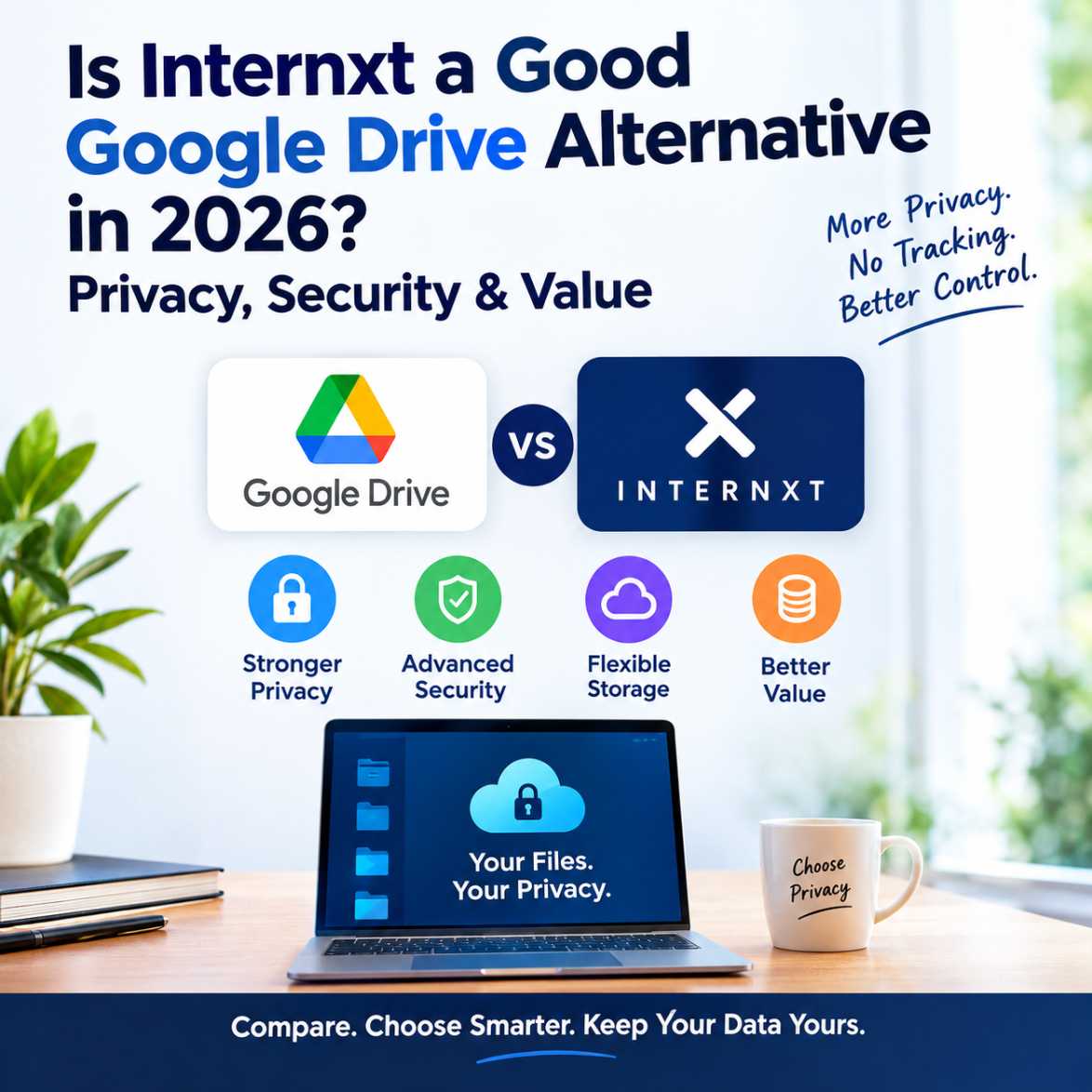
Quick Verdict: Who Is Internxt For?
Internxt is particularly relevant if you are looking for:
- A privacy-focused Google Drive alternative
- Zero-knowledge cloud storage
- Client-side encryption
- Encrypted file storage and backups
- Open-source cloud-storage software
- A European privacy-focused provider
- Linux, Windows, macOS and mobile access
- Long-term cloud-storage options
- Greater control over sensitive personal or business files
Google Drive remains highly attractive if your priority is:
- Google Docs collaboration
- Sheets and Slides
- Large-scale team collaboration
- Google Workspace integration
- Familiar sharing workflows
- Integration with the wider Google ecosystem
The distinction matters because Internxt is not simply trying to reproduce every feature of Google Drive.
Its strongest proposition is privacy-focused storage.
What Is Internxt Drive?
Internxt Drive is a cloud-storage service designed to store, synchronize, back up and share files while emphasizing privacy and encryption.
Internxt currently advertises:
- Zero-knowledge encryption
- Post-quantum encryption
- AES-256 encryption
- Open-source software
- External security audits
- Desktop and mobile applications
- Web access
- File synchronization and backups
- Secure file sharing
- WebDAV and Rclone support
- NAS-related functionality
Internxt also currently offers a free option with 1 GB of encrypted cloud storage, alongside paid storage tiers. Its current pricing page lists 1 TB, 3 TB and 5 TB storage options, with annual and lifetime plans available.
That makes Internxt different from a typical cloud-storage provider that primarily competes on ecosystem integration.
The product proposition is straightforward:
Store your files in the cloud without making convenience the only priority.
Internxt vs Google Drive: Privacy
Privacy is probably the biggest reason someone would consider switching from Google Drive to Internxt.
Internxt says its Drive service follows a zero-knowledge model. According to Internxt, files are encrypted before leaving your device, meaning the provider does not hold the decryption keys needed to read your stored file contents.
Internxt also says its Drive product does not access personal files for advertising purposes and is designed to minimize data collection.
Google Drive is not an unencrypted service.
Google states that Drive files are encrypted in transit and at rest using AES-256. Google Workspace can also provide client-side encryption for eligible organizations, where Google says it cannot decrypt the protected files.
The important distinction is therefore the encryption architecture and who controls the keys, rather than simply asking whether encryption exists.
For a privacy-conscious buyer, that distinction can be significant.
If you're also weighing pCloud against Google Drive, our comparison looks at privacy, storage, encryption and long-term value from a practical buyer's perspective.
Does Internxt Track You?
This question deserves careful wording.
Internxt's current product materials state that its privacy-focused Drive service has no trackers and that it does not scan users' files with AI. Internxt also states that it cannot access the contents of files protected by its zero-knowledge architecture.
That is substantially different from simply saying:
"Your cloud storage is encrypted."
Encryption alone does not tell you everything about a provider's privacy model.
If minimizing provider access and tracking is one of your primary requirements, Internxt's architecture is therefore worth examining.
However, buyers should always review the provider's current privacy policy and technical documentation before storing highly sensitive information.
Internxt vs Google Drive: Encryption
Encryption is where the comparison becomes technically interesting.
Google says standard Drive content is encrypted in transit and at rest using AES-256.Internxt says it encrypts files on the user's device and uses zero-knowledge encryption, alongside AES-256 and Kyber 512 post-quantum cryptography.
What does zero-knowledge mean?
In practical terms, a zero-knowledge architecture is designed so that the provider does not possess the information required to decrypt your files.
That changes the trust model.
With conventional cloud storage, the provider may control or manage encryption infrastructure on the server side.
With a zero-knowledge model, the objective is to ensure that your cloud provider cannot simply open and read your stored files.
That is particularly relevant for:
- Private photographs
- Financial documents
- Business records
- Intellectual property
- Contracts
- Research
- Client files
- Personal backups
What Is Post-Quantum Encryption?
Post-quantum cryptography is designed to address future threats from sufficiently powerful quantum computers.
Internxt says its Drive product uses Kyber 512 as part of its post-quantum encryption approach. Its documentation describes this as being combined with zero-knowledge policies to protect stored data against current and future threats.
For an ordinary cloud-storage customer, this isn't something you will notice when uploading a photograph or PDF.
But strategically, it represents an important approach to long-term data protection.
The point is not that a quantum computer is going to decrypt your holiday photographs tomorrow.
The point is that sensitive data can have a long lifespan, and cryptographic protection needs to consider future threats as well as today's attacks.
Internxt vs Google Drive: Security
Both platforms take security seriously, but their approaches differ.
Internxt emphasizes:
- Zero-knowledge architecture
- Encryption before data leaves the device
- Post-quantum cryptography
- Open-source code
- External audits
- Privacy-focused infrastructure
Internxt says its software is open source and has been independently audited.
Google Drive emphasizes:
- Encryption at rest
- Encryption in transit
- Account and access controls
- File-sharing permissions
- Google Workspace security controls
- Optional client-side encryption for eligible Workspace users
If you're choosing cloud storage for confidential business files, our Tresorit vs Google Drive security comparison takes a closer look at encryption, private file sharing and business security requirements.
Google provides granular sharing controls including viewer, commenter and editor permissions, while organizations can apply restrictions to downloading, copying and external sharing.
So security isn't simply a matter of one service having security and the other not.
The question is which security model matches your requirements?
Internxt vs Google Drive: File Sharing
Google Drive has a mature sharing system.
Users can assign different permissions, including:
- Viewer
- Commenter
- Editor
Google also provides restricted-access and broader link-sharing options.
That makes Google Drive particularly convenient for collaborative work.
Internxt takes a more privacy-oriented approach to sharing, with encrypted storage and privacy-focused sharing features.
If your workflow revolves around:
"Here is a document. Five people need to edit it together."
Google Drive has a very strong ecosystem advantage.
If your workflow is:
"Here is a sensitive file. I want it stored and shared privately."
Internxt's privacy architecture becomes considerably more relevant.
Internxt vs Google Drive: Collaboration
This is one area where buyers should not assume that a privacy-focused storage service is automatically a full replacement for Google Workspace.
Google Drive is deeply integrated with:
- Google Docs
- Google Sheets
- Google Slides
- Google Meet
- Gmail
- Google Workspace
- Shared Drives
Its collaboration model is a major reason businesses use it.
Google's sharing infrastructure supports real-time collaborative workflows and detailed permissions.
Internxt's core proposition is different.
It focuses primarily on private cloud storage, synchronization, backup and secure sharing.
Therefore:
If collaboration is your number-one requirement, Google Drive remains difficult to replace.
If privacy is your number-one requirement, Internxt deserves serious consideration.
That's an important distinction before paying for either service.
Internxt Cloud Storage: Is It Good for Personal Files?
Yes, this is one of the clearest use cases.
Think about the information stored in a typical personal cloud account:
- Passport scans
- Tax documents
- Insurance records
- Family photographs
- Personal videos
- Financial documents
- Private correspondence
- Backup files
- Important PDFs
These are not necessarily files you want sitting inside an ecosystem optimized primarily around convenience.
Internxt's zero-knowledge approach is specifically designed around limiting provider access to encrypted content.
For privacy-conscious individuals, that makes the service worth investigating.
Is Internxt Good for Business Documents?
It can be, particularly when privacy and encrypted storage are more important than collaborative document editing.
Internxt currently advertises compliance and certifications including GDPR, HIPAA, ISO 27001 and SOC 2 on its Drive product pages. Businesses should nevertheless verify the precise scope, applicable plan and current certification documentation before using any cloud service for regulated workloads.
For businesses, the decision should therefore be based on:
- Data sensitivity
- Regulatory requirements
- Collaboration needs
- Administration requirements
- Access controls
- Backup requirements
- Integration requirements
- Vendor support
- Contractual requirements
Don't buy a cloud-storage platform solely because it has a security badge.
Match the architecture to the workload.
Internxt Pricing and Value in 2026
Pricing changes, promotions and regional taxes can alter the actual amount you pay.
Internxt's current pricing structure includes free storage plus paid storage tiers and both annual and lifetime options. Its current product pages list 1 TB, 3 TB and 5 TB plans.
The most interesting part for buyers is the lifetime option.
A lifetime plan changes the financial calculation from:
"How much will I pay every month?"
to:
"Is the upfront cost reasonable for how long I expect to use this storage?"
That can make sense for users who expect to keep a large personal archive for years.
But lifetime storage should not automatically be treated as cheaper.
You should compare:
upfront cost ÷ expected years of use = approximate annualized cost
Then consider:
- Storage capacity
- Included products
- Backup functionality
- Encryption
- Support
- Future storage requirements
- Migration costs
- Whether you actually need the capacity
Check the live Internxt pricing page before purchasing because promotional prices can change.
Is Internxt Worth Paying For?
For the right buyer, potentially yes.The strongest reason to pay for Internxt isn't simply "more storage."
It is the combination of:
privacy + encrypted storage + zero-knowledge architecture + open-source transparency + long-term storage options.
If you only need basic cloud storage for documents that are already public or non-sensitive, you may not notice enough difference to justify switching.
But if you regularly store information you consider private, the privacy architecture becomes part of the value proposition.
That's when paying for a privacy-focused cloud service starts making more sense.
Who Should Switch From Google Drive to Internxt?
Internxt deserves consideration if you are:
Privacy-conscious
You don't want your cloud provider to have ordinary access to the contents of your files.
A freelancer or creator
Your cloud may contain client documents, contracts, invoices, project files and intellectual property.
A small business
You need private storage without building your own infrastructure.
A Linux user
Internxt provides support across Linux, Windows and macOS, alongside mobile platforms.
A long-term storage buyer
Lifetime plans may be attractive if you intend to maintain a large archive for many years.
Someone reducing dependence on Big Tech
If your goal is to gradually replace services that are tightly integrated into a large technology ecosystem, Internxt can be one component of that transition.
Who Should Stay With Google Drive?
Google Drive can still be the more practical solution if your workflow depends heavily on:
- Google Docs
- Google Sheets
- Google Slides
- Gmail
- Google Meet
- Google Workspace
- Real-time collaboration
- Existing business workflows
- Large teams already using Google
Google's sharing and collaboration infrastructure is mature and extensive.
This is important.
A Google Drive alternative does not have to reproduce every Google feature to be valuable.
Internxt is solving a different problem.
Internxt vs Google Drive: Quick Comparison
| Feature | Internxt | Google Drive |
|---|---|---|
| Privacy-first positioning | Yes | No |
| Zero-knowledge architecture | Yes | Not standard Drive |
| Client-side encryption | Yes, according to Internxt | Available through eligible Workspace client-side encryption |
| AES-256 encryption | Yes | Yes |
| Post-quantum encryption | Yes, according to Internxt | Not the standard Drive encryption model |
| Open-source client/software | Yes | No |
| File sharing | Yes | Yes |
| Real-time Docs collaboration | Limited compared with Google ecosystem | Strong |
| Google Workspace integration | No | Excellent |
| Free storage | 1 GB | Google account storage available |
| Lifetime plans | Available | No |
| Linux support | Yes | Web-based access |
| Privacy-focused architecture | Core proposition | Not the primary proposition |
Google confirms standard Drive encryption at rest and in transit, while Internxt documents its zero-knowledge and post-quantum approach.
What Makes Internxt Different From Other Google Drive Alternatives?
There are many Google Drive alternatives.
Some compete on:
- Price
- Storage capacity
- Collaboration
- Lifetime plans
- Business features
- Encryption
- European data protection
- Open-source technology
Internxt's differentiation is its combination of privacy architecture and encrypted storage.
That puts it in a different category from services whose primary advantage is simply offering more storage for less money.
For buyers who want privacy to be a fundamental part of the storage architecture, that's an important distinction.
If you're narrowing your shortlist beyond Google Drive, our pCloud vs Tresorit comparison explores the trade-offs between long-term storage value, privacy and secure business collaboration.
How to Decide Before You Buy Internxt
Before purchasing, ask yourself five questions.
1. What am I storing?
If you're storing ordinary downloads, privacy may not be your primary concern.
If you're storing financial, business, personal or confidential information, it becomes much more important.
2. Do I need real-time collaboration?
If your team lives inside Docs, Sheets and Slides, Google Drive has an obvious advantage.
3. Do I want zero-knowledge storage?
If the answer is yes, Internxt becomes much more relevant.
4. How much storage do I actually need?
Don't purchase 5 TB because it sounds impressive.
Estimate your current usage and likely growth.
5. Am I comfortable with a privacy-first workflow?
Privacy-focused systems sometimes involve different workflows and trade-offs compared with mainstream platforms.
Understanding that before migrating is far better than discovering it after paying.
Should You Replace Google Drive Completely?
Not necessarily.For many people, the smarter approach is to use the right cloud for the right data.
You might keep Google Drive for:
- Collaborative documents
- Shared spreadsheets
- Team projects
- Google Workspace files
And use Internxt for:
- Private archives
- Personal documents
- Sensitive backups
- Private photographs
- Confidential files
- Long-term encrypted storage
That hybrid strategy can provide a practical balance between productivity and privacy.
You don't have to treat cloud storage as an all-or-nothing decision.
How to Move From Google Drive to Internxt
If you're considering switching, don't migrate everything blindly.
Start with a small test.
Step 1: Identify sensitive files
Create a list of files you consider private or confidential.
Step 2: Test Internxt
Open a free account and evaluate the workflow before purchasing.
Internxt currently advertises 1 GB of free encrypted storage.
Step 3: Install the appropriate apps
Test your desktop and mobile workflow.
Step 4: Upload a small dataset
Check:
- Upload speed
- Download speed
- Synchronization
- File organization
- Sharing
- Device compatibility
Step 5: Test recovery
Before moving your entire archive, make sure you understand how files can be exported or recovered.
Step 6: Migrate gradually
Move important files in stages rather than deleting your Google Drive archive immediately.
Step 7: Keep an independent backup
Cloud storage should not automatically become your only backup.
A good 3-2-1 backup strategy remains valuable for important data.
The Bottom Line: Is Internxt a Good Google Drive Alternative in 2026?
Internxt is a compelling Google Drive alternative for buyers who put privacy and encrypted storage ahead of deep collaboration features.
Its current Drive offering emphasizes zero-knowledge encryption, client-side protection, post-quantum cryptography, open-source software and privacy-focused storage.
Google Drive remains extremely capable for collaboration, sharing and integration with the broader Google Workspace ecosystem. Google also provides encryption at rest and in transit, with stronger client-side encryption available for eligible Workspace environments.
So the decision isn't simply:
Internxt vs Google Drive — which cloud is better?
The better question is:
Which cloud-storage model fits the way you want your data handled?
If privacy, encrypted storage and reduced provider access are high on your list, Internxt is worth testing before you commit to another long-term cloud-storage subscription.
And if you are already paying for storage but increasingly uncomfortable with putting sensitive files inside a mainstream ecosystem, this may be the right time to reconsider where your most important data lives.
Frequently Asked Questions
Is Internxt a good Google Drive alternative in 2026?
Internxt can be a strong alternative for users who prioritize privacy, encrypted storage and zero-knowledge architecture. Google Drive remains particularly strong for real-time collaboration and Google Workspace integration.
Is Internxt more private than Google Drive?
Internxt is specifically designed around a zero-knowledge privacy model and says files are encrypted before leaving the user's device. Google Drive provides encryption at rest and in transit, while client-side encryption is available in eligible Google Workspace environments.
Is Internxt secure for personal files?
Internxt says its Drive service uses zero-knowledge encryption, AES-256 and post-quantum cryptography. It also publishes its software as open source and says its systems have undergone external audits.
Does Internxt track users?
Internxt's current Drive materials state that its privacy-focused service has no trackers and does not use AI scanning of stored files. Buyers should still review the current privacy policy and technical documentation for the latest details.
Does Internxt use end-to-end encryption?
Internxt states that Drive uses zero-knowledge encryption and encrypts files before they leave the user's device.
Does Google Drive encrypt files?
Yes. Google states that files uploaded to Drive or created in Docs, Sheets and Slides are encrypted in transit and at rest using AES-256. Additional client-side encryption is available for eligible Google Workspace configurations.
Does Internxt have a free plan?
Yes. Internxt currently advertises 1 GB of free encrypted cloud storage.
Does Internxt offer lifetime cloud storage?
Yes. Internxt currently offers lifetime storage options alongside annual plans, subject to the plans and offers available at the time of purchase.
Is Internxt good for business?
It can be appropriate for businesses that prioritize encrypted storage and privacy, but companies should evaluate compliance, administration, collaboration, support and contractual requirements before purchasing.
Is Internxt better than Google Drive for collaboration?
Not necessarily. Google Drive has a mature collaboration ecosystem built around Docs, Sheets, Slides and Google Workspace. Internxt's primary differentiation is privacy-focused storage rather than replicating the entire Google collaboration stack.
Should I switch from Google Drive to Internxt?
If privacy and provider access to your stored data are major concerns, testing Internxt makes sense. If your business depends heavily on Google Workspace collaboration, a complete migration may not be necessary.
Can I use Internxt and Google Drive together?
Yes. Using different services for different workloads can be a practical approach. For example, Google Drive can handle collaborative documents while Internxt can hold sensitive archives and private backups.
Is Internxt worth paying for?
For users who value privacy-focused cloud storage, zero-knowledge encryption and long-term storage options, Internxt may justify the cost. The right plan depends on your storage requirements and expected length of use.
If privacy is becoming a bigger consideration in where you keep your personal or business files, this is a good point to see what Internxt currently offers. Check the latest Internxt plans and storage options, compare them with your needs, and decide whether a privacy-focused cloud alternative makes sense for you.
Final Takeaway
Cloud storage is no longer simply about getting enough gigabytes.
It is about where your data lives, how it is encrypted, who can access it and which ecosystem you are willing to trust.
Google Drive remains a powerful productivity platform.Internxt takes a different path: privacy-first cloud storage designed to reduce provider access to your files.
If that difference matters to you, Internxt deserves a place on your shortlist.
Start with the free option, test the workflow with your own files, compare the current plans and then decide whether moving your most sensitive data makes financial and practical sense.
Related Kuruntha Smarket guides
If you're comparing privacy-focused cloud storage, you may also find these Kuruntha Smarket guides useful:
- pCloud vs Google Drive — useful if you're comparing mainstream cloud storage with a privacy-oriented alternative.
- Tresorit vs Google Drive — useful for readers evaluating secure business storage.
- pCloud vs Tresorit — useful when comparing different approaches to privacy, storage and security.
- Internxt Secure Cloud Storage — our earlier Internxt-focused guide covering its privacy-first storage proposition.
#Internxt #GoogleDriveAlternative #CloudStorage #SecureCloudStorage #PrivateCloudStorage #CloudPrivacy #DataPrivacy #ZeroKnowledge #EncryptedCloudStorage #CyberSecurity #PrivacyTech #DigitalPrivacy #DataSecurity #CloudSecurity #InternxtDrive #GoogleDrive #PrivacyFocused #SecureStorage #BusinessCloudStorage #OnlinePrivacy
Disclosure: This article is intended for informational and educational purposes. This article may contain affiliate links. If you choose a service through our links, we may earn a commission at no extra cost to you.

Product capabilities, availability, pricing, plans and integrations can change. Always verify current details with the provider before purchasing.

This article was created with AI-assisted research and carefully reviewed by our in-house team before publication