LMS for Training Providers: Build Once, Scale Across Clients with LearnWorlds
LMS for Training Providers: Build Once, Scale Across Clients with LearnWorlds
An LMS for training providers is a learning management system designed for businesses that sell and deliver training to multiple organizations, rather than only managing internal employee learning. It should make it possible to reuse core training programs, create client-specific cohorts or access groups, manage seats and permissions, track learner progress, provide reporting, and customize the experience without rebuilding the entire training operation for every customer. LearnWorlds specifically positions its platform for B2B training providers running multi-client programs.
Winning a new corporate training client should be a growth event.
It should not mean rebuilding your course, onboarding process, learner access, reporting structure and administration from scratch.
Yet that is exactly what happens inside many growing training businesses.
The first client may be straightforward.
The second requires a few changes.
The fifth needs different reporting.
The tenth wants different branding, learner groups, permissions and onboarding.
Before long, the training business is spending more time managing delivery variations than improving the actual learning experience.
That is where a scalable LMS for training providers becomes important.
The goal is not to make every client identical.
The goal is to identify what already works, reuse it systematically, and customize only the parts that genuinely need to change.
This is the thinking behind the 80/20 training rollout model that LearnWorlds is highlighting in its September 29, 2026 live webinar. The company describes an approach where approximately 80% of the core operation can be reused across corporate clients while the remaining portion is adapted for individual requirements.
For training companies, consultants, professional academies and B2B learning businesses, this is more than a productivity idea.
It is an operating model.
If you’re already delivering training to multiple companies, this is a good time to look at how your LMS handles client setup, reusable courses, learner access and reporting. Explore LearnWorlds for training providers and see whether its B2B-focused tools fit the way you currently deliver training.
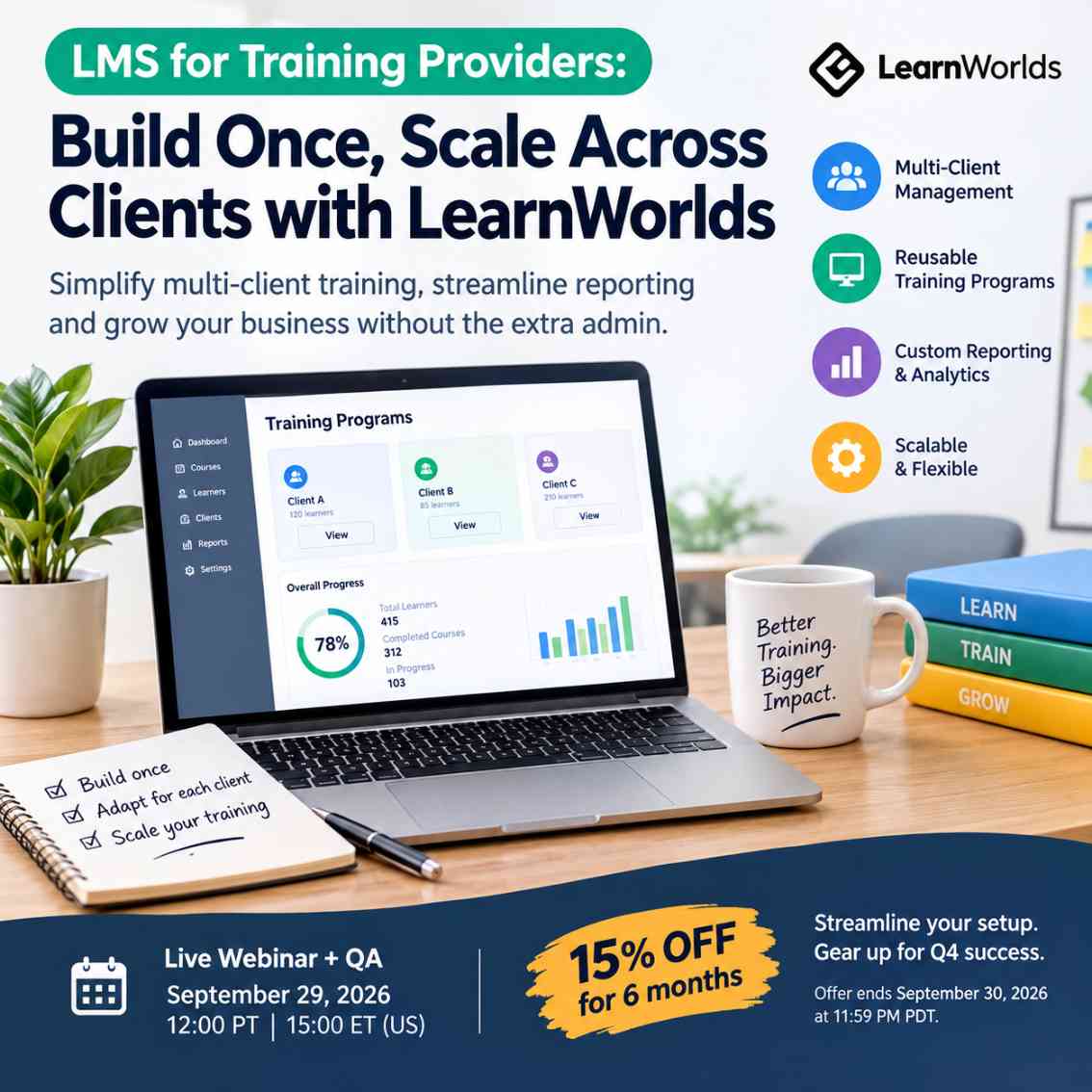
Why Training Providers Eventually Hit a Scaling Problem
Creating a great training program is only the beginning.
Once you start selling that program to businesses, the operational requirements change.
A corporate customer may ask for:
- A specific cohort schedule
- Different learner groups
- Company branding
- Custom onboarding
- Separate reporting
- Different permissions
- Multiple administrators
- Additional seats
- Custom communications
- Certificates or completion records
None of these requests is unreasonable.
The problem occurs when every request creates a completely new implementation.
Imagine a training company with 15 corporate customers.
If every customer requires a separate course structure, separate reporting process and separate administrative workflow, the business has effectively created 15 training operations.
That does not scale well.
The better question is:
Which parts of our training operation should be identical, and which parts actually need to be different?
That question is at the heart of the 80/20 model.
What Is the 80/20 Training Model?
In the context of B2B training delivery, the 80/20 model means building a repeatable foundation and reserving customization for the areas where the client genuinely needs it.
The 80% reusable layer can include:
- Core training programs
- Learning structure
- Learner journey
- Onboarding flows
- Reporting structure
- Access framework
- Assessments
- Certification processes
- Standard communications
The 20% customizable layer can include:
- Client branding
- Client-specific messaging
- User roles
- Permissions
- Visibility settings
- Cohort schedules
- Client-specific learning requirements
- Customized delivery details
LearnWorlds' September 29 webinar describes essentially this division, with the reusable side covering core programs, reporting, onboarding, learner journey and access, while customization can be applied to branding, messaging, roles, permissions and client-specific adjustments.
If you want to see the operating principle behind this approach in greater depth, our guide to scaling corporate learning with the 80/20 training model explains how training providers can standardize delivery while still accommodating client-specific requirements.
The objective is straightforward:
Customize the experience without rebuilding the infrastructure.
Why an LMS for Training Providers Matters
A standard course platform may be enough if you are selling individual courses directly to consumers.
B2B training is different.
You may have one training program being sold to:
- A technology company
- A consulting firm
- A healthcare organization
- A manufacturing business
- A professional association
- A government contractor
- A university
- A workforce development organization
The underlying training may remain substantially the same.
The commercial relationship does not.
This is why a training-provider LMS needs to support more than course hosting.
LearnWorlds currently describes its training-provider platform around multi-client programs, separate or segmented access, enterprise requirements, reporting, seat packages, custom deals and reusable programs.
That distinction matters when you're evaluating software.
You are not simply buying a place to upload videos.
You are selecting part of the operating infrastructure for your training business.
Build the Core Training Program Once
The first step is to create a strong master program.
That could contain:
- Core lessons
- Videos
- Interactive content
- Assessments
- Assignments
- Supporting resources
- Completion requirements
- Certificates
- Standard learner communications
- Reporting requirements
Once that foundation is stable, it becomes the reusable asset.
A new corporate customer should not automatically require you to recreate every component.
Instead, you create the appropriate client deployment around the existing program.
This approach has another advantage.
When the core training needs an update, you have a defined source of truth.
You are no longer maintaining multiple disconnected versions of essentially the same course.
Then Customize the Parts That Actually Matter
Standardization does not mean giving every customer an identical experience.
That would defeat the purpose of B2B training.
Corporate customers often expect their learning experience to reflect their organization.
That is where controlled customization becomes valuable.
For example:
Client A
A leadership development program with:
- Client branding
- Six-week cohort
- Internal managers
- Weekly live workshops
Client B
The same core leadership curriculum with:
- Different branding
- Eight-week schedule
- Senior executives
- Additional assessment
Client C
The same foundational program with:
- Self-paced delivery
- Different learner groups
- Different reporting requirements
The training company does not need to reinvent the curriculum three times.
The core stays consistent.
The deployment changes.
That is the practical advantage of the 80/20 approach.
What Should Training Providers Standardize?
A useful starting point is to divide your operation into two columns.
| Standardize | Customize |
|---|---|
| Core curriculum | Client branding |
| Learning journey | Client messaging |
| Assessments | Client-specific requirements |
| Reporting framework | Reporting views |
| Onboarding process | Client onboarding details |
| Certification workflow | Certificate branding |
| Core communications | Client-specific communications |
| Access framework | Roles and permissions |
| Course structure | Cohort schedule |
This simple exercise can expose where your team is repeatedly doing work that does not need to be repeated.
Ask your team:
What did we build for the last client that we will probably build again for the next client?
That is often where your scalability problem is hiding.
How LearnWorlds Fits the Multi-Client Training Model
LearnWorlds currently positions itself specifically for training providers that need to deliver programs across multiple client organizations. Its platform highlights client segmentation, structured and cohort-based programs, branded experiences, reporting, seat packages and reusable delivery.
For a training business, several areas deserve particular attention.
1. Reusable Training Programs
If the same fundamental program is sold repeatedly, the ability to reuse the underlying structure can reduce unnecessary implementation work.
The objective is not simply faster course creation.
It is faster client deployment.
2. Multiple Client Organizations
B2B training requires a way to distinguish one organization's learners and stakeholders from another.
Client segmentation can help organize learners according to company, cohort, group or other business requirements. LearnWorlds describes groups, cohorts and tags as part of its approach to client segmentation.
3. Seat-Based Training
Corporate buyers often do not purchase education in the same way an individual consumer does.
A company may purchase:
- 25 seats
- 100 seats
- 500 seats
- A cohort
- A training package
- A recurring subscription
LearnWorlds currently highlights bulk licenses, multiple seats and custom deals for B2B training providers.
4. Reporting
Reporting becomes increasingly important as client numbers grow.
A training provider may need to answer questions such as:
- Who completed the program?
- Who has not started?
- How is each cohort progressing?
- Which learners need follow-up?
- What completion rate did the organization achieve?
- Can the client receive a progress report?
A scalable reporting structure can reduce the amount of manual work required every time a client asks for an update.
5. Controlled Access
Not every stakeholder needs the same level of visibility.
A learner may need access to training.
A manager may need progress visibility.
A client administrator may need broader reporting.
Your internal team may need operational control.
Role-based permissions and controlled visibility therefore become important when a training company is working with multiple organizations. LearnWorlds lists role-based permissions and secure access among its B2B capabilities.
LMS for Training Providers vs. an Employee Training LMS
These two use cases are easy to confuse.
An employee training LMS primarily supports an organization training its own workforce.
An LMS for training providers supports a business that sells and delivers training to other organizations.
The operational requirements can therefore be very different.
| Requirement | Internal employee training | B2B training provider |
|---|---|---|
| Internal employees | Core audience | Client employees |
| Multiple companies | Usually no | Yes |
| Seat packages | Sometimes | Frequently |
| Client-specific branding | Limited | Often important |
| Client reporting | Internal | Commercial requirement |
| Multiple cohorts | Possible | Common |
| Reusable program across clients | Less central | Critical |
| Client permissions | Limited | Important |
| B2B sales workflow | Not central | Core requirement |
If your business sells training to external organizations, evaluating software solely as an employee-training LMS can lead you toward the wrong platform architecture.
How to Scale a Training Business Without Rebuilding Everything
Technology helps, but software alone will not fix an inefficient operating model.
A scalable training business needs a repeatable process.
Step 1: Identify your flagship program
Choose the training product you sell repeatedly.
Step 2: Separate fixed and variable components
Document what almost every customer receives and what changes from client to client.
Step 3: Build a master version
Create the core training experience before adding customer-specific variations.
Step 4: Define your customization rules
Decide what sales teams and delivery teams are allowed to customize.
Without rules, "customization" can become uncontrolled scope expansion.
Step 5: Create a client onboarding workflow
Document:
- Client setup
- Learner enrollment
- Access
- Branding
- Communications
- Cohort scheduling
- Reporting
Step 6: Standardize reporting
Create a consistent reporting framework.
Then add client-specific metrics only where necessary.
Step 7: Measure operational workload
Track how much time your team spends onboarding each client.
This gives you a useful baseline.
Step 8: Improve the system after every deployment
Every new client should teach you something.
If the same issue appears repeatedly, fix the underlying workflow instead of creating another workaround.
The Real Business Value Is Not Just Time Savings
The biggest advantage of a repeatable B2B training operation may not be saving a few hours.
It is creating a business where revenue can grow without operational complexity increasing at the same rate.
Consider a simplified example.
If one client requires:
- 10 hours of setup
- 5 hours of reporting
- 5 hours of administrative work
the total operational requirement is 20 hours.
If the next client requires another 20 hours, then ten clients create 200 hours of similar work.
But if a repeatable operating model reduces the reusable component and limits customization to the parts that genuinely differ, the marginal workload can become much lower.
The exact savings will vary by business.
The principle remains:
Build the system once. Improve it continuously. Reuse it intelligently.
That is where scalable training infrastructure becomes commercially meaningful.
What the September 29 LearnWorlds Webinar Covers
LearnWorlds is hosting “The 80/20 training model: Build once, adapt across client companies” on September 29, 2026, at 12:00 PT / 15:00 ET. The event is presented as a live webinar with Q&A.
The session focuses on how training and consulting companies can:
- Reuse training setups
- Onboard more clients
- Scale training programs
- Reduce reporting work
- Avoid delivery bottlenecks
- Standardize core operations
- Customize the parts that matter
LearnWorlds says the webinar will also feature a real-world story from Vincent Bégin of Mobula Design and speakers from LearnWorlds' learning design and customer success teams.
Who Should Consider Attending?
The webinar is particularly relevant if you are:
- Running a training company
- Selling professional training to businesses
- Operating a consulting or coaching business
- Expanding from B2C into B2B training
- Managing multiple corporate customers
- Spending too much time on client onboarding
- Producing manual reports
- Rebuilding training programs repeatedly
- Looking for a more scalable LMS
The session is free to register for, and LearnWorlds says a recording will be shared afterward.
Webinar date: September 29, 2026
Time: 12:00 PT / 15:00 ET
Format: Live webinar + Q&A
Participation: Free
LearnWorlds 15% Off for Six Months
For buyers who are already evaluating their training platform, timing can matter.
The current LearnWorlds promotion you are covering offers 15% off for six months, with the offer ending September 30, 2026 at 11:59 PM PDT.

That creates a narrow window around the webinar for businesses that have already identified an LMS requirement.
However, the discount should be treated as an incentive—not the reason to buy.
The more important questions are:
- Can the platform support your client model?
- Can your team reuse training effectively?
- Can you manage multiple organizations?
- Can you handle your reporting requirements?
- Can you sell training commercially?
- Can the platform support your expected growth?
If the answer to those questions is yes, a time-limited promotion can improve the economics of getting started.
If the platform does not fit your operational model, a discount does not solve that problem.
Is LearnWorlds Suitable for B2B Training Providers?
LearnWorlds is explicitly positioning its platform for B2B training providers, training consultancies, professional training businesses and organizations delivering programs to multiple client companies. Its current training-provider offering emphasizes reusable programs, client segmentation, branded experiences, cohorts, certifications, reporting and B2B purchasing workflows.
That makes the platform particularly relevant to businesses that have moved beyond simply selling individual courses.
The stronger use case is a training company that needs to manage a repeatable commercial learning operation.
For example:
Sales → Client agreement → Seats → Client setup → Learner onboarding → Training delivery → Progress tracking → Reporting → Completion → Renewal
The LMS becomes part of that workflow.
That is a much more strategic role than simply hosting course videos.
If you're already comparing platforms before committing to a long-term learning business, our LearnWorlds review and Podia comparison takes a broader look at pricing, features and the overall platform experience.
What About the LearnWorlds Roadmap?
The 80/20 training model also fits into the broader direction LearnWorlds is taking in 2026.
Kuruntha recently covered the LearnWorlds Roadmap 2026, including AI-assisted course creation, interactive learning, Learner Agents, Management Agents, AI Brand Builder and other planned capabilities.
That article is useful for readers who are evaluating the platform from a product-development and AI perspective.
This article addresses a different question:
Can a training business use LearnWorlds to build a more repeatable B2B delivery operation?
Those are complementary buying questions.
If AI-assisted course creation, learner support and recurring training are part of your platform decision, our LearnWorlds 2026 roadmap analysis looks more closely at the upcoming AI agents, new learning capabilities and October 1 preview.
LearnWorlds and the Move From Creator to B2B Training Business
There is another important use case.
A creator may begin by selling one course to individual customers.
Over time, that creator may start receiving requests from:
- Companies
- HR teams
- L&D departments
- Professional associations
- Agencies
- Consultancies
The business model changes.
Instead of selling one course to one learner, the creator may sell one program to an organization that distributes access to dozens of employees.
That is a completely different commercial opportunity.
The infrastructure needs to evolve with it.
LearnWorlds specifically lists course creators looking to expand into B2B sales among the audiences for the September 29 webinar.
For creators at this transition point, an LMS for training providers can become more relevant than a simple creator storefront.
How This Fits With Other Learning Platforms
Not every training business needs the same infrastructure.
A simple digital-product seller may need:
- Checkout
- Digital delivery
- Basic email
- A lightweight course
A growing education business may need:
- Courses
- Community
- Memberships
- Coaching
- Digital products
A B2B training provider may additionally need:
- Multiple client organizations
- Seat packages
- Cohorts
- Client-specific access
- Reporting
- Permissions
- Repeatable deployment
- Corporate purchasing workflows
That is why comparing platforms only by the number of features can be misleading.
The better question is:
Does the platform match the way my business actually sells and delivers education?
For creators evaluating different business models, Kuruntha also covers Podia and LearnWorlds in related articles.
You can explore our New Podia 2026 coverage when comparing broader creator-business platforms.
You can also review our existing LearnWorlds vs. Podia analysis when the buying decision involves creator platforms and online education infrastructure.
A Practical 80/20 Checklist for Training Providers
Before rebuilding your training operation, list the following:
Keep standardized
☐ Core curriculum
☐ Learning objectives
☐ Course structure
☐ Assessment framework
☐ Completion rules
☐ Certification process
☐ Standard onboarding
☐ Core reporting
☐ Learner journey
☐ Internal administration
Customize strategically
☐ Client branding
☐ Client messaging
☐ Cohort dates
☐ Client-specific access
☐ Roles and permissions
☐ Client reporting requirements
☐ Additional resources
☐ Organization-specific examples
The objective is not to force every customer into the same box.
It is to prevent customization from turning every new contract into a new implementation project.
When Should You Invest in an LMS for Training Providers?
You may be reaching the point where a dedicated B2B training LMS makes sense if:
- You have multiple corporate clients.
- Your team repeatedly rebuilds courses.
- Client onboarding consumes too much time.
- Reporting is still heavily manual.
- You sell training by seats or cohorts.
- Different customers require different access.
- Your training operation depends heavily on spreadsheets.
- Your team is becoming the bottleneck.
- You are preparing to sell larger B2B contracts.
- You want a more repeatable delivery model.
You do not need to wait until the operation becomes chaotic.
In fact, implementing a repeatable system before growth accelerates can be considerably easier than trying to rebuild the infrastructure after operational complexity has already accumulated.
Is LearnWorlds Worth Considering for Training Providers?
The answer depends on your business model and requirements.
For a training provider selling programs to multiple companies, the important capabilities are not limited to course creation.
You need to consider:
Client management
Can you separate and manage different organizations?
Delivery
Can the same program be reused across multiple client deployments?
Customization
Can you adapt branding, access and scheduling without rebuilding everything?
Commercial model
Can you sell seats, packages, cohorts or other B2B arrangements?
Reporting
Can your clients and internal team access the information they actually need?
Scalability
Will the platform still make sense when you have substantially more customers?
LearnWorlds' current training-provider positioning addresses many of these requirements directly.
That does not mean every training business will have the same requirements.
The sensible approach is to map your actual delivery process against the platform before committing.
Frequently Asked Questions
What is an LMS for training providers?
An LMS for training providers is software designed to help businesses sell, deliver and manage training for external organizations. Unlike an internal employee LMS, it needs to support commercial training workflows such as multiple clients, cohorts, seats, permissions, reporting and reusable programs.
What is the 80/20 training model?
For B2B training, the 80/20 training model means keeping the majority of the training operation standardized while customizing the smaller portion that needs to reflect each client's requirements. LearnWorlds' September 29 webinar uses this approach to explain repeatable delivery across client organizations.
How does the 80/20 model help training companies scale?
It can reduce repeated work by allowing providers to reuse core training content, onboarding structures, reporting frameworks and learner journeys while adapting only client-specific elements.
Can an LMS support multiple corporate training clients?
Yes. Platforms designed for B2B training can provide ways to segment learners, manage groups or cohorts, control access and report on different client organizations. LearnWorlds specifically markets its platform for multi-client training programs.
Can training providers customize each client's learning experience?
Yes. The goal of the 80/20 model is controlled customization rather than eliminating customization. Branding, messaging, permissions, schedules and client-specific requirements can be adapted while the core program remains reusable.
Is LearnWorlds suitable for corporate training providers?
LearnWorlds currently positions its training-provider solution for B2B training companies, consultancies, certification providers and other organizations selling training to businesses. Its stated capabilities include client segmentation, cohorts, reporting, seat packages, branded experiences and reusable programs.
Can LearnWorlds be used for training sold to multiple companies?
Yes. Multi-client training is a specific use case highlighted by LearnWorlds. Its training-provider offering is designed around delivering repeatable programs across different client organizations.
What should a training provider standardize first?
Start with the components that rarely change: curriculum, learning objectives, course structure, assessments, onboarding framework, reporting structure and certification workflow. Customize only the elements that genuinely vary by customer.
What should training providers customize?
Common customization areas include branding, messaging, cohort schedules, user roles, permissions, reporting views and client-specific learning requirements.
When is a training company ready for a multi-client LMS?
A dedicated solution becomes increasingly relevant when client onboarding, reporting, learner management and repeated course deployment are consuming significant operational time or when the business is preparing to handle more corporate customers.
When is the LearnWorlds 80/20 webinar?
The LearnWorlds webinar “The 80/20 training model: Build once, adapt across client companies” is scheduled for September 29, 2026, at 12:00 PT / 15:00 ET. It is a live webinar with Q&A and is free to registered participants. LearnWorlds says a recording will also be shared afterward.
What will the LearnWorlds webinar cover?
The session focuses on reusable training delivery, client onboarding, reporting, learner management, customization and reducing operational bottlenecks when working with multiple corporate clients.
Is there currently a LearnWorlds discount?
The current promotion being covered here offers 15% off for six months, ending September 30, 2026 at 11:59 PM PDT. Buyers should verify the applicable plans and terms at checkout because promotional eligibility can change.
If your team is spending too much time rebuilding training for every corporate client, it may be worth testing a more repeatable setup before your next round of growth. Take a closer look at LearnWorlds for B2B training, and if you're evaluating it now, the September 29 webinar and current 15% six-month offer are worth checking before the September 30 deadline.
Final Takeaway
Scaling a training business is not simply a matter of selling more courses.
At some point, the real challenge becomes delivering those courses repeatedly without allowing every new client to create another layer of operational work.
That is the problem the 80/20 training model addresses.
Keep the parts that work.
Reuse the core infrastructure.
Customize the parts that matter.
Then build your processes around that principle.
For training providers selling to multiple companies, an LMS should therefore be evaluated as business infrastructure, not merely as course-hosting software.
LearnWorlds is specifically positioning its platform around this multi-client B2B training model, with reusable programs, client segmentation, cohorts, reporting, branded learning experiences and corporate purchasing capabilities.
And if you are currently evaluating whether your training operation is ready for this approach, the September 29, 2026 LearnWorlds 80/20 webinar provides a timely opportunity to see how the model works in practice.
For buyers: compare your current onboarding, reporting and client-delivery workload against the workflow described above. If too much of your team's time is spent rebuilding the same operation for every customer, that is a signal worth investigating—not necessarily another reason to add more people.
Related Kuruntha Smarket Reading
- LearnWorlds Roadmap 2026: Explore the broader AI, learner-agent and academy-management direction covered in our recent LearnWorlds roadmap analysis.
- LearnWorlds vs. Podia: Useful when comparing LearnWorlds with a broader creator-oriented platform.
- New Podia 2026: See how Podia's latest direction fits creators building courses, products, memberships and communities.
- The 80/20 Training Model: Kuruntha's earlier operational article provides additional background on scaling corporate training through standardization.
#LearnWorlds #LMS #LMSForTrainingProviders #TrainingProviders #B2BTraining #CorporateTraining #TrainingBusiness #OnlineTraining #LearningManagementSystem #EdTech #TrainingTechnology #CorporateLearning #LMSForBusiness #DigitalLearning #eLearning #LearningAndDevelopment #TrainingConsultants #OnlineCourseBusiness #TrainingCompany #BusinessGrowth