The 80/20 Training Model: How B2B Training Providers Scale Corporate Learning Without Growing Their Team
The 80/20 Training Model: How B2B Training Providers Scale Corporate Learning Without Growing Their Team
Growth Often Breaks Before Demand Does
The 80/20 training model helps B2B training providers scale corporate training by standardizing approximately 80% of their learning delivery while customizing only the remaining 20% for individual clients. This approach reduces onboarding time, lowers administrative workload, improves operational consistency, and allows training businesses to support more corporate customers without significantly increasing team size or costs.
Many training businesses assume their biggest challenge is finding new clients.
In reality, growth often slows for a completely different reason.
Operations.
A consulting firm lands three corporate clients. Then five. Then ten.Suddenly every new contract introduces another onboarding process, another reporting format, another set of administrative requests, another custom learning environment, and another workflow that someone internally must manage.
The business is growing.
The systems are not.
What started as a training company gradually turns into an administration company.
This operational bottleneck is one of the most common reasons B2B training providers struggle to scale profitably.
The organizations that break through this ceiling usually discover a simple principle:
Stop rebuilding the same training business for every client.
That is where the 80/20 training model becomes particularly valuable.
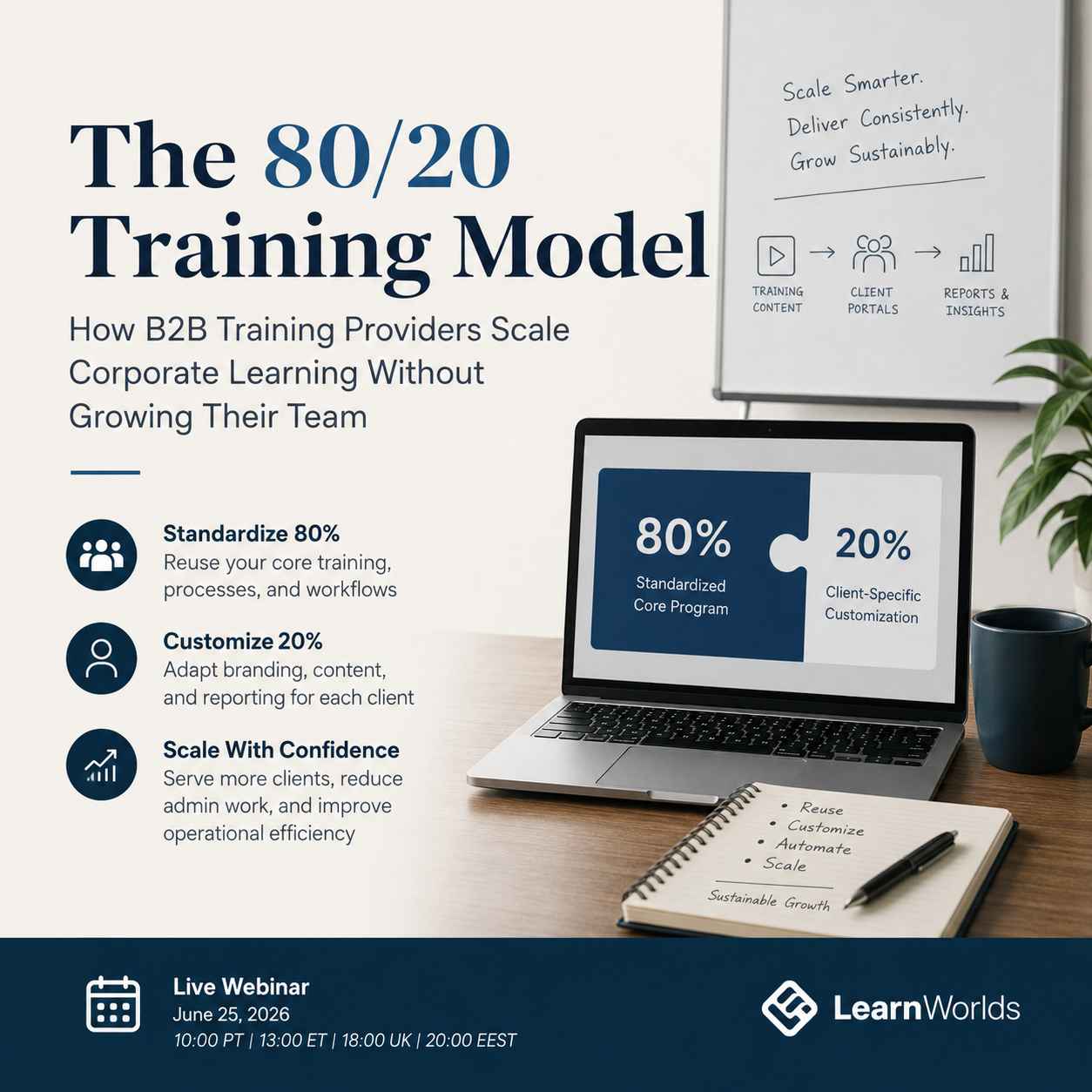
Many training providers don't struggle because of a lack of clients—they struggle because growth creates operational complexity. If you're exploring ways to standardize delivery, reduce administration, and support more corporate customers without constantly expanding your team, this live LearnWorlds webinar is worth a closer look.
What Is the 80/20 Training Model?
The 80/20 training model applies a practical operational mindset to corporate learning delivery.
Instead of creating entirely unique programs for every customer, training providers standardize approximately 80% of the learning experience while reserving 20% for client-specific customization.
The standardized 80% often includes:
- Core training content
- Learning paths
- Assessments
- Reporting structures
- Automation workflows
- Certificates
- Learner onboarding processes
The customizable 20% typically includes:
- Company branding
- Industry-specific examples
- Custom reporting views
- Internal terminology
- Organization-specific requirements
The objective is not to eliminate customization.
The objective is to eliminate unnecessary reinvention.
Why Most Corporate Training Businesses Eventually Hit a Wall
From an operator's perspective, scaling a training business usually introduces four recurring problems.
Problem 1: Duplicate Content Creation
Teams repeatedly create similar content for different clients.
The differences are often minor.
The workload is not.
A program that should take a few hours to deploy suddenly consumes days of manual adjustments.
Problem 2: Administrative Expansion
As client numbers increase, administration grows faster than revenue.
Common examples include:
- User provisioning
- Enrollment management
- Progress tracking
- Report generation
- Support requests
Many training companies discover that administrative work scales faster than learning delivery itself.
Problem 3: Inconsistent Client Experiences
When every deployment is treated as a custom project, quality becomes unpredictable.
Different clients receive different experiences.
Different trainers follow different processes.
Different reports measure different outcomes.
Consistency disappears.
Problem 4: Hiring Becomes the Default Growth Strategy
Without operational standardization, growth requires additional personnel.
More clients equals more coordinators.
More administrators.
More project managers.
Margins begin shrinking.
The Operator's View: What Actually Changes After Implementing the 80/20 Model?
The biggest change is not technological.
It is organizational.
Training providers stop thinking about courses as individual projects and start treating them as scalable systems.
This shift affects almost every workflow.
Client Onboarding
Traditional model:
- New client arrives
- Build environment
- Configure workflows
- Create reports
- Set permissions
- Repeat
80/20 model:
- Deploy standardized framework
- Apply client-specific branding
- Adjust reporting
- Launch
Implementation becomes dramatically faster.
Content Management
Instead of maintaining multiple versions of similar courses, teams maintain a central knowledge asset.Updates happen once.
Every client benefits.
This reduces long-term maintenance significantly.
Reporting Workflows
Reporting is often one of the largest hidden costs in corporate learning.
When reports are standardized:
- Data collection improves
- Quality becomes consistent
- Delivery becomes predictable
Most importantly, reporting stops consuming disproportionate amounts of team capacity.
The Role of Modern Learning Platforms
The 80/20 model becomes far easier when supported by a capable learning platform.
Modern learning systems allow organizations to:
- Reuse learning assets
- Manage multiple client environments
- Automate enrollment
- Generate standardized reports
- Maintain operational oversight
This is one reason why many growing training businesses are moving away from fragmented spreadsheets and manually managed workflows.
The operational savings often exceed the software investment.
Businesses evaluating platforms for scalable corporate learning may find it useful to compare the operational strengths, limitations, and growth potential discussed in our LearnWorlds vs Podia analysis before committing to a long-term training infrastructure.
Workflow Analysis: Where Efficiency Gains Actually Come From
Many articles focus on features.
Operators focus on workload reduction.
The biggest efficiency gains usually come from five areas.
1. Reduced Setup Time
The same infrastructure supports multiple clients.
Teams stop rebuilding systems repeatedly.
2. Lower Content Maintenance
One update improves multiple deployments.
Documentation becomes easier to manage.
Compliance updates become less painful.
3. Better Resource Allocation
Subject matter experts spend more time teaching.
Less time configuring systems.
Organizations exploring AI-assisted workflows for course creation, learner engagement, reporting, and operational scaling may also benefit from the insights shared during the LearnWorlds WOL:AI Summit 2026.
4. Predictable Delivery
Repeatable processes reduce mistakes.
Clients receive a more consistent experience.
5. Improved Profit Margins
When operational costs increase more slowly than revenue, profitability improves.
This is often where the model creates its greatest business value.
Where Friction Still Exists
The 80/20 model is not a magic formula.
Several challenges remain.
Stakeholder Expectations
Some corporate clients expect extensive customization.
Not every prospect will accept standardized frameworks.
Providers must learn how to communicate value effectively.
Initial System Design
Creating a reusable training infrastructure requires upfront effort.
Organizations often underestimate this phase.
The first implementation may require substantial planning.
Internal Resistance
Teams accustomed to custom project work may initially resist standardization.
The transition requires operational discipline.
Edge Cases
Certain industries have highly specialized compliance requirements.
The 80/20 approach may need modification for these environments.
Comparing the 80/20 Model with Traditional Custom Training
Traditional Custom Delivery
Advantages:
- Maximum flexibility
- Tailored client experiences
- Easier to accommodate unusual requirements
Disadvantages:
- Higher costs
- Slower deployment
- Operational complexity
- Reduced scalability
80/20 Training Model
Advantages:
- Faster deployment
- Better scalability
- Improved consistency
- Lower administrative burden
- Higher operational efficiency
Disadvantages:
- Requires strong system design
- Less flexibility for edge cases
- Initial setup investment
For most growing B2B training providers, the trade-off is favorable.
Who Benefits Most from This Approach?
The model works particularly well for:
Corporate Training Providers
Organizations serving multiple business clients with similar learning objectives.
Consultants
Professionals transforming expertise into repeatable training programs.
Coaching Businesses
Groups moving from one-to-one delivery toward scalable learning models.
Customer Education Teams
Companies educating partners, distributors, or customers.
Certification Businesses
Organizations requiring consistent assessment and reporting processes.
Who Should Avoid It?
Not every organization benefits equally.
The model may be less suitable for:
- Highly customized consulting engagements
- Bespoke executive coaching programs
- Specialized compliance training with unique requirements
- Small providers serving only a few clients
In these scenarios, customization may remain the more practical approach.
A Practical Opportunity for Learning Businesses
For training providers interested in implementing this approach, LearnWorlds is hosting a live webinar focused on the operational realities of scaling B2B training delivery.
Attendees will explore:
- Applying the 80/20 training model
- Reusing programs across multiple clients
- Improving client visibility
- Reducing manual administration
- Supporting larger clients with lean teams
For many growing learning businesses, these operational questions become more important than content creation itself.
Content may attract customers.
Operations determine whether growth remains profitable.
Most training providers don't need more content—they need a more scalable operating model. If you're curious how experienced learning businesses standardize delivery, reduce administrative workload, and support more corporate clients without adding headcount, the upcoming LearnWorlds webinar offers a practical look behind the curtain.
9. FAQ Section
What is the 80/20 training model?
The 80/20 training model standardizes approximately 80% of training delivery while allowing 20% customization for client-specific needs. This approach helps training providers scale more efficiently.
How does the 80/20 model help scale corporate training?
It reduces duplicate work, speeds up onboarding, standardizes reporting, and minimizes administrative overhead, allowing providers to support more clients without significantly increasing staff.
Is the 80/20 training model suitable for small training businesses?
Yes. Smaller training businesses often benefit significantly because operational efficiency becomes increasingly important as client numbers grow.
Can training providers still customize programs?
Absolutely. The model is designed around controlled customization. The goal is to customize strategically rather than rebuild entire programs.
What technologies support the 80/20 training model?
Learning management systems, automation platforms, reporting tools, CRM integrations, and client management systems can all contribute to successful implementation.
Does the 80/20 model reduce training quality?
Not when implemented correctly. In many cases, standardization improves consistency and ensures best practices are applied across all client deployments.
How long does implementation typically take?
Implementation varies depending on business complexity. Organizations with existing learning infrastructure may transition quickly, while others may require a more extensive redesign process.
Is the 80/20 model only for corporate training providers?
No. Consultants, coaches, certification organizations, customer education teams, and learning businesses can also benefit from this approach.
The businesses that scale corporate training successfully are rarely the ones creating the most content. They're the ones building repeatable systems behind the scenes. If you're ready to see how experienced training providers apply the 80/20 model in practice, you can reserve your seat for the upcoming LearnWorlds session and explore the framework before implementing it in your own business.
10. Final Verdict
The 80/20 training model is less about learning design and more about operational maturity.
Many training businesses spend years optimizing content while ignoring the systems that deliver it. Eventually, growth exposes those weaknesses.
The providers most likely to succeed in the next phase of corporate learning are not necessarily those creating the most content. They are the organizations building repeatable delivery systems that can serve dozens or hundreds of clients without multiplying operational complexity.
For B2B training providers looking to scale corporate learning, improve margins, reduce administrative burden, and support larger clients with lean teams, the 80/20 training model offers one of the most practical frameworks currently available.
It will not eliminate every operational challenge.
It will, however, eliminate many of the unnecessary ones.
Disclosure:
This article may contain affiliate links. If you choose a service through our links, we may earn a commission at no extra cost to you.
This article was created with AI-assisted research and carefully reviewed by our in-house team before publication