MuleRun vs ChatGPT Agents (2026): Which AI Actually Completes Work Instead of Just Answering Questions?
MuleRun vs ChatGPT Agents (2026): Which AI Actually Completes Work Instead of Just Answering Questions?
The Growing Frustration With Modern AI Tools
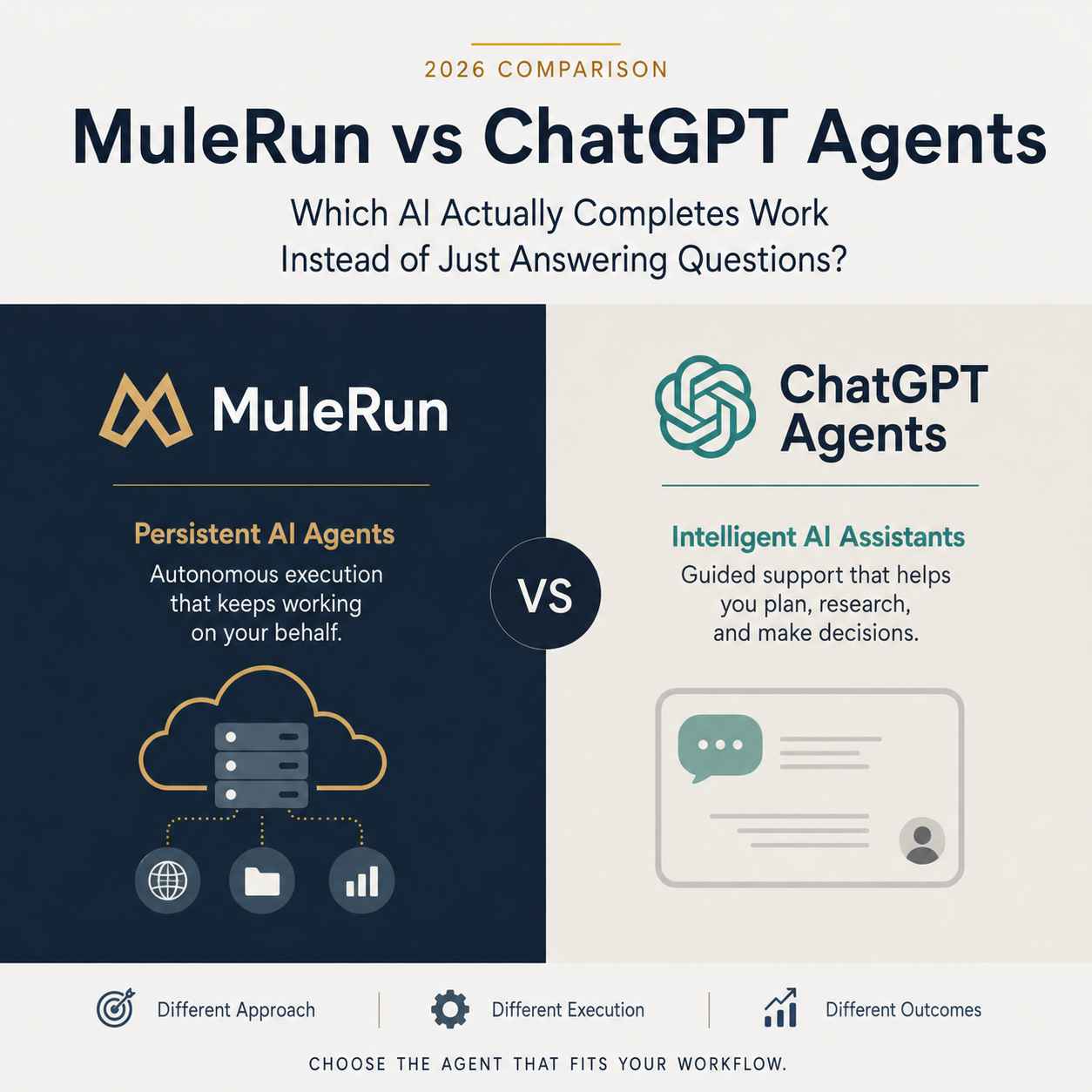
MuleRun and ChatGPT Agents both represent the next generation of AI automation, but they solve different problems. ChatGPT Agents excel at planning, research, and guided task execution, while MuleRun focuses on persistent AI agents that continue working independently inside cloud-based environments. Businesses seeking autonomous workflow automation may find MuleRun more execution-oriented, whereas ChatGPT Agents remain stronger for conversational assistance and human-guided workflows.
For the last two years, businesses have been told that AI will transform productivity.
In many cases, it has.
Writers draft faster. Developers debug quicker. Marketers generate ideas in seconds.
Yet a common frustration continues to appear once organizations move beyond experimentation.
Most AI systems still require constant supervision.
They provide answers.
Humans perform the work.
The process usually looks like this:
- Ask AI for research
- Copy results
- Open another tool
- Execute manually
- Return for additional instructions
- Repeat
The intelligence exists.
The execution gap remains.
This is where a new category of AI platforms has emerged.
Instead of simply generating responses, these platforms attempt to perform actual work on behalf of users.
Two names frequently appearing in this discussion are MuleRun and ChatGPT Agents.
Although both belong to the broader AI agent movement, their operational philosophies are remarkably different.
Understanding those differences is critical before choosing one for your workflows.
Curious whether autonomous AI agents can actually reduce your daily workload? Explore MuleRun firsthand and see how persistent AI agents handle research, monitoring, and repetitive business tasks long after a typical chatbot conversation ends.
Understanding the Core Difference
Most comparisons focus on features.
That approach misses the bigger picture.
The real distinction is not what these platforms can do.
It is how they operate.
ChatGPT Agents
ChatGPT Agents are designed around intelligent interaction.
The user remains actively involved.
The agent can:
- Conduct research
- Analyze information
- Browse websites
- Plan projects
- Execute certain actions
- Generate content
- Coordinate workflows
However, the human typically remains the manager.
You initiate tasks.
You monitor progress.
You approve outcomes.
The agent assists.
You operate.
MuleRun
MuleRun approaches the problem differently.
The platform focuses on persistent autonomous agents operating within dedicated cloud environments.
Instead of responding only when prompted, agents can remain active and continue executing assigned objectives over extended periods.
The goal is not merely assistance.
The goal is delegated execution.
That distinction changes how workflows are designed.
Readers who are new to the platform may benefit from our detailed MuleRun AI review, which explores how persistent AI agents operate in practice, where they save time, and which workflows are most likely to benefit from autonomous execution.
Operator Perspective: What Actually Changes?
After testing both approaches, one observation becomes immediately clear.
Neither platform eliminates work.
They redistribute it.
The question becomes:
Where does the workload move?
With ChatGPT Agents
Most effort shifts from execution to supervision.
You spend less time doing repetitive work and more time reviewing outputs.
For many teams, this is already a significant productivity improvement.
Research projects become faster.
Documentation improves.
Content creation accelerates.
However, the workflow still revolves around human intervention.
With MuleRun
The shift is more dramatic.
Instead of managing individual tasks, users increasingly manage objectives.
The workflow becomes:
- Define goal
- Configure environment
- Assign agent
- Monitor outcomes
The operational mindset changes from task execution to system oversight.
For founders, creators, consultants, and small teams, this can create meaningful leverage when implemented correctly.
Workflow Integration Analysis
Content Creation Workflows
Consider a creator managing:
- Blog production
- SEO research
- Competitive analysis
- Content updates
- Distribution planning
ChatGPT Agents perform exceptionally well during the planning phase.
They help generate:
- outlines
- keyword opportunities
- research summaries
- editorial ideas
MuleRun becomes more interesting during ongoing execution.
Persistent agents can continue researching competitors, gathering insights, monitoring content opportunities, and updating task queues without constant prompting.
For content operations, the combination can be surprisingly effective.
AI agents become far more valuable when integrated into a complete creator business stack that combines content production, automation, audience growth, and operational efficiency.
Small Business Operations
Many businesses operate with limited personnel.
A founder often becomes:
- marketer
- operator
- support manager
- strategist
ChatGPT Agents reduce cognitive workload.
MuleRun attempts to reduce operational workload.
The distinction matters.One helps you think.
The other aims to help you execute.
Research and Monitoring
This is where MuleRun begins to stand apart.
Most research workflows involve:
- repeated searches
- ongoing monitoring
- information gathering
- trend tracking
Persistent agents are naturally suited to these activities.
Instead of restarting workflows daily, agents can continue operating within dedicated environments.
This creates opportunities for:
- market intelligence
- competitor tracking
- lead research
- industry monitoring
Where ChatGPT Agents Remain Stronger
MuleRun is impressive in certain scenarios.
That does not mean it wins every category.
Several areas still favor ChatGPT Agents.
Better User Experience
ChatGPT's interface remains easier for beginners.
Most users understand conversational AI immediately.
The learning curve is significantly lower.
Stronger General Intelligence
For complex reasoning tasks, strategic planning, and nuanced problem solving, ChatGPT Agents often provide more polished outputs.
This is especially noticeable when:
- brainstorming
- writing
- analyzing
- decision support
Larger Ecosystem
ChatGPT continues benefiting from:
- integrations
- plugins
- enterprise adoption
- developer ecosystem
- widespread familiarity
Businesses often underestimate how valuable ecosystem maturity can be.
Where MuleRun Has an Advantage
Persistent Operation
This is arguably MuleRun's defining capability.
Most AI systems stop working when interaction ends.
Persistent agents continue operating.
That creates entirely different workflow possibilities.
Reduced Manual Oversight
Organizations seeking operational automation rather than productivity assistance may find MuleRun more aligned with their objectives.
The platform encourages delegation.Not merely acceleration.
Multi-Step Execution
Many business processes require:
- data collection
- organization
- processing
- follow-up actions
Persistent AI agents are naturally suited to these chains of activity.
Businesses exploring broader automation strategies should also evaluate how AI agents fit within the wider business automation ecosystem rather than viewing them as standalone productivity tools.
The Hidden Cost Few Reviews Discuss
The excitement surrounding AI agents often overlooks an important reality.
Automation introduces maintenance.
Every automated system requires:
- monitoring
- refinement
- troubleshooting
- governance
The more autonomous the system becomes, the more important oversight becomes.
MuleRun users should understand this before deployment.
Persistent agents can save time.
Poorly configured persistent agents can waste it.
This is not a criticism.It is simply operational reality.
Learning Curve and Adoption Challenges
Neither platform is truly plug-and-play.
ChatGPT Agents are easier to start with.
MuleRun often demands a different mindset.
Users must think in terms of:
- workflows
- objectives
- delegation
- automation design
This learning curve may discourage casual users.
For systems-minded operators, however, it can become the platform's greatest strength.
Sustainability and Long-Term Workflow Design
One overlooked aspect of AI adoption is sustainability.
Not environmental sustainability.
Operational sustainability.
Can the workflow remain effective six months later?
Many organizations build AI processes that collapse once enthusiasm fades.
The strongest systems are:
- documented
- repeatable
- maintainable
MuleRun's persistent architecture encourages system building.
ChatGPT Agents encourage task enhancement.
Both approaches have value.
The optimal choice depends on organizational maturity.
The most durable AI workflows rarely exist in isolation; they perform best when connected to a broader digital stack designed for long-term operational resilience.
Who Should Choose ChatGPT Agents?
ChatGPT Agents make the most sense for:
Ideal Users
- Writers
- Researchers
- Consultants
- Educators
- Analysts
- Small teams beginning AI adoption
Best Use Cases
- Content creation
- Strategic planning
- Research
- Analysis
- Decision support
Potential Drawback
Execution still requires substantial human involvement.
Who Should Choose MuleRun?
MuleRun becomes compelling for:
Ideal Users
- Operators
- Technical founders
- Workflow architects
- Automation enthusiasts
- Agencies
- Creator businesses managing multiple processes
Best Use Cases
- Workflow automation
- Ongoing monitoring
- Research operations
- Repetitive business processes
- Agent-based execution systems
Potential Drawback
Setup complexity is higher and workflow design requires more deliberate planning.
Teams exploring workflow automation often learn more from a few days of real-world testing than from hours of reading reviews. Setting up a live MuleRun workspace is often the fastest way to determine whether autonomous agents can meaningfully reduce operational overhead.
The Bigger Trend Behind Both Platforms
The most important takeaway is not whether MuleRun or ChatGPT Agents wins.
It is understanding where AI is heading.
The market is moving from:
AI assistants
toward
AI workers
Businesses that understand this shift early will likely gain operational advantages over the next several years.
The question is no longer:
"Can AI help me?"
The question increasingly becomes:
"What work should AI own?"
That is a fundamentally different conversation.
9. FAQ Section
Is MuleRun better than ChatGPT Agents?
Not necessarily. MuleRun is stronger for persistent workflow automation and delegated execution, while ChatGPT Agents excel at research, reasoning, planning, and human-guided tasks.
What makes MuleRun different from ChatGPT?
MuleRun focuses on autonomous agents that can continue operating inside dedicated environments, whereas ChatGPT Agents primarily function as interactive AI assistants with execution capabilities.
Can MuleRun automate business workflows?
Yes. MuleRun is designed to automate multi-step operational workflows, particularly those involving ongoing monitoring, research, and repetitive business activities.
Are ChatGPT Agents suitable for business automation?
They can automate parts of workflows, but most implementations still require significant user oversight and approval throughout the process.
Which platform is better for creators?
Creators focused on content planning, research, and writing may prefer ChatGPT Agents. Creators building scalable operational systems may find MuleRun more attractive.
Does MuleRun require technical knowledge?
Basic users can get started relatively quickly, but extracting meaningful value often requires understanding workflow design, automation principles, and objective-based task management.
Can MuleRun replace employees?
No. Like most AI agent platforms, MuleRun works best as a productivity multiplier rather than a replacement for human expertise, judgment, and decision-making.
Is MuleRun worth trying in 2026?
For users seeking autonomous workflow execution rather than conversational assistance, MuleRun represents one of the more interesting platforms currently emerging in the AI agent ecosystem.
If your goal is to move beyond AI-generated answers and start building systems that execute work on your behalf, MuleRun is worth testing. A short hands-on trial will quickly reveal whether persistent AI agents fit your workflow better than traditional AI assistants.
10. Final Verdict
MuleRun and ChatGPT Agents should not be viewed as direct substitutes.
They occupy different positions along the automation spectrum.
ChatGPT Agents remain the stronger choice for thinking, planning, research, writing, and decision support. The user stays at the center of execution.
MuleRun becomes more compelling when the goal shifts from assistance to delegation. Its persistent-agent model introduces workflow possibilities that traditional AI assistants struggle to replicate.
For beginners, ChatGPT Agents are easier to adopt and provide faster immediate value.
For operators, founders, agencies, and workflow-focused businesses willing to invest time into automation design, MuleRun offers a more ambitious vision of what AI-driven execution could become.
The platform is not perfect. The onboarding curve is real. The ecosystem is still evolving.
Yet among emerging agent platforms, MuleRun is one of the more interesting attempts to answer a question many businesses are now asking:
What happens when AI stops helping with work and starts owning parts of it?
Disclosure:
This article may contain affiliate links. If you choose a service through our links, we may earn a commission at no extra cost to you.
This article was created with AI-assisted research and carefully reviewed by our in-house team before publication