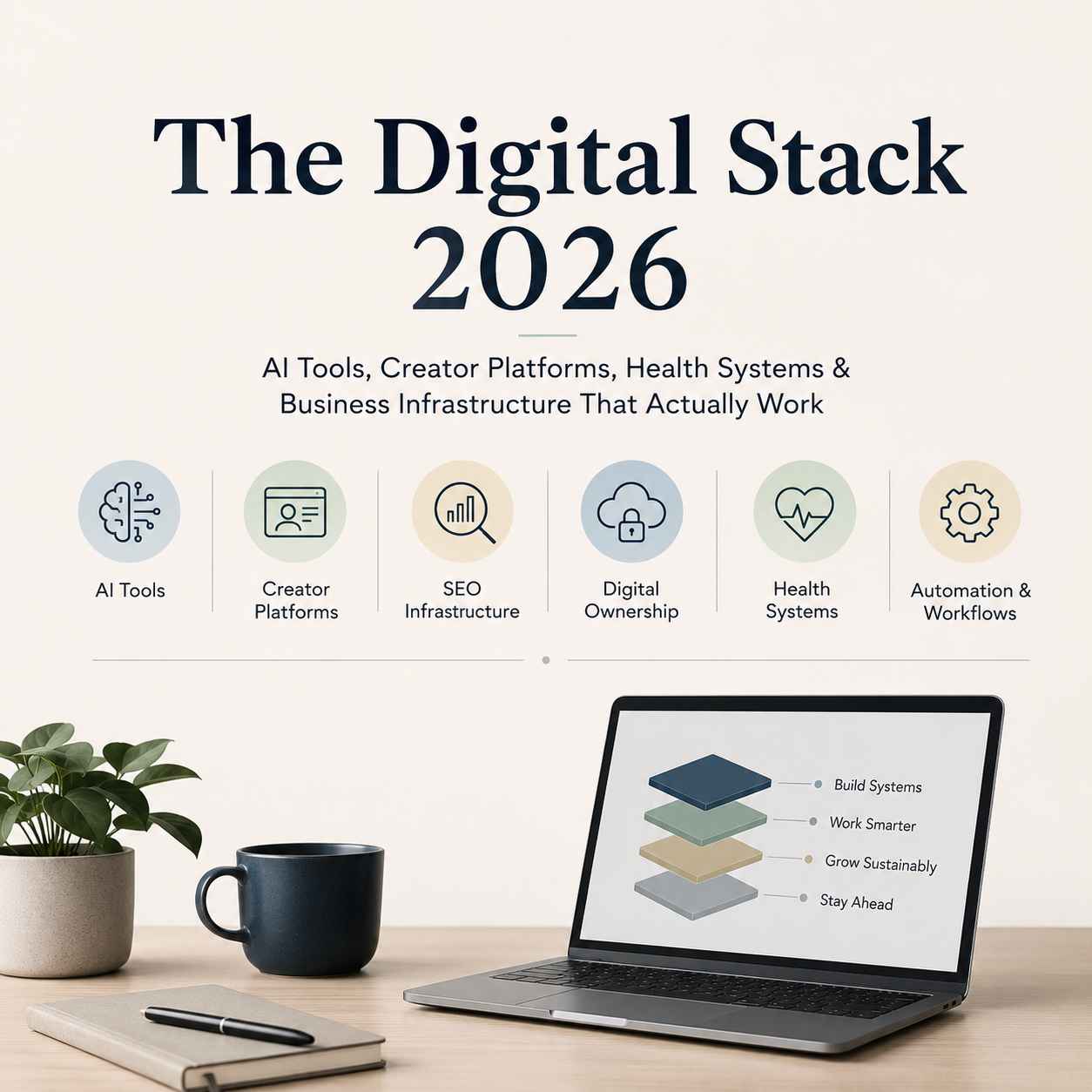
The Digital Stack 2026: AI Tools, Creator Platforms, Health Systems & Business Infrastructure That Actually Work
The Digital Stack 2026: AI Tools, Creator Platforms, Health Systems & Business Infrastructure That Actually Work
The internet is crowded with “best tools” lists that promise growth but rarely deliver meaningful long-term results.Most creators, entrepreneurs, and digital businesses do not fail because they lack ambition. They fail because their systems are fragmented.
One tool handles content.
Another manages SEO.
Another stores files.
Another tracks health.
Another manages courses.
Nothing connects properly.
That model is outdated.
In 2026, sustainable growth comes from building a complete digital stack — a connected ecosystem of tools, systems, platforms, and workflows that improve productivity, visibility, health, ownership, and long-term business resilience.
After analyzing the tools, platforms, and systems covered across our recent weekly reports and platform reviews, one thing became clear:
The businesses scaling efficiently today are not using the most tools.
They are using the right stack.
This guide breaks down the digital stack categories that are actually working right now for creators, educators, digital entrepreneurs, and modern online businesses.
Building a modern digital business is no longer about chasing every new tool. The real advantage comes from choosing systems that work together. If you want to see which creator platforms, AI ecosystems, SEO tools, and digital ownership systems are actually helping businesses grow in 2026, start with the detailed breakdowns below before investing in another subscription.
Why the “Digital Stack” Matters in 2026
The creator economy has matured.AI changed content creation.
Search engines changed discovery.
Customers became more skeptical.
Attention spans collapsed.
As a result, successful businesses are now optimizing for:
- ownership
- automation
- sustainable workflows
- search visibility
- operational simplicity
- long-term digital leverage
That requires infrastructure — not random subscriptions.
The strongest digital stacks now combine:
- AI-powered learning
- creator platforms
- SEO intelligence
- digital ownership systems
- wellness optimization
- sustainable automation
Businesses treating these as isolated categories are already falling behind.
1. AI Learning & Creator Education Systems
The AI education space exploded in 2026, but most webinars and “AI masterclasses” are shallow marketing funnels.
What stands out now are practical AI ecosystems built specifically for creators and educators.
The recent LearnWorlds WOL:
AI Summit highlighted an important shift:
AI is no longer replacing creators.
It is becoming operational infrastructure for creators.
Modern course creators are now using AI for:
- curriculum structuring
- content repurposing
- multilingual expansion
- learner personalization
- AI-assisted community engagement
- workflow automation
This matters because creator businesses are increasingly competing on speed and adaptability.
The creators scaling fastest are not necessarily producing more content.
They are building systems that multiply the value of every piece of content they create.
For online educators, AI-enhanced learning platforms are becoming one of the strongest leverage points in digital business today.
2. Creator Platforms That Reduce Operational Complexity
Many creators still juggle:
- separate website builders
- email software
- checkout tools
- membership systems
- course platforms
- community apps
That fragmentation kills momentum.
Platforms like Podia gained traction because they simplify operations into one manageable ecosystem.
That matters more than ever in 2026.
Many creators eventually realize that juggling disconnected tools costs more time and money than using a centralized ecosystem. For a deeper breakdown of how modern creators are simplifying operations, memberships, digital products, and audience management, explore our detailed analysis of Podia’s all-in-one creator infrastructure before committing to another fragmented tool stack.
Today’s highest-performing creator businesses are prioritizing:
- simplicity
- ownership
- low maintenance
- predictable recurring revenue
- centralized audience management
The all-in-one creator platform model is winning because it reduces:
- technical friction
- subscription overload
- platform fatigue
- integration failures
For creators trying to scale sustainably, operational simplicity has become a competitive advantage.
The smartest creator businesses are now asking:
“How do we reduce operational drag while increasing revenue efficiency?”
That is the right question.
3. SEO Infrastructure Is Becoming a Survival Requirement
Organic visibility is changing rapidly.Ranking on Google alone is no longer enough.
Businesses now need visibility across:
- Google Search
- Bing
- AI Overviews
- Perplexity
- Claude-generated citations
- conversational search engines
This is where SEO infrastructure becomes critical.
Businesses trying to rank in Google, Bing, AI Overviews, and conversational search engines now need more than basic keyword tracking. Our in-depth comparison of Nightwatch, SE Ranking, and Semrush breaks down which SEO intelligence platform delivers the strongest long-term visibility advantage depending on your business model and growth stage.
The comparison between Nightwatch, SE Ranking, and Semrush reveals a major reality in 2026:
Businesses need SEO intelligence systems — not just keyword trackers.
Modern SEO stacks now require:
- ranking intelligence
- competitor monitoring
- AI visibility tracking
- content gap analysis
- search intent mapping
- SERP volatility monitoring
The biggest winners are combining:
- human-first content
- AI-readable structure
- semantic topical authority
- strategic internal linking
Search engines increasingly reward:
- expertise
- consistency
- topical ecosystems
- structured answers
- practical experience
Thin affiliate pages are declining.System-driven authority content is growing.
That shift is enormous.
4. Digital Ownership Is Becoming Non-Negotiable
Subscription fatigue is real.
Many creators and small businesses are rethinking dependence on monthly SaaS ecosystems.
That is why lifetime infrastructure products like pCloud Family plans are attracting attention.
Digital ownership matters because businesses now manage:
- AI assets
- course libraries
- media archives
- client documents
- operational data
- content systems
The ability to securely control long-term digital assets without recurring platform dependency is becoming strategically valuable.
As subscription fatigue increases, many creators and digital businesses are reconsidering how they store and protect long-term assets. If you are evaluating cloud ownership versus endless recurring storage fees, our full pCloud Family Lifetime analysis explains where lifetime infrastructure can genuinely reduce long-term operational costs.
In 2026, digital resilience is no longer optional.Businesses increasingly want:
- ownership
- portability
- privacy
- long-term cost stability
- reduced platform risk
This trend is likely to grow significantly over the next few years.
5. Health Systems Are Becoming Business Infrastructure
One of the biggest blind spots in digital entrepreneurship is health.
Many founders optimize software but ignore biological sustainability.
That approach eventually collapses.
Modern digital operators are now building personal health stacks alongside business stacks.
This includes:
- sleep optimization
- hormone awareness
- recovery systems
- stress reduction
- nutrition tracking
- wearable-driven health insights
- wellness-focused routines
The reason is simple:
Burnout destroys execution quality.
High-performing founders are increasingly treating sleep, recovery, stress management, and biological sustainability as operational assets rather than personal side projects. Our complete Personal Health Stack guide explores how modern entrepreneurs are building sustainable performance systems that support long-term execution and resilience.
The businesses lasting long term are increasingly built by founders who treat health as operational infrastructure rather than a personal side issue.
This trend is especially visible among:
- remote entrepreneurs
- creators
- educators
- digital operators
- AI-focused founders
Sustainable performance is becoming a competitive advantage.
6. The Rise of the Integrated Digital Stack
The biggest shift happening right now is integration.
The strongest digital businesses no longer operate as disconnected software collections.
They operate as unified systems.
A modern digital stack in 2026 often combines:
- AI-assisted creation
- centralized creator platforms
- SEO intelligence
- owned cloud infrastructure
- wellness optimization
- automation workflows
- audience ecosystems
This integrated approach creates:
- operational clarity
- faster scaling
- lower friction
- better audience retention
- stronger margins
- long-term resilience
That is what modern growth actually looks like now.
Not hype.
Not random tools.
Systems.
What Buyers Should Prioritize Before Purchasing Any Tool
Before buying another platform, software subscription, or automation system, ask:
Does this reduce operational complexity?
Does this improve long-term ownership?
Does this create leverage?
Does this integrate with existing workflows?
Will this still matter in 3 years?
Does this improve sustainability — not just speed?
Most tools fail these questions.
The best infrastructure products pass them consistently.
The Future of Digital Business Is System-Based
The next generation of successful creators and digital businesses will not be built on isolated tactics.
They will be built on:
- connected ecosystems
- operational simplicity
- AI-enhanced workflows
- resilient infrastructure
- sustainable health systems
- strategic ownership
That is the real digital stack.
And the businesses adopting this mindset early are positioning themselves for long-term compounding growth instead of short-term spikes.
2026 is not rewarding businesses that chase every new trend.
It is rewarding businesses that build durable systems.
Frequently Asked Questions (FAQ)
What is a digital stack in 2026?
A digital stack is the complete ecosystem of tools, platforms, workflows, and systems a business or creator uses to operate efficiently. This includes AI tools, creator platforms, SEO systems, cloud storage, automation tools, and health optimization systems.
Why are integrated business systems important now?
Integrated systems reduce operational friction, improve scalability, lower software fatigue, and create more sustainable workflows for long-term business growth.
Are AI tools enough to grow a business in 2026?
No. AI tools help improve efficiency, but businesses still need:
- strong infrastructure
- SEO visibility
- audience trust
- ownership systems
- operational clarity
- sustainable workflows
AI is infrastructure — not a complete business strategy.
Why are creator platforms becoming more popular?
Creators increasingly prefer all-in-one ecosystems that simplify operations, reduce technical complexity, and centralize audience management.
Why is SEO still important with AI search engines growing?
AI search engines still rely heavily on structured, authoritative web content. Businesses with strong SEO foundations are more likely to appear in AI-generated answers, citations, and search summaries.
Why are wellness systems now considered part of business infrastructure?
Founder health directly impacts productivity, decision-making, consistency, creativity, and long-term execution quality. Sustainable businesses increasingly treat health optimization as operational infrastructure.
What makes a good digital business stack?
A strong digital stack should:
- reduce friction
- improve ownership
- increase leverage
- support automation
- integrate smoothly
- scale sustainably
- remain useful long term
Final Thoughts
The modern digital economy is becoming less about individual tools and more about connected ecosystems.
Businesses that combine:
- AI systems
- creator infrastructure
- SEO intelligence
- digital ownership
- wellness optimization
- sustainable workflows
will likely outperform fragmented competitors over the next decade.
The future belongs to businesses that build systems — not noise.
The businesses growing sustainably in 2026 are not relying on isolated apps or short-term hacks. They are building connected digital stacks that improve visibility, ownership, automation, health, and long-term operational resilience. If you are evaluating tools for your next stage of growth, explore the platforms and systems referenced throughout this guide and identify which stack fits your workflow before your competitors do.
#DigitalStack2026 #AITools #CreatorEconomy #BusinessInfrastructure #SEO2026 #DigitalBusiness #CreatorTools #OnlineBusiness #BusinessGrowth #AIForBusiness #CreatorPlatform #HealthStack #DigitalOwnership #AutomationTools #AISEO #FutureOfWork #PassiveIncomeTools #ProductivitySystems #BusinessAutomation #SmartBusinessTools
Disclosure:
This article may contain affiliate links. If you choose a service through our links, we may earn a commission at no extra cost to you.
This article was created with AI-assisted research and carefully reviewed by our in-house team before publication