How to Turn Expertise Into an Online Course in 2026
How to Turn Expertise Into an Online Course in 2026
Turning expertise into an online course starts with identifying one specific problem you can help learners solve, validating that people want the outcome, structuring your knowledge into a practical learning path, and choosing a platform to host, sell and deliver the course. The biggest mistake is building the entire course before confirming that the idea and audience are commercially viable.
Having valuable expertise is not the same thing as having a course people will buy.
A consultant may have spent years solving client problems. A trainer may have delivered hundreds of workshops. A cybersecurity professional may have developed a highly specialized skill set. A healthcare educator may know a subject inside out.
But turning that knowledge into a commercial learning product requires more than recording videos and uploading PDFs.
You need a clear learner outcome, evidence that people want it, a sensible course structure, a way to build trust, and eventually a platform capable of handling delivery and sales.
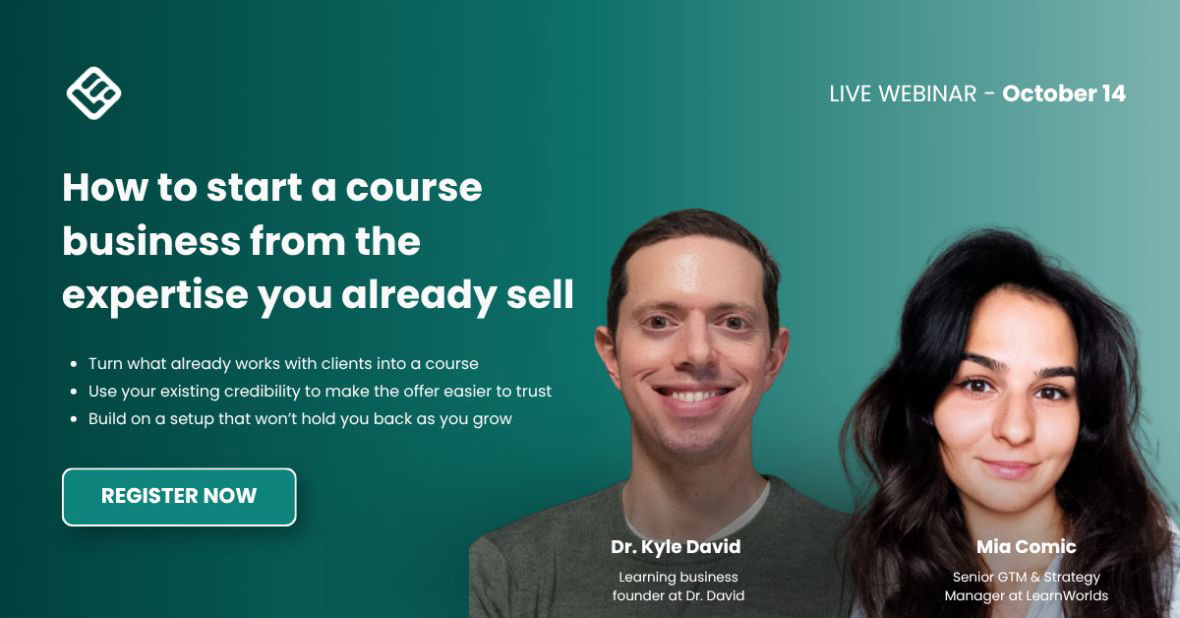
That is the theme behind LearnWorlds' “Turn your expertise into a learning business” webinar on October 14, 2026, featuring Dr. Kyle David and his reported journey to more than 12,000 learners.
If you already have expertise that people repeatedly ask you to explain, teach or solve, this is the point where it makes sense to investigate whether that knowledge can become a structured learning product.Register for the LearnWorlds webinar
The real challenge is not creating the course
The internet is full of advice about recording lessons, designing slides and choosing microphones.
Those are production decisions.
The more important business question comes earlier:
What specific result are people willing to pay you to help them achieve?
That distinction matters.
“Cybersecurity” is a subject.
“Teach small-business managers how to identify common phishing risks” is a potential learning outcome.
“Digital marketing” is a broad field.
“Help independent consultants build a repeatable LinkedIn lead-generation process” is much closer to a product.
Your expertise becomes commercially useful when it can be translated into a defined transformation.
LearnWorlds itself recommends beginning course creation with a course idea, understanding the audience and defining learning objectives before building the content.
1. Start with the problem, not the curriculum
One of the easiest mistakes is opening a document and immediately writing Module
1. Do not start there.
First ask:
- What problem do I repeatedly solve?
- Who has this problem?
- What do they currently do instead?
- What mistakes do they commonly make?
- What result would make the training valuable?
- Can that result realistically be taught online?
Your existing work is often the best source of course ideas.
Client questions, consulting projects, workshops, support requests, internal training and frequently repeated explanations can reveal useful patterns.
The goal is to find the intersection between what you know well and what another person has a reason to learn.
A simple test
Write this sentence:
“I help [specific audience] achieve [specific outcome] without [important obstacle].”
If you cannot complete that sentence clearly, the course idea probably needs more work.
2. Validate the idea before producing everything
This is where many prospective course creators get the economics backwards.
They spend months creating:
- 30 video lessons
- downloadable workbooks
- quizzes
- presentation decks
- certificates
- sales pages
- email sequences
Then they discover that the market was not particularly interested.
A better approach is to validate the demand before making a large production investment.
Practical validation methods
You could:
- Interview potential learners.
- Review questions people already ask in relevant communities.
- Examine competing courses and their positioning.
- Publish educational content around the proposed subject.
- Run a free workshop.
- Offer a short pilot course.
- Build a waitlist.
- Sell a small version before expanding it.
The objective is not to prove that everyone wants your course.
It is to find enough evidence that a defined audience has a meaningful problem and considers your proposed solution valuable.
That is a much safer basis for building.
3. Turn expertise into a learning outcome
Expertise tends to be messy.
A professional may have hundreds of interconnected ideas in their head. A learner needs a sequence.
That means course design is partly an exercise in removing information.
Ask:
What must the learner be able to do by the end?
A useful learning objective should describe an observable capability.
For example:
By the end of the course, learners will be able to create a basic cybersecurity risk assessment for a small business.
That is more useful than:
Learners will understand cybersecurity.
The first statement gives you something to build around.
It can influence:
- lessons
- exercises
- assessments
- downloadable resources
- sales-page copy
- learner expectations
LearnWorlds' current course-creation workflow supports building courses manually or using AI to generate an initial outline, followed by editing and structuring the material.
That can reduce the mechanical work, but it does not remove the need for subject-matter judgment.
Buyers considering LearnWorlds should also distinguish current functionality from announced developments, which we cover in our LearnWorlds 2026 roadmap analysis.
4. Build the smallest useful version first
A first course does not need to contain everything you know.
In fact, trying to include everything may make the course worse.
A focused course can be easier to:
- explain
- market
- price
- complete
- improve
- update
Consider a five-module course that solves one clearly defined problem rather than a 40-hour course attempting to cover an entire profession.
You can expand later when learner questions and feedback reveal what is missing.
This also creates a useful feedback loop:
Expertise → first course → learner feedback → improved course → additional products
That is closer to building a learning business than simply publishing a large digital file.
5. Build trust before expecting sales
The webinar's second major theme is credibility.
That is important because an expert's knowledge is invisible to someone who has never encountered them before.
A potential learner is effectively asking:
“Why should I trust you to teach me this?”
You do not necessarily need a huge personal brand.
But you do need evidence.
That could come from:
- professional experience
- published work
- client outcomes
- demonstrations
- free educational material
- workshops
- testimonials
- case studies
- credentials where relevant
- useful public explanations
This is one reason content marketing can work well alongside an online course.
A useful article can demonstrate expertise before asking someone to purchase training.
For course creators, the commercial journey can therefore look like:
Search → useful content → trust → free resource/webinar → course evaluation → purchase
That is considerably stronger than sending cold traffic directly to a sales page.
6. Choose the platform after understanding the business model
The platform decision should come after you understand what you are actually selling.
There is a meaningful difference between:
- one inexpensive course
- multiple courses
- subscriptions
- memberships
- coaching
- certifications
- corporate training
- customer education
- multi-client academies
The infrastructure requirements change as the business changes.
LearnWorlds currently positions itself across creators, coaches, training providers, customer education and branded academies. Its current pricing structure includes Starter, Pro Trainer, Learning Center and Corporate options.
Its current pricing page lists:
| Plan | Current annual-billing price | Notable consideration |
|---|---|---|
| Starter | $24/month | $5 per paid enrollment |
| Pro Trainer | $79/month | No enrollment fees |
| Learning Center | $249/month | Designed for branded academies and training teams |
| Corporate | Custom | Higher-volume / multi-school requirements |
Prices and promotional pricing can change, so they should be checked before purchasing. The current pricing page also shows promotional reductions on Pro Trainer and Learning Center, meaning those displayed figures should not automatically be treated as permanent standard pricing.
For someone creating a first course, the important question is therefore not simply “Which plan has the most features?”
It is:
“Which plan matches my actual operating model today without creating unnecessary cost?”
If your course business eventually expands into client training, certification or multiple organizations, our guide to training provider software looks at the additional operational requirements.
7. Understand the economics before choosing a plan
Platform pricing becomes easier to evaluate when you put it against your expected sales model.
For example, a creator selling one $50 course needs to think differently from a business selling:
- $500 professional training
- $1,000 certification
- $100/month membership
- corporate training packages
LearnWorlds' current Starter plan carries a $5 fee per paid enrollment, while Pro Trainer and higher plans do not list enrollment fees. Pro Trainer also adds subscriptions, memberships and payment plans.
That makes the pricing calculation more nuanced than simply comparing monthly subscription numbers.
You should consider:
Platform cost + payment processing + marketing cost + production cost + support time + expected sales
A cheap platform is not automatically cheaper if it forces you to add several other systems later.
Conversely, paying for advanced infrastructure before you have validated demand can be wasteful.
8. When should you move beyond a marketplace?
Dr. Kyle David's journey is particularly relevant here.
According to the LearnWorlds webinar page, his progression included moving from Udemy to LearnDash and eventually LearnWorlds as his education business developed.
That illustrates a broader strategic point:
The platform that helps you start does not necessarily have to be the platform you use forever.
Marketplaces can provide distribution and an existing audience.
Owned course platforms can provide greater control over:
- branding
- learner experience
- pricing
- customer relationships
- course structure
- sales processes
- memberships
- subscriptions
- analytics
Neither model should be treated as universally correct.
The right question is whether you need marketplace distribution or greater ownership of the learning business.
9. LearnWorlds has become more than a course-hosting tool
Current LearnWorlds documentation and product pages show that the platform now extends beyond basic course hosting.
Depending on the plan, its capabilities include:
- AI-assisted course creation
- assessments
- video hosting
- learning paths
- certificates
- subscriptions
- payment plans
- website and landing pages
- analytics
- integrations
- communities
- webinars and live sessions
- affiliate functionality
- white-label capabilities on higher tiers
The current pricing comparison confirms that feature availability varies substantially by plan.
Its course-creation tools also allow creators to upload existing material, use AI to help generate an outline and structure learning activities.
That matters for experts who already have years of material sitting in:
- presentations
- PDFs
- workshop recordings
- internal documentation
- blog posts
- research
- training manuals
The opportunity is not necessarily to start from an empty page.
It may be to productize material that already exists.
A practical “expertise to course” workflow
Here is the process I would use before committing significant time or money.
Stage 1 — Inventory
List the subjects you know well.
Then identify the areas where people regularly ask for your help.
Stage 2 — Narrow
Choose one audience and one meaningful outcome.
Do not attempt to teach your entire profession.
Stage 3 — Validate
Speak to potential learners and study competing offers.
Look for evidence of a real problem rather than relying on enthusiasm from friends or colleagues.
Stage 4 — Design
Create a simple learning path:
Problem → concepts → demonstration → practice → assessment → outcome
Stage 5 — Pilot
Teach a small group before investing heavily in production.
Stage 6 — Productize
Turn the proven material into a repeatable course.
Stage 7 — Sell
Build a landing page, pricing model and acquisition process.
Stage 8 — Measure
Track:
- visitors
- leads
- purchases
- completion
- refunds
- learner feedback
- support requests
- repeat purchases
Stage 9 — Improve
Use actual learner behavior to decide what needs changing.
This is the point where software becomes infrastructure rather than the strategy itself.
The October 14 LearnWorlds webinar: what is actually being offered?
This is where the current opportunity fits into the bigger picture.
LearnWorlds has confirmed a free webinar titled “Turn your expertise into a learning business” for October 14, 2026. The session is scheduled for 10 AM PT, 1 PM ET and 6 PM UK. That corresponds to 10:30 PM IST on October 14.
The advertised case study focuses on Dr. Kyle David, whose professional background includes privacy, AI governance and cybersecurity. LearnWorlds says he built a full-time education business and reached more than 12,000 learners.
The session is intended to cover three practical areas:
- identifying which expertise can become a paid learning product
- building credibility and social proof before having a large brand
- choosing infrastructure that can support growth
Those points make the event relevant to experts who are still deciding whether their knowledge can become a business.
Current offer: free webinar registration.
Date: October 14, 2026.
Time: 10 AM PT / 1 PM ET / 6 PM UK / 10:30 PM IST.
Geographic restriction: none is stated on the official event page.
Important condition: registration is required through the event page.
Register for the October 14 webinar
Who should consider this approach?
This model is particularly relevant to:
Consultants
Instead of repeatedly explaining the same framework to individual clients, some expertise can be packaged into structured training.
Coaches
A course can complement rather than replace higher-touch coaching.
Professional trainers
Existing workshops can potentially become repeatable digital programs.
Subject-matter experts
Specialized knowledge can become valuable when it solves a clearly defined problem.
Businesses
Training can become part of customer education, employee development or certification.
Technical professionals
Fields such as cybersecurity, privacy, AI governance and software can contain highly specialized knowledge that benefits from structured learning.
The key qualification is not simply “I know a lot.”
It is:
“I know something specific that another audience has a reason to learn.”
Who should probably wait?
Creating a course is not automatically the right move.
You may want to wait if:
- you have no clearly defined audience
- you have not identified a meaningful problem
- your expertise is still too broad
- nobody has demonstrated interest
- you dislike teaching
- you are expecting passive income without marketing
- you are unwilling to update the material
- you are buying software before validating the idea
A platform cannot manufacture demand.
It can provide infrastructure after you have a business proposition worth supporting.
LearnWorlds pricing: what buyers should know
For readers evaluating LearnWorlds specifically, the current annual-billing prices shown by LearnWorlds are $24/month for Starter, $79/month for Pro Trainer and $249/month for Learning Center, with a custom Corporate tier. Starter also carries a $5 paid-enrollment fee, while Pro Trainer and higher plans show no enrollment fees.
LearnWorlds also currently advertises a 30-day trial, with the pricing page stating that the trial provides access to the platform's core features and functionality.
That trial is useful for a practical reason: you can evaluate whether the workflow actually fits your course model before committing to a subscription.
But do not confuse a trial with market validation.
Testing software answers:
“Can I build this here?”
It does not answer:
“Will anyone buy this?”
Those are two different questions.
If you are already comparing platforms, our detailed LearnWorlds review examines its broader features, pricing and fit against Podia.
What happens after the webinar?
The webinar itself is temporary.
The underlying business problem is not.
After October 14, the useful takeaway should still be the same:
- identify the expertise
- define the audience
- validate the problem
- design the outcome
- build a focused course
- choose appropriate infrastructure
- launch
- collect learner evidence
- improve
- expand only when demand justifies it
The webinar can be the trigger.
The course business needs to be the longer-term strategy.
That distinction is why this topic remains useful even after the event registration period ends.
The bigger lesson for prospective course creators
There is a tendency to think that an online course is primarily a content-production project.
It is not.
It is a product.
The content is one component.
The actual product includes:
- the problem being solved
- the target learner
- the promised outcome
- the learning experience
- the delivery mechanism
- the price
- the sales process
- the support model
- the proof that the training works
This is also why choosing an LMS should come later than many people expect.
First establish the proposition.
Then validate it.
Then select infrastructure that supports the proposition.
LearnWorlds is one platform built for this model, and its current feature set goes well beyond basic video hosting. But the right platform depends on the creator's audience, sales model, course complexity, budget and growth requirements.
For someone starting with a validated idea and wanting an owned learning environment, it is worth evaluating. For someone who has not yet established demand, spending heavily on sophisticated infrastructure may be premature.
FAQ
Can I turn my professional expertise into an online course?
Yes. The strongest candidates usually solve a specific problem for a clearly defined audience rather than attempting to package an entire profession into one course.
How do I know if my course idea will sell?
Validate the problem before building the complete course. Talk to potential learners, study competing offers, test educational content, run a workshop or pilot and look for evidence that the audience values the proposed outcome.
What is the best platform for selling an online course?
There is no universal best platform. The decision depends on your course model, audience, pricing, marketing requirements, learner volume, branding needs and whether you need features such as memberships, subscriptions, certifications or corporate training.
Is LearnWorlds suitable for first-time course creators?
LearnWorlds currently offers a Starter plan aimed at launching a first paid course, as well as higher plans for growing course businesses and branded academies. The platform also offers a 30-day trial.
How much does LearnWorlds cost in 2026?
The current official pricing page lists Starter at $24/month when billed annually, Pro Trainer at $79/month and Learning Center at $249/month, with a custom Corporate tier. Starter also has a $5 paid-enrollment fee, while Pro Trainer and higher plans show no enrollment fees. Pricing can change, so buyers should verify the current page before subscribing.
Is the LearnWorlds October 14, 2026 webinar free?
Yes. LearnWorlds lists the October 14 webinar as free to register. The session focuses on turning expertise into a learning business and features Dr. Kyle David.
What time is the LearnWorlds webinar in India?
The event is scheduled for 10 AM PT, 1 PM ET and 6 PM UK on October 14, 2026, which corresponds to approximately 10:30 PM IST.
Should I choose an LMS before validating my course?
Usually, validation should come first. Software can help you create and deliver a course, but it cannot prove that your audience wants the product. Establish the problem and demand before committing heavily to infrastructure.
Can existing knowledge be turned into an online course?
Yes. Existing workshops, presentations, documentation, recordings, articles and training materials can provide the raw material for a course. They still need to be reorganized around a learner outcome rather than simply uploaded as a collection of information. LearnWorlds currently supports importing and structuring existing content as part of its course-creation workflow.
Final takeaway
Turning expertise into an online course is not about putting everything you know behind a login.
It is about taking something you know well, identifying a problem worth solving, creating a structured path to a useful outcome, proving that learners value it, and then building the commercial infrastructure around that evidence.
The October 14 LearnWorlds webinar provides a timely opportunity to hear one creator's experience with that journey, including his progression through different learning platforms.
But the more durable lesson is bigger than one webinar or one LMS:
Validate the expertise before scaling the infrastructure.
That approach gives you a better chance of building a course that is useful to learners and commercially sustainable for the person creating it.
Disclosure: Some links in this article may be affiliate links. If you purchase through one of these links, Kuruntha may earn a commission at no additional cost to you.

Our analysis is intended to help you evaluate the product independently.

This article was created with AI-assisted research and carefully reviewed by our in-house team before publication
#LearnWorlds #OnlineCourses #CourseCreation #OnlineCourseBusiness #CreatorEconomy #Elearning #LMS #CourseCreators