Zolt vs Gumroad: Which Creator Platform Is Better in 2026?
Zolt vs Gumroad: Which Creator Platform Is Better in 2026?
Zolt vs Gumroad: Zolt is better suited to creators who want lower platform fees, Stripe-powered payouts, and products, tips, and memberships in one place. Gumroad is stronger for creators who want an established digital-product platform and Merchant of Record tax handling. The better choice depends on revenue, payment needs, country availability, and how much tax administration the creator wants the platform to handle.
Zolt vs Gumroad is an interesting comparison in 2026 because the two platforms take noticeably different approaches to creator commerce.
Gumroad is the established platform: creators can sell digital products through a simple storefront, while Gumroad handles sales-tax collection and remittance as a Merchant of Record. Zolt is taking a newer, lower-fee approach built around Stripe Connect, combining digital products, tips, and memberships on a single creator page.
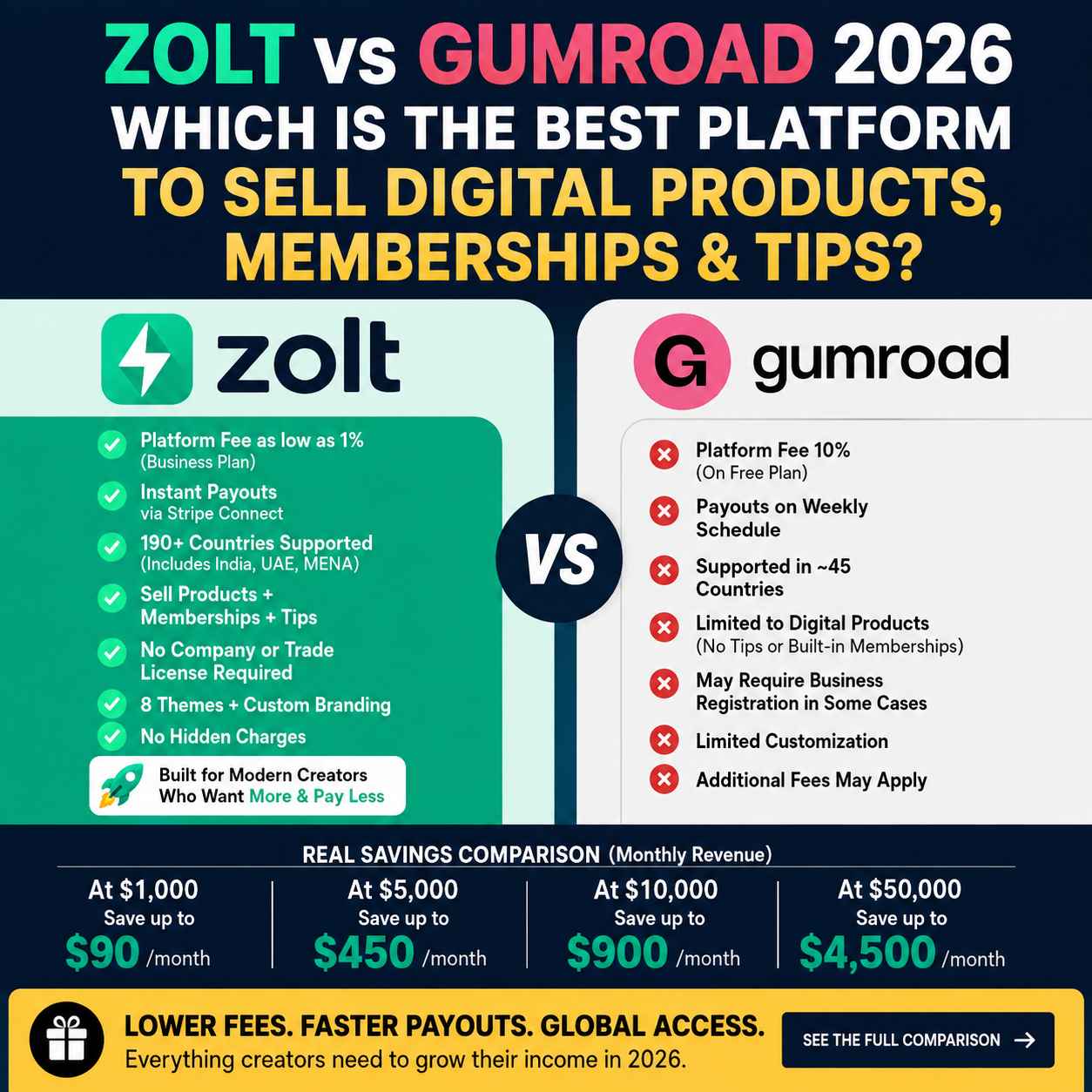
At first glance, Zolt looks significantly cheaper. Its platform fees range from 8% on the free plan to 1% on the Business plan, while Gumroad currently charges 10% + $0.50 per direct sale. But platform fees are only one part of the decision.
The more useful question is:
Is Zolt's lower platform cost and broader creator toolkit worth giving up some of the infrastructure and tax simplicity that Gumroad provides?
This Zolt vs Gumroad comparison looks at pricing, payment processing, payouts, country availability, products, memberships, customization, taxes, limitations, and which platform makes more sense for different types of creators.
Thinking about moving away from Gumroad? Explore Zolt for yourself and see whether its lower platform fees, memberships, tips, and Stripe-powered payouts fit the way you sell online.
Zolt vs Gumroad at a Glance
| Feature | Zolt | Gumroad |
|---|---|---|
| Free plan | Yes | Yes |
| Platform fee | 8% Free; 5% Starter; 2% Pro; 1% Business | 10% + $0.50 per direct sale |
| Monthly plans | $0, $5, $15, $49 | No monthly platform fee |
| Payment processing | Stripe processing applies separately | Included in Gumroad's transaction economics |
| Digital products | Yes | Yes |
| Tips | Yes | Not its primary model |
| Paid memberships | Yes | Limited compared with dedicated membership platforms |
| Creator page | Yes | Yes |
| Themes/customization | 8 themes and customization | More storefront-focused |
| Embedding | Yes | Yes |
| Payout infrastructure | Stripe Connect | Gumroad payout system |
| Sales-tax handling | Creator responsibility should be assessed separately | Gumroad acts as Merchant of Record |
| Buyer countries | Zolt says 190+ | Global reach, subject to payment availability |
| Creator payout countries | 46+ via Stripe Connect, according to Zolt | Country-specific bank/PayPal availability |
| Physical products | No | Primarily digital/creator products |
| Best for | Creators wanting low fees + products + tips + memberships | Creators wanting a mature digital-commerce platform with tax handling |
If you’re still deciding which platform deserves a place in your creator business, our [Best Gumroad Alternatives in 2026] comparison looks beyond Zolt and compares other options based on the type of products and business you want to build.
See which Gumroad alternatives are actually worth considering →
Zolt's current public pricing and feature information confirms the four plans and Stripe-powered payout structure. Gumroad's official pricing currently lists 10% + $0.50 for direct/profile sales and 30% for Discover marketplace sales.
What Is Zolt?
Zolt is a creator monetization platform designed to put several revenue streams on one page.
Creators can use it to:
- Sell digital products
- Accept tips
- Run paid memberships
- Create a customizable creator page
- Embed payment functionality on another website
- Track analytics
- Connect Stripe for payouts
Zolt currently promotes eight customizable themes and describes its platform as an all-in-one alternative to services such as Gumroad, Patreon, Ko-fi, and Buy Me a Coffee.
Its positioning is particularly interesting for independent creators who do not want to build a complete ecommerce stack.
A writer, designer, developer, educator, coach, musician, or content creator could theoretically use one Zolt page for products, recurring memberships, and direct audience support.
That is a broader proposition than simply being a digital-download storefront.
What Is Gumroad?
Gumroad is one of the better-known platforms for selling digital products directly to an audience.
Creators can sell products such as:
- Ebooks
- Templates
- Courses
- Design assets
- Software
- Music
- Videos
- Other digital downloads
Gumroad's model is straightforward: there is no monthly platform subscription, but direct/profile sales currently carry a 10% + $0.50 transaction fee. Sales generated through Gumroad Discover carry a 30% fee.Where Gumroad becomes particularly interesting is taxation.
Gumroad states that it acts as the Merchant of Record and handles worldwide sales-tax collection and remittance. That can remove a substantial administrative burden for creators selling internationally.
That distinction matters when comparing Gumroad with a lower-fee platform.
Zolt vs Gumroad Pricing
Pricing is probably the biggest reason creators will compare these two platforms.
Zolt pricing
Zolt currently lists:
| Plan | Monthly price | Platform fee |
|---|---|---|
| Free | $0 | 8% |
| Starter | $5 | 5% |
| Pro | $15 | 2% |
| Business | $49 | 1% |
Zolt also states that Stripe's standard processing fee applies separately. Its public pricing currently describes that processing as approximately 2.9% + $0.30, although actual Stripe costs can vary by payment method, country, currency, and other factors.
Gumroad pricing
Gumroad currently charges:
- 10% + $0.50 per direct/profile sale
- 30% for sales through Discover
- No monthly platform subscription
Gumroad also states that it handles sales-tax obligations worldwide as Merchant of Record.
The important distinction
It would be misleading to simply say:
"Zolt is 1% and Gumroad is 10%."
That is only part of the picture.
Zolt's 1% rate requires its $49/month Business plan. Its Pro plan is 2% plus $15/month, and the free plan is 8%.
Gumroad has no monthly subscription but charges a fixed $0.50 on each direct sale in addition to the 10% platform fee.
Payment-processing costs also need to be considered separately when calculating a creator's actual net revenue.
Which Zolt Plan Makes Sense?
For many small creators, Zolt's Free plan is probably the easiest starting point.
At 8%, it has a lower percentage fee than Gumroad's 10% platform fee, although the economics depend on average order value and transaction-processing costs.
The Starter plan costs $5 per month and reduces the platform fee to 5%.
The Pro plan is where Zolt becomes much more interesting for growing creators: $15 per month reduces the platform fee to 2%.
The Business plan drops the platform fee to 1%, but the $49 monthly subscription means it makes the most sense at higher revenue levels.
Approximate Zolt platform-fee breakpoints
Ignoring payment-processing fees:
- Free → Starter: around $167/month
- Starter → Pro: around $333/month
- Pro → Business: around $3,400/month
These are simple mathematical break-even points, not recommendations. A creator should also consider the additional features attached to each plan.
For example, Zolt currently lists 200MB uploads on Pro and 500MB uploads on Business, along with advanced features such as analytics and CSV export.
Zolt vs Gumroad: Which Is Cheaper?
For creators focused purely on platform fees, Zolt can be substantially cheaper once you move onto its Pro or Business plans.
For example, consider $5,000 in monthly sales.
A simplified platform-fee comparison would be:
| Platform | Approximate platform cost* |
|---|---|
| Zolt Free | $400 |
| Zolt Starter | $255 |
| Zolt Pro | $115 |
| Zolt Business | $99 |
| Gumroad direct sales | $500 + $0.50 per transaction |
*Illustrative platform-fee comparison only. It does not represent the creator's complete payment-processing cost, taxes, refunds, chargebacks, currency conversion, or other potential charges.
This is where Zolt's proposition becomes compelling.
But the lower platform fee should not automatically determine the winner.
A creator may reasonably accept Gumroad's higher fee in exchange for having Gumroad handle sales-tax collection and remittance as Merchant of Record.
Zolt vs Gumroad: Payment Processing
This is an area where comparisons can become confusing.
Zolt is built around Stripe Connect. Zolt says payments go through Stripe Connect and Stripe deposits funds to the creator's bank according to the creator's Stripe payout schedule.
That means creators should not interpret "1% Zolt fee" as the complete cost of accepting a payment.
Stripe processing is additional.
Gumroad has a different structure. Its published 10% + $0.50 direct-sale price represents the platform's transaction pricing, while Gumroad handles payment and tax infrastructure as part of its service.
Therefore, when comparing the two, the correct question is not simply:
1% vs 10% — who wins?
It is:
What does the creator actually pay, and what operational responsibilities come with that cost?
Zolt vs Gumroad: Payouts
Zolt's payout model is built around Stripe Connect.
Zolt says Stripe Connect sends earnings to the connected Stripe account and Stripe then deposits funds to the creator's bank according to the creator's chosen payout schedule.
Gumroad currently operates its own payout system. Gumroad's documentation says sales generally remain in the Gumroad balance for at least seven days before becoming eligible for payout, and creators can configure payout schedules such as weekly, monthly, or quarterly where supported. Daily payouts have additional eligibility requirements.
That creates a genuine difference.
Zolt
Best suited to creators who want Stripe-based payout infrastructure.
Gumroad
Better suited to creators who prefer Gumroad to manage more of the payment and commerce infrastructure.
One correction is important here: calling Zolt's system simply "instant bank payouts" can be too broad. Stripe still controls the actual bank payout schedule and country-specific processing. Zolt itself says payouts follow the creator's Stripe schedule.
Zolt vs Gumroad: Countries
This is one of Zolt's more interesting selling points.
Zolt says buyers from 190+ countries can make payments, while creators can receive payouts in countries where Stripe Connect is available, which Zolt currently describes as 46+ countries. India, UAE, UK, US, Canada and Australia are among the countries it specifically identifies.
That distinction is important.
190+ buyer countries does not mean 190+ creator payout countries.
Gumroad also supports a broad range of creator payout countries. Its current help documentation lists direct bank payouts across numerous countries, including India, Australia, Canada, Bangladesh, UAE, UK, Vietnam and others, with PayPal available in some locations where direct bank payouts aren't supported.
So Zolt should not be presented as simply "available in more countries than Gumroad."
The better conclusion is:
Zolt's Stripe Connect model may be particularly attractive to creators in supported countries who want to sell internationally, but creators should verify their specific payout eligibility before switching.
Is Zolt Available in India?
Yes, Zolt currently specifically markets its platform to Indian creators and identifies India as one of its supported Stripe Connect payout countries.
This is potentially significant for Indian creators selling digital products internationally.
Zolt also states that individual creators do not need a company or trade license to begin using the platform, with Stripe handling identity verification and compliance during onboarding.
However, creators should still distinguish between:
- Zolt's platform requirements
- Stripe's verification requirements
- Indian tax obligations
- GST or other applicable business/tax rules
"No company required" does not mean "no tax obligations."
That distinction is important.
Zolt vs Gumroad: Digital Products
Both platforms support digital products.
Zolt currently lists products such as:
- Ebooks
- Templates
- Presets
- Courses
- Design files
- Code
- Music
- Other digital downloads
It also provides automated digital delivery.
Gumroad has a much longer history as a digital-product platform and remains a straightforward option for creators whose main requirement is selling downloadable products.
Winner: Gumroad for maturity
Winner: Zolt for broader creator monetization
If you only need a storefront for digital products, Gumroad remains difficult to dismiss.
If you want products plus tips plus memberships on one page, Zolt's broader positioning becomes more compelling.
Zolt vs Gumroad: Memberships
This is one of Zolt's clearest differentiators.
Zolt supports paid memberships alongside digital products and tips.
Gumroad is fundamentally better known for digital-product commerce rather than being a dedicated membership community platform.
That means a creator who wants:
Product + tip jar + recurring membership
may find Zolt's single-page approach attractive.
However, creators running sophisticated communities, extensive member content, video libraries, or advanced community features may still need a dedicated membership platform.
Zolt is not automatically a replacement for every Patreon-style business.
Zolt vs Gumroad: Customization
Zolt currently promotes:
- 8 themes
- Custom colors
- Creator branding
- Social links
- A page builder
- Embedding on external websites
It also says custom domains are planned for Pro and Business, but that feature is currently listed as coming soon.
That makes Zolt appealing to creators who care about building a branded home for their audience.
Gumroad is more established around its storefront and product-selling workflow.
Winner for customization: Zolt
Winner for established digital-commerce workflow: Gumroad
What About Taxes?
This is arguably the most important section of the entire comparison.
Gumroad currently operates as a Merchant of Record and says it handles worldwide sales-tax collection and remittance.
That is a meaningful benefit.
Creators often focus on the difference between a 1%, 2%, 5%, or 10% platform fee without considering the administrative work associated with international digital sales.
A lower platform fee is not necessarily cheaper if the creator has to take on significant additional compliance responsibilities.
Zolt's public materials focus heavily on Stripe-powered payments and creator onboarding. Creators considering Zolt should therefore understand their own tax and compliance responsibilities rather than assuming that Zolt provides the same Merchant of Record service as Gumroad.
This is where Gumroad has a major advantage.
For creators who value administrative simplicity and worldwide sales-tax handling, Gumroad can justify its higher platform fee.
Zolt vs Gumroad: What Can You Sell?
| Selling option | Zolt | Gumroad |
|---|---|---|
| Digital downloads | Yes | Yes |
| Templates | Yes | Yes |
| Ebooks | Yes | Yes |
| Courses/digital materials | Yes | Yes |
| Tips | Yes | Not its primary model |
| Memberships | Yes | Less central |
| Physical products | No | Not its core focus |
| Digital subscriptions | Yes, through memberships | Available through its creator-commerce model |
| Embeddable selling | Yes | Yes |
Zolt is deliberately trying to combine several creator monetization models into one platform.
Zolt isn't the only option for creators who want to combine digital products and memberships; if you’re looking for another creator-focused platform with a more established digital-storefront approach, our [Payhip review for 2026] takes a closer look at where it fits.
See whether Payhip could be the better fit for your digital business →
Zolt vs Gumroad: File Limits
Zolt currently lists:
- Starter: 100MB uploads
- Pro: 200MB uploads
- Business: 500MB uploads
These limits matter if you sell large design files, media assets, software packages, or other heavy downloads.
For ordinary ebooks, templates, PDFs, spreadsheets and smaller digital products, these limits are unlikely to be a deciding factor.
Creators selling large files should check the current limits before committing to a plan.
What Zolt Does Not Currently Offer
Zolt is not a perfect Gumroad replacement.Its current public information identifies several limitations:
- Stripe Connect is required for payouts.
- Creator payout availability depends on Stripe Connect support in the creator's country.
- Physical product shipping is not its focus.
- Cryptocurrency payments are not currently offered by Zolt.
- Custom domain support is still listed as coming soon.
- Higher upload limits require higher plans.
Those limitations should be part of the buying decision.
What Gumroad Does Better
Despite Zolt's attractive pricing, Gumroad still has several important advantages.
1. Merchant of Record tax handling
This is probably the biggest one.Gumroad handles worldwide sales-tax collection and remittance as Merchant of Record.
2. Established ecosystem
Gumroad has been around considerably longer and has a large existing creator base.
3. Discover marketplace
Gumroad can generate sales through its Discover marketplace, although those sales carry a much higher 30% transaction fee.
4. Mature digital-product infrastructure
If your entire business revolves around selling digital products, Gumroad's simplicity is still a strength.
5. No monthly subscription
Gumroad's basic pricing model does not require choosing between Free, Starter, Pro, and Business plans.
You pay when you sell.
What Zolt Does Better
Zolt's strongest advantages are different.
1. Lower platform fees at higher volumes
The Pro and Business plans can dramatically reduce the percentage paid to the platform.
2. Tips + products + memberships
Zolt puts these revenue models together on one creator page.
3. Stripe Connect
Creators who prefer Stripe's ecosystem may appreciate the direct integration.
4. More customizable creator pages
The eight themes and page customization provide more room for branding.
5. Strong international positioning
Zolt specifically targets creators in markets such as India and the UAE, while supporting payments from buyers in 190+ countries according to its current public information.
Zolt vs Gumroad: Which Should You Choose?
There isn't one universal winner.
Choose Zolt if:
- You want lower platform fees as your revenue grows.
- You want tips, products and memberships in one place.
- You already use Stripe or prefer Stripe-powered payments.
- You want a more customizable creator page.
- You are an individual creator who doesn't want to establish a company solely to start selling.
- You are located in a Stripe Connect-supported country.
- You want to build several revenue streams around one creator link.
Choose Gumroad if:
- You want a mature digital-product platform.
- You value Merchant of Record tax handling.
- You want Gumroad to manage worldwide sales-tax collection and remittance.
- You want access to Gumroad Discover.
- You prefer a straightforward no-monthly-subscription model.
- Your business is primarily focused on selling digital products.
If your digital product business is moving toward structured courses, coaching, or a branded learning experience, the decision changes considerably — our [LearnWorlds vs Gumroad comparison] explains where a dedicated learning platform starts to make more sense.
See which platform makes more sense for a serious course business →
Zolt vs Gumroad for Indian Creators
For Indian creators, Zolt deserves a closer look.
Zolt currently identifies India as a supported creator payout market through Stripe Connect.
Its combination of:
- Digital products
- Tips
- Memberships
- Stripe payments
- International buyers
- Individual creator onboarding
could make it attractive to Indian freelancers, educators, designers, developers, bloggers, YouTubers and other independent creators.
Gumroad also supports bank payouts in India according to its current payout documentation.
So the decision for an Indian creator isn't simply about availability.
The more important question is whether the creator values lower platform fees and a Stripe-first model or Gumroad's Merchant of Record infrastructure and established ecosystem.
Zolt vs Gumroad: Our Verdict
Zolt is the more interesting choice for creators who are optimizing for lower platform fees and multiple revenue streams. Gumroad remains the stronger choice for creators who prioritize an established platform and simplified international sales-tax handling.
That distinction is important.
Zolt's 1% Business fee looks impressive, but most creators should not immediately jump to the Business plan. The Pro plan at $15/month and 2% platform fee may be the more interesting middle ground for creators generating meaningful revenue. Zolt's Free plan also provides a relatively low-risk way to test the platform before committing to a paid plan.
Gumroad, meanwhile, continues to make a strong case for its higher transaction cost because it does more than simply provide a storefront. Its Merchant of Record model can take a substantial tax-compliance burden away from creators.
Our overall assessment
Zolt wins on:
- Platform-fee flexibility
- Products + tips + memberships
- Creator-page customization
- Stripe Connect integration
- Appeal to international independent creators
Gumroad wins on:
- Merchant of Record tax handling
- Established ecosystem
- Digital-product maturity
- Discover marketplace
- Simple pay-as-you-sell pricing
Bottom line
If you're a creator who wants to keep more of your revenue and combine products, tips and memberships under one link, Zolt is worth testing in 2026.
If you want a proven digital-commerce platform that takes responsibility for worldwide sales-tax collection and remittance, Gumroad remains difficult to beat.
The best choice depends less on the headline platform fee and more on how you sell, where your customers are located, how much you earn, and how much tax/compliance work you want the platform to handle.
Still deciding between the two? See the full Zolt vs Gumroad comparison before you choose the platform that will handle your digital sales.
Frequently Asked Questions
Is Zolt cheaper than Gumroad?
Potentially, yes. Zolt's platform fees range from 8% on its Free plan to 1% on its Business plan, while Gumroad currently charges 10% + $0.50 for direct/profile sales. However, Zolt's Stripe processing fees apply separately, and the total cost depends on transaction size, payment method and plan.
Is Zolt a good Gumroad alternative in 2026?
Yes, particularly for creators who want digital products, tips and memberships on one page and prefer a Stripe Connect-based payout system. It is less compelling for creators who place a high value on Gumroad's Merchant of Record tax handling.
Does Zolt require a company?
Zolt says individual creators can sign up without company registration or a trade license, with Stripe handling identity verification and compliance during Connect onboarding. However, this does not eliminate the creator's own tax or regulatory responsibilities.
Does Zolt support India?
Yes. Zolt currently lists India among the countries where creators can receive payouts through Stripe Connect.
Does Gumroad support India?
Yes. Gumroad's current payout documentation lists India among its supported bank-payout countries.
Does Zolt handle sales tax like Gumroad?
Creators should not assume that Zolt provides the same Merchant of Record service as Gumroad. Gumroad explicitly states that it handles worldwide sales-tax collection and remittance as Merchant of Record.
Does Zolt support memberships?
Yes. Zolt currently supports paid monthly memberships alongside digital products and tips.
Does Gumroad charge a monthly fee?
No. Gumroad's current pricing does not charge a monthly platform subscription. Instead, it charges 10% + $0.50 on direct/profile sales and 30% on Discover sales.
#Zolt #Gumroad #CreatorEconomy #DigitalProducts #OnlineBusiness #CreatorTools
Editorial Note
Pricing, features, payout availability and platform policies can change. This comparison reflects information publicly available from the platforms' official websites and help documentation at the time of publication. Zolt's product information was also supplied to Kuruntha for editorial evaluation, but competitor claims were independently checked against official sources.
For creators making a final decision, check the platform's current pricing, payout eligibility, payment-processing rates and applicable tax requirements before switching.
Related reading: [Best Gumroad Alternatives in 2026: 3 Platforms Worth Switching To]
Disclosure:
This article may contain affiliate links. If you choose a service through our links, we may earn a commission at no extra cost to you.
This article was created with AI-assisted research and carefully reviewed by our in-house team before publication