AI Hiring Workflow in 2026: From AI Recruitment to Global Compliance & Payroll
AI Hiring Workflow in 2026: From AI Recruitment to Global Compliance & Payroll
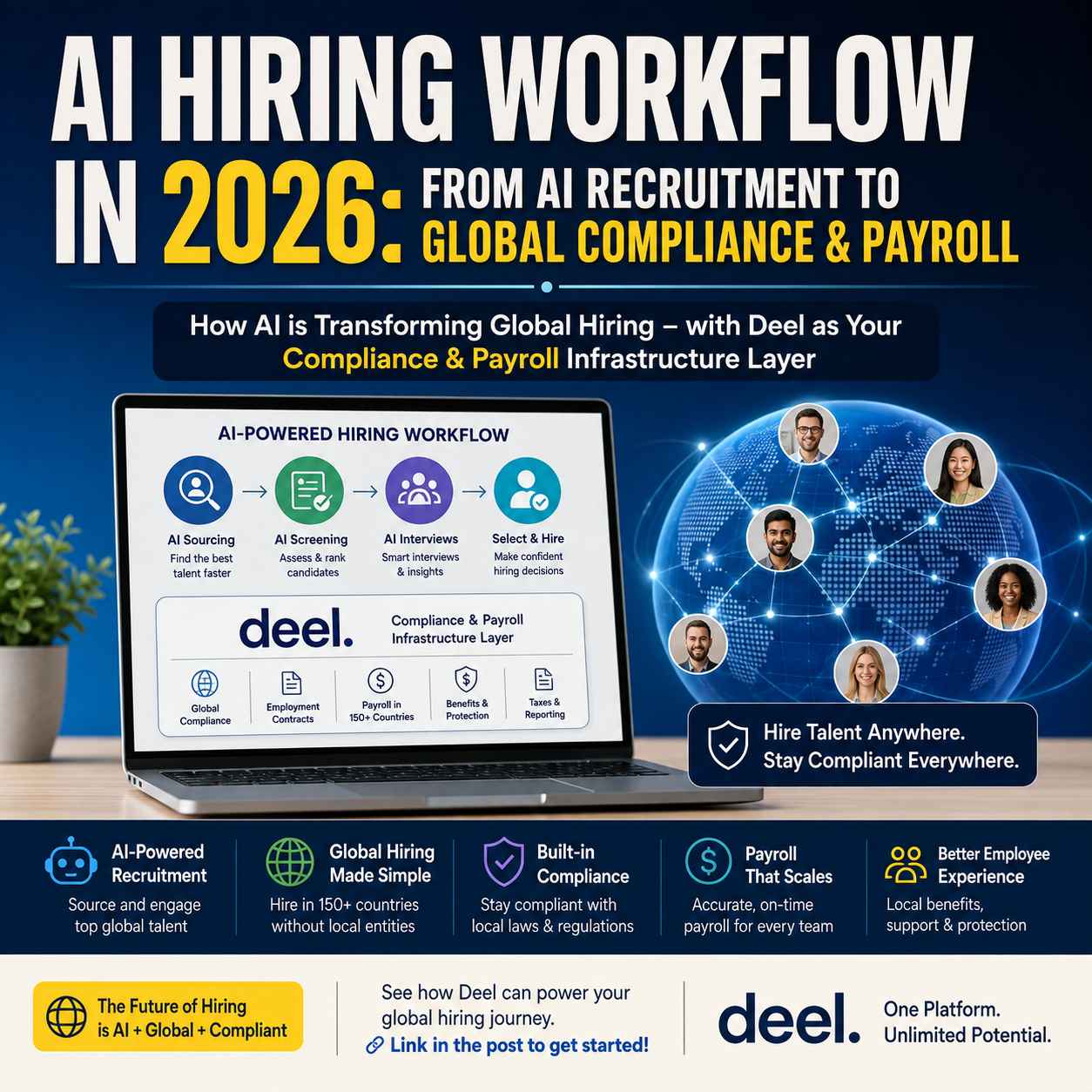
An AI hiring workflow is a structured recruitment process that uses artificial intelligence to assist with tasks such as job description creation, talent sourcing, candidate matching, application screening, interview scheduling, skills assessment and recruitment analysis, while humans remain responsible for important employment decisions. In global hiring, the workflow should extend beyond recruitment into worker classification, employment contracts, local compliance, onboarding and payroll. AI can accelerate the front end of hiring, but compliant global employment still requires reliable legal, HR and payroll infrastructure.
Hiring has entered a new operating model.
Artificial intelligence can now help recruiters identify candidates, analyze applications, generate job descriptions, summarize interviews and surface potential matches much faster than traditional manual workflows. But there is a critical distinction that businesses need to understand:
AI can accelerate the hiring decision. It does not remove the responsibilities that begin after the hiring decision.
That distinction becomes even more important when the candidate is located in another country.
A company may find an outstanding developer in India, a sales specialist in Germany, a customer-success professional in the Philippines or an AI specialist in Canada within hours. The difficult part may begin after the candidate says yes.
Which employment model applies?
Who handles the contract?
What local employment rules apply?
How are taxes and statutory benefits handled?
Who manages payroll?
What happens if the company has no legal entity in that country?
That is why the modern hiring stack should not stop at AI recruitment.
It should connect AI-powered talent acquisition with compliant global employment infrastructure.
For companies building international teams in 2026, that is the real AI hiring workflow.
Ready to connect AI-driven recruitment with compliant global employment?
Why AI Is Changing Hiring in 2026
AI is not simply replacing individual recruitment tasks. It is changing the economics and structure of talent acquisition.
PwC's 2026 Global AI Jobs Barometer analyzed more than one billion job advertisements across 27 countries and found that jobs requiring specific AI skills were growing approximately eight times faster than the overall jobs market. It also reported a 62% average wage premium for AI skills.
The same research found that the skills required for the most AI-exposed jobs were changing more than twice as quickly as those required for the least AI-exposed jobs.
That creates a practical problem for employers.
The challenge is no longer simply:
"Where can we find candidates?"
It is increasingly:
"How can we identify the right skills, evaluate them effectively, hire the right person and employ that person compliantly wherever they are located?"
This is where an AI hiring workflow becomes valuable.
AI is also changing workforce policy, job design, and the way companies think about responsible adoption. For a broader look at these developments, explore our guide to AI and the future of work, including what the Deel AI Policy Summit 2026 highlights for employers planning their next workforce strategy.
The Modern AI Hiring Stack
A practical 2026 hiring stack can be viewed as seven connected layers:
- Workforce planning
- AI-assisted recruitment
- Candidate screening and assessment
- Human evaluation and decision-making
- Global employment and compliance
- Onboarding and workforce management
- Payroll and ongoing administration
The first three layers are where AI can dramatically improve speed and efficiency.
The final layers are where employment infrastructure becomes essential.
The winning companies will not treat these as separate systems.
They will design the entire workflow.
1. Start With Workforce Planning, Not Recruitment
The first mistake companies make with AI hiring is starting with the job advertisement.
The better approach starts with the business problem.
Before recruiting, determine:
- What outcome does the company need?
- Which skills are genuinely required?
- Which responsibilities can AI automate?
- Which responsibilities require human judgment?
- Is the role permanent, temporary or project-based?
- Should the worker be an employee or contractor?
- Where can the right talent realistically be found?
- What countries can the business support compliantly?
This matters because AI is changing the skills companies need.
PwC's 2026 research found that AI-exposed roles increasingly require human-intensive capabilities such as judgment, creativity and leadership.
In other words, AI does not necessarily make human capability less important.
It can make good human judgment more valuable.
2. Use AI to Build Better Job Descriptions
Once the role is defined, AI can accelerate job-description development.
Recruiters can use AI to:
- Structure job descriptions
- Identify missing competencies
- Convert internal requirements into candidate-friendly language
- Generate role variations
- Create screening questions
- Identify overlapping responsibilities
- Map skills to job requirements
- Improve clarity and consistency
But human review should remain mandatory.
A generated job description can sound polished while still containing unrealistic requirements or unnecessary qualifications.
The objective should not be:
"Let AI write the job description."
It should be:
"Use AI to produce a stronger first draft that a qualified human validates."
That distinction becomes important when hiring decisions have legal and reputational consequences.
3. AI-Powered Talent Sourcing
Traditional recruitment often requires recruiters to search through large candidate pools manually.
AI can reduce that workload.
Depending on the recruitment technology being used, AI can help:
- Match candidates to skills
- Search large talent databases
- Identify transferable capabilities
- Recommend potential candidates
- Prioritize applications
- Personalize outreach
- Identify talent pools in different markets
This is especially useful for global companies.
Instead of limiting recruitment to the local labor market, businesses can search for skills across geographic boundaries.
That is increasingly relevant because international hiring is becoming more specialized.
Deel's 2026 Global Hiring Report analyzed more than one million worker contracts involving 37,000+ companies across 150+ countries. It found that AI trainer roles grew 283% in cross-border hiring during 2025, illustrating how quickly new AI-related talent categories can emerge globally.
The lesson is straightforward:
AI is expanding both the demand for talent and the geographic scope of talent acquisition.
4. AI Candidate Screening: Faster Does Not Mean Automatic
Candidate screening is one of the most obvious areas for AI adoption.
An AI-enabled workflow can potentially help recruiters:
- Organize applications
- Extract skills from resumes
- Compare qualifications against defined criteria
- Identify relevant experience
- Prioritize candidates
- Summarize application information
- Reduce repetitive administrative work
But screening is also one of the areas requiring the greatest caution.
Why?
Because an automated system can reproduce problems contained in the data, assumptions or criteria used to build it.
Current reporting shows growing scrutiny of AI hiring systems around transparency, discrimination and candidate rights. Recent lawsuits and regulatory developments have intensified attention on how automated recruitment systems evaluate applicants.
Therefore, a responsible AI hiring workflow should include:
AI assistance → human review → documented criteria → appropriate oversight
Not:
AI score → automatic rejection → no explanation
5. Human Judgment Remains a Core Part of AI Hiring
The smartest AI hiring strategy is not "remove humans."
It is:
Remove unnecessary administrative work so humans can spend more time on high-value decisions.
Recruiters and hiring managers should still evaluate:
- Communication
- Judgment
- Cultural contribution
- Leadership potential
- Problem-solving ability
- Motivation
- Relevant experience
- Role-specific expertise
This is particularly important because the skills demanded by AI-exposed occupations are changing quickly.
PwC reports that the most AI-exposed jobs are experiencing substantially faster skill transformation and that AI is increasing the importance of human-intensive skills.
That means hiring teams need to become better at assessing humans, not simply better at automating them.
6. From "Candidate Selected" to "Employee Legally Engaged"
This is where many AI hiring discussions stop too early.
The candidate accepts the offer.
Now the business has a different problem.
How should the person be engaged?
There are several possibilities:
- Employee through an existing local entity
- Employee through an Employer of Record
- Independent contractor
- Other legally appropriate employment arrangements depending on jurisdiction
This decision cannot simply be delegated to an AI recruitment system.
Employment classification is jurisdiction-specific, and the consequences of getting it wrong can be significant.
A scalable global hiring workflow therefore needs a clear handoff:
Recruitment technology → employment infrastructure
That is the point where Deel becomes relevant.
7. Why Compliance Is the Missing Layer in Many AI Hiring Stacks
AI can help answer:
"Who should we interview?"
It does not automatically answer:
"How should we legally employ this person in another country?"
Global employment involves issues such as:
- Worker classification
- Employment contracts
- Tax withholding
- Statutory contributions
- Mandatory benefits
- Leave requirements
- Payroll rules
- Local employment regulations
- Termination requirements
- Data and documentation obligations
These requirements vary by jurisdiction and can change over time.
Deel's 2026 global payroll guidance highlights the complexity of country-specific tax rules, minimum wages, benefits, reporting requirements and other payroll obligations.
This is why AI recruitment and global compliance should be viewed as complementary layers rather than competing technologies.
Once AI helps identify the right candidate, the harder operational questions begin: employment classification, local requirements, contracts, taxes, and payroll. Our guide to global payroll and compliance breaks down these challenges and explains why international hiring needs more than a recruitment tool.
8. Where Deel Fits Into the AI Hiring Workflow
Deel should not be presented as an AI recruiting engine replacing every recruitment platform.
That would miss the point.
A better way to understand Deel is as the employment, compliance and payroll infrastructure layer that can follow the recruitment decision.
A simplified workflow looks like this:
AI Hiring Layer
Workforce need
↓
AI-assisted job creation
↓
Talent sourcing
↓
Candidate matching
↓
Screening
↓
Assessment
↓
Human interview
↓
Hiring decision
Global Employment Layer
Country and worker assessment
↓
Employment model
↓
Contract
↓
Compliance
↓
Onboarding
↓
Payroll
↓
Ongoing workforce management
The two layers solve different problems.
That is exactly why they work well together.
9. Employer of Record: The Bridge Between Global Talent and Employment Infrastructure
An Employer of Record, commonly called an EOR, can be useful when a company wants to employ someone in a country where it does not have its own legal entity.
The EOR becomes the legal employer for the employment relationship while the client company generally retains responsibility for the worker's day-to-day role and management.
For a company using AI to discover global talent, this can remove a major operational bottleneck.
Instead of:
Find candidate → establish entity → build payroll → establish compliance → hire
the workflow can become:
Find candidate → select appropriate employment structure → engage through EOR where suitable → onboard → pay
Deel describes its EOR model as supporting international employment while handling local employment infrastructure, payroll and compliance responsibilities.
However, an EOR is not a universal substitute for legal advice. The appropriate employment structure depends on the country, worker relationship, business circumstances and applicable law.
For companies that have identified the right international candidate but don't yet have a legal entity in that country, the next question is how to employ that person compliantly. Our practical guide explains how to hire global teams without setting up local entities, including where an Employer of Record can fit into the expansion process.
10. Global Payroll Is Where the Workflow Becomes Operational
Recruitment gets someone into the company.
Payroll keeps the employment relationship operational.
Once a company has employees in multiple countries, payroll may involve:
- Local currencies
- Tax withholding
- Statutory deductions
- Benefits
- Pay schedules
- Reporting
- Payroll records
- Country-specific requirements
Deel's current global payroll materials emphasize the need to track jurisdiction-specific taxes, reporting requirements, benefits and employment obligations.
For a growing company, managing these processes manually across multiple countries can quickly become a significant operational burden.
That is why payroll should not be treated as an afterthought to AI recruitment.
It is the final operational layer of the hiring workflow.
11. The Complete AI Hiring Workflow for Global Companies
A mature 2026 workflow can therefore look like this:
Step 1: Define the business need
Identify the outcome, responsibilities and required capabilities.
Step 2: Map the skills
Separate AI-automatable tasks from responsibilities requiring human judgment.
Step 3: Build the role
Use AI to help structure the job description and candidate criteria.
Step 4: Source talent
Use recruitment platforms and AI-assisted sourcing to expand the candidate pool.
Step 5: Screen applications
Use AI to organize and prioritize candidates against clearly defined criteria.
Step 6: Assess candidates
Combine structured assessments with human interviews.
Step 7: Make the decision
Keep accountable human decision-makers in the loop.
Step 8: Determine the employment structure
Evaluate employee, contractor or other appropriate arrangements according to local requirements.
Step 9: Establish compliant employment
Use an existing entity or an appropriate EOR solution where suitable.
Step 10: Onboard the worker
Collect documentation, execute the appropriate agreement and establish the employment relationship.
Step 11: Run payroll
Handle compensation, taxes, benefits and required payroll processes.
Step 12: Manage the workforce
Continue with HR administration, compliance monitoring and workforce operations.
This is the AI hiring workflow that actually matters.
12. Why Companies Should Not Build the Entire Stack Themselves
At first glance, it may appear cheaper to assemble individual tools.
One AI recruiting platform.
One applicant tracking system.
One HR system.
One payroll provider.
One local legal adviser.
One contractor platform.
One international payment provider.
One compliance database.
One reporting system.
The problem is not necessarily that any individual tool is bad.
The problem is operational fragmentation.
Every additional system introduces:
- Data handoffs
- Integration requirements
- Duplicate administration
- Security considerations
- Vendor management
- Reconciliation work
- Potential points of failure
For a company hiring in one country, this may be manageable.
For a company hiring across ten, twenty or fifty countries, the complexity becomes much harder to control.
This is why global workforce platforms can have strategic value.
13. What Buyers Should Look for in an AI Hiring Stack
If you are evaluating technology for 2026, don't simply ask:
"Does this platform use AI?"
Ask better questions.
Recruitment
- Does it improve sourcing?
- Does it reduce repetitive screening work?
- Can recruiters understand why candidates are surfaced?
- Are humans still able to review decisions?
Compliance
- How are local employment requirements managed?
- How frequently are regulatory changes incorporated?
- Can the platform support multiple countries?
- Is worker classification addressed?
Employment
- Can the company employ workers where it has no entity?
- Does the platform support EOR arrangements?
- How does onboarding work?
Payroll
- Can payroll be managed across multiple jurisdictions?
- Are local requirements supported?
- Can HR and finance access centralized information?
Scalability
- Can the system support contractors and employees?
- Can the company add countries without rebuilding its infrastructure?
- Does the platform support growing teams?
Governance
- Is there appropriate human oversight?
- Can the company document important decisions?
- Are privacy and security requirements considered?
The strongest stack is not necessarily the one with the most AI features.
It is the one that connects speed, judgment, compliance and execution.
14. AI Hiring and the Future of Global Talent
The global talent market is becoming more skills-driven.
Companies are increasingly able to search beyond their immediate geography.
At the same time, workers with AI capabilities are becoming more valuable.
PwC's 2026 research found a 62% average wage premium for AI skills and reported that AI-skilled jobs were growing dramatically faster than the broader job market.
Deel's global hiring data provides another perspective: AI trainer roles grew 283% in cross-border hiring during 2025, and the company reported more than 70,000 AI trainers across more than 600 organizations in its dataset.
The implication for employers is significant.
The future of hiring may be less about where a candidate lives and more about how effectively a company can discover, evaluate and compliantly engage the right skills.
AI can expand the search.
Global employment infrastructure can make the resulting workforce operational.
15. The Human Side of an AI Hiring Workflow
There is a temptation to think that the future of hiring will become completely automated.
I don't think that is the strongest model.
Hiring is ultimately a decision about people.
AI is excellent at processing information, identifying patterns, summarizing large datasets and accelerating repetitive work.
Humans remain essential for context, judgment, accountability and trust.
That is particularly important when hiring internationally.
A candidate is not simply a data record.
They are a person entering an employment relationship.
The best companies will therefore build workflows where:
AI handles scale.
Humans handle judgment.
Employment infrastructure handles compliance and execution.
That is a far more sustainable model than trying to automate every decision.
16. What AI Hiring Could Mean for Startups
Startups may benefit disproportionately from this model.
A small company may not have:
- A large recruiting department
- International HR specialists
- Payroll teams in multiple countries
- Local legal departments
- Dedicated compliance personnel
Yet it may still need access to global talent.
AI can reduce some of the recruitment workload.
An EOR can potentially reduce the infrastructure required to employ people internationally.
Global payroll technology can reduce administrative fragmentation.
Together, these layers can allow a smaller company to operate with capabilities that historically required a much larger organization.
That is one of the most important strategic consequences of the AI hiring stack.
17. What AI Hiring Means for Enterprises
Enterprises face the opposite challenge.
They may already have recruitment systems, HRIS platforms, payroll infrastructure and local entities.
Their problem is often fragmentation at scale.
For enterprises, AI hiring should therefore be evaluated around:
- Governance
- Integration
- Data consistency
- Compliance visibility
- Workforce analytics
- Security
- Global payroll
- Employee experience
- Auditability
The question becomes less:
"Can AI recruit candidates?"
and more:
"Can our entire workforce operating model safely absorb AI-driven recruitment?"
That is a much more strategic question.
18. The Business Case: Speed Is Only Half the ROI
Companies often calculate recruitment ROI using time-to-hire.
That matters.
But global hiring creates additional costs.
Consider:
Recruitment cost
HR administration
Legal support
Entity setup
Payroll administration
Compliance management
Currency and payment administration
Potential cost of mistakes
The real value of a connected workflow is therefore not merely faster recruitment.It is reducing friction between:
candidate discovery → employment → payroll → workforce management
That is where infrastructure can generate operational leverage.
19. When Should a Company Consider Deel?
Deel may be particularly relevant when a business:
- Wants to hire internationally
- Has employees or contractors in multiple countries
- Wants to expand without immediately establishing local entities
- Needs EOR support
- Needs global payroll capabilities
- Wants centralized workforce operations
- Is scaling a remote or distributed team
- Wants to reduce fragmented global employment administration
Deel's current global hiring materials position its platform around international hiring, workforce management, payroll and related global employment infrastructure.
But buyers should still evaluate their specific country coverage, employment model, pricing and legal requirements before committing.
20. How to Build a Future-Ready AI Hiring Workflow
If you are starting from scratch, don't attempt to automate everything on day one.
Build in layers.
Layer 1 — Recruitment
Choose tools that improve sourcing, screening and candidate management.
Layer 2 — Human governance
Define which decisions require human review.
Layer 3 — Employment
Create a clear process for employee versus contractor engagement.
Layer 4 — Compliance
Establish country-specific compliance controls.
Layer 5 — Payroll
Centralize payroll where practical.
Layer 6 — Workforce management
Connect onboarding, HR operations, documentation and reporting.
Layer 7 — Measurement
Track:
- Time-to-hire
- Quality of hire
- Cost per hire
- Candidate conversion
- Compliance incidents
- Payroll accuracy
- Employee retention
- Geographic hiring performance
This turns AI hiring from an experiment into an operating system.
AI Hiring Workflow: A Practical Example
Imagine a software company needs an AI engineer.
The old workflow might look like:
Write job description → advertise → manually review applications → interview → negotiate → contact lawyers → establish employment structure → onboard → payroll
The AI-enabled workflow can be considerably more streamlined:
Define skills → AI-assisted job creation → AI-supported sourcing → structured screening → human assessment → select candidate → determine employment structure → compliant onboarding → payroll
The important point is that AI improves the front half of the workflow.
Global employment infrastructure manages much of the back half.
That is why the two technologies should not be treated as substitutes.
They solve different problems.
AI Hiring Workflow vs. Traditional Hiring Workflow
| Traditional approach | Modern AI-enabled approach |
|---|---|
| Manual job-description creation | AI-assisted role creation |
| Manual candidate sourcing | AI-assisted talent discovery |
| Resume-by-resume review | AI-supported screening |
| Manual scheduling | Automated workflows |
| Unstructured interviews | Structured assessments |
| Local talent focus | Global talent pools |
| Separate compliance processes | Connected employment infrastructure |
| Fragmented payroll | Centralized global payroll |
| Manual reporting | Automated workforce data |
| Reactive compliance | Continuous compliance processes |
The objective isn't to eliminate recruiters.It is to eliminate unnecessary friction.
A Critical Warning: Don't Let AI Become the Decision Maker
The faster AI hiring becomes, the more important governance becomes.
Businesses should establish clear policies for:
- What AI can do
- What AI cannot do
- Which decisions require human review
- How candidate information is handled
- How automated recommendations are evaluated
- How errors are corrected
- How candidates are treated fairly
This is not bureaucracy for its own sake.
It is risk management.
Recent scrutiny of automated recruitment systems demonstrates why companies should take transparency and discrimination risks seriously.
A responsible hiring workflow should make AI accountable to the hiring process, rather than making the hiring process accountable to an opaque AI system.
Where the Real Competitive Advantage Lies
The biggest advantage of AI hiring isn't simply hiring faster.
It is creating a company that can identify talent faster, evaluate talent intelligently and deploy talent globally without creating operational chaos.
That requires three capabilities:
1. Intelligence
AI helps discover and process information.
2. Judgment
People make important hiring decisions.
3. Infrastructure
Employment, compliance and payroll systems turn those decisions into functioning employment relationships.
Remove any one of the three and the system becomes weaker.
How Deel Fits the Final Mile of AI-Powered Global Hiring
This is the point where Deel deserves consideration.
If AI helps a company identify the right international candidate, the company still needs a reliable way to employ and pay that person.
Deel provides infrastructure around areas such as global hiring, Employer of Record services, contractor management, payroll and workforce operations.
For businesses without local entities, an EOR can be a particularly relevant model because the provider can act as the local legal employer while the client manages the employee's day-to-day work, subject to the applicable arrangement and jurisdiction.
For companies that already have entities, global payroll capabilities can help centralize payroll operations and compliance processes.
The key is not to think of Deel as the AI recruiter.
Think of it as the global employment infrastructure that can sit downstream of an AI-enabled recruitment workflow.
Ready to connect AI-driven recruitment with compliant global employment?
👉 Explore Deel for global hiring
Should You Build an AI Hiring Stack in 2026?
For companies hiring occasionally in one country, a sophisticated stack may be unnecessary.
For businesses hiring continuously across borders, the equation changes.
A scalable AI hiring workflow can help reduce repetitive recruitment work while giving hiring teams access to larger talent pools.
But recruitment is only the beginning.
The real operating challenge begins when the candidate becomes an employee or contractor.
That is why your 2026 hiring strategy should connect:
AI recruitment→ Human decision-making→ Global employment→ Compliance→ Onboarding→ Payroll→ Workforce management
That is the complete AI hiring workflow.
Final Verdict: AI Will Change Hiring, but Infrastructure Will Determine Whether It Scales
AI is transforming recruitment.
It is changing how companies discover candidates, evaluate skills, organize applications and manage hiring workflows.
But AI does not eliminate employment law.
It does not eliminate payroll.It does not eliminate worker classification.
It does not eliminate local employment requirements.
And it certainly does not eliminate the consequences of getting global employment wrong.
The strongest companies in 2026 will therefore avoid treating AI hiring as a standalone recruitment trend.
They will build a connected system.
AI finds and helps evaluate talent.
Humans make accountable decisions.
Global employment infrastructure turns those decisions into compliant working relationships.
Payroll keeps those relationships operational.
For companies building international teams, that final connection may be the difference between simply hiring globally and actually scaling globally.
If your company is already using AI to find talent—or planning to do so—the next question should be simple:
Can your global employment infrastructure move as quickly as your recruitment technology?
If the answer is no, that is the part of your hiring stack worth fixing next.
Ready to build a compliant global team?
👉 Explore Deel for global hiring
Frequently Asked Questions
What is an AI hiring workflow?
An AI hiring workflow is a recruitment process that uses artificial intelligence to assist with activities such as job creation, sourcing, candidate matching, screening, scheduling and assessment. Human decision-makers should remain responsible for consequential employment decisions.
How is AI changing recruitment in 2026?
AI is increasingly being used to accelerate sourcing, candidate screening, job-description creation, scheduling, skills matching and recruitment analysis. At the same time, employers must manage growing expectations around human oversight, transparency and responsible AI use.
Can AI hire employees automatically?
AI can automate or assist with many recruitment tasks, but completely automating consequential employment decisions creates significant governance and fairness concerns. A stronger model combines AI assistance with human review and accountability.
What is an AI hiring workflow for global teams?
For global teams, an AI hiring workflow extends beyond recruitment. It can include workforce planning, AI-assisted sourcing and screening, human evaluation, employment classification, compliant contracts, onboarding, payroll and ongoing workforce management.
How can companies use AI to hire internationally?
Companies can use AI to identify and evaluate talent across larger geographic markets, then use appropriate employment infrastructure to engage workers according to local requirements. The recruitment technology and employment-compliance layers should be treated as separate but connected parts of the workflow.
What is the role of an Employer of Record in AI hiring?
An Employer of Record can provide a legal employment structure for companies hiring workers in countries where they do not have their own local entity, subject to the applicable laws and arrangement. The EOR can handle relevant employment, payroll and compliance responsibilities while the client manages the worker's day-to-day role.
Does AI remove the need for global payroll software?
No. AI can improve recruitment and workforce administration, but employees still need to be paid correctly and in accordance with applicable local requirements. Global payroll remains an important operational layer for internationally distributed teams.
Is Deel an AI recruitment platform?
Deel should not be viewed simply as an AI recruitment platform. Its broader value is global workforce infrastructure covering areas such as international hiring, Employer of Record services, contractor management, payroll and workforce operations.
Is Deel suitable for startups hiring internationally?
Deel can be relevant for startups that need to hire internationally and want employment infrastructure without immediately establishing local entities. The appropriate solution depends on the startup's countries, worker types, business model and specific requirements.
Is Deel suitable for companies that already have international entities?
It can be. Companies with their own entities may have different requirements from businesses using an EOR. Global payroll and workforce-management capabilities can be relevant where organizations need centralized operations across multiple jurisdictions.
What should companies look for in an AI hiring platform?
Look beyond the AI label. Evaluate sourcing, screening, transparency, human oversight, integrations, candidate experience, data governance, reporting and scalability. For international hiring, also evaluate how the recruitment system connects with employment, compliance and payroll infrastructure.
What is the biggest risk of AI hiring?
One of the major risks is treating AI-generated recommendations as unquestionable decisions. Bias, inadequate criteria, poor data and lack of transparency can create serious problems. Human oversight, documented processes and appropriate governance should remain central.
What is the future of global hiring?
The direction is toward increasingly skills-based and technology-assisted recruitment combined with more sophisticated global workforce infrastructure. AI can expand the pool of potential talent, while employment, compliance and payroll systems determine how effectively companies can turn that talent into sustainable global teams.
Related Kuruntha Smarket Guides
If you are researching the global hiring stack, these existing Kuruntha Smarket resources provide useful supporting context:
- Global Payroll & Compliance: Learn why international hiring requires more than simply finding candidates.
- Deel Review for Remote Teams (2026): A broader look at Deel's EOR, payroll and contractor capabilities.
- Deel AI Policy Summit 2026: Background on AI, workforce policy and the future of work.
- Hire Global Teams Without Local Entities: Practical context for companies expanding internationally.
- Global HR Software for International Hiring, Payroll & Compliance: A broader workforce-infrastructure perspective.
The AI hiring revolution is not simply about replacing manual recruitment.
It is about redesigning the entire path from talent discovery to productive employment.
In 2026, the strongest hiring systems will combine AI-powered recruitment with human judgment and dependable global employment infrastructure.
For companies hiring internationally, that means thinking beyond the applicant tracking system.
Think:
AI recruitment → human evaluation → compliant employment → onboarding → payroll → workforce management.
That is the AI hiring workflow built for global growth.
Disclosure:
This article may contain affiliate links. If you choose a service through our links, we may earn a commission at no extra cost to you.
This article was created with AI-assisted research and carefully reviewed by our in-house team before publication
#AIHiring #AIHiringWorkflow #AIRecruitment #GlobalHiring #InternationalHiring #AIRecruitment2026 #FutureOfWork #TalentAcquisition #GlobalWorkforce #AIHR #HRTech #HiringTechnology #GlobalPayroll #PayrollAutomation #EmployerOfRecord #EOR #GlobalCompliance #HiringCompliance #RemoteWorkforce #WorkforceManagement #InternationalPayroll #GlobalHR #AIJobs #TalentManagement #BusinessGrowth #StartupHiring #RemoteHiring #DigitalBusiness #Deel #KurunthaSmarket