AI Salesforce Chat Automation: How Businesses Are Turning Conversations Into Revenue
AI Salesforce Chat Automation: How Businesses Are Turning Conversations Into Revenue
Artificial intelligence is everywhere right now. Every software company claims to have “AI-powered” tools, smarter workflows, and automated experiences. Buyers have seen the buzzwords. What they actually want now is proof.
Can AI reduce workload?
Can it improve conversions?
Can it generate measurable revenue?
That is where AI Salesforce chat automation is starting to separate serious business platforms from marketing hype.
Businesses are no longer looking for chatbots that simply answer questions. They want AI systems that can update CRM records, qualify leads, trigger workflows, support customers, and help sales teams close deals faster — all in real time.
The companies winning today are not the ones talking most loudly about AI. They are the ones using AI to automate real business outcomes.
Curious how AI conversations can automatically update your CRM, qualify leads, and track real revenue impact? Explore how Text turns customer chats into automated business workflows without adding more manual work for your team.
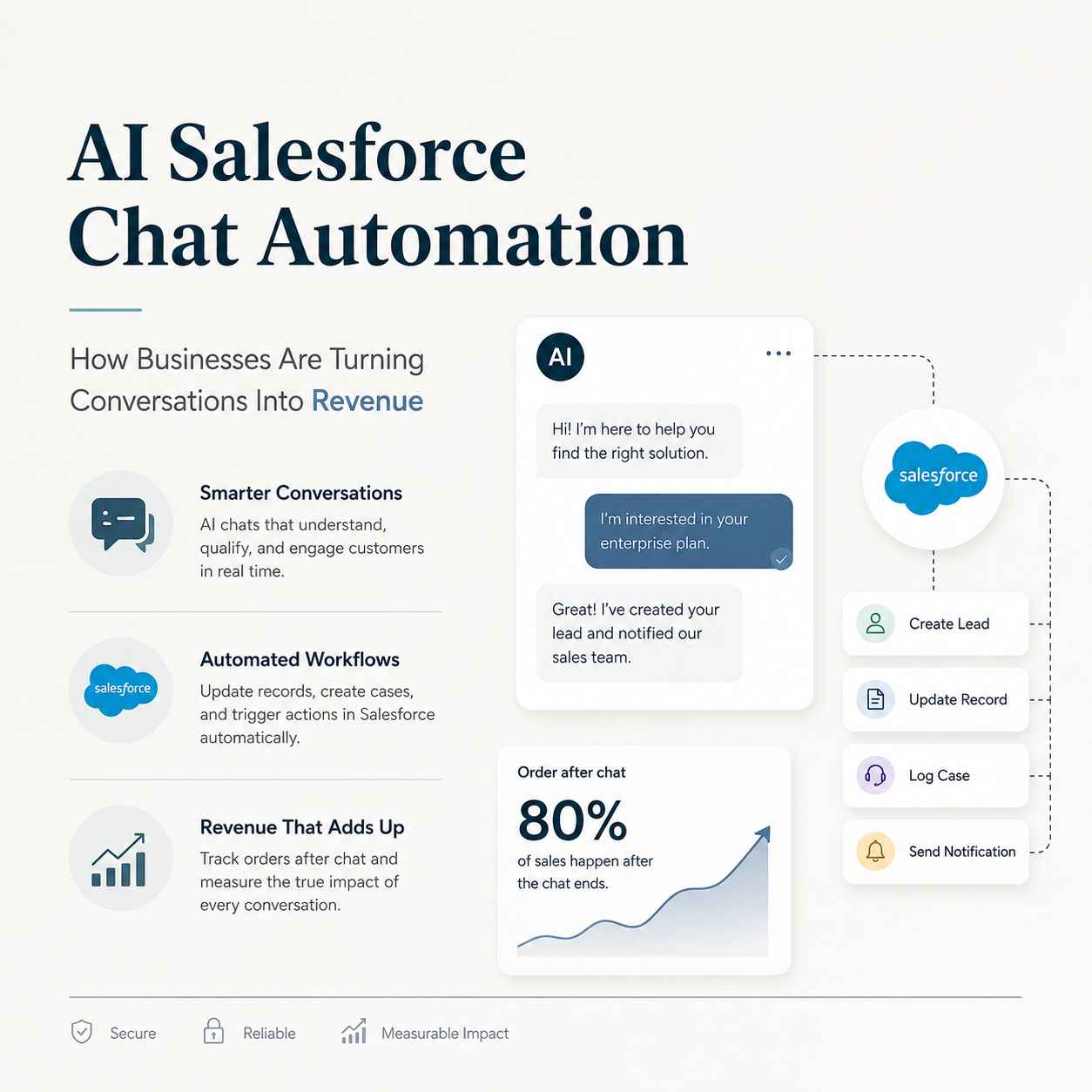
And one of the biggest shifts happening right now is the integration between conversational AI and Salesforce workflows.
Why AI Chat Automation Is Becoming Essential for Modern Businesses
Customer behavior has changed dramatically over the last few years.
People no longer want to:
- wait for support emails
- fill out long forms
- repeat information multiple times
- wait days for sales follow-ups
They expect immediate responses and personalized experiences.
That creates pressure for businesses. Sales teams are overloaded. Support teams are stretched thin. CRM data often becomes outdated because manual updates happen too late — or never happen at all.
Businesses looking to scale faster are increasingly combining AI chat workflows, CRM automation, and customer support systems into one connected growth strategy. Some of the most effective platforms leading this shift are covered in our breakdown of AI business automation tools smart companies are already using to increase revenue.
This is exactly why AI CRM automation is becoming a major growth category.
When AI chat systems connect directly with Salesforce, businesses can automate tasks instantly while conversations are still happening.
Instead of treating chats as isolated interactions, companies can turn every conversation into actionable business data.
That changes everything.
What Is AI Salesforce Chat Automation?
AI Salesforce chat automation connects conversational AI systems with Salesforce workflows so that customer interactions automatically trigger actions inside the CRM.
Instead of manually entering data after a customer interaction, AI handles it automatically.
This can include:
- creating leads
- updating customer records
- logging support tickets
- tracking customer intent
- flagging churn risks
- triggering sales follow-ups
- assigning cases to teams
- identifying upsell opportunities
The biggest advantage is speed.
Businesses can respond to customer behavior in real time rather than hours or days later.
That creates a much better customer experience while also improving operational efficiency.
The Real Problem Businesses Face With CRM Workflows
Most CRM systems are reactive.
A customer chats with support. Then someone manually updates Salesforce later.
A sales conversation happens. Then somebody enters notes afterward.
A support ticket is resolved. Then another team tries to follow up days later.
This delay creates three major problems:
1. Lost Revenue Opportunities
By the time teams respond, the customer may already be gone.
2. Incomplete Customer Data
Manual entry often leads to missing information and inconsistent records.
3. Slower Decision-Making
Leadership teams cannot act quickly because customer insights arrive too late.
AI-powered workflow automation solves this by turning conversations into live business actions.
How Businesses Are Using AI Salesforce Automation Today
The strongest AI workflow platforms are moving beyond simple chatbot functions and becoming operational systems.
Here are some of the most effective use cases businesses are adopting right now.
Automated Lead Capture
When a visitor starts a conversation, AI can:
- collect customer details
- qualify the lead
- create Salesforce records automatically
- route prospects to sales teams instantly
This removes delays that normally reduce conversion rates.
Customer Support Workflow Automation
Support conversations can now:
- create Salesforce cases automatically
- attach conversation history
- prioritize urgent issues
- trigger escalation workflows
Customer expectations are changing fast, and businesses that automate support conversations are gaining a major advantage in response time and customer retention. We recently explored how AI agents are reshaping customer service workflows and helping businesses handle support more efficiently without expanding support teams.
Customers receive faster resolutions while support teams handle more requests efficiently.
Churn Detection & Retention
AI systems can analyze conversation patterns and detect frustration signals.
If a customer appears at risk of leaving, workflows can automatically:
- alert retention teams
- create follow-up tasks
- offer support resources
- trigger personalized outreach
Retention is often more profitable than acquisition. Smart automation protects recurring revenue.
Upsell & Cross-Sell Opportunities
AI conversations reveal customer intent in real time.
Businesses can use this information to:
- recommend upgrades
- suggest premium services
- trigger targeted offers
- personalize follow-up campaigns
That turns support interactions into revenue opportunities instead of cost centers.
Why “Order After Chat” Tracking Changes the ROI Conversation
One of the biggest mistakes businesses make is measuring only immediate conversions.
Many customers do not purchase during the first interaction.
They:
- research
- compare options
- discuss internally
- return later to buy
This is especially common in B2B software and higher-ticket purchases.
Recent AI chat analytics now allow businesses to track revenue generated after conversations end.
This matters because many sales happen hours, days, or even weeks later.In some cases, businesses are discovering that the majority of revenue connected to AI chats happens after the original conversation.
That completely changes how companies evaluate AI ROI.
The question is no longer:
“Did the chatbot close the sale immediately?”
The better question is:
“How much revenue did this conversation influence overall?”
That is a much larger and far more valuable metric.
Why Buyers Are Moving Away From Generic AI Platforms
The market is flooded with AI tools.
Most sound impressive during demos but fail during real operational use.
Businesses are becoming more selective because they need:
- measurable ROI
- workflow integration
- operational automation
- reliable analytics
- scalable customer support
Generic AI tools that only generate responses are no longer enough.
Decision-makers now prioritize platforms that:
- connect with existing systems
- automate business operations
- improve customer retention
- increase revenue attribution
- reduce manual workloads
That is why conversational AI integrated with Salesforce is gaining momentum across industries.
The Competitive Advantage of Real-Time CRM Automation
Speed creates competitive advantage.
When businesses automate CRM workflows during live customer interactions, they can:
- respond faster
- personalize better
- close deals quicker
- reduce operational friction
- improve customer satisfaction
Companies still relying on manual CRM updates will struggle to keep pace.
Modern businesses are no longer separating customer support from revenue operations. AI-powered contact center platforms are now helping teams automate conversations, improve response times, and create faster sales cycles through smarter customer engagement systems.
This shift is similar to what happened with email automation years ago. Early adopters gained a massive efficiency advantage while competitors stayed stuck using manual processes.
AI workflow automation is following the same path.
What Businesses Should Look for in an AI Automation Platform
Not all AI tools are built for serious business growth.
Before choosing a platform, businesses should evaluate whether it can:
Integrate With Salesforce
Native integrations reduce complexity and improve reliability.
Automate Workflows
AI should trigger actions automatically — not just answer questions.
Track Revenue Attribution
Understanding post-chat conversions is critical for accurate ROI measurement.
Scale Across Teams
The platform should support sales, support, marketing, and operations together.
Improve Customer Experience
Automation should make interactions faster and more personalized.
The right AI platform becomes part of the business infrastructure — not just another software tool.
AI Automation Is No Longer Optional
Businesses that delay automation risk falling behind competitors that move faster and operate more efficiently.
Customers now expect:
- instant responses
- personalized support
- seamless communication
- fast resolutions
AI Salesforce chat automation helps businesses meet those expectations while improving internal operations and increasing revenue opportunities.
This is no longer about experimenting with AI.
It is about operational efficiency, customer retention, and scalable growth.
The companies implementing real AI workflow automation today are building systems that will outperform competitors for years.
Final Thoughts
The AI market is crowded with promises.
What businesses need now are platforms that produce measurable outcomes.
AI Salesforce chat automation stands out because it connects conversations directly to business operations.
Every customer interaction becomes an opportunity to:
- improve service
- automate workflows
- update CRM systems
- increase conversions
- track long-term revenue impact
That is the future of conversational AI.
Not more hype.More results.
Frequently Asked Questions (FAQ)
What is AI Salesforce chat automation?
AI Salesforce chat automation connects conversational AI tools with Salesforce workflows to automate CRM actions such as lead creation, customer support case logging, and sales follow-ups in real time.
How does AI CRM automation improve sales conversions?
AI CRM automation reduces delays, improves customer response times, personalizes interactions, and helps businesses follow up faster — all of which improve conversion rates and customer experience.
Can AI chat systems update Salesforce automatically?
Yes. Modern AI workflow platforms can automatically create records, update contacts, assign cases, and trigger workflows directly inside Salesforce during live customer conversations.
Why is post-chat sales tracking important?
Many customers purchase after the initial conversation ends. Post-chat tracking helps businesses measure the true revenue impact of customer conversations instead of focusing only on immediate conversions.
Is AI workflow automation suitable for small businesses?
Yes. Small businesses can use AI automation to reduce manual tasks, improve customer service, streamline sales processes, and compete more efficiently without large support teams.
What industries benefit most from AI Salesforce automation?
Industries with customer support, lead generation, and CRM-heavy operations benefit significantly, including SaaS, healthcare, ecommerce, consulting, finance, education, and B2B services.
Most AI tools stop at conversations. The smarter platforms turn conversations into measurable revenue, automated Salesforce actions, and faster customer decisions. If your business is still handling CRM updates and follow-ups manually, this is the moment to see what modern AI workflow automation actually looks like in practice.
#AISalesforceAutomation #AIWorkflowAutomation #SalesforceAI #ConversationalAI #CRMautomation #AICustomerSupport #AIforBusiness #SalesAutomation #BusinessAutomation #AIChatbots #CustomerExperience #LeadGeneration #RevenueGrowth #DigitalTransformation #AIIntegration #SmartAutomation #B2BSaaS #CustomerRetention #WorkflowAutomation #AIRevenueGrowth
Disclosure:
This article may contain affiliate links. If you choose a service through our links, we may earn a commission at no extra cost to you.
This article was created with AI-assisted research and carefully reviewed by our in-house team before publication