Curiosity Box Review 2026: Pricing & Camera Lucida
Curiosity Box: What Are You Actually Paying For?
The Curiosity Box is a quarterly science subscription from the creators of Vsauce, with the current plans priced at $75 per box quarterly or $280 per year. The current annual plan includes a free Camera Lucida, while subscribers also receive 10% off Curiosity Box Shop orders. The subscription is best suited to adults, science enthusiasts, collectors and curious learners who value unusual hands-on objects rather than conventional educational kits.
A science subscription box sounds straightforward until you start looking at what is actually being delivered.
Some boxes are primarily children's activity kits. Others are collections of inexpensive novelty products. Curiosity Box takes a different route.
The service is built around limited-edition science toys, experiments, puzzles, books, collectibles and other objects designed around scientific ideas.
The connection to Vsauce is part of the appeal, but the more important question for a buyer is what happens after the box arrives.
Do the objects actually give you something to explore?
Do they have enough substance to justify another subscription charge?
And does the annual plan make more sense than paying quarterly?
Those are better questions than simply asking whether the box looks interesting.
Current verdict: Curiosity Box makes the most sense for someone who enjoys science as a hobby and wants physical objects that encourage experimentation, discussion and curiosity. It is less compelling for someone looking for a structured science curriculum or a conventional children's STEM activity kit.
If the annual plan already fits what you want from Curiosity Box, it is worth checking the current annual subscription and Camera Lucida offer before choosing between annual and quarterly billing.
Current Curiosity Box Pricing
Curiosity Box currently offers two main subscription choices.
| Plan | Current price | Billing | Current benefit |
|---|---|---|---|
| Quarterly | $75 per box | Every 3 months | 10% off Shop orders |
| Annual | $280 | Charged annually | Free Camera Lucida + 10% off Shop orders |
The annual price works out to $70 per scheduled box, compared with $75 for the quarterly plan.
That means the annual subscription saves $20 against four quarterly payments before considering the value of the Camera Lucida.
However, there is an important distinction here.
The annual plan requires $280 upfront. The quarterly option costs more over a full year, but it gives the buyer a smaller financial commitment and more frequent opportunities to reconsider the subscription.
For someone who already knows they want Curiosity Box, the annual plan is the stronger value proposition.
For someone testing the concept for the first time, quarterly is the lower-commitment route.
The Current Annual Offer: Free Camera Lucida
This is the part of the current promotion that deserves attention.
Curiosity Box is currently advertising a free Camera Lucida for annual subscribers.
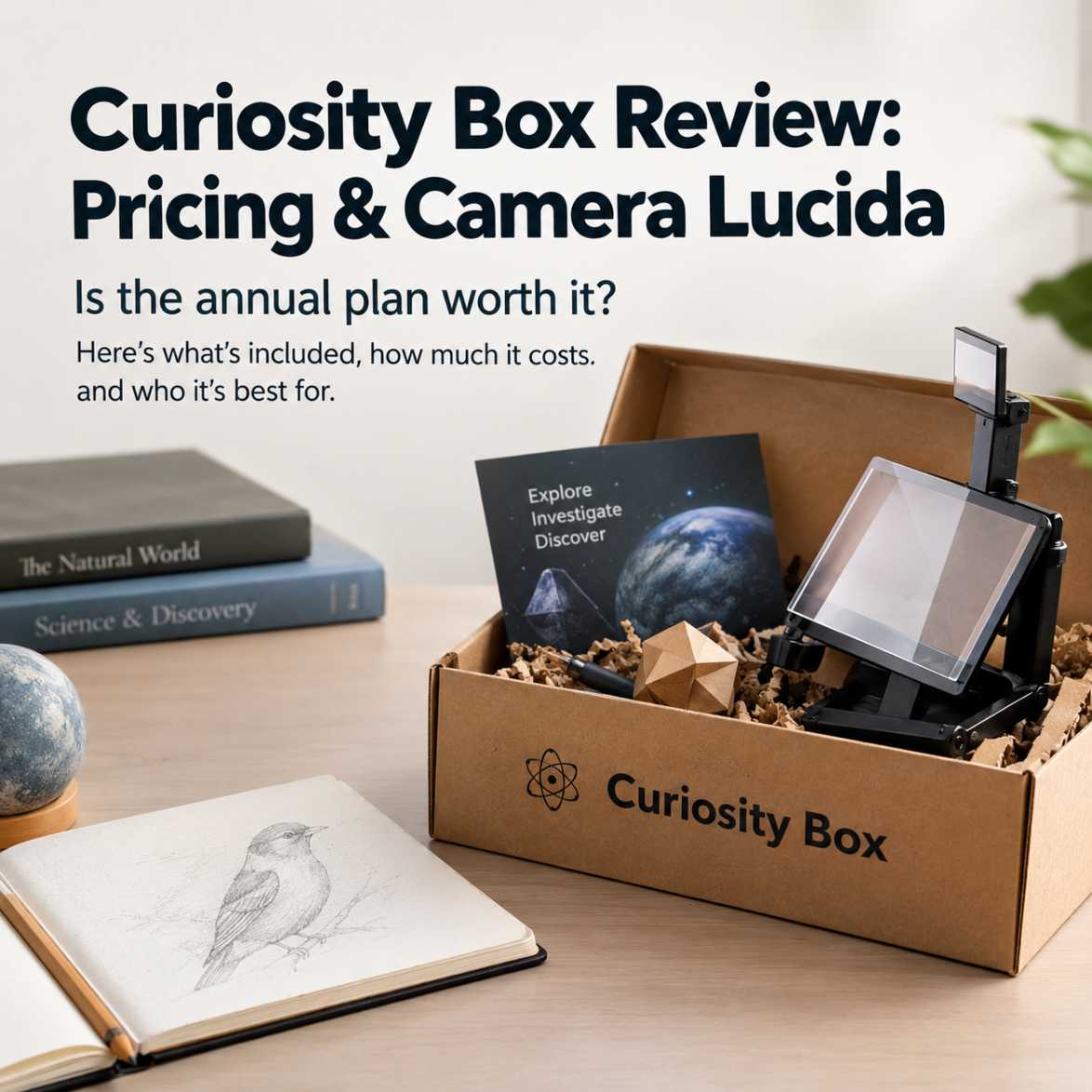
The Camera Lucida is an optical drawing tool that uses optics to superimpose an image of the subject onto paper, allowing the user to trace it. The current Curiosity Box version includes built-in polarizing filters for adjusting the visibility of the projected image.
The standalone product page currently lists the Camera Lucida at $49.90, although it is separately shown as a pre-order with a November shipping estimate.
That gives the annual subscription a tangible additional benefit rather than a vague promotional bonus.
But buyers should avoid treating the $49.90 figure as a guaranteed cash saving.
The right way to look at it is:
$280 annual subscription + Camera Lucida included
rather than:
$280 subscription minus $49.90 = guaranteed savings.
The second calculation assumes that you would otherwise have bought the Camera Lucida separately.
If you have no interest in the device, its listed retail price does not automatically make the subscription a better purchase.
What Is Inside a Curiosity Box?
The exact contents change with each seasonal release, which is part of the point.
Curiosity Box describes its boxes as limited-edition collections of science-related objects and says that once a box sells out, it is not made again.
The current Fall 2026 collection illustrates the model well.
It includes items connected with:
- measurement
- mathematics
- photography
- physics
- puzzles
- scientific history
- art
- visual observation
The Fall collection includes the Ruler of the Universe, a snowflake matching game based on Wilson Bentley's photography, a Rutherford-themed shirt, a 60-puzzle hexagram challenge, Leonardo da Vinci material and related stickers.
This is quite different from receiving four nearly identical experiment kits throughout the year.
The subjects move around.
That variety is one of Curiosity Box's biggest strengths, but it is also something prospective subscribers should understand before paying.
You are subscribing to curated intellectual curiosity, not a narrowly defined STEM curriculum.
For a deeper look at the current seasonal collection, Kuruntha's Curiosity Box Fall 2026 review provides a more detailed breakdown of the individual items.
The exact contents change with each seasonal release, so our Curiosity Box Fall 2026 review provides a closer look at what subscribers are actually receiving in the latest collection.
Who Is Curiosity Box Really For?
The marketing can make the product sound broadly suitable for anyone who likes science.The reality is narrower.
I would put the strongest audience into five groups.
1. Curious adults
This is probably the clearest fit.
If you enjoy science documentaries, puzzles, optical illusions, unusual inventions or learning something simply because it is interesting, the subscription makes sense.
2. Science enthusiasts
The boxes are particularly appealing when you enjoy having a physical object connected to a scientific concept.
That makes the subscription different from simply watching educational videos.
3. Collectors
Limited-edition products create another reason to subscribe.
Once a particular box disappears, the collection may become difficult to reproduce later.
4. Gift buyers
A Curiosity Box subscription can work as a recurring gift for someone who is genuinely interested in science, puzzles and intellectual hobbies.
The key word is genuinely.Buying a science-themed subscription for someone who does not enjoy this type of material is unlikely to change their interests.
5. Families that enjoy learning together
Some of the objects can create useful discussion or activities between adults and children.
But I would not classify Curiosity Box as a replacement for a structured educational curriculum.
That distinction matters.
Considering Curiosity Box?
The current annual plan is particularly interesting if you already know you want the subscription and would use the included Camera Lucida. Compare the annual and quarterly commitment before choosing.
Curiosity Box for Adults vs. Kids
One of the more useful distinctions when evaluating Curiosity Box is that it is not simply a children's STEM kit.
The company itself positions the current collection around adult curiosity, scientific principles and intellectual play.
That explains why some of the products are puzzles, historical objects, design pieces, books or collectibles rather than conventional experiment kits.
For younger children, parents may want something more structured.
For adults and older learners, the open-ended nature can actually be the advantage.
There is no expectation that every item becomes a formal lesson.
You can simply pick something up, investigate it and start asking questions.
That is a different kind of educational experience.
Is the Curiosity Box Annual Plan Worth It?
For the right buyer, yes.
But the annual plan should not be judged only by the $70-per-box figure.
There are three separate value calculations.
The subscription value
At $280 per year, the annual plan reduces the advertised per-box price from $75 to $70.
The Camera Lucida
Annual subscribers currently receive the Camera Lucida as the promotional gift.
That makes the annual option more attractive if the device genuinely interests you.
The commitment
The annual payment is made upfront.
That is the trade-off.Someone who is uncertain about Curiosity Box may prefer paying $75 quarterly even though the annual plan has the lower advertised per-box price.
Someone who already knows they enjoy this type of subscription has a stronger reason to choose annual.
My view is simple:
Choose annual for commitment and value. Choose quarterly for flexibility.
The 10% Shop Discount Is Useful — But Don't Let It Distort the Decision
Current subscribers also receive 10% off Curiosity Box Shop orders.
That can be useful if you discover a particular product you want outside the regular subscription.
But it should not be used as a justification for subscribing by itself.
A discount on future purchases only has value if you actually make those purchases.
This is a common subscription trap across many industries: a secondary benefit can make the headline offer look more valuable than it really is for an individual buyer.
Treat the Shop discount as an extra, not the primary reason to subscribe.
What Buyers Should Know Before Subscribing
There are several practical details worth knowing before entering payment information.
The subscription renews automatically
Curiosity Box states that subscriptions automatically renew.
The company's FAQ says quarterly plans renew every three months, while annual subscriptions renew for another year after the four-box subscription term.
Cancellation stops future renewals, but it does not automatically refund charges that have already been processed.
That makes the renewal date worth recording when you subscribe.
Subscription sales are final
The company's current FAQ and terms state that subscription sales are final.
That is materially different from buying an ordinary standalone product where a return policy may apply.
If you are uncertain about the product category, quarterly is the safer way to test the service.
Shipping is additional
Shipping costs can be calculated at checkout.
International customers should pay particular attention to this because the final landed cost can be materially different from the headline subscription price.
Curiosity Box states that it supports international shipping, but the available country list should be checked before assuming delivery is available to a particular destination.
Boxes are seasonal
The company describes the service as four limited-edition boxes per year.
That means the contents are not fixed.
Someone subscribing primarily for one particular item should understand that future boxes will change.
Because the contents change between releases, the Curiosity Box Summer 2026 review is useful for seeing how substantially the subscription can vary from one season to another.
Curiosity Box vs. Buying Individual Science Products
This is where the decision becomes more interesting.
If you only want one particular Curiosity Box product, buying a standalone item may make more sense.
If you enjoy the discovery process itself, the subscription has a stronger proposition.
Think of the two choices this way:
Standalone purchase:
"I know what I want."
Subscription:
"I enjoy finding out what comes next."
That distinction is more important than the advertised dollar value of the contents.
The subscription is designed around discovery.
If discovery is not valuable to you, paying for four boxes a year may feel excessive.
If you are not sure whether Curiosity Box is the right format for the recipient, compare it with other science subscription boxes for adults and kids before committing to an annual subscription.
Is Curiosity Box a Good STEM Gift?
It can be, but I would avoid treating it as a universal STEM gift.
For a child who needs age-specific experiments with clear instructions and measurable learning objectives, there are more specialised options.
For a teenager, adult, science enthusiast, puzzle lover or curious family, the format can be considerably more appealing.
The strongest gift scenario is therefore someone who already has an interest in:
- science
- puzzles
- optical illusions
- unusual inventions
- mathematics
- scientific history
- hands-on exploration
In that situation, the recurring surprise is part of the gift.
Curiosity Box vs. a Traditional Science Kit
The two products solve different problems.
A traditional science kit usually starts with a learning objective.
For example:
Learn about electricity → perform an experiment → observe the result.
Curiosity Box often works in the opposite direction:
Receive an unusual object → investigate it → discover the science behind it.
Neither approach is inherently better.
But they appeal to different learners.
If your priority is curriculum-aligned learning, look at dedicated science education kits.
If your priority is curiosity, unusual objects and intellectual play, Curiosity Box becomes much more interesting.
What I Like About Curiosity Box
The subjects change
The service does not lock itself into one scientific discipline.
That keeps the experience unpredictable.
The products have a story
The stronger items are not simply things with "science" printed on them.
They connect to an idea, historical development, optical principle, mathematical concept or experiment.
It encourages physical interaction
There is value in taking a break from purely digital learning.
A physical object can lead to experimentation in a way that another video does not.
The annual offer has a tangible benefit
The Camera Lucida is a much more meaningful annual-plan incentive than a generic percentage discount if you actually want the product.
What I Would Watch Carefully
The $280 upfront commitment
This is the biggest consideration.
Do not choose annual simply because "$70 per box" sounds cheaper.
You are committing $280 at once.
Automatic renewal
Put the renewal date somewhere you will remember.
The company explicitly states that subscriptions renew automatically.
Shipping
The headline price is not necessarily your final landed cost, particularly for international customers.
Not every item will appeal equally
A curated box inevitably contains something you like more than something else.
If you expect every item to be a personal favourite, the subscription model will disappoint.
Don't confuse it with formal education
Curiosity Box is better understood as science-inspired intellectual play and collecting than as a replacement for a science curriculum.
Current Curiosity Box Offer
As checked for this update, Curiosity Box is currently promoting:
- Quarterly: $75 per box
- Annual: $280 charged annually
- Annual-plan pricing: advertised as $70 per box
- Annual-plan bonus: free Camera Lucida
- Shop benefit: 10% off Curiosity Box Shop orders
- Subscription status: currently shipping
- Offer expiry: no specific end date is shown on the current official pages reviewed
The offer can change without notice, so buyers should verify the checkout page before paying.
The important point is that this is not a Black Friday-only offer with a published deadline. It is the current annual-plan positioning shown by Curiosity Box.
After weighing the pricing, renewal terms, shipping considerations and what you actually want from the boxes, you can compare the current Curiosity Box options and choose the plan that fits your budget and interests.
My Verdict: Is Curiosity Box Worth It?
Yes — but only if you value curiosity more than predictable utility.
That is the central question.
If you want a science box that follows a structured curriculum, Curiosity Box is probably not the first product I would choose.
If you want four opportunities each year to receive unusual science objects, puzzles, experiments and collectibles, the proposition becomes much stronger.
The current annual promotion makes the decision easier for existing fans because the $280 plan combines the lower advertised per-box price with a free Camera Lucida.
For a first-time buyer who is uncertain, I would lean toward the quarterly plan.
For someone who already knows that this type of collection fits their interests, the annual plan is the more compelling option.
And that is ultimately how I would evaluate the current offer:
Don't subscribe because the Camera Lucida is free. Subscribe because you want the Curiosity Box — then treat the Camera Lucida as the bonus.
Ready to compare the current subscription options?
Check the latest Curiosity Box plans, shipping availability and annual-plan terms before completing your order.
Frequently Asked Questions
How much does Curiosity Box cost?
The current Curiosity Box pricing is $75 per box on the quarterly plan or $280 charged annually, which the company presents as $70 per box.
What does the Curiosity Box annual plan include?
The current annual promotion includes the regular Curiosity Box subscription plus a free Camera Lucida. Annual subscribers also receive 10% off Curiosity Box Shop orders.
Is the Camera Lucida included with Curiosity Box?
Yes. Curiosity Box is currently advertising the Camera Lucida as a free gift for annual subscribers.
Can I buy the Camera Lucida separately?
Yes. The current product page lists the Camera Lucida separately at $49.90, although it is currently shown as a pre-order with a November shipping estimate.
How often does Curiosity Box ship?
Curiosity Box describes its service as four limited-edition boxes per year, delivered approximately every three months.
Does Curiosity Box automatically renew?
Yes. Curiosity Box subscriptions automatically renew unless cancelled before the next renewal.
Can I cancel Curiosity Box?
Yes. Curiosity Box says subscribers can cancel future renewals through their account. Cancellation does not refund subscription payments that have already been processed.
Does Curiosity Box ship internationally?
Curiosity Box offers international shipping to a number of countries. Shipping charges vary by destination and are calculated at checkout. Buyers should verify that their specific country is supported before subscribing.
Is Curiosity Box good for kids?
It can be, but its current positioning is particularly strong for adults and older learners who enjoy science, puzzles, experimentation and intellectual curiosity. It should not be confused with a structured curriculum-based STEM kit.
Is Curiosity Box worth the annual price?
For someone who already enjoys science-related collectibles and hands-on exploration, the annual plan can be attractive because it lowers the advertised per-box price to $70 and currently includes the Camera Lucida. Buyers who are uncertain should consider the quarterly plan first.
#CuriosityBox #ScienceSubscriptionBox #STEMGifts #ScienceForAdults #ScienceEducation #Vsauce
Disclosure: Kuruntha may earn a commission if you purchase through a qualifying partner link. This does not change our editorial assessment or the price you pay.

This article was created with AI-assisted research and carefully reviewed by our in-house team before publication