DataCamp $1 Sale 2026: First Month for $1
DataCamp $1 Sale 2026: First Month for $1
What is the DataCamp $1 sale?
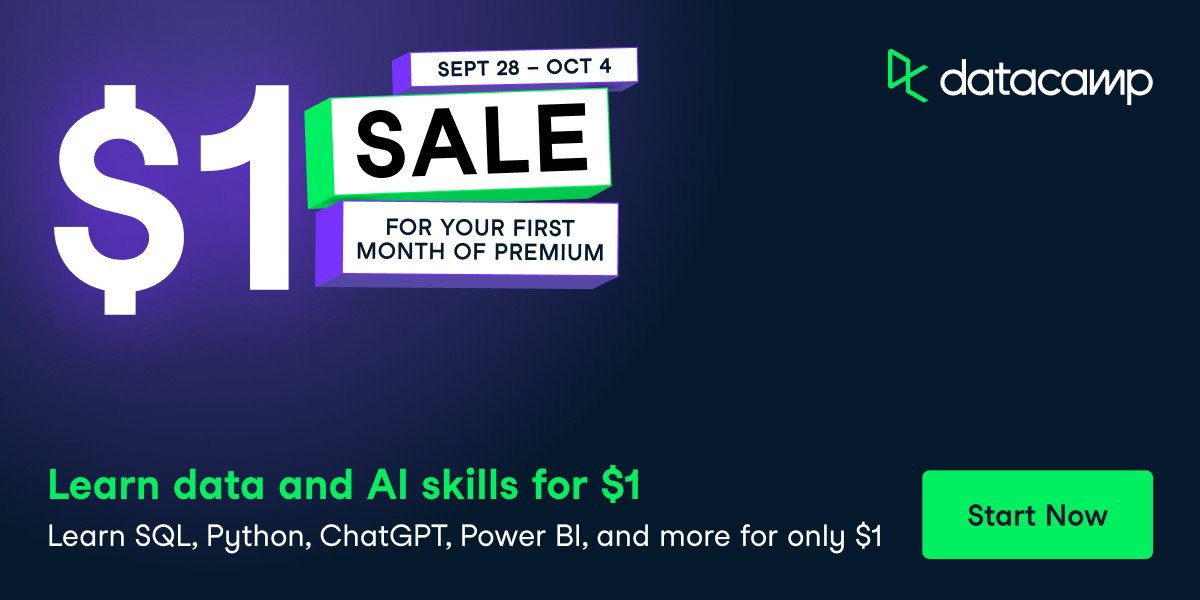
The DataCamp $1 sale is a limited-time promotion offering eligible new subscribers access to DataCamp Premium for $1 during the first month. The current partner campaign is scheduled through October 5, 2026, but buyers should confirm the final price, eligibility, renewal terms and applicable plan at checkout.
If you have been considering DataCamp for learning Python, SQL, AI, Power BI, Tableau or data analytics, the current DataCamp $1 sale changes the economics of trying the platform.
According to the current partner promotion, eligible customers can get their first month of DataCamp Premium for $1, with the campaign scheduled to run through October 5, 2026 at 23:59 EST. The exact promotional price and eligibility should be confirmed on the offer page before payment.
The bigger question, however, is not whether $1 is cheap.It obviously is.
The more useful question is whether DataCamp Premium is worth continuing after the promotional month.
DataCamp currently lists 790+ courses covering data, AI, cloud and software-related skills, along with projects, career and skill tracks, certificates and industry certifications.
That makes this more than a simple discount announcement. It is an opportunity to test whether a structured, interactive learning platform fits your learning goals before committing more money.
Editor's note: The $1 price and October 5 deadline come from the current partner promotion. Promotional eligibility, applicable plans and final checkout pricing can change, so verify the live offer before purchasing.
If you have a specific data, AI, Python or SQL skill you want to build, check the current DataCamp $1 offer and review the applicable terms before subscribing.

Investigate the current $1 opportunity
DataCamp $1 Sale at a Glance
| Detail | Current information |
|---|---|
| Promotion | DataCamp Premium first month for $1 |
| Current campaign | September/October 2026 promotion |
| End date | October 5, 2026 |
| End time | 23:59 EST |
| Platform | DataCamp |
| Main subjects | AI, Python, SQL, Power BI, Tableau, data analytics and more |
| Premium catalog | 790+ courses |
| Projects | Included with Premium |
| Certifications | Available through DataCamp |
| Billing | Subscription-based |
| Renewal | Automatically renews unless cancelled |
| Best first step | Confirm the offer and final checkout terms |
DataCamp's official pricing page currently lists Premium at $28/month when billed annually on the version of its pricing page crawled recently, although pricing can vary by promotion, geography and page context.
That is why the $1 promotion needs to be viewed as an introductory offer, not as the normal long-term cost of DataCamp.
What Does the DataCamp $1 Sale Actually Give You?
The attraction is straightforward: instead of paying the normal subscription price for your first month, the current campaign offers eligible customers Premium access for $1.
The important part is what Premium provides.
DataCamp's current individual Premium plan includes access to 790+ courses, projects, certificates, career and skill tracks, and industry certifications.
Its curriculum covers areas such as:
- Artificial intelligence
- AI engineering
- Python
- SQL
- Data analytics
- Data science
- Machine learning
- Power BI
- Tableau
- Data engineering
- Cloud-related skills
- Business intelligence
- Non-coding data skills
DataCamp also emphasizes interactive, browser-based learning rather than requiring learners to install a development environment for its courses and exercises.
That matters for beginners.You can move from explanation to exercise without spending the first evening configuring software.
Why the $1 First Month Is More Interesting Than a Normal Discount
Most online learning discounts are really about reducing the price of a longer subscription.
This promotion has a different psychological and practical advantage.
The first month gives a learner a relatively inexpensive opportunity to answer several questions:
- Do I actually enjoy DataCamp's learning format?
- Are the courses at the right level?
- Can I fit the platform into my weekly schedule?
- Are the exercises useful enough to keep me engaged?
- Does DataCamp cover the skills I actually need?
- Will I use enough of the platform to justify a longer subscription?
That is much more useful than buying an annual subscription simply because a percentage discount looks attractive.
The $1 offer should therefore be treated as a low-cost test of the learning platform, provided the promotional terms at checkout match the current partner offer.
What Can You Learn on DataCamp?
Python
Python remains central to data analysis, automation, machine learning and many AI workflows.
DataCamp has beginner-level Python material as well as more advanced learning paths.
A sensible progression could be:
Python fundamentals → data manipulation → visualization → statistics → machine learning
You do not need to complete every Python course.
The better approach is to identify the skill required for your actual goal and work backward.
SQL
SQL is one of the most practical skills for people working with structured business data.
It is relevant to:
- Data analysts
- Business analysts
- Database professionals
- BI teams
- Product teams
- Marketing analysts
- Operations professionals
- Aspiring data professionals
DataCamp offers SQL learning from fundamentals through more advanced topics.
For many beginners, SQL can be a more immediately useful starting point than jumping directly into machine learning.
Artificial Intelligence and AI Engineering
DataCamp has expanded beyond traditional data analytics into AI-focused education.
The current platform includes AI and AI-engineering learning content, while DataCamp has also introduced newer AI Tutor courses that use AI-based instruction. DataCamp says its existing courses remain accessible through Premium, while AI Tutor courses use credits.
That distinction is worth understanding.
Premium access does not necessarily mean every new AI feature operates without limits.
DataCamp's current support documentation specifically explains that AI Tutor courses use credits, while its existing course library remains available without those credits.
If you're evaluating tools for building practical AI and analytics capability, our guide to DataCamp for practical AI and analytics skills looks at where the platform fits within a broader technology stack.
Power BI
Power BI is particularly relevant to professionals working in reporting, dashboards and business intelligence.
DataCamp provides Power BI learning content that can help users understand data preparation, visualization and dashboard workflows.
For someone trying to move into business intelligence, a combination such as:
SQL + Power BI + data visualization
may be more practical than attempting to learn every data technology at once.
Tableau
Tableau is another major data visualization platform covered by DataCamp.
It can be relevant to analysts and business professionals who need to turn datasets into dashboards and visual explanations for decision-makers.
Again, the sensible approach is to build around a use case rather than collecting courses.
Who Is the DataCamp $1 Sale For?
Beginners in Data and AI
If you are starting from scratch, the structured nature of DataCamp can be useful.
The platform offers beginner-oriented courses and career paths rather than expecting users to assemble an entire curriculum themselves. DataCamp states that its courses are designed for learners ranging from beginners to advanced users.
Career Changers
Career changers can use the first month to test a structured learning roadmap.
For example:
Python → SQL → Data Analytics → Power BI → ProjectsOr:Python → Statistics → Machine Learning → AI
The right path depends on the role you are targeting.
Working Professionals
You do not need to become a data scientist to benefit from data skills.
Marketing, finance, operations, product management and business teams increasingly interact with dashboards, databases, automation and AI systems.
A professional who simply wants stronger data literacy may need a very different learning plan from someone preparing for a technical data-science role.
Aspiring Data Professionals
If your objective is to build toward data analyst, data scientist, data engineer or AI-related work, DataCamp's career and skill tracks can provide a structured starting point.
However, online learning should be treated as one part of the process.
Projects, experience, portfolios and the ability to apply skills still matter.
If DataCamp is on your shortlist, our dedicated guide to DataCamp for AI, Python and SQL learning goes deeper into its current pricing, course access, promotion terms and subscription considerations.
Is DataCamp Worth Trying for $1?
For someone with a genuine learning objective, the economics of the current offer are straightforward.
$1 gives you a relatively inexpensive way to test the platform.
But that does not automatically make a longer subscription worthwhile.
The value depends on usage.Consider two learners.
Learner A buys DataCamp for $1, completes several courses, builds projects and decides whether to continue.
Learner B signs up because the price is $1, completes two lessons and forgets about the account.
The promotional price is identical.
The outcome is not.
The best reason to use the promotion is therefore not:
"It's only $1."
It is:
"I can use the first month to determine whether this learning platform deserves a place in my longer-term learning plan."
The Important Part: What Happens After the $1 Month?
This is where buyers need to pay attention.
DataCamp is a subscription service, and its subscriptions are set to auto-renew by default. DataCamp says monthly subscriptions renew monthly and annual subscriptions renew annually unless automatic billing is stopped.
That means the $1 promotional month should not be treated as a permanent $1 subscription.
Before completing the purchase, check:
- The promotional price.
- The length of the promotional period.
- The plan being activated.
- The renewal price.
- The renewal date.
- Whether the subscription will automatically renew.
- The cancellation process.
DataCamp says users can cancel their subscriptions and retain Premium access until the end of the current billing period. It also states that unused subscription time is not refunded or prorated.
A practical buyer tip
If you are using the $1 promotion as a trial of the platform, put the renewal date in your calendar immediately after subscribing.
That removes the risk of forgetting about the subscription.
DataCamp's support documentation also explains that the renewal date can be checked under Account Settings → Subscription.
Can Existing DataCamp Subscribers Use the Promotion?
This is another point worth checking before attempting to claim the offer.
DataCamp's promotional FAQ says that existing active subscriptions are not eligible for new offers. Users generally need to wait until their current term expires before taking advantage of a new promotion.
Therefore, do not assume that every DataCamp account qualifies for the $1 campaign.
Confirm eligibility before payment.
The final checkout page should be treated as the authority for the actual offer available to your account.
What About the Free DataCamp Plan?
The $1 offer is not the only way to test DataCamp.
DataCamp also provides a free account. Its support documentation says non-paying users can access the first lesson of each course without providing a payment method.
That creates an important buying decision.Use the free option if:
- You only want to inspect the teaching style.
- You are not ready to commit.
- You want to sample different subjects.
- You are unsure whether interactive learning suits you.
Consider the $1 promotion if:
- You already know the subjects you want to study.
- You want broader Premium access.
- You want to test projects and learning paths.
- You expect to study consistently during the month.
- The current offer is available to your account.
For someone already motivated to learn, the $1 promotion is considerably more useful than simply watching a few introductory lessons.
If you want to test DataCamp before committing to a paid subscription, our earlier coverage of DataCamp's free access option explains how its temporary free-access campaign worked.
DataCamp vs Free YouTube Learning
You can learn Python, SQL, AI and data analytics without paying for a structured platform.
YouTube, documentation, open courses and community resources can provide enormous amounts of free education.
So why pay?
The strongest argument for DataCamp is structure and practice.
With scattered free resources, you have to determine:
- What should I learn first?
- Which course comes next?
- How should I practice?
- Which exercises should I complete?
- What should I build?
- How do I track progress?
DataCamp packages much of that learning process into a single platform.
That convenience has a value.
But if you are disciplined enough to build your own curriculum, free resources can still be a legitimate alternative.
DataCamp vs Buying Individual Courses
The subscription model becomes more interesting when you want to learn several connected skills.
Suppose your objective is data analytics.You might need:
SQL + Python + statistics + Power BI + data visualization
Buying unrelated courses from several providers can produce a fragmented learning experience.
A subscription platform gives you one environment in which to explore the subjects.
That does not automatically make it cheaper.
The right comparison is:
Total cost + course quality + practice + projects + structure + how much you will actually use
rather than simply comparing advertised prices.
What About DataCamp Certifications?
DataCamp offers both certificates of completion and industry-oriented certifications.
Its current Premium pricing page lists projects, certificates and industry-leading certifications among the benefits associated with Premium.
However, buyers should understand the distinction between completing a course and demonstrating a skill.
A course completion certificate primarily indicates that you completed the training.
A skills-based certification or assessment can provide additional evidence of competency.
Neither should be treated as a guarantee of employment.
A strong portfolio, practical experience, communication skills and interview performance still matter.
A Better Way to Use the First Month
Do not start your $1 month by opening random courses.
Start with an objective.
Week 1: Establish Your Baseline
Choose one primary subject.
For example:
Python
or
SQL
or
Power BI
Do not attempt to master five subjects simultaneously.
Week 2: Build the Fundamentals
Complete the foundational material and identify where you are struggling.
Week 3: Apply the Skills
Move toward exercises and projects.
The objective is to produce something rather than simply accumulate completed lessons.
Week 4: Evaluate the Subscription
Ask:
- Did I actually use DataCamp?
- Did I make measurable progress?
- Is the course library relevant to my goals?
- Do I want to continue?
- Is the regular renewal price justified by my expected usage?
If the answer is no, cancel before the renewal date.
If the answer is yes, you now have evidence rather than simply a promotional impulse.
Who Should Think Twice Before Buying?
The $1 price is low enough to be tempting even when the product is not a good fit.
Think twice if:
- You have no specific learning objective.
- You already have several unfinished learning subscriptions.
- You rarely have time for structured study.
- You only need one very specialized course.
- You prefer instructor-led classroom training.
- You need substantial one-to-one mentorship.
- You are expecting a certification alone to produce a job.
- You are subscribing simply because the price is $1.
A cheap subscription can still become an expensive subscription if you forget to cancel it.
DataCamp's Current Pricing Beyond the Promotion
The promotional price should not be confused with DataCamp's standard pricing.
DataCamp's current official pricing page lists:
- Basic: Free
- Premium: currently displayed at $28/month when billed annually on the pricing page accessed for this review
- Teams: currently displayed at $28/user/month when billed annually on the same page
Pricing displays can change, including through regional pricing and promotional campaigns, so check the live pricing page before making a longer-term decision.
DataCamp also maintains a student plan with separate discounted pricing for eligible students. Its current student page lists Premium access with a separate monthly and annual student price structure.
That means students should compare their eligibility before automatically choosing a general promotional offer.
DataCamp's $1 Sale: My Buyer Checklist
Before clicking the purchase button, check these seven things:
1. Is the $1 price actually displayed?
Do not rely solely on the headline.
2. Which plan does the promotion apply to?
Confirm that the offer is attached to the Premium plan you actually want.
3. What happens after month one?
Check the renewal price.
4. When will the next charge occur?
Record the date.
5. Am I eligible?
Existing subscriptions and other promotional restrictions may apply.
6. Do I have a realistic learning plan?
If not, the discount may not matter.
7. Have I checked the alternatives?
A different platform—or free resources—may better match your learning style.
How to Claim the DataCamp $1 Offer
If the promotion is available to your account:
- Open the current DataCamp promotional page.
- Review the $1 offer and applicable terms.
- Confirm the Premium plan and promotional price.
- Check the renewal terms before payment.
- Complete the purchase if the offer fits your learning objective.
- Record the renewal date.
- Start with a focused learning path rather than browsing randomly.
Check the current DataCamp $1 offer and confirm the promotional price at checkout.
The official DataCamp promotions page is the appropriate place to verify currently active offers. DataCamp says its live promotions are available through its promotions page and that promotional availability changes over time.
Final Assessment: Is the DataCamp $1 Sale Worth Trying?
The DataCamp $1 sale makes the platform unusually inexpensive to test for the first month, assuming the partner-provided offer is available to you at checkout.
That is the strongest part of this promotion.
The decision after that is different.
DataCamp currently offers a broad catalog of 790+ courses, interactive exercises, projects, learning tracks and certification options.
That breadth is useful if you have a genuine learning roadmap.
It is less useful if you simply collect online subscriptions.
My practical approach would be:
Use the $1 month as a test.
Choose one meaningful learning objective.
Use the platform consistently.
Complete practical exercises.
Try a project.
Then decide whether the normal subscription cost makes sense for you.
And most importantly, remember that the subscription auto-renews by default.
The $1 price gets you through the door.
What determines the real value is what you accomplish once you are inside.
If DataCamp's course library, learning format and renewal terms fit your goals, review the current Premium offer and choose the subscription that makes sense for you.Make the subscription decision
Frequently Asked Questions
What is the DataCamp $1 sale?
The DataCamp $1 sale is a current promotional offer giving eligible customers access to DataCamp Premium for $1 during the first month. The current partner promotion is scheduled through October 5, 2026, subject to eligibility and the terms shown at checkout.
When does the DataCamp $1 sale end?
The current partner information states that the promotion ends October 5, 2026 at 23:59 EST. Confirm the deadline on the live DataCamp promotion page before purchasing because promotional terms can change.
What does DataCamp Premium include?
DataCamp currently lists 790+ courses, projects, certificates, career and skill tracks and industry certifications with Premium.
Can I learn Python on DataCamp?
Yes. Python is one of the major subjects covered by DataCamp, with learning content ranging from beginner material to more advanced data-science applications.
Can I learn SQL on DataCamp?
Yes. DataCamp provides SQL courses and learning paths covering foundational and more advanced database skills.
Does DataCamp teach AI?
Yes. DataCamp currently offers AI and AI-engineering learning content. It also has newer AI Tutor courses that use credits, while its existing course library remains accessible through Premium.
Does DataCamp teach Power BI and Tableau?
Yes. Power BI and Tableau are among the technologies covered by DataCamp's learning catalog.
Does DataCamp offer certifications?
Yes. DataCamp provides certificates and industry-oriented certification options.
Does DataCamp automatically renew?
Yes. DataCamp says individual subscriptions automatically renew by default unless automatic billing is stopped.
Can I cancel DataCamp after the $1 month?
You can cancel a subscription, and DataCamp says you retain Premium access through the end of the current billing period.
Does DataCamp refund unused subscription time?
DataCamp says it does not refund or prorate unused subscription periods after cancellation.
Can existing DataCamp subscribers use the $1 promotion?
DataCamp's promotional FAQ says active subscriptions are not eligible for new promotional offers. You generally need to wait until the current subscription term ends.
Does DataCamp have a free plan?
Yes. DataCamp says free users can access the first lesson of each course without providing a payment method.
Is DataCamp worth it at $1?
It can be worth testing if you already have a clear learning objective and intend to use the platform during the promotional month. The longer-term value depends on your usage and whether the regular subscription price fits your budget and learning goals.
Is DataCamp enough to get a job?
No course or certification can guarantee employment. DataCamp can help develop skills, but practical projects, experience, portfolio evidence, applications and interview performance also matter.
Should I subscribe to DataCamp just because it costs $1?
No. The strongest reason to use the promotion is to test whether DataCamp's learning format and content fit a genuine learning objective—not simply because the promotional price is low.
Disclosure: This article contains affiliate links. If you purchase through a qualifying link, Kuruntha may earn a commission at no additional cost to you. Our editorial analysis is based on the product information and terms available at the time of publication.

This article was created with AI-assisted research and carefully reviewed by our in-house team before publication
#DataCamp #DataScience #ArtificialIntelligence #Python #SQL #DataAnalytics #OnlineLearning #TechSkills