Best AI Tools, Software Deals & Business Platforms in 2026: Reviews, Discounts and Smart Buying Decisions
Best AI Tools, Software Deals & Business Platforms in 2026: Reviews, Discounts and Smart Buying Decisions
Technology Buying Has Become More Difficult Than Ever
The best AI tools, software deals, and business platforms in 2026 are those that reduce operational friction, improve productivity, strengthen security, and deliver measurable value relative to cost. For most businesses, the smartest buying decisions focus on practical workflow improvements rather than feature-heavy platforms that create additional complexity.
A decade ago, selecting software was relatively straightforward.
You bought a CRM, a VPN, an antivirus product, perhaps an online learning subscription, and moved on.
Today, the situation is very different.
Every category is crowded. Every vendor claims to use AI. Every landing page promises efficiency, automation, growth, security, and productivity. Meanwhile, founders, creators, freelancers, and small business operators are expected to make purchasing decisions with limited budgets and limited time.
The real challenge is not finding software.
The challenge is identifying which software actually improves operations.
Businesses trying to build a sustainable software stack often struggle because they evaluate tools individually instead of viewing them as part of a larger operational ecosystem. Our analysis of the Digital Stack approach explains why connected systems outperform disconnected subscriptions in 2026.
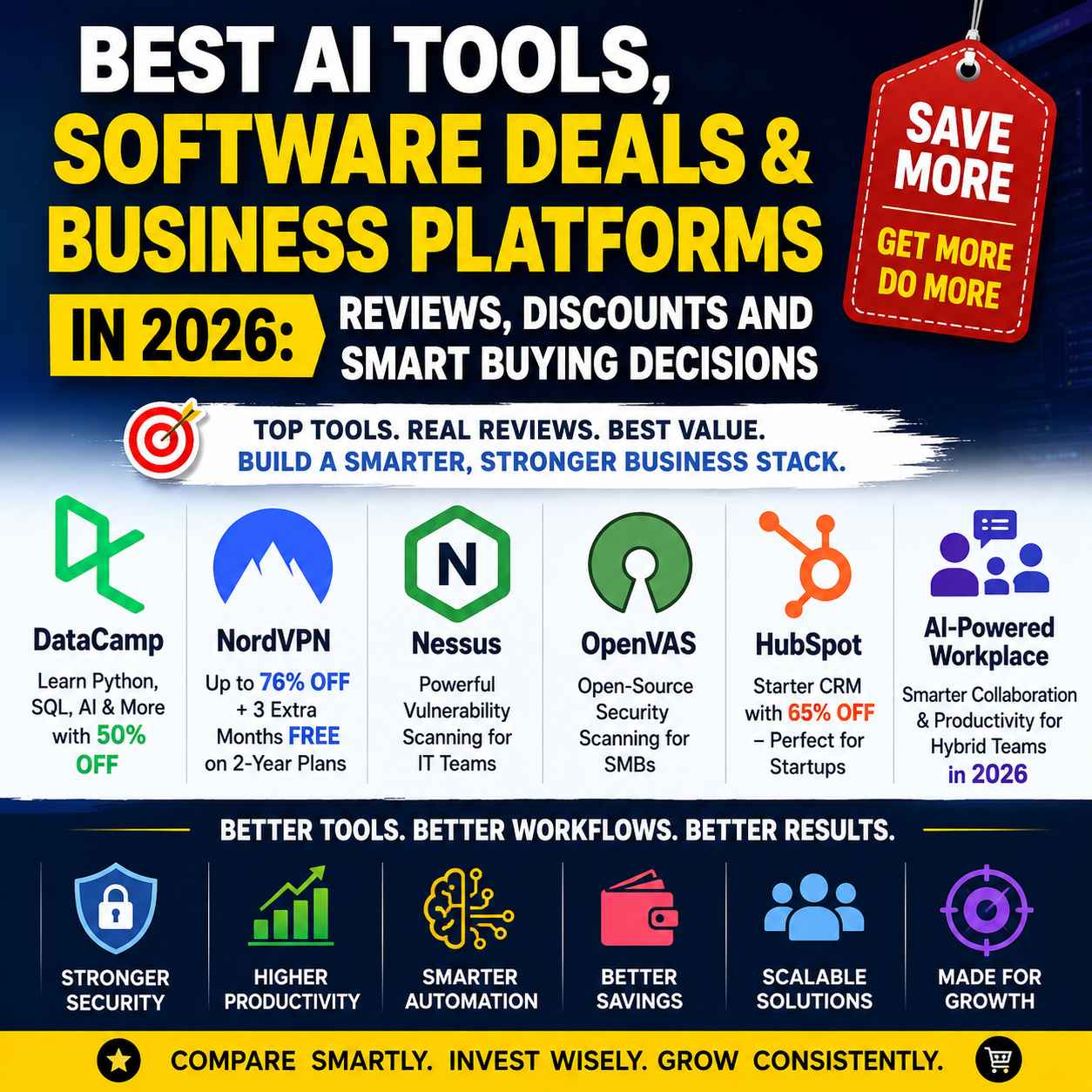
Over the past week, we examined several platforms spanning education, cybersecurity, customer management, remote work, and business infrastructure. Rather than evaluating them in isolation, it makes more sense to view them through a practical lens:
Which tools genuinely improve workflows?
Which deals create meaningful value?
And which platforms deserve a place in a modern business stack?
Let's examine them from an operator's perspective.
1. DataCamp: One of the Most Practical Learning Investments in 2026
Many businesses talk about becoming data-driven.
Far fewer invest in the skills required to make that happen.
The gap between business ambition and technical capability remains one of the biggest bottlenecks in modern organizations.
This is where DataCamp stands out.
Instead of offering purely academic content, the platform focuses heavily on applied learning in:
- Python
- SQL
- Data Analytics
- Power BI
- Machine Learning
- AI Fundamentals
The biggest operational advantage is that employees can learn directly through browser-based environments without complex software installations.
If your goal is building practical AI, analytics, and automation skills rather than collecting certificates, our recent review explains why DataCamp remains one of the strongest training investments available this year.
Workflow Impact
For startups and SMBs:
- Faster onboarding into analytics
- Lower training costs
- Reduced dependency on external consultants
- Improved internal reporting capabilities
Limitations
DataCamp works best for structured learners.
People expecting rapid mastery through passive video watching often struggle.
Technical concepts still require practice, repetition, and real-world application.
Who Should Consider It?
Ideal for:
- Business analysts
- Marketing teams
- Startup operators
- Aspiring data professionals
- AI-curious professionals
Less suitable for:
- Users seeking advanced research-level AI education
- Teams needing highly specialized certifications
2. NordVPN: Security That Requires Almost No Operational Overhead
Security tools frequently fail because employees don't use them.
Complexity kills adoption.
NordVPN succeeds because deployment requires minimal technical expertise.
The platform addresses several practical concerns:
- Public Wi-Fi security
- Remote workforce protection
- Geographic content access
- Basic privacy management
Workflow Impact
For distributed teams:
- Reduced exposure to network risks
- Better remote work security practices
- Consistent protection across devices
The biggest advantage is simplicity.
Employees are far more likely to use a VPN that takes seconds to activate.
Limitations
NordVPN is not a replacement for:
- Endpoint protection
- Identity management
- Security awareness training
- Enterprise-grade security operations
Organizations should treat it as one layer of protection rather than a complete security strategy.
Buying Perspective
The long-term subscription discounts significantly improve value, especially for small businesses seeking affordable security improvements.
For readers evaluating subscription costs, feature differences, and long-term value, our latest NordVPN breakdown examines whether the current promotional offer is actually worth locking in.
3. Nessus vs OpenVAS: Commercial Efficiency vs Open-Source Flexibility
Cybersecurity teams face a recurring dilemma.
Should they purchase commercial tools or build around open-source alternatives?
The Nessus versus OpenVAS discussion perfectly illustrates this tradeoff.
Nessus
Strengths:
- Faster deployment
- Easier reporting
- Better user experience
- Strong vulnerability coverage
Weaknesses:
- Licensing costs
- Less flexibility
OpenVAS
Strengths:
- Open-source
- No licensing expenses
- Greater customization
Weaknesses:
- Steeper learning curve
- More maintenance
- Higher operational complexity
Workflow Reality
For most SMBs, time is often more expensive than software licenses.
Organizations without dedicated security teams frequently gain more value from Nessus.
Technical teams with Linux expertise and operational resources may prefer OpenVAS.
Organizations comparing vulnerability management platforms should also evaluate operational overhead, reporting quality, and maintenance requirements before choosing between commercial and open-source security tools.
Sustainability Perspective
Open-source solutions remain attractive because they reduce vendor dependency and support long-term technology independence.
However, they demand greater internal expertise.
4. AI-Powered Virtual Workplaces Are Becoming Operational Infrastructure
The conversation around hybrid work has matured.
The question is no longer whether remote work is possible.
The question is whether teams can collaborate effectively without creating communication overload.
Modern AI-powered workplace platforms are attempting to solve:
- Information fragmentation
- Meeting overload
- Knowledge retrieval
- Collaboration bottlenecks
What Changes Operationally?
Teams spend less time searching.
Documentation becomes more accessible.
Knowledge becomes easier to surface.Repetitive administrative work decreases.
Where Friction Still Exists
AI-generated summaries are improving but remain imperfect.
Organizations still require:
- Governance
- Documentation standards
- Human review
The technology works best when supporting good processes rather than replacing them.
Practical Observation
Companies expecting AI to fix broken communication habits will likely be disappointed.
Companies with structured workflows often see meaningful improvements.
5. HubSpot Starter Customer Platform: Simplicity Wins More Often Than Complexity
Many startups make the same mistake.
They purchase enterprise-grade CRM systems long before they need them.
The result is predictable:
- Low adoption
- Poor data quality
- Administrative burden
HubSpot Starter succeeds because it remains approachable.
Workflow Advantages
Small teams can:
- Track leads
- Manage contacts
- Run email campaigns
- Monitor customer interactions
without requiring dedicated CRM administrators.
Operational Benefit
The platform reduces fragmentation by centralizing customer information.
For growing businesses, this creates visibility that spreadsheets rarely provide.
Limitations
As operational complexity increases, some teams may eventually outgrow entry-level plans.
However, simplicity is often an advantage rather than a weakness during early growth stages.
Ideal Users
- Startups
- Consultants
- Agencies
- Small sales teams
- Service businesses
What Smart Buyers Are Doing Differently in 2026
One pattern continues to emerge.
Successful buyers no longer purchase software based on features.
They purchase software based on workflow outcomes.
That distinction matters.
Instead of asking:
"What can this platform do?"
They ask:
"What operational problem does this platform remove?"
The difference is substantial.
Feature-focused purchasing often creates software sprawl.
Workflow-focused purchasing creates efficiency.
The same pattern appears across creator businesses, SaaS operators, consultants, and digital entrepreneurs who are increasingly building integrated business stacks instead of managing dozens of disconnected tools.
Discover the Creator Business Stack That Actually Delivers Results →
The platforms discussed this week perform well because each addresses a clear operational challenge:
| Platform | Core Problem Solved |
|---|---|
| DataCamp | Skills and capability gaps |
| NordVPN | Basic remote security |
| Nessus | Vulnerability visibility |
| OpenVAS | Cost-effective security scanning |
| AI Workplace Platforms | Collaboration inefficiencies |
| HubSpot Starter | Customer management fragmentation |
Building a Smarter Technology Stack in 2026
For most startups, creators, and growing businesses, a practical technology stack looks surprisingly simple.
Foundation Layer
- Reliable CRM
- Documentation system
- Password management
- VPN protection
Growth Layer
- Analytics training
- AI productivity tools
- Marketing automation
Optimization Layer
- Vulnerability management
- Workflow automation
- Knowledge management
The goal should never be maximum software adoption.
The goal should be maximum operational clarity.
Every tool should justify its place in the workflow.
If a platform creates more maintenance than value, it should be reconsidered regardless of its popularity.
FAQ Section
What are the best AI tools and software deals in 2026?
Some of the strongest value opportunities include DataCamp for skills development, NordVPN for security, HubSpot Starter for customer management, and AI-powered workplace platforms for collaboration and productivity.
Is DataCamp worth paying for in 2026?
For professionals learning Python, SQL, analytics, or AI fundamentals, DataCamp remains one of the most practical and cost-effective educational investments available.
Is NordVPN a good choice for small businesses?
Yes. NordVPN provides an affordable and easy-to-deploy security layer for remote teams, freelancers, and small businesses, though it should not replace a broader security strategy.
Should SMBs choose Nessus or OpenVAS?
Most SMBs benefit from Nessus due to faster deployment and lower maintenance requirements. OpenVAS is attractive for organizations with technical expertise and a preference for open-source infrastructure.
Is HubSpot Starter enough for growing businesses?
For many startups and service-based businesses, HubSpot Starter offers sufficient CRM functionality without introducing unnecessary complexity.
How should businesses evaluate software purchases in 2026?
Focus on operational outcomes rather than feature lists. Evaluate whether a platform reduces friction, improves productivity, strengthens security, or creates measurable efficiency gains.
Are software discounts worth considering when choosing platforms?
Discounts matter, but long-term workflow value matters more. A discounted platform that solves a real business problem is usually a better investment than a cheaper tool with limited operational impact.
If you're still evaluating which categories deserve investment first, our broader roundup of AI tools, SaaS deals, and business opportunities provides additional context for prioritizing software purchases and growth initiatives.
Final Verdict
The strongest technology investments in 2026 are not necessarily the most advanced platforms. They are the tools that quietly eliminate friction, reduce wasted effort, improve decision-making, and strengthen operational resilience.
Among the solutions reviewed, DataCamp stands out for capability development, HubSpot Starter delivers impressive value for growing businesses, NordVPN remains a practical security investment, and the Nessus versus OpenVAS decision continues to depend largely on internal expertise and maintenance capacity.
The common thread is clear: smart technology buying is no longer about accumulating software. It is about building a focused, sustainable, and efficient operating system for your business.
Organizations that prioritize workflow improvements over feature accumulation will almost always achieve better results, lower complexity, and stronger long-term returns from their technology investments.
Disclosure:
This article may contain affiliate links. If you choose a service through our links, we may earn a commission at no extra cost to you.
This article was created with AI-assisted research and carefully reviewed by our in-house team before publication