Nessus vs OpenVAS in 2026: Which Vulnerability Scanner Is Better for SMBs and IT Teams?
Nessus vs OpenVAS in 2026: Which Vulnerability Scanner Is Better for SMBs and IT Teams?
Cybersecurity is no longer optional for small and mid-sized businesses. Ransomware attacks, compliance requirements, cloud infrastructure risks, and remote work environments have made vulnerability scanning a core part of IT operations in 2026.
For many businesses, the biggest question is simple:
Should you choose the free open-source approach with OpenVAS, or invest in the commercial power of Nessus?
Both tools are respected in the cybersecurity world. Both can identify vulnerabilities and help organizations reduce risk. But when time, staffing, compliance, reporting, and operational simplicity become critical, the differences start to matter.
In this guide, we compare Tenable’s Nessus with OpenVAS to help SMBs and IT teams choose the right vulnerability scanner for their environment in 2026.
Want a faster way to identify vulnerabilities without spending hours configuring scanners manually? Many SMBs and IT teams are now exploring Nessus Professional for its streamlined deployment, compliance-ready reporting, and enterprise-grade vulnerability detection capabilities.
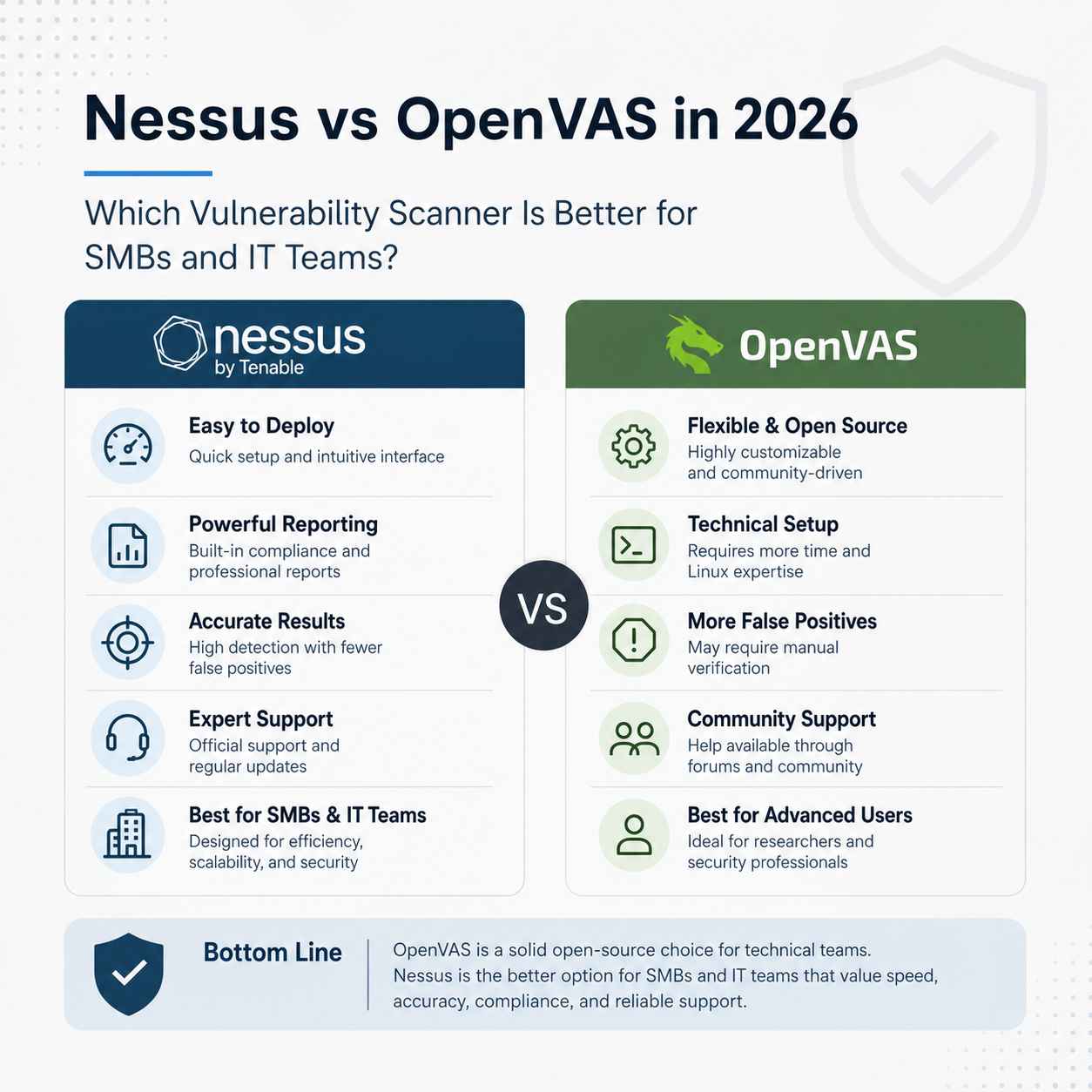
Quick Comparison: Nessus vs OpenVAS
| Feature | Nessus Professional | OpenVAS |
|---|---|---|
| Ease of Setup | Very Easy | Moderate to Complex |
| User Interface | Modern & Professional | Technical & Basic |
| Compliance Reporting | Excellent | Limited |
| False Positives | Lower | Higher |
| Support | Commercial Support | Community-Based |
| Best For | SMBs, IT Teams, Enterprises | Security Researchers & Advanced Linux Users |
| Automation | Strong | Moderate |
| Maintenance | Minimal | Higher Manual Maintenance |
| Pricing | Paid | Free & Open Source |
| Deployment Speed | Fast | Slower |
Why Vulnerability Scanning Matters More Than Ever in 2026
Attack surfaces have expanded dramatically. Businesses now manage:
- cloud servers
- remote devices
- Linux workloads
- SaaS applications
- IoT devices
- hybrid infrastructures
A single unpatched vulnerability can lead to:
- ransomware infections
- compliance penalties
- operational downtime
- customer trust loss
This is why vulnerability management is becoming a standard operational process even for smaller businesses.
What Is Nessus?
Nessus is one of the most widely used vulnerability assessment tools in the world. Developed by Tenable, it is designed to help organizations identify security weaknesses quickly with professional reporting and streamlined workflows.
Organizations wanting a deeper look into deployment models, scan accuracy, compliance workflows, and advanced vulnerability coverage can explore our detailed breakdown of Tenable Nessus vulnerability assessment capabilities in 2025.
Nessus is widely adopted because it combines:
- powerful scanning
- simple deployment
- extensive vulnerability coverage
- compliance auditing
- enterprise-grade reporting
For lean IT teams, that operational simplicity becomes extremely valuable.
What Is OpenVAS?
OpenVAS is a free and open-source vulnerability scanner widely used by Linux administrators, researchers, and advanced security teams.
Its biggest advantage is cost:
- no licensing fees
- flexible deployment
- customizable scanning
However, OpenVAS often requires:
- more technical expertise
- Linux administration knowledge
- manual tuning
- additional maintenance effort
For technically experienced teams, that flexibility can be useful. For smaller organizations with limited resources, it can also become time-consuming.
Where OpenVAS Performs Well
OpenVAS still remains attractive in several situations.
1. Budget-Conscious Environments
Organizations with extremely tight budgets often start with OpenVAS because there are no licensing costs.
2. Linux-Focused Teams
Advanced Linux administrators may appreciate the customization and open-source ecosystem.
3. Learning & Research
Security students, labs, and researchers frequently use OpenVAS for testing and experimentation.
Where Nessus Becomes the Better Operational Choice
This is where many SMBs and IT teams start shifting toward Nessus.
1. Faster Deployment
Nessus can often be installed and scanning within a short timeframe. OpenVAS environments usually require more configuration and ongoing maintenance.
For small IT departments, time matters.
2. Better Reporting for Compliance
Compliance reporting is increasingly important for:
- ISO 27001
- PCI DSS
- HIPAA
- internal audits
- cyber insurance requirements
Nessus provides cleaner, easier-to-understand reports that are useful for both technical and non-technical stakeholders.
3. Lower Operational Overhead
Many SMBs do not have dedicated security engineers.
They need tools that:
- work reliably
- require less maintenance
- reduce troubleshooting time
- simplify vulnerability prioritization
This is where commercial tools usually outperform open-source alternatives operationally.
4. Reduced False Positives
False positives waste valuable time.
One major advantage often reported by IT professionals using Nessus is improved scan accuracy and vulnerability prioritization.
For busy IT teams, that can significantly reduce alert fatigue.
Which Tool Is Better for SMBs?
For most SMBs in 2026, the practical answer is clear.
OpenVAS is better if:
- you need a completely free solution
- you have strong Linux/security expertise
- you can dedicate time to maintenance
- compliance reporting is not a major requirement
For SMBs and IT teams considering a commercial vulnerability scanner, current buyers can also explore available Tenable Nessus discounts and cybersecurity training offers before making a deployment decision.
Nessus is better if:
- your team is small
- you need faster deployment
- you want professional reporting
- you need compliance support
- you want fewer operational headaches
- you value long-term efficiency
Many businesses initially choose free tools but later move toward commercial platforms because internal time costs eventually exceed software licensing costs.
Real Operational Reality for IT Teams
The biggest hidden cost in cybersecurity is not software pricing.
It is:
- staff time
- troubleshooting
- missed vulnerabilities
- reporting inefficiencies
- burnout from manual processes
That is why many growing businesses eventually adopt commercial vulnerability management tools like Nessus.
Why Nessus Continues to Lead in 2026
Several reasons explain why Nessus remains one of the most trusted vulnerability scanners globally:
- extensive vulnerability database
- mature scanning engine
- strong enterprise adoption
- professional support
- reliable compliance capabilities
- broad platform compatibility
- efficient user experience
Businesses planning long-term exposure management strategies may also want to review how Tenable vulnerability management platforms support compliance, cloud visibility, and risk prioritization across modern IT environments.
For organizations that need operational consistency, those advantages matter daily.
Final Verdict: Which Vulnerability Scanner Should You Choose?
There is no universal winner.
The best choice depends on:
- team size
- technical expertise
- compliance needs
- available time
- operational maturity
However, for most SMBs and lean IT teams in 2026, Nessus offers a more practical balance of:
- usability
- reporting
- deployment speed
- operational efficiency
- professional-grade vulnerability management
OpenVAS remains a strong open-source option, but many organizations eventually discover that simplicity, support, and efficiency deliver greater long-term value than software cost alone.
If your goal is to strengthen security posture without overwhelming your IT team, Nessus remains one of the strongest vulnerability assessment platforms available today.
Teams running Linux-based infrastructure may also benefit from exploring lightweight and performance-focused Linux environments optimized for modern IT workloads.
Frequently Asked Questions (FAQ)
Is Nessus better than OpenVAS for small businesses?
For many SMBs, Nessus is often easier to manage because it provides faster setup, professional reporting, and lower maintenance overhead compared to OpenVAS.
Is OpenVAS completely free?
Yes. OpenVAS is open-source and free to use, making it attractive for organizations with limited budgets and strong technical expertise.
Does Nessus support compliance reporting?
Yes. Nessus includes reporting capabilities useful for compliance frameworks such as PCI DSS, ISO 27001, and HIPAA.
Which vulnerability scanner is easier for Linux environments?
Both support Linux environments, but OpenVAS often requires deeper Linux administration knowledge. Nessus generally provides a smoother deployment experience for mixed IT environments.
Can OpenVAS replace Nessus completely?
For some advanced technical teams, OpenVAS may be sufficient. However, many organizations prefer Nessus because of operational simplicity, support, reporting quality, and reduced maintenance burden.
Is Nessus worth paying for in 2026?
For businesses that value efficiency, faster vulnerability management workflows, and professional reporting, many IT teams consider Nessus a worthwhile investment.
If your IT team needs a vulnerability scanner that balances speed, usability, compliance reporting, and operational efficiency, exploring Tenable Nessus can be a practical next step for strengthening your cybersecurity posture in 2026.
Conclusion
Cybersecurity operations are becoming more demanding every year. Vulnerability scanning is no longer just a technical task — it is now part of business continuity, compliance, and operational resilience.
OpenVAS delivers flexibility and open-source freedom.
But for many SMBs and IT teams that need reliability, speed, reporting, and reduced complexity, Nessus continues to stand out as one of the most practical vulnerability assessment solutions in 2026.
#Nessus #OpenVAS #CyberSecurity #VulnerabilityScanner #Tenable #SMBCyberSecurity #ITSecurity #VulnerabilityManagement #LinuxSecurity #ComplianceSecurity #CyberThreats #NetworkSecurity #SecurityTools #CyberDefense #EthicalHacking #SecurityAssessment #CyberAwareness #ManagedSecurity #EnterpriseSecurity #InfoSec
Disclosure:
This article may contain affiliate links. If you choose a service through our links, we may earn a commission at no extra cost to you.
This article was created with AI-assisted research and carefully reviewed by our in-house team before publication