Best Digital Tools for Small Business in 2026: 6 Smart Picks for Websites, Marketing, Security & Learning
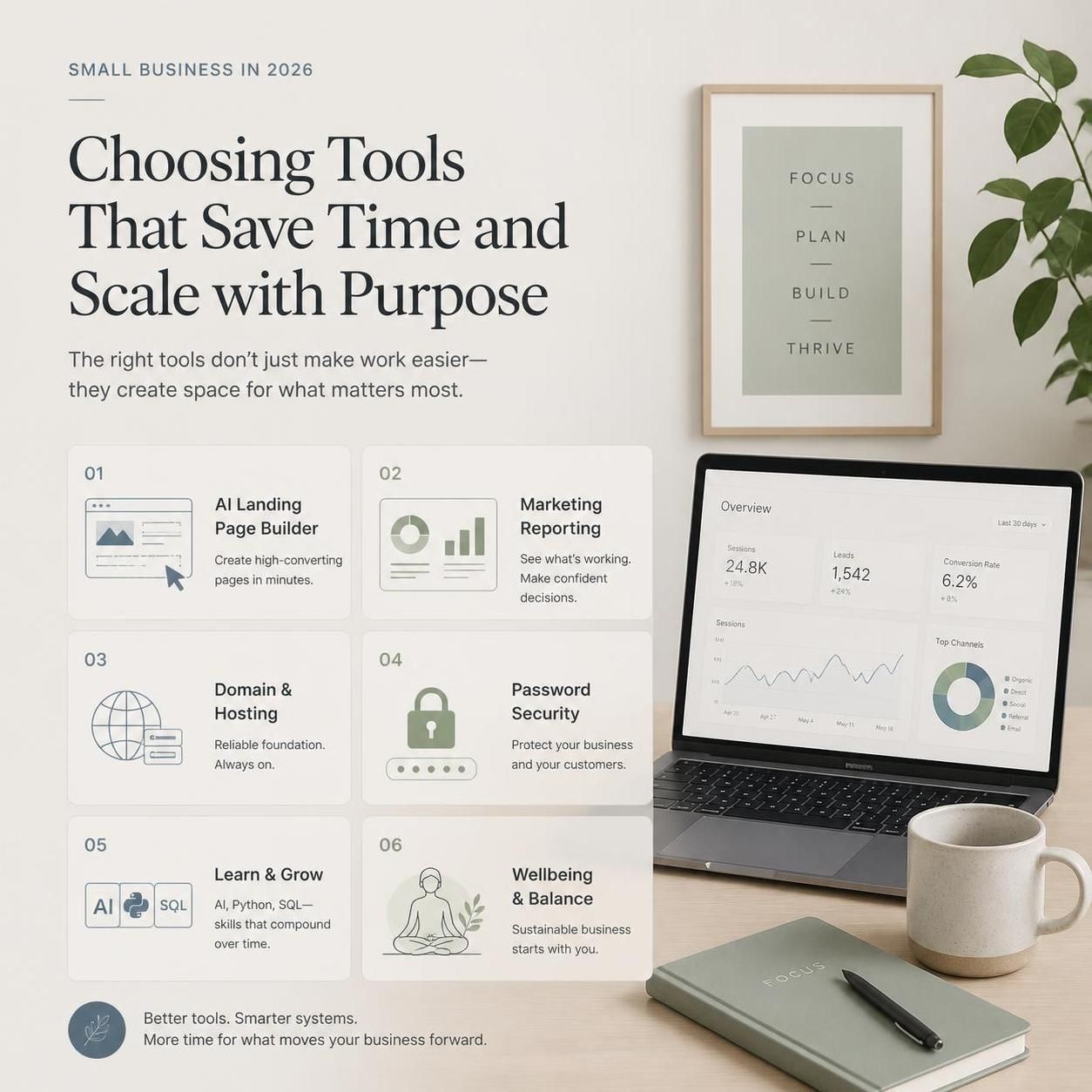
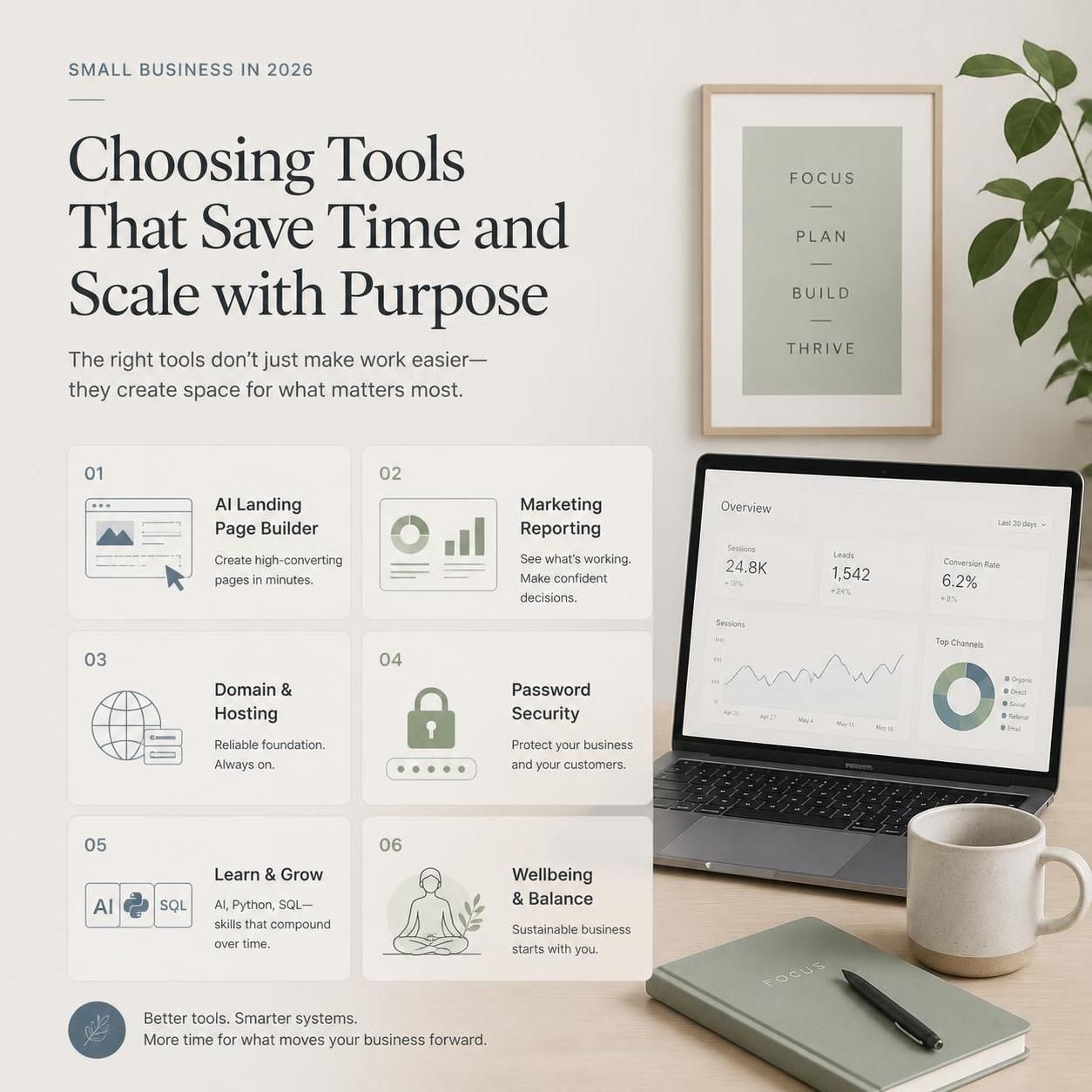
Best Digital Tools for Small Business in 2026: 6 Smart Picks for Websites, Marketing, Security & Learning
The best digital tools for small businesses in 2026 are not necessarily the tools with the most features. They are the platforms that solve a specific business problem while saving time, improving security, increasing marketing efficiency, or developing valuable skills. Six practical options worth evaluating include AI landing page builders for no-code website campaigns, DashThis for automated marketing reporting, Namecheap for domains and hosting, Passpack for business password security, DataCamp for AI, Python and SQL learning, and simple herbal self-care routines for sustainable personal wellbeing. The right choice depends on your business goals, budget, workflow, integrations and expected return on investment.
Running a small business in 2026 does not mean you need dozens of subscriptions.
In fact, buying too many disconnected tools can create a new problem: higher costs, duplicated work, complicated workflows and another collection of passwords your team has to manage.
The smarter approach is to build a focused digital stack.
Choose technology because it solves a genuine problem.
You might need a faster way to create a landing page without hiring a developer. Perhaps your agency is wasting hours assembling client marketing reports. Maybe you're launching a new website and need an affordable domain and hosting package. Your team may need better password security and mobile access. Or perhaps you're investing in AI, Python and SQL skills to remain competitive.
And there is another part of the equation that is often overlooked: the people using the technology.
A sustainable business needs productive technology—but people also need sustainable routines, learning and time away from screens.
That is why this week's six picks cover a deliberately broad digital-business journey:
Build → Market → Launch → Protect → Learn → Recharge
Below are six practical tools, offers and resources worth evaluating before you spend your money.
1. AI Landing Page Builders: Launch Faster Without Coding
A landing page has a simple commercial purpose: persuade a visitor to take a specific action.
That might mean:
- Buying a product
- Booking a consultation
- Starting a free trial
- Registering for an event
- Requesting a quote
- Joining an email list
- Downloading a resource
Traditionally, creating a good landing page could involve a designer, copywriter and developer.
AI-powered landing page builders are changing that workflow.Instead of starting with a blank screen, you can describe your business, audience and objective and let the platform generate an initial page structure. You can then refine the copy, layout, forms and calls to action through a no-code interface.
But there is an important distinction:
AI can help you create a landing page quickly. It cannot guarantee that the page will convert.
The offer, audience, messaging, trust signals, page speed and user experience still matter.
Our latest Best AI Landing Page Builders in 2026 comparison evaluates platforms including Leadpages, Unbounce, Jotform, Framer, MailerLite, Appy Pie and Hostinger Horizons from a buyer's perspective.
What should a small business look for?
Before paying for an AI landing page builder, check whether it provides:
- AI-assisted page generation
- No-code editing
- Mobile responsiveness
- Lead capture
- Custom domains
- Analytics
- Conversion tracking
- A/B testing
- Marketing integrations
- SEO controls
- Payment functionality where required
For businesses running paid advertising, conversion optimization can be particularly important.
There is little value in creating a beautiful page if you cannot determine which version generates more qualified leads or sales.
Which type of buyer should consider an AI landing page builder?
Choose a conversion-focused platform if your priority is lead generation and campaign optimization.
Choose a forms-focused platform if registrations, applications, payments or data collection are central to your workflow.
Choose a design-focused platform if visual presentation is the primary concern.
Choose a broader AI website builder if you need an entire website rather than a single campaign page.
Buyer verdict
If you're launching campaigns regularly, an AI landing page builder can reduce the distance between idea → page → test → improvement.
Don't buy because the platform has impressive AI features.
Buy when it helps you create and improve pages that contribute to measurable business results.
👉 Read the full comparison here
2. DashThis: Automate Marketing Reporting Instead of Living in Spreadsheets
Marketing agencies have a recurring problem that rarely receives enough attention:
Reporting consumes time that could be spent actually improving campaigns.
An agency may have data coming from Google Ads, social platforms, analytics tools, SEO systems and other marketing channels.
Collecting those numbers, formatting them and turning them into something a client can understand can become a repetitive monthly chore.
That's where automated marketing reporting software becomes valuable.
Our DashThis Review 2026 examines the platform for agencies, consultants, freelancers and marketing teams. DashThis is designed to centralize marketing data into dashboards and automate reporting across numerous integrations.
Why DashThis is interesting for agencies
The platform focuses on:
- Automated reporting
- Marketing dashboards
- White-label reports
- KPI monitoring
- Scheduled reports
- Drag-and-drop dashboards
- Pre-built reporting templates
- Multiple marketing integrations
The commercial benefit is straightforward.
If your team currently spends several hours each month manually preparing client reports, automation can potentially turn that repetitive workload into a much more streamlined process.
What should you evaluate before buying?
Don't only compare the monthly subscription price.
Ask:
- How many client dashboards do we need?
- Which platforms must be integrated?
- Do we require white-label branding?
- How frequently do reports need to be delivered?
- Which KPIs matter to our clients?
- Will the team actually use the dashboards?
- Does the platform reduce reporting time enough to justify the cost?
The key metric isn't the number of features.
It's hours saved and reporting quality improved.
DashThis vs general-purpose reporting tools
A general-purpose dashboard platform can provide significant flexibility.
However, agencies may prefer a specialist reporting platform if they want ready-made marketing integrations, client dashboards, templates and white-label functionality without building the entire reporting infrastructure themselves.
Buyer verdict
DashThis makes the most sense when reporting has become an operational burden.
If your agency manages multiple clients and your staff are still copying marketing data between platforms and spreadsheets, automated reporting deserves serious consideration.
3. Namecheap Sale 2026: Secure the Digital Foundation of a New Business
Before a small business can build its online presence, it needs the basics:
A domain. A website. Hosting. Often professional email.
That's why domain and hosting offers can be more valuable than they initially appear.
The current Namecheap Sale 2026 offers selected discounts of up to 95% on domains and up to 68% on hosting and email, with the current promotion scheduled to end September 7, 2026 at 11:59 PM ET.
However, there is a major buyer warning:
“Up to 95% off” does not mean every domain costs 95% less.
The actual price depends on the extension, product, eligibility and promotional terms.
What makes the Namecheap offer interesting?
For someone launching a business, the digital infrastructure can look like:
Domain → Hosting → Website → Professional Email → Marketing → Customers
The domain becomes part of the brand.
The website becomes the company's digital storefront.
Professional email supports credibility.
Hosting keeps the website operational.
So this is not simply a question of finding the cheapest domain.
What should you check before buying?
Before purchasing a discounted domain or hosting package, check:
- First-year price
- Renewal price
- Domain extension
- Transfer terms
- Privacy protection
- Hosting storage
- Website limits
- Traffic allowances
- Backup options
- SSL
- Email availability
- Contract period
- Migration requirements
A $1 domain that becomes expensive at renewal is not necessarily a bargain.
Likewise, inexpensive hosting that cannot support your website's future requirements may create more expense later.
Who should consider the current Namecheap promotion?
The offer is particularly relevant if you are:
- Starting a new business
- Launching a website
- Registering a new brand
- Building a blog
- Creating a portfolio
- Setting up professional email
- Testing an online business idea
Buyer verdict
If you already know the domain and hosting services you need, the current promotion is worth checking before the September 7 deadline.
But don't purchase something simply because the percentage discount looks impressive.
Buy the infrastructure you actually intend to use.
👉 Read the full deal analysis here
4. Passpack: Strengthen Business Password Security With Mobile Access and TOTP
As businesses become more distributed, password security becomes an operational issue—not merely an IT issue.
Employees may need access to:
- CRM systems
- Advertising accounts
- Hosting dashboards
- Customer portals
- SaaS subscriptions
- Financial systems
- Internal applications
And they may need those credentials from a desktop, laptop or smartphone.
Passpack's latest product developments are particularly relevant here.
The Passpack iPhone app became available on the App Store on August 16, 2026, and the updated experience includes mobile access, biometric unlocking, Record Health, password generation, browser extensions and built-in TOTP functionality.
Why mobile password access matters
Imagine a consultant travelling to a client meeting who suddenly needs access to a business account.
If the credentials are only accessible through a desktop workflow, the process becomes unnecessarily inconvenient.
A controlled mobile password-management environment provides another access point for authorized users.
Passpack's iPhone application supports Face ID, Touch ID or the Packing Key for unlocking, according to the current product information reviewed in our article.
What is TOTP?
TOTP stands for Time-Based One-Time Password.
It is commonly used as part of multi-factor authentication and generates a temporary authentication code.
Passpack's approach places TOTP functionality alongside the associated credential, potentially reducing the fragmentation that occurs when passwords and authentication codes are stored in completely separate workflows.
That can be particularly useful for teams sharing authorized access to business accounts.
Record Health adds another useful layer
A password manager shouldn't merely become a digital filing cabinet.
Passpack's Record Health feature identifies issues such as weak, reused or older passwords, giving users a practical starting point for improving credential hygiene.
What should businesses evaluate?
Before choosing a password manager, look at:
- Mobile access
- Password generation
- MFA/TOTP support
- Browser extensions
- Team sharing
- Access controls
- Recovery options
- Security architecture
- Ease of use
- Administrative controls
- Scalability
Buyer verdict
For small businesses, agencies and distributed teams, password management should be treated as part of the business operating system.
A centralized credential workflow can be significantly better than storing passwords in spreadsheets, browser notes or shared messages.
5. DataCamp: Invest in AI, Python and SQL Skills While the 50% Offer Is Available
Technology changes quickly.
That means a business's digital stack is only one side of competitiveness.
The people operating that stack also need to keep learning.
Data skills are particularly relevant in 2026.
AI, Python, SQL, data analytics, Power BI and Tableau can support careers and business functions ranging from software development and analytics to marketing, operations and business intelligence.
The current DataCamp September 2026 promotion offers eligible learners 50% off during the promotional period running from August 31 through September 24, 2026.
What can you learn?
DataCamp's current learning ecosystem covers areas including:
- Artificial intelligence
- AI engineering
- Python
- SQL
- Data analytics
- Data science
- Data engineering
- Power BI
- Tableau
- Machine learning
- Business intelligence
The platform emphasizes interactive and hands-on learning rather than relying exclusively on passive video consumption.
Who should consider DataCamp?
Beginners
Structured learning paths can make it easier to move from basic concepts toward more advanced subjects.
Career changers
A defined sequence such as:
Python → SQL → Data Analytics → Power BI → Projects
can be more useful than buying unrelated courses.
Working professionals
You don't have to become a data scientist.
Marketing, finance, operations and management professionals can benefit from stronger data literacy.
Aspiring AI professionals
AI-focused learning paths can provide a structured starting point for people who want to develop more technical AI skills.
Is 50% off automatically a good deal?
No.
This is another important purchasing principle.
A discount only creates value if you actually use the product.
If you subscribe at 50% off and complete one short course before abandoning the platform, the discount may not mean much.
If you already have a six-month learning plan involving Python, SQL, AI or data analytics, the economics can be much more attractive.
Buyer verdict
If developing practical AI or data skills is already on your 2026 plan, the current promotion is worth evaluating before September 24.
👉 Read the full offer analysis here
6. 10-Minute Herbal Self-Care: The Human Side of a Digital Business Stack
There is a reason this article includes something that isn't business software.
Technology is supposed to make work better.
It shouldn't consume every waking minute.
Small-business owners, freelancers and entrepreneurs often work across browsers, dashboards, email, messaging apps, analytics platforms and AI tools throughout the day.
Eventually, the person operating the technology needs a break.
That is where simple herbal self-care rituals can fit.
Our 10-Minute Herbal Self-Care Rituals guide focuses on small, practical rituals such as herbal tea, a warm foot soak, tending herbs, botanical routines, journaling and learning about one herb at a time.
Why only 10 minutes?
Because complicated routines are difficult to maintain.
A ten-minute ritual can fit around an ordinary workday.
You could:
- Prepare an herbal tea
- Sit without your phone
- Tend a small herb garden
- Write in an herbal journal
- Learn about one plant
- Enjoy a simple evening ritual
- Take a short mindful pause
The objective isn't to turn self-care into another productivity project.
It is to create a repeatable pause.
From self-care to learning
A ten-minute ritual can also lead to deeper curiosity.
You might start by drinking herbal tea.
Then you become interested in tea blending.
Then plant identification.
Then gardening.
Then botanical skincare.
Eventually, you may want structured herbalism education.
Our related Hobby Herbalist guide explores ways to develop that interest through online learning.
Important safety distinction
Herbal self-care should not be confused with medical treatment.
“Natural” does not automatically mean safe.
Some herbs can interact with medications or may be unsuitable for certain people.
Anyone considering herbs for health purposes—particularly people taking medication, pregnant or breastfeeding individuals, or those managing a medical condition—should seek appropriate professional healthcare advice.
Buyer verdict
Not every valuable investment has to be another software subscription.
Sometimes investing in your own attention, knowledge and ability to disconnect is just as important.
How These Six Picks Fit Into a Small-Business Digital Stack
At first glance, these six topics may look unrelated.
They aren't.
Think of them as six different layers.
| Business need | What to consider | Featured resource |
|---|---|---|
| Build | Create campaigns without coding | AI landing page builders |
| Market | Automate performance reporting | DashThis |
| Launch | Secure domain, hosting and email | Namecheap |
| Protect | Manage business credentials | Passpack |
| Learn | Build AI and data skills | DataCamp |
| Recharge | Protect personal time and curiosity | Herbal self-care |
This is a more useful way to think about digital tools.
You don't need more software.
You need the right software for the right problem.
These six picks are only one part of a modern business stack. If you're building beyond websites, marketing and security, our guide to Best Online Business Tools in 2026 explores additional platforms for selling online, managing operations, hiring globally and scaling a digital business.
Building your business stack from the ground up? See which platforms are worth evaluating before you add another subscription.
How to Choose Digital Tools for a Small Business in 2026
Before purchasing any tool, ask these seven questions.
1. What problem am I solving?
Be specific.
“Improve marketing” is too vague.
“Reduce five hours of monthly client reporting” is measurable.
“Generate more leads from paid advertising” is measurable.
“Stop sharing passwords through chat” identifies a security problem.
“Launch my website without hiring a developer for every change” is a clear operational objective.
Start there.
2. Who will use the tool?
A technically powerful platform is useless if your team finds it difficult to operate.
Consider:
- Ease of use
- Training requirements
- User permissions
- Workflow complexity
- Mobile access
- Support
3. Does it integrate with your existing stack?
A new tool should ideally communicate with the systems you already use.
Check for:
- Integrations
- APIs
- Data exports
- Automation
- CRM compatibility
- Analytics compatibility
- Marketing integrations
The goal is to reduce manual work—not create another silo.
4. What is the total cost?
Never evaluate software only by its advertised monthly price.
Consider:
Subscription + usage + implementation + integrations + training + switching costs
Also check renewal pricing.
This is particularly important for discounted domains, hosting and software promotions.
5. Can it scale?
Ask:
What happens when our business doubles?
Will pricing change?
Will usage limits become restrictive?
Will you need a more expensive plan?
Will performance remain adequate?
Will migration become difficult?
6. Can you leave?
This question is frequently ignored.
Before committing to a platform, understand:
- Data export
- Cancellation terms
- Migration options
- Contract obligations
- Account ownership
- Integration dependencies
Your business should not become permanently trapped inside a tool simply because migration is difficult.
7. Can you measure the value?
Every serious business purchase should have an expected outcome.
For example:
DashThis → fewer reporting hours
AI landing page builder → faster campaign launches
Passpack → better credential management
DataCamp → stronger technical skills
Namecheap → lower initial website infrastructure costs
Self-care → more intentional downtime
If you cannot explain the expected benefit, reconsider the purchase.
Choosing a tool is only half the decision. Before committing to another subscription, use our Business Software Buying Guide 2026 to compare pricing, integrations, scalability, implementation requirements and long-term business value.
Don't buy software because the demo looks impressive—use our buying checklist to find out whether it actually deserves a place in your stack.
The Biggest Small-Business Software Mistake in 2026
The biggest mistake isn't failing to use AI.
It is buying technology without a clear business case.
The current market is full of AI-powered software promising faster workflows, better productivity and effortless automation.
Some of it is excellent.
Some of it isn't worth the subscription.
The same principle applies to discounts.
A 50% discount isn't automatically a good purchase.
A 95% domain discount isn't automatically a good domain.
A cheap SaaS plan isn't automatically good value.
The best purchase is the one that solves a meaningful problem at a cost your business can justify.
AI is only valuable when it improves the way work gets done. If you're comparing a wider range of AI platforms and business software before spending money, our Best AI Tools, Business Software & Wellness Platforms in 2026 guide takes the same practical approach—looking beyond feature lists to workflow impact and real-world usefulness.
Before adding another AI subscription, compare the tools that can genuinely earn their place in your business stack.
A Simple 2026 Digital-Tool Buying Framework
Use this five-step process before you click Buy.
Step 1: Identify the bottleneck
Where are you losing time, money, security or opportunities?
Step 2: Find three realistic solutions
Don't compare ten tools if three credible options can answer the question.
Step 3: Test before committing
Use a free plan, trial, demo or limited implementation where available.
Step 4: Calculate the business value
Estimate what the tool saves or generates.
Step 5: Review after 30–90 days
Ask:
- Are we actually using it?
- Did it solve the original problem?
- Did it save time?
- Did it improve revenue or efficiency?
- Would we purchase it again?
If the answer is consistently no, cancel it.
Which of These Six Digital Tools Should You Buy?
There is no universal winner.
Your decision depends on your immediate priority.
Choose an AI landing page builder if:
You need to launch campaign pages, lead-generation pages or sales pages quickly without relying heavily on developers.
Consider DashThis if:
Your agency or marketing team spends too much time producing client reports.
Consider Namecheap if:
You're ready to register a domain, launch a website or establish basic online infrastructure and the current promotional pricing fits your needs.
Consider Passpack if:
Your team needs centralized business credential management, mobile access and integrated authentication workflows.
Consider DataCamp if:
You're serious about building practical AI, Python, SQL or data skills and can commit to actually using the platform.
Try a 10-minute herbal ritual if:
Your problem isn't another software gap.
It's that your workday has no meaningful pause.
Final Verdict: Build a Smaller, Smarter Digital Stack
Small businesses don't win by accumulating the most software.
They win by using the right tools at the right time.
The six resources covered here address very different needs:
AI landing page builders can reduce the technical barrier to launching campaigns.
DashThis can reduce repetitive marketing reporting work.
Namecheap can help establish the domain, hosting and email foundation of an online business while the current promotion is available.
Passpack addresses the increasingly important problem of business credential management across devices and teams.
DataCamp can help professionals develop practical AI and data skills.
And 10-minute herbal self-care rituals provide a reminder that sustainable productivity also requires time away from the screen.
The underlying lesson is simple:
Don't buy another digital tool because everyone else is using it. Buy it because it solves a problem you can measure.
Before purchasing, define the problem.
Check the workflow.
Compare alternatives.
Calculate the real cost.
Test the platform.
Then decide.
That's how a small business can build a digital stack that supports growth instead of creating another layer of complexity.
Frequently Asked Questions
What are the best digital tools for small businesses in 2026?
The best tools depend on the problem being solved. For website campaigns, AI landing page builders are worth evaluating. Agencies may benefit from automated marketing reporting software such as DashThis, while businesses launching websites can evaluate domain and hosting services such as Namecheap. Teams concerned with credential security can consider Passpack, and professionals developing AI or data skills can evaluate DataCamp.
What digital tools does a small business actually need?
Most small businesses need fewer tools than they think. A practical stack may include a website or landing-page solution, domain and hosting, marketing tools, analytics, secure password management, communication systems and appropriate accounting or operational software. Start with business problems rather than buying tools simply because they are popular.
Are AI tools worth paying for in 2026?
They can be, particularly when they save measurable time or improve an important workflow. An AI tool is worth considering when it reduces manual work, improves output quality, speeds up execution or creates measurable commercial value. The AI label alone is not a sufficient reason to subscribe.
What is the best AI landing page builder for a small business?
There is no single winner for every business. Leadpages is particularly relevant for conversion-focused campaigns, Unbounce is attractive for advanced experimentation and paid traffic, while Jotform can be compelling when forms, registrations, payments or lead collection are central to the workflow. The right choice depends on the conversion goal and marketing stack.
Is DashThis worth it for a marketing agency?
It can be, particularly for agencies that spend substantial time manually collecting and formatting client marketing data. DashThis focuses on automated reporting, dashboards, integrations, white-label presentation and scheduled reports. The best way to assess the value is to compare its cost with the staff time and reporting effort it can save.
Is the Namecheap Sale 2026 worth buying?
It can be worthwhile if you already need a domain, hosting or professional email and the specific promotional price fits your requirements. The current September promotion advertises up to 95% off selected domains and up to 68% off hosting and email, but buyers should check the exact product price, renewal price and eligibility before purchasing.
When does the Namecheap September 2026 sale end?
The current Namecheap Back to Business promotion is scheduled to end on September 7, 2026 at 11:59 PM ET. Promotional terms can change, so buyers should verify the live offer before checkout.
Is Passpack a good password manager for small business teams?
Passpack is worth evaluating for small businesses, agencies and distributed teams that need centralized credential management. Its current 2026 developments include an iPhone app, browser extension, Record Health, password generation, biometric access and built-in TOTP functionality.
What is TOTP and why does it matter for business?
TOTP stands for Time-Based One-Time Password. It generates temporary authentication codes commonly used as part of multi-factor authentication. Integrating TOTP with credential management can simplify access to accounts where authorized team members need both the password and authentication code.
Is DataCamp worth it at 50% off?
It can be, particularly if you already have a structured plan to learn AI, Python, SQL, data analytics or related skills. The current September 2026 promotion advertises 50% off for eligible learners through September 24, 2026. The value depends on how consistently you use the platform.
When does the DataCamp 50% off September 2026 offer end?
The current promotion is scheduled to run through September 24, 2026 at 11:59 PM EST, subject to the campaign's eligibility and promotional terms. Check the live offer before purchasing.
Can I learn AI, Python and SQL on DataCamp?
Yes. DataCamp's current catalog includes learning content covering AI, AI engineering, Python, SQL, data analytics, data science, Power BI, Tableau and related technology subjects.
Are 10-minute herbal self-care rituals useful?
A short ritual can be a practical way to introduce intentional pauses into a busy day. Examples include preparing herbal tea, tending plants, journaling or spending a few screen-free minutes learning about herbs. Herbal self-care should not be treated as a substitute for professional medical care.
Can beginners learn herbalism online?
Yes. Beginners can start with structured online herbalism courses or introductory educational resources. A focused course can provide more organized learning than collecting unrelated information from social media and random websites. Kuruntha Smarket's related herbalism content explores beginner-friendly learning paths.
How should a small business choose software in 2026?
Start with the business problem. Then compare functionality, integrations, usability, security, scalability, pricing, data portability and expected return on investment. The cheapest product is not necessarily the best value, and the most feature-rich product is not necessarily the best fit.
Should a small business buy multiple SaaS tools?
Only when each tool has a clear role. A smaller, integrated technology stack is often easier to manage than a collection of overlapping subscriptions. Before adding software, ask what problem it solves and whether an existing platform can already handle the requirement.
Quick Buyer Checklist
Before purchasing any digital tool in 2026, ask:
☐ What problem does it solve?
☐ Who will use it?
☐ Does it integrate with my current tools?
☐ What is the complete cost?
☐ What happens when usage increases?
☐ Can I export my data?
☐ Can I test it first?
☐ What measurable result should I expect?
☐ Would I still buy it without the discount?
☐ Does it genuinely make my business better?
If you cannot answer those questions, don't buy yet.
Explore the Six Kuruntha Smarket Picks
Build: Best AI Landing Page Builders in 2026
Market: DashThis Review 2026
Launch: Namecheap Sale 2026
Protect: Passpack Mobile App Review 2026
Learn: DataCamp 50% Off September 2026
Recharge: 10-Minute Herbal Self-Care Rituals
Disclosure: Some links on Kuruntha Smarket may be affiliate links. If you purchase through an eligible link, we may earn a commission at no additional cost to you. Our recommendations are based on the practical usefulness of the product or service; promotional pricing, features and availability can change, so verify the current terms before purchasing. This article was created with AI-assisted research and carefully reviewed by our in-house team before publication
#SmallBusinessTools #SmallBusiness2026 #DigitalTools #BusinessTools #AITools #AIToolsForBusiness #AIForSmallBusiness #NoCode #NoCodeTools #DigitalBusiness #BusinessSoftware #MarketingTools #MarketingAutomation #MarketingReporting #DashThis #LandingPageBuilder #AILandingPage #Namecheap #WebHosting #DomainDeals #CyberSecurity #PasswordManager #Passpack #BusinessSecurity #DataCamp #LearnAI #Python #SQL #DataAnalytics #Herbalism #SelfCare #OnlineLearning #DigitalTransformation