Best AI Tools, Business Software & Wellness Platforms in 2026: 10 Reviews to Help You Choose Smarter
Best AI Tools, Business Software & Wellness Platforms in 2026: 10 Reviews to Help You Choose Smarter
Why Most Software Decisions Fail Before Implementation
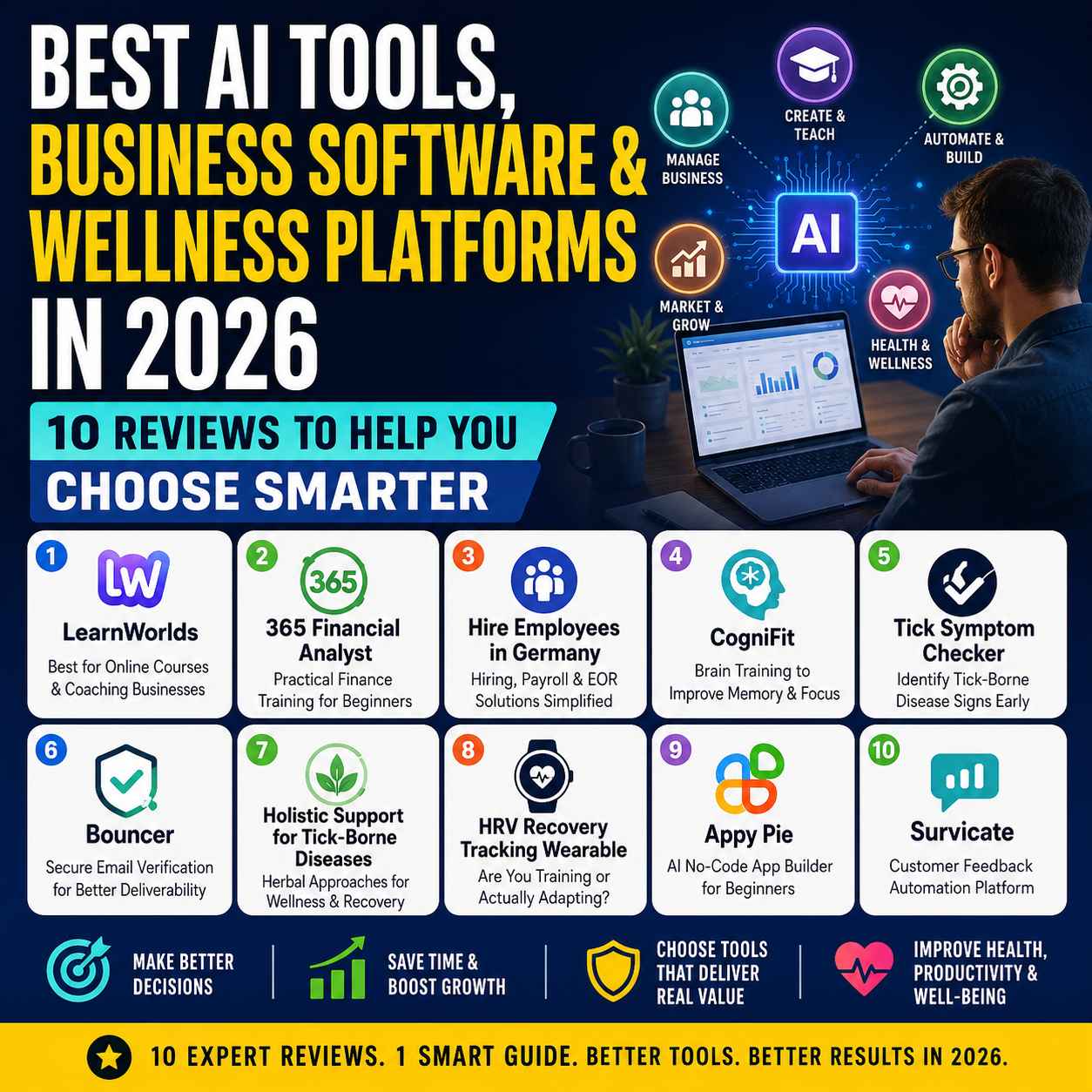
The best AI tools, business software, and wellness platforms in 2026 are those that solve real operational problems rather than simply adding more features. From course creation and no-code development to email verification, employee hiring, customer feedback, and health optimization, this guide reviews 10 platforms based on workflow impact, implementation effort, long-term value, and practical usability.
Most software purchases do not fail because the technology is bad.
They fail because the platform never becomes part of the workflow.
A founder subscribes to a tool but never finishes onboarding. A creator buys a platform but struggles to attract customers. A marketer adds another dashboard without improving decision-making. A wellness enthusiast collects data without changing behavior.
The result is familiar:
- More subscriptions
- More complexity
- More notifications
- Very little operational improvement
Over the past two weeks, we reviewed ten different platforms across business infrastructure, creator tools, marketing software, workforce management, and wellness technology.
Rather than ranking them based on feature counts, we evaluated them through a more practical lens:
Does this tool improve real-world workflows?
Here are the platforms that stood out—and where they still fall short.
1. LearnWorlds vs Gumroad: Two Very Different Business Models
Many creators compare LearnWorlds and Gumroad as if they serve the same audience.
They do not.
LearnWorlds
LearnWorlds is designed for people building an education business.
The platform provides:
- Course delivery
- Student management
- Learning experiences
- Assessments
- Branded academies
The operational advantage is ownership.
Creators control the customer experience instead of simply processing transactions.
Gumroad
Gumroad is significantly simpler.
You can start selling:
- ebooks
- templates
- digital downloads
- memberships
within hours.
Its biggest strength is speed.
Its biggest limitation is scalability.
Practical Verdict
If you are building a long-term education brand, LearnWorlds makes more sense.
If you want to validate a product idea quickly, Gumroad remains one of the easiest entry points available.
Course creators evaluating LearnWorlds should also explore how AI is changing online course businesses, especially as automation, personalization, and AI-assisted content workflows become increasingly important for scaling educational brands
2. 365 Financial Analyst: A Practical Entry Point Into Finance
Many finance courses focus heavily on theory.
365 Financial Analyst takes a more applied approach.
The platform introduces:
- financial modeling
- valuation concepts
- Excel workflows
- business analysis
without assuming prior experience.
Where It Works Well
Beginners often struggle with fragmented learning paths.
365 Financial Analyst provides a structured progression that reduces confusion.
Where It Falls Short
Experienced professionals may outgrow the content relatively quickly.
Some learners will eventually require deeper specialization.
Practical Verdict
Excellent for beginners.Less compelling for professionals seeking advanced financial analysis credentials.
3. Hiring Employees in Germany: Complexity Hidden Behind Growth
Expanding into Germany sounds straightforward until compliance enters the conversation.
Organizations quickly encounter:
- employment contracts
- payroll obligations
- tax regulations
- social contributions
- worker protections
Why EOR Solutions Matter
Employer of Record services remove substantial administrative burden.
Instead of establishing local entities immediately, businesses can hire talent legally while reducing compliance risk.
Operational Perspective
For startups and SMEs, EOR providers often create faster hiring pathways than traditional entity setup.
Practical Verdict
Companies hiring one or two employees can save considerable time through EOR solutions.
Larger organizations may eventually benefit from building local infrastructure.
4. CogniFit: Data-Driven Brain Training With Realistic Expectations
The brain-training industry often makes ambitious claims.
CogniFit takes a more structured approach.
The platform evaluates:
- memory
- attention
- processing speed
- cognitive flexibility
through ongoing assessments and exercises.
What Improves
Users gain awareness of cognitive strengths and weaknesses.
The tracking mechanisms provide measurable feedback.
Important Limitation
Brain training should not be mistaken for guaranteed cognitive enhancement.
Lifestyle factors still matter significantly:
- sleep
- exercise
- nutrition
- stress management
Practical Verdict
Useful as a measurement and training framework.
Not a replacement for broader health habits.
5. Tick Symptom Checkers: Early Awareness Matters
Tick-borne diseases remain difficult to identify during early stages.
Symptoms often resemble common illnesses.
Operational Value
A symptom checker creates an initial screening layer.
It can help users recognize:
- fatigue
- fever
- joint discomfort
- neurological symptoms
that may warrant further medical evaluation.
Critical Limitation
No symptom checker should replace professional diagnosis.
Practical Verdict
Helpful for awareness.Not appropriate as a standalone medical decision-making tool.
6. Bouncer: Solving an Expensive Email Problem
Poor email lists create hidden costs.
Businesses lose:
- deliverability
- sender reputation
- engagement quality
every time invalid addresses enter the database.
Workflow Impact
Bouncer focuses on prevention.
Before sending campaigns, teams can validate addresses and reduce bounce rates.
What Stands Out
Implementation is relatively straightforward.
Results are measurable almost immediately.
Where Competitors May Win
Large enterprise organizations may require broader ecosystem functionality.
Practical Verdict
One of the most practical tools reviewed this month.
Particularly valuable for marketers managing growing subscriber lists.
Bouncer is a good example of the type of software investments that deliver measurable business value, where small operational improvements can significantly impact marketing performance and customer acquisition.
7. Herbal Academy's Tick Webinar: Expanding the Conversation
Most discussions around tick-borne diseases focus exclusively on diagnosis and treatment.
The webinar explored complementary support strategies.
Topics included:
- herbal education
- prevention awareness
- wellness considerations
- recovery support
Why It Matters
Users increasingly want holistic understanding alongside conventional medical guidance.
Practical Verdict
Useful educational resource.Should complement—not replace—professional healthcare advice.
8. HRV Recovery Tracking Wearables: Data vs Adaptation
Many people track exercise.
Far fewer track recovery.
This distinction matters.
What HRV Measures
Heart Rate Variability provides insight into how the body responds to:
- training load
- stress
- recovery demands
Real-World Benefit
Users gain visibility into whether they are adapting positively or accumulating fatigue.
Common Mistake
Collecting recovery data without adjusting behavior.
Metrics alone do not improve outcomes.
Practical Verdict
Highly valuable when paired with decision-making.
Far less useful as a passive dashboard.
Recovery tracking becomes significantly more useful when combined with broader health systems, which is why many users are now focused on building a complete wellness technology stack that includes sleep, stress, recovery, and long-term health monitoring.
9. Appy Pie: Lowering Barriers to Software Creation
Building software traditionally required development resources.
Appy Pie reduces that dependency.
Strengths
The platform enables users to create:
- mobile apps
- workflow automations
- business tools
without coding expertise.
Operational Advantage
Small businesses can launch prototypes significantly faster.
Limitations
Complex applications eventually reach platform constraints.
Customization remains more limited than traditional development.
Practical Verdict
Ideal for validation, automation, and early-stage projects.
Less suitable for highly customized enterprise systems.
If Appy Pie sparks ideas around automation, it is worth exploring other AI business automation tools that reduce repetitive work, particularly for lead management, customer communication, and operational efficiency across growing businesses.
10. Survicate: Turning Feedback Into Decisions
Many organizations collect feedback.
Few operationalize it.
This is where Survicate becomes interesting.
Workflow Benefits
The platform helps teams:
- gather responses
- analyze trends
- identify friction points
- prioritize improvements
What Changes
Customer feedback becomes part of decision-making rather than a neglected dataset.
Limitation
Feedback collection only creates value when organizations act on insights.
Practical Verdict
Strong fit for product teams, SaaS companies, and customer-centric organizations.
What These 10 Reviews Reveal About Technology Adoption in 2026
Despite serving different industries, all ten platforms share a common theme.
The best tools reduce operational friction.
They help users:
- make decisions faster
- automate repetitive work
- improve visibility
- reduce uncertainty
- build sustainable systems
The worst software investments are rarely the most expensive.
They are the platforms that never become part of everyday workflows.
When evaluating new technology, ask a simple question:
Will this improve how work gets done next month—not just look impressive during onboarding?
That question eliminates a surprising number of software purchases.
Rather than evaluating software in isolation, many organizations are now focused on building a complete digital stack where creator tools, AI systems, automation platforms, and wellness technologies work together as a connected ecosystem.
9. FAQ Section
What are the best AI and business software platforms reviewed in 2026?
Some of the most practical platforms reviewed include LearnWorlds, Appy Pie, Bouncer, and Survicate because they directly improve operational workflows and business efficiency.
Which platform is better for selling online courses?
LearnWorlds is generally better for creators building a long-term education business, while Gumroad is better for quickly selling digital products with minimal setup.
Is Appy Pie suitable for beginners?
Yes. Appy Pie is designed for non-technical users and offers a relatively low barrier to entry for app creation and workflow automation.
Why is email verification important?
Email verification helps maintain sender reputation, improve deliverability, reduce bounce rates, and increase overall marketing effectiveness.
Are HRV recovery wearables worth using?
They can provide valuable recovery insights, especially for active individuals. However, the data only becomes useful when it influences training and recovery decisions.
Is CogniFit scientifically useful?
CogniFit can provide structured cognitive assessments and training exercises, but it should be viewed as one component of a broader wellness strategy.
What is the benefit of customer feedback automation?
Automation helps organizations collect, analyze, and act on customer insights faster, improving product development and customer experience.
10. Final Verdict
After reviewing these ten platforms, a clear pattern emerges.
The strongest products are not necessarily the most feature-rich.
They are the tools that create measurable workflow improvements with reasonable implementation effort.
For creators, LearnWorlds stands out as the stronger long-term platform.
For marketers, Bouncer delivers immediate operational value.
For customer-centric organizations, Survicate transforms feedback into actionable intelligence.
For no-code builders, Appy Pie lowers the barrier to software creation.
For health-conscious users, HRV tracking and CogniFit provide useful decision-support data when used realistically.
The common lesson is simple:
Technology should reduce friction, not create more of it.
The platforms worth adopting in 2026 are the ones that help you make better decisions, faster, with less operational overhead.
Disclosure:
This article may contain affiliate links. If you choose a service through our links, we may earn a commission at no extra cost to you.
This article was created with AI-assisted research and carefully reviewed by our in-house team before publication