The Complete Guide to Hiring Employees in Germany (2026): Employment Law, Payroll Compliance, and EOR Solutions
Hiring in Germany Sounds Simple Until Compliance Becomes the Bottleneck
Hiring employees in Germany requires compliance with local employment laws, payroll tax regulations, social security contributions, and worker protection requirements. Companies can either establish a German legal entity or use an Employer of Record (EOR) solution to hire talent while maintaining compliance with German labor regulations. Understanding these requirements is essential for reducing legal risk and ensuring smooth workforce expansion.
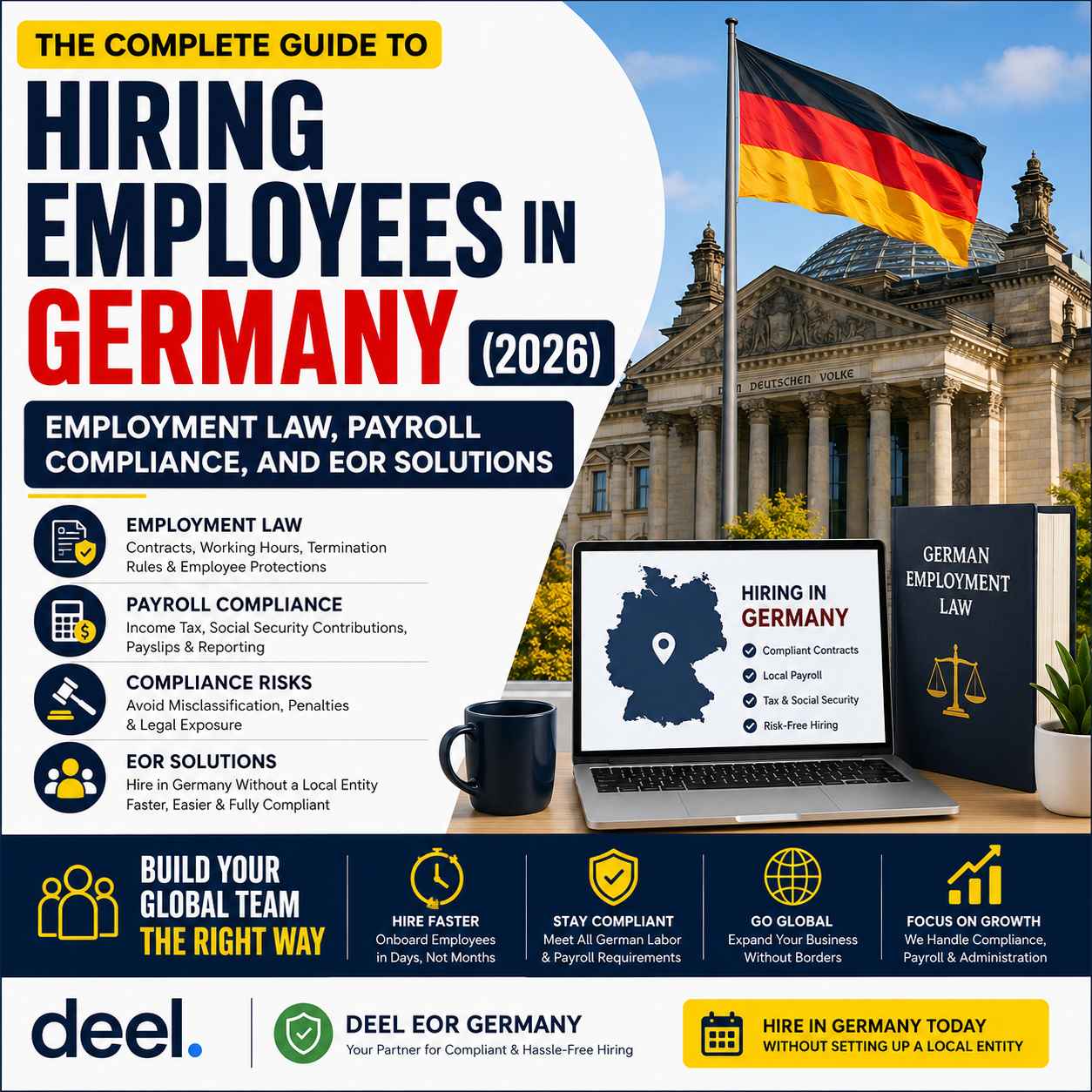
For many growing companies, Germany appears near the top of the international hiring shortlist.
The country offers a highly educated workforce, strong engineering talent, mature infrastructure, and access to one of Europe's largest economies. Whether you're hiring software developers, product managers, customer success professionals, or sales teams, Germany consistently attracts attention from global employers.
The challenge begins after identifying the right candidate.
What initially looks like a straightforward hiring decision quickly becomes an operational project involving employment contracts, payroll registration, tax obligations, social insurance contributions, termination protections, and ongoing compliance management.
Many founders discover this reality only after attempting to hire their first employee.
The question shifts from "Can we find talent?" to "Can we legally employ them without creating compliance risk?"
This guide explores the practical realities of hiring employees in Germany in 2026, including employment law requirements, payroll obligations, compliance considerations, and how Employer of Record (EOR) solutions such as Deel can simplify international expansion.
Expanding into Germany can create significant compliance responsibilities long before your first employee starts work. If you're evaluating alternatives to setting up a local entity, see how Deel helps companies hire, onboard, and pay employees globally while staying compliant with local regulations.
Why Germany Continues to Attract Global Employers
Germany remains one of Europe's most attractive hiring destinations for several reasons.
First, the talent pool is deep.
The country has a strong tradition of engineering, manufacturing, software development, research, and industrial innovation. German professionals are frequently recruited by international organizations seeking highly skilled employees with experience operating in structured business environments.
Second, Germany serves as a strategic gateway to the European market.Organizations hiring in Germany often view it as a foundation for broader European expansion.
Third, remote work adoption has increased opportunities for international employers to access German talent without establishing a full local office presence.
However, access to talent does not eliminate compliance responsibilities.
Germany is known for robust worker protections and detailed employment regulations. Employers that ignore local requirements can face costly consequences.
The First Strategic Decision: Entity or Employer of Record?
Before hiring employees in Germany, businesses must determine how they will legally employ workers.
This decision affects setup costs, timelines, administrative burden, and compliance exposure.
Option 1: Establish a German Legal Entity
Creating a local subsidiary provides full operational control.
Advantages include:
- Direct employment relationships
- Long-term market presence
- Full organizational control
- Greater flexibility for larger workforce expansion
However, establishing an entity introduces complexity.
Businesses must manage:
- Corporate registration
- Local tax administration
- Payroll infrastructure
- Legal compliance
- Accounting requirements
- Ongoing regulatory reporting
For companies hiring only a few employees, the administrative overhead can be significant.
Option 2: Use an Employer of Record (EOR)
An Employer of Record acts as the legal employer on behalf of the hiring company.
This model allows businesses to hire workers in Germany without establishing a local entity.
Operational advantages include:
- Faster hiring timelines
- Reduced legal complexity
- Local compliance management
- Payroll administration support
- Simplified onboarding
For startups, remote-first companies, and organizations testing a new market, an EOR often provides a more practical path.
For companies evaluating whether to establish a German entity or use an Employer of Record, understanding how EOR infrastructure works in practice can significantly shorten the learning curve. Our analysis of how businesses can hire globally without establishing local entities explores the operational advantages and compliance considerations in greater detail.
Understanding German Employment Contracts
Employment contracts are one of the most important compliance foundations when hiring in Germany.
Unlike some jurisdictions where informal agreements may occur, German employment relationships benefit from clear documentation.
A compliant contract generally includes:
- Employee role and responsibilities
- Compensation details
- Working hours
- Vacation entitlements
- Notice periods
- Probation arrangements
- Confidentiality provisions
From an operational perspective, contract localization is often underestimated.
A contract template that works perfectly in one country may create legal exposure in another.
This is one reason many international employers choose localized employment support instead of adapting domestic contracts themselves.
Working Hours and Employee Protections
Germany maintains strict labor protections compared to many international markets.
Employers should understand that German labor law is designed to protect employees and promote work-life balance.
Key considerations include:
Standard Working Hours
Typical working schedules generally range around forty hours per week.
Employers must carefully manage overtime practices and documentation.
Rest Period Requirements
Employee well-being is not merely a cultural expectation.
Various labor regulations impose obligations regarding working time and rest periods.
Vacation Entitlements
Germany offers generous vacation standards relative to many global markets.
Organizations must accurately track leave entitlements and ensure compliance with applicable requirements.
For operational leaders accustomed to more flexible labor environments, these regulations may initially appear restrictive.In practice, they create a predictable framework that benefits both employers and employees when managed properly.
Germany Payroll Compliance: Where Complexity Increases
Payroll is often the area where international employers experience the most operational friction.
Paying an employee is easy.
Running compliant payroll is significantly harder.
German payroll administration involves multiple moving parts that must function correctly every pay cycle.
Many organizations discover that payroll complexity grows faster than headcount. If your team operates across multiple countries, our guide on global payroll and compliance management for international teams explains how centralized payroll systems reduce administrative overhead and compliance risk.
Income Tax Withholding
Employers are responsible for withholding and remitting employee income taxes.
Errors can create financial liabilities and administrative complications.
Social Security Contributions
Germany's social insurance system includes several components.
Employers typically contribute toward:
- Health insurance
- Pension insurance
- Unemployment insurance
- Long-term care insurance
Calculating and managing these obligations accurately is critical.
Payroll Reporting
Payroll compliance extends beyond salary calculations.
Employers must also manage:
- Reporting obligations
- Documentation requirements
- Payslip generation
- Record retention
For organizations without local expertise, maintaining compliance manually can become resource-intensive very quickly.
The Contractor Misclassification Risk
One of the most common mistakes international companies make is treating employees as independent contractors.
The logic often seems straightforward.
A company identifies a talented German professional and hires them as a contractor to avoid employment complexity.
Unfortunately, regulatory authorities may view the relationship differently.
If a contractor effectively functions as an employee, businesses may face:
- Back taxes
- Social contribution liabilities
- Employment law claims
- Financial penalties
This risk increases when contractors:
- Work exclusively for one company
- Follow company schedules
- Use company systems extensively
- Operate under direct managerial supervision
For organizations scaling internationally, misclassification risk should never be viewed as a minor administrative issue.
It is a strategic compliance concern.
Operational Reality: Hiring One Employee Can Create Ongoing Administration
Many founders assume compliance challenges end after onboarding.
The opposite is often true.
Employment creates recurring operational responsibilities.
These include:
- Monthly payroll processing
- Tax reporting
- Leave management
- Contract updates
- Regulatory monitoring
- Employee lifecycle administration
As headcount grows, complexity grows with it.
What begins as one employee can quickly evolve into a significant administrative workload.
This is where many organizations begin evaluating EOR providers.
How Deel Helps Companies Hire in Germany
When evaluating international hiring infrastructure, the most important question is not simply whether a platform works.
The question is whether it reduces operational risk while supporting growth.
Deel's Germany-focused capabilities address several common pain points.
These include:
Localized Employment Contracts
Contracts aligned with German employment requirements.
Country-Specific Onboarding
Employee onboarding tailored to local regulations and documentation requirements.
Payroll Processing
Management of salary payments, payroll administration, and compliance obligations.
Compliance Monitoring
Support for maintaining compliance with changing local regulations.
In-Country Expertise
Access to localized legal and workforce knowledge.For growing organizations, these capabilities shift international hiring from a legal project into a manageable operational workflow.
Companies comparing international hiring platforms should also evaluate how workforce management, contractor administration, payroll operations, and EOR services fit into a broader global expansion strategy. Our detailed Deel review for remote and distributed teams provides a practical look at these capabilities in real-world hiring environments.
Comparing Traditional Expansion with EOR-Based Expansion
A useful way to evaluate hiring options is to compare operational effort.
| Category | Local Entity | EOR Solution |
|---|---|---|
| Setup Time | High | Low |
| Initial Cost | High | Lower |
| Payroll Administration | Internal | Managed |
| Compliance Oversight | Internal | Supported |
| Hiring Speed | Slower | Faster |
| Market Testing | Less Flexible | More Flexible |
Neither model is universally superior.
The right choice depends on workforce size, long-term expansion goals, and available internal resources.
However, for organizations hiring a small or medium-sized team, EOR solutions often provide a more efficient route to market.
Who Should Consider an EOR in Germany?
Based on practical operational considerations, EOR solutions are particularly useful for:
- Startups hiring their first international employees
- Remote-first organizations
- SaaS companies expanding into Europe
- Agencies building distributed teams
- Businesses testing German market opportunities
- Companies seeking faster hiring timelines
Organizations planning large-scale, permanent expansion may eventually benefit from establishing a local entity.
However, many businesses use an EOR as an intermediate step while validating growth opportunities.
FAQ Section
Can a foreign company hire employees in Germany without a local entity?
Yes. An Employer of Record can legally employ workers on behalf of a foreign company, allowing businesses to hire in Germany without establishing a local subsidiary.
What payroll taxes must employers manage in Germany?
Employers generally manage income tax withholding and social security-related contributions, including health insurance, pension insurance, unemployment insurance, and long-term care insurance obligations.
Is Germany contractor-friendly for international hiring?
Contractors can be used in appropriate circumstances, but businesses must carefully evaluate worker classification. Misclassification risks can result in financial and legal consequences.
How long does it take to hire an employee in Germany?
Timelines vary depending on hiring method. Using an EOR is typically faster than establishing a local legal entity.
When should a company choose an EOR instead of creating an entity?
An EOR is often a practical choice when hiring a small number of employees, testing a new market, or seeking faster expansion without significant administrative investment.
Is Germany a good market for remote hiring?
Yes. Germany offers strong access to skilled professionals across technology, engineering, operations, and business functions, making it attractive for distributed teams.
If your team is planning to expand into Germany, the biggest challenge is rarely finding talent—it is managing employment law, payroll compliance, and ongoing workforce administration correctly. Before investing time and resources into creating a local entity, see how Deel's Germany hiring infrastructure can help you hire, pay, and support employees with less operational overhead.
Final Verdict
Germany remains one of the most attractive markets for international hiring, but it is not a market where compliance can be treated as an afterthought.
Employment contracts, payroll obligations, social insurance requirements, and worker protections create a regulatory environment that rewards preparation and penalizes shortcuts.
For organizations building a long-term German presence with significant headcount, establishing a local entity may eventually make sense.
For startups, remote-first companies, agencies, and growing technology businesses, an Employer of Record often provides a faster and operationally simpler path.
From a workflow perspective, the biggest value of an EOR is not payroll processing.
It is reducing compliance overhead so leadership teams can focus on hiring, onboarding, and business growth rather than navigating regulatory administration.
Disclosure:
This article may contain affiliate links. If you choose a service through our links, we may earn a commission at no extra cost to you.
This article was created with AI-assisted research and carefully reviewed by our in-house team before publication