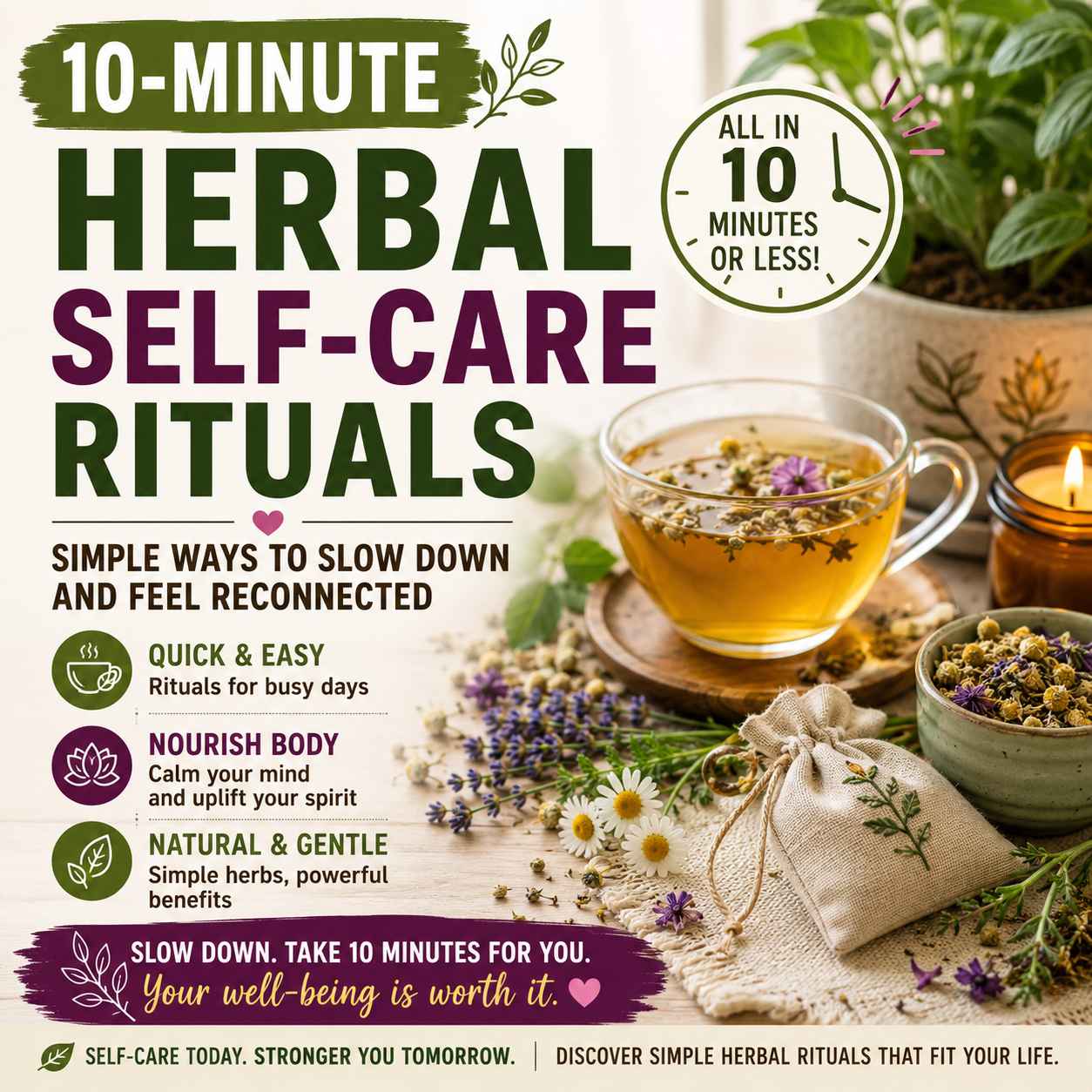
10-Minute Herbal Self-Care Rituals: Simple Ways to Slow Down and Feel Reconnected
10-Minute Herbal Self-Care Rituals: Simple Ways to Slow Down and Feel Reconnected
Herbal self-care is the practice of using simple, intentional plant-based routines to create moments of relaxation, reflection, and everyday wellness. You do not need an elaborate apothecary or an hour of free time to begin. Simple activities such as preparing an herbal tea, enjoying a warm herbal foot soak, tending a few herbs, or creating a calming evening routine can turn 10 minutes into a meaningful pause. For beginners who want to go beyond occasional rituals, structured herbal education can provide the knowledge and confidence to explore herbs more responsibly and creatively.
Self-care has somehow become another item on the modern to-do list.
There are elaborate morning routines, hour-long wellness rituals, complicated supplement schedules, meditation programs, skincare routines, fitness plans and countless apps reminding us to relax.
The irony is obvious.Sometimes we become so busy trying to practice self-care that self-care itself starts to feel like work.
A better approach can be much simpler.
You can start with 10 minutes.
Ten quiet minutes with a cup of herbal tea. Ten minutes soaking your feet in warm water. Ten minutes tending a plant, preparing a simple botanical ritual, or sitting without another screen demanding your attention.
That is where herbal self-care becomes interesting.It brings together traditional plant knowledge, simple hands-on activities and intentional pauses that can fit into ordinary life.
And you do not have to become an herbalist overnight.
You simply need to begin.
Ready to turn a few quiet minutes into a deeper relationship with herbs?Explore Herbal Academy's collection of online herbalism courses and discover a learning path that fits your interests and experience.
What Is Herbal Self-Care?
Herbal self-care is not about treating every problem with a plant.
It is about creating intentional routines that incorporate herbs, botanical traditions and mindful moments into everyday life.
For one person, that might mean preparing an herbal tea before bed.
For another, it could mean growing herbs on a balcony, making a simple botanical skin-care product or learning how different plants have traditionally been used.
The important part is the ritual.
You stop.
You pay attention.
You work with something tangible.
And for a few minutes, you step away from the constant stream of notifications, deadlines and screens.
That makes herbal self-care particularly appealing for people who want wellness practices that feel practical rather than performative.
Why 10 Minutes Can Be Enough
You do not need a free afternoon to create a useful pause in your day.
A 10-minute ritual is small enough to repeat.
That matters.
A complicated routine that you perform once is unlikely to become part of your lifestyle. A simple ritual that takes 10 minutes and fits naturally into your day has a much better chance of becoming a habit.
Think of it as a minimum viable wellness ritual.
You are not trying to transform your entire life before breakfast.
You are creating one small moment that belongs to you.
Over time, those moments can become a gateway to deeper learning about plants, traditional herbal practices and natural living.
1. Make an Intentional Herbal Tea
One of the easiest herbal self-care rituals is also one of the oldest.
Make a cup of herbal tea and actually give yourself time to drink it.
Not while answering email.
Not while scrolling through social media.
Not while rushing between meetings.
Just tea.
Choose an herbal tea you already enjoy, prepare it according to its directions, and use the few minutes while it steeps as a deliberate pause.
You can make the ritual even more mindful by noticing:
- The aroma of the herbs
- The warmth of the cup
- The color of the infusion
- The taste as you drink
- How you feel before and after the pause
This isn't about claiming that a particular herb will cure a condition.
It is about changing the way you experience an ordinary cup of tea.
Want to learn more than simply brewing tea?
If tea blending catches your attention, structured education can take the hobby much further.
Herbal Academy currently offers a Tea Blending 101 Mini Course, alongside broader herbalism programs.
2. Try a Warm Herbal Foot Soak
A foot soak can turn an ordinary evening into a small ritual.
Fill a basin with comfortably warm water and, if appropriate for you, add a suitable herbal preparation or bath product according to its instructions.
Then sit down.
That's the important part.
For 10 minutes, you don't need to accomplish anything.
You can simply breathe, listen to quiet music or enjoy the feeling of stepping out of a busy day.
Keep the ritual uncomplicated.
The goal isn't to create a spa in your bathroom.
The goal is to create a transition between doing and resting.
3. Create a Five-Minute Herbal Breathing Pause
You don't need special equipment to make a short mindful pause.
Place a cup of an herbal beverage nearby, sit comfortably and spend a few minutes paying attention to your breathing.
Slow down.
Notice your shoulders.
Relax your hands.
Take a few comfortable breaths.
If you enjoy aromatic herbs, you can also explore their traditional uses through proper herbal education rather than treating every scent or plant as a medical intervention.
This distinction matters.Herbal self-care should encourage curiosity and informed choices—not replace professional medical care.
4. Start a Tiny Herbal Garden
Self-care does not have to happen indoors.
Growing herbs can become a ritual in itself.
You don't need a large garden.
A sunny windowsill, balcony or a few containers can be enough to begin exploring herbs.
Spend 10 minutes:
- Checking your plants
- Watering when needed
- Removing damaged leaves
- Observing new growth
- Learning the names of your plants
- Recording what you notice
This creates something that many modern wellness routines lack:
a relationship with something living.
And if gardening becomes your interest, herbal education can help you move beyond simply keeping plants alive.
Herbal Academy currently offers an Herbal Gardening Course covering planning, planting, tending and harvesting an herb garden.
5. Build a Simple Botanical Skin-Care Ritual
Another easy direction for herbal self-care is botanical skin care.
Instead of buying another complicated collection of products, you can spend a few minutes learning about botanical ingredients and simple plant-based preparations.
A short evening routine might involve:
- Cleansing your skin.
- Applying a product you already know works for you.
- Taking a moment to enjoy its texture or botanical aroma.
- Putting the products away rather than continuing to add more steps.
If the subject fascinates you, learning how botanical preparations are actually formulated is far more valuable than copying random recipes from social media.
Herbal Academy offers a Botanical Skin Care Course covering herbal-infused products and botanical skin-care preparation.
6. Keep an Herbal Journal
This might be the most underrated herbal self-care ritual.
Take a notebook and spend 10 minutes writing about your relationship with herbs.
You could record:
- Herbs you are learning about
- Teas you have tried
- Plants growing in your garden
- Questions you want answered
- Traditional uses you want to research
- Recipes you want to explore
- Observations from your garden
- Books or courses you want to study
You are gradually creating your own personal herbal reference.
Over time, those pages can become much more valuable than a collection of random bookmarks.
This is also one reason structured herbal education can be worthwhile: instead of endlessly collecting information, you begin organizing what you learn.
7. Make Your Evening Tea a Screen-Free Ritual
Try one small experiment.
For 10 minutes, put your phone somewhere else.
Prepare your herbal tea.
Sit somewhere comfortable.
Drink it slowly.
No scrolling.
No notifications.
No multitasking.
This isn't revolutionary.
It is simply intentional.
And sometimes traditional habits become valuable precisely because they are uncomplicated.
A cup of tea can become a signal that the working part of the day is finished.
8. Learn One Herb at a Time
You don't need to memorize an entire materia medica.
Choose one herb that genuinely interests you.
Then spend 10 minutes learning about it.
Look at:
- Its botanical name
- Plant family
- Parts traditionally used
- Historical uses
- Preparation methods
- Safety considerations
- Growing conditions
- Relevant research
The objective isn't to become an expert in one evening.
It is to build knowledge gradually.
One herb.
Then another.
Then another.
That is how a casual interest can eventually become a genuine herbalism hobby.
If these small rituals are turning into a genuine interest in plants and traditional herbal knowledge, our guide to Hobby Herbalism: 5 Joyful Ways to Learn Herbalism Online and Start Your Herbal Journey offers practical ways to explore that interest without making learning feel overwhelming.
From Herbal Self-Care to Learning Herbalism
This is where the journey gets interesting.
A 10-minute herbal ritual may begin as a simple wellness habit.
Then curiosity takes over.
You start wondering why one herb is traditionally prepared as tea while another is infused into oil.
You become interested in growing plants.
Then you discover botanical skincare.
Then tea blending.
Then plant identification.
Before long, you aren't simply using herbs—you are learning about them.
That transition is exactly where structured education can make sense.
If your 10-minute rituals are turning into a genuine interest in plants, preparation and traditional herbal knowledge, our guide to Herbalism as a Hobby: Best Online Courses for a Joyful, Hands-On Herbal Journey is a natural next step for exploring where that curiosity can take you.
Is an Online Herbalism Course Worth It for a Beginner?
It can be—particularly when you want structure.
Free articles, videos and social posts are useful for discovering topics.
But they can leave beginners with fragmented knowledge.
A structured course can bring together:
- Plant identification
- Herbal foundations
- Traditional uses
- Preparation methods
- Safety considerations
- Practical projects
- Botanical subjects
- Progressive learning
Herbal Academy's current course catalog includes introductory and intermediate programs as well as specialist courses covering areas such as tea blending, botanical skincare, herbal gardening, formulation and self-care.
That makes it possible to choose education based on what you actually want to learn, rather than buying a course simply because it has the word “herbal” in its title.
If you're comparing structured learning options rather than piecing together information from random websites, our guide to the best online herbalism courses for beginners and intermediate learners can help you compare the learning paths before you invest.
Which Herbal Course Should a Beginner Consider?
Start with your interest.
If you want broad herbal foundations
An introductory herbal course is the logical starting point.
Herbal Academy describes its Introductory Herbal Course as a self-study program intended for people with little or no previous herbal experience.
If tea is what interests you
A tea-focused mini course may be a more focused entry point.
If you love making natural products
A botanical skincare or herbal preparation course may be more appealing.
If gardening is your passion
An herbal gardening course gives you a practical direction.
If you want to develop deeper herbal knowledge
You can consider progressing from introductory study into intermediate and advanced education.
The important thing is not to buy the most advanced course.
It is to buy the right learning experience for your current stage.
Herbal Academy's Current Course Offer
If you're ready to turn your 10-minute rituals into deeper herbal knowledge, this is a particularly useful time to look at Herbal Academy's catalog.
The official site is currently promoting its Back to Joy Sale with savings of up to 40% on online herbal courses, with no coupon required. The promotion also includes selected path packages and payment options for certain programs.
That gives beginners and hobbyists an opportunity to explore structured herbal education while the promotion is available.
A Simple 10-Minute Herbal Self-Care Routine
If you want something you can actually repeat, try this:
Minute 1–2: Prepare
Make your herbal tea or prepare your chosen ritual.
Put your phone away.
Minute 3–4: Pause
Sit comfortably.
Take a few relaxed breaths.
Let your attention settle.
Minute 5–7: Enjoy
Drink your tea, tend a plant, journal or enjoy your foot soak.
Don't multitask.
Minute 8–10: Reflect
Ask yourself:
How do I feel now compared with 10 minutes ago?
Write down one sentence if you like.
That's it.
No complicated routine.
No expensive equipment.
No pressure to make the ritual perfect.
How to Make Herbal Self-Care a Habit
The best herbal self-care routine is the one you actually repeat.
Try attaching your ritual to something you already do.
For example:
After breakfast → herbal tea
After work → 10-minute garden check
Before bed → screen-free tea ritual
Sunday afternoon → herbal journal
This approach is easier than trying to completely redesign your lifestyle.
Start with one ritual.
Keep it manageable.
Let curiosity expand naturally.
Herbal Self-Care Should Be Simple—But It Should Also Be Responsible
There is an important difference between enjoying an herbal ritual and using herbs as medicine.
Plants can be biologically active.
Some herbs may interact with medicines, supplements or health conditions. Some are inappropriate during pregnancy or for certain people. Correct identification, preparation and dosage matter.
So don't assume that “natural” automatically means “safe.”
For anyone new to herbalism, learning basic herbal safety is an important part of building responsible knowledge.
When experimenting with herbs internally or using concentrated preparations, consult an appropriately qualified healthcare professional when necessary—especially if you take medication, are pregnant or breastfeeding, have a medical condition, or are considering herbs for a child.
Self-care should make you more informed, not less cautious.
Why Herbal Self-Care Can Become More Than a Wellness Trend
There is a reason herbalism continues to attract people who want a more hands-on relationship with wellness.
It combines learning with doing.
You can read about a plant.
Grow it.
Observe it.
Learn its history.
Prepare something with it.
Record what you discover.
Then move on to another plant.
That makes herbalism different from many passive forms of online content.
You're not simply consuming information.
You're building a skill.
And that is where a 10-minute ritual can become the beginning of a much bigger journey.
Your Next Step: Turn 10 Minutes Into a Lifelong Herbal Habit
You don't need to become a professional herbalist.
You don't need an enormous herb garden.
You don't need a cabinet full of tinctures.
Start with 10 minutes.
Make a cup of herbal tea.
Spend time with a plant.
Write one page in an herbal journal.
Explore a botanical preparation.
Then, if your curiosity grows, invest in proper education.
For readers ready to move from casual herbal self-care into structured learning, Herbal Academy currently offers online courses ranging from introductory herbalism to focused subjects such as tea blending, botanical skincare, herbal gardening and herbal self-care.
Your first 10 minutes could be a ritual.
Your next 10 minutes could be a lesson.
And eventually, those small moments can become a genuine herbal practice.
Explore Herbal Academy's Online Herbalism Courses and Current Savings
Frequently Asked Questions About Herbal Self-Care
What is herbal self-care?
Herbal self-care is the intentional use of simple plant-based activities as part of an everyday wellness routine. Examples include preparing herbal tea, tending herbs, keeping an herbal journal, enjoying a suitable herbal bath or learning about traditional plant practices.
Can I practice herbal self-care in 10 minutes?
Yes. A short ritual can be as simple as preparing and mindfully drinking an herbal tea, spending time with a plant, journaling about one herb or enjoying a brief foot soak.
What are the best herbal self-care rituals for beginners?
Begin with simple activities that require little preparation. Herbal tea, gardening, journaling and learning about one herb at a time are accessible ways to begin exploring herbal self-care.
Do I need to know herbalism before trying herbal self-care?
No. You can begin with simple, familiar activities. However, if you want to use herbs more extensively, learning basic herbal safety and foundational herbalism is a sensible next step.
Can herbal self-care replace medical treatment?
No. Herbal self-care should not be presented as a replacement for diagnosis, medical treatment or professional healthcare. Herbs can be biologically active and may interact with medications or be unsuitable for some people.
How can I learn herbalism online?
You can start with structured online herbalism education. Beginner programs can introduce foundational concepts, while specialized courses can focus on areas such as tea blending, botanical skincare, gardening or herbal preparation. Herbal Academy currently offers courses across these areas.
What is a good herbalism course for a beginner?
Look for a course that matches your current knowledge and interests. Someone completely new to herbalism may benefit from an introductory program, while someone primarily interested in tea, gardening or botanical skincare may prefer a focused course.
Is Herbal Academy suitable for beginners?
Herbal Academy currently offers an Introductory Herbal Course specifically described as a self-study option for learners with little or no herbal experience. Its catalog also includes intermediate, advanced and specialized courses.
Are Herbal Academy courses currently discounted?
Yes. At the time of writing, Herbal Academy's official course page advertises its Back to Joy Sale with savings of up to 40% on online herbal courses, with no coupon required. Because promotions change, check the official offer page for the current terms before purchasing.
Is herbalism a good hobby?
Herbalism can be an enjoyable hobby for people interested in plants, gardening, traditional knowledge, tea blending, botanical crafts and hands-on learning. You can explore it casually or gradually move into structured study.
Ready to take your interest in herbs beyond occasional self-care rituals? Explore Herbal Academy's online herbalism courses and find a program that fits the way you want to learn—from foundational herbalism and tea blending to botanical skincare and herbal gardening.
Final Takeaway
Self-care does not have to be another demanding project.
Sometimes it is simply ten quiet minutes.
A warm cup of tea.
A few minutes with your plants.
A notebook filled with observations.
A simple botanical ritual.
The real value is not in making the routine complicated. It is in making it intentional enough to repeat.
And if those small rituals awaken a deeper interest in herbs, don't stop at collecting random tips online.
Learn.
Experiment responsibly.
Build practical knowledge.
Let a 10-minute pause become the beginning of a lifelong relationship with herbalism.
Related Kuruntha Smarket Reading
- Herbalism as a Hobby: Best Online Courses for a Joyful, Hands-On Herbal Journey
- Hobby Herbalist: 5 Joyful Ways to Learn Herbalism Online and Start Your Herbal Journey
- Herbal Remedies & Rituals: A Daily Guide to Rooted Routines and Time-Honored Recipes
- Start Your Herbal Journey Safely: Free Beginner's Guide
- Best Herbalism Course Bundle 2026
#Hashtags#HerbalSelfCare #HerbalWellness #HerbalismForBeginners #Herbalism #NaturalSelfCare #HerbalTea #PlantBasedWellness #LearnHerbalism #HerbalLifestyle #HerbalEducation #HomeHerbalism #HerbalGarden #BotanicalSkincare #MindfulLiving #NaturalWellness
Disclaimer:
This content is for informational purposes only and does not constitute medical advice. Always consult a qualified healthcare professional before making decisions related to your health.This article was created with AI-assisted research and carefully reviewed by our in-house team before publication
This article may contain affiliate links. If you choose to purchase through these links, we may earn a commission at no additional cost to you.