Hobby Herbalist: 5 Joyful Ways to Learn Herbalism Online and Start Your Herbal Journey
Hobby Herbalist: 5 Joyful Ways to Learn Herbalism Online and Start Your Herbal Journey
A hobby herbalist is someone who studies and enjoys herbalism for personal interest rather than necessarily pursuing it as a profession. You can start by learning about herbs, growing a small herb garden, making herbal teas, exploring botanical skincare, keeping an herbal notebook or taking a self-paced online herbalism course. For beginners, structured online learning can provide a more organized way to build foundational knowledge while allowing you to explore the parts of herbalism you enjoy most.
Not every hobby needs to become a side business.
Not every hour of your day needs to be productive.
Sometimes, you simply need something that gives you a reason to slow down, learn something interesting and make something with your own hands.
That is where herbalism can become surprisingly rewarding.
You might start with an interest in herbs. Then you discover herbal teas. Perhaps that leads you to gardening, botanical skincare or learning how different plants have traditionally been used. Before long, what started as curiosity becomes a genuine hobby.
And you do not need to become a professional herbalist to enjoy the journey.
You can simply become a hobby herbalist.
Ready to turn your interest in herbs into a structured hobby? Explore Herbal Academy's online herbalism courses and choose a learning path that matches your interests and experience level.
Why Herbalism Makes Such a Good Hobby
Modern life gives us plenty of ways to consume information but surprisingly few opportunities to work with our hands.
Herbalism changes that.
You can read about a plant, grow it, observe it, learn how it has traditionally been used and eventually explore practical preparations or creative projects.
It creates a natural connection between learning and doing.
For some people, the attraction is gardening.
For others, it is tea blending.Some enjoy making botanical skincare products, while others are fascinated by plant identification, traditional herbal knowledge or responsible foraging.
There is no single correct way to enjoy herbalism.
That flexibility is one of its greatest strengths.
A hobby herbalist can:
- Learn about herbs and plants
- Grow herbs at home
- Explore traditional herbal practices
- Experiment with herbal tea recipes
- Keep an herbal journal
- Learn botanical skincare techniques
- Explore responsible plant identification
- Develop practical herbal preparation skills
- Take online herbalism courses
- Gradually move from beginner topics into more advanced study
The important part is choosing an approach that genuinely interests you.
If you're curious about turning that interest into a more structured learning experience, explore our guide to herbalism as a hobby and the best online courses for a joyful, hands-on herbal journey before choosing where to begin.
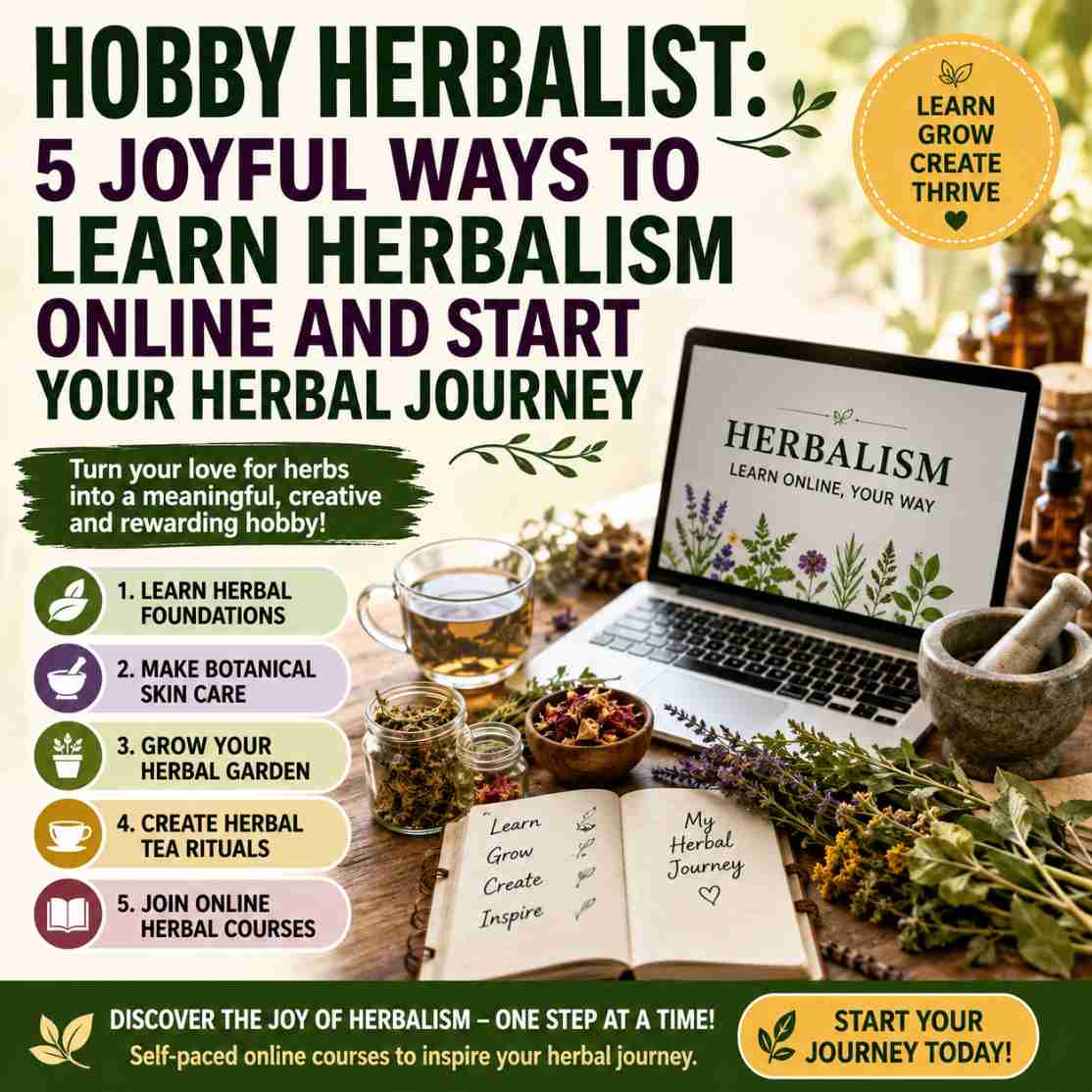
5 Joyful Ways to Learn Herbalism Online
1. Start With a Beginner Herbalism Course
If you have ever searched for herbalism online, you already know how much information is available.
That abundance can actually become a problem.
One article talks about teas.
Another discusses tinctures.
A video covers gardening.
A social media post introduces a completely different herbal tradition.
Before long, you have twenty browser tabs open and still don't know what you should learn first.
A structured beginner herbalism course can solve that problem.
Instead of jumping randomly between topics, you can follow a learning path and gradually build your knowledge.
For someone completely new to herbalism, the Herbal Academy Introductory Herbal Course is designed as a self-study program covering foundational concepts, herbal preparations and related topics. The current course information describes six in-depth units, more than 30 lessons, downloadable resources and practical topics including teas, infusions, decoctions, tinctures, syrups, topical preparations and body care.
That makes an introductory course particularly useful if your question is simply:
“I am interested in herbs. Where do I start?”
Best for:
Curious beginners who want structure without immediately committing to professional-level study.
2. Turn Herbalism Into a Creative Hobby With Botanical Skincare
Some people learn best when they can make something.
If that sounds like you, botanical skincare can make herbalism feel less like studying and more like creating.
Instead of simply reading about plants, you can explore how botanical ingredients fit into practical projects such as soaps, creams, salves, bath products and other personal-care preparations.
Herbal Academy's Botanical Skin Care Course currently includes four instructional units, written lessons, video tutorials, printable resources and more than 200 herbal skincare recipes. Its curriculum includes subjects such as infused oils, salves, bath products, creams, lotions, body butters, herbal soaps and hair care.
That combination of learning and making is exactly what many people want from a hobby.
You finish a study session with something tangible to explore.
Best for:
DIY enthusiasts, crafters and anyone who enjoys working with natural ingredients and creating practical projects.
3. Grow Your Own Herbal Garden
You do not need acres of land to bring herbalism into your daily life.
A few containers on a balcony can be enough to begin.
Growing herbs changes the way you learn because you are no longer looking at plants only through photographs or descriptions.
You can watch them develop.
You can observe their leaves, growth habits and seasonal changes.
You can keep notes.
And you can begin building a relationship with the plants you are studying.
If growing your own herbs sounds like the most enjoyable part of becoming a hobby herbalist, start with these herb garden plans for growing medicinal herbs at home and turn your interest in plants into something you can actually cultivate.
For people who enjoy gardening, an herbal gardening course can therefore become a natural extension of herbal education.
Herbal Academy's current Herbal Gardening Course focuses on planning, planting, tending and harvesting an herb garden according to factors such as available space, climate, lifestyle and goals.
That makes this route especially appealing if you want your hobby to take you outdoors.
Best for:
Gardeners, nature lovers and beginners who want a hands-on connection with plants.
4. Make Herbal Tea Part of Your Learning Ritual
You do not have to begin with complicated preparations.
Tea can be one of the simplest ways to develop curiosity about herbs.
Instead of treating your tea break as another five minutes of scrolling, make it a small learning ritual.Choose an herb.
Learn about it.
Explore its traditional uses.
Notice its aroma and flavor.
Write down what you discover.
Then move on to another plant when you are ready.
This approach turns an ordinary daily habit into a gentle form of continuing education.
And it demonstrates an important principle of hobby herbalism:
Your hobby does not have to consume your life to become meaningful.
Ten or fifteen minutes of genuine curiosity can be enough to keep the learning going.
If you are new to herbal tea, start with simple, well-understood ingredients and use reputable educational resources rather than assuming that every plant is automatically safe because it is “natural.”
5. Build Your Own Herbal Learning Journal
This might be the simplest idea on the list, but it can become one of the most valuable.
Keep a notebook dedicated to your herbal journey.
For every plant you study, record things such as:
- Common name
- Botanical name
- What part of the plant interests you
- Traditional uses
- Preparation methods you are studying
- Growing observations
- Questions you still have
- Sources you want to revisit
- Personal learning notes
Over time, the notebook becomes more than a collection of notes.
It becomes a record of your development as a hobby herbalist.
You can also use it to keep track of courses, recipes, garden observations and projects you want to try later.
You don't need an expensive journal.A simple notebook is perfectly adequate.
Before turning herbalism into a new hobby, you can start much smaller. Our guide to 10-minute herbal self-care rituals shows how simple plant-based routines can fit into even the busiest day.
Why Take an Online Herbalism Course Instead of Learning for Free?
This is the question many people should ask before spending money.
There is no shortage of free herbal information online.
So why pay for a course?
Structure.
Free information is useful when you already understand what you need to learn.
It becomes less useful when you are starting from scratch and don't know which topic should come first.
A structured course can give you a logical progression through the material.
Depending on the program, you may also receive lessons, downloadable resources, recipes, demonstrations and other learning materials.
Herbal Academy describes its online courses as self-paced, giving students flexibility around when and how quickly they study.
For a hobbyist, that matters.A hobby should fit around your life—not create another rigid obligation.
If you’re ready to compare different learning paths before investing, our guide to online herbalism courses for beginners and intermediate learners breaks down the options so you can choose a course that matches where you are now.
How to Choose the Right Herbalism Course
Don't buy an herbalism course simply because it has the most lessons.
Choose based on what you actually want to do.
If You Are Completely New
Look for an introductory herbalism course that explains fundamental concepts and gives you a foundation before moving into specialized subjects.
The Herbal Academy Introductory Herbal Course is positioned for learners with little or no previous herbal experience.
Best fit: The curious beginner.
If You Love Making Things
Look for a botanical skincare course or another practical program focused on creating herbal products.
Best fit: The creative hobbyist.
If Gardening Is Your Passion
An herbal gardening course may be more relevant than a broad herbalism program.
Best fit: Gardeners and plant lovers.
If You Already Know the Basics
Once you have foundational knowledge, you can consider intermediate or specialized education.
Herbal Academy currently offers intermediate, advanced, business and specialized herbal education alongside its introductory material.
Best fit: Hobbyists whose curiosity has developed into deeper study.
Herbalism Does Not Have to Become a Career
This point deserves emphasis.
There is nothing wrong with learning something simply because you enjoy it.
You don't have to monetize your garden.
You don't have to sell herbal products.
You don't have to become a professional herbalist.
You don't even have to complete an advanced course.
You can learn because plants fascinate you.
You can learn because gardening relaxes you.
You can learn because you enjoy making things.
You can learn because you want a hobby that gets you away from another screen.
That is enough.
If your interests eventually become more serious, structured education can grow with you. Herbal Academy, for example, currently provides progression from introductory study into intermediate and advanced programs.
How to Start Your Hobby Herbalist Journey This Week
Don't overcomplicate the beginning.
Try this simple five-step approach.
Step 1: Choose one area
Pick one:
- Herbal tea
- Gardening
- Botanical skincare
- Plant identification
- General herbalism
Don't attempt everything simultaneously.
Step 2: Give yourself a small amount of time
Even 10–20 minutes can be enough.The objective is consistency, not intensity.
Step 3: Learn from a structured source
Use reputable educational material instead of piecing your entire education together from random social media posts.
Step 4: Do something practical
Grow something.
Make notes.
Study a plant.
Prepare a simple project appropriate to your knowledge level.
Connect learning with action.
Step 5: Decide whether you want to go deeper
After a few weeks, you will know whether herbalism is simply an interesting curiosity or a hobby you genuinely want to develop.
If the interest sticks, that is the point where investing in a structured course makes much more sense.
Ready to Turn Curiosity Into a Real Hobby?
You don't need to wait for the “perfect” time.
You don't need a huge garden.
You don't need professional ambitions.
And you certainly don't need to know everything before you begin.
Still deciding whether Herbal Academy is the right fit for your learning goals? Our Herbal Academy review takes a closer look at its courses and learning experience before you make a decision.
Start with one plant, one notebook, one small project or one beginner-friendly lesson.
If you want structured online education, Herbal Academy offers courses ranging from introductory herbalism to specialized subjects such as botanical skincare and herbal gardening.
If you're ready to see which course fits your interests, explore the full Herbal Academy course collection here:
For a complete beginner, the Introductory Herbal Course is the logical place to investigate first. It is designed to build foundational herbal knowledge while allowing students to study at their own pace.
Disclosure: Kuruntha Smarket may earn a commission when you purchase through qualifying affiliate links. This does not change the price you pay.
Frequently Asked Questions About Becoming a Hobby Herbalist
What is a hobby herbalist?
A hobby herbalist is someone who studies and explores herbalism primarily for personal interest and enjoyment rather than necessarily pursuing professional herbal practice. A hobbyist might grow herbs, study plants, make herbal preparations, explore botanical skincare or take online courses.
Is herbalism a good hobby for beginners?
Yes. Herbalism can be a good hobby for beginners because you can start with a small area of interest and gradually expand your knowledge. Gardening, herbal tea, plant study and introductory online courses are all possible starting points.
Can I learn herbalism online?
Yes. Online herbalism courses can provide structured lessons and learning resources without requiring you to attend a physical classroom. Self-paced programs can be particularly convenient for people fitting a hobby around work and family commitments. Herbal Academy currently offers online courses across beginner, intermediate, advanced and specialized subjects.
What is the best online herbalism course for beginners?
There is no universal best course because the right choice depends on your goals. Someone completely new to herbalism may benefit most from an introductory program, while someone interested specifically in skincare or gardening may prefer a specialized course.For a general foundation, the Herbal Academy Introductory Herbal Course is specifically designed for learners with little or no previous herbal experience.
Can herbalism be a relaxing hobby?
It can be. The hobby can include quiet activities such as reading about plants, maintaining a garden, keeping an herbal journal or preparing tea. The key is to approach it as something you enjoy rather than another productivity obligation.
Do I need a garden to become a hobby herbalist?
No. A garden is optional. You can begin by studying herbs, keeping an herbal notebook, exploring tea, taking an online course or learning botanical skincare. If you later want to grow plants, even containers can provide a starting point.
Can I learn herbalism without becoming a professional herbalist?
Absolutely. Herbalism can be studied simply as a personal interest or creative hobby. Professional herbal practice is a different goal and requires a much more serious approach to education, scope of practice and safety.
Are online herbalism courses worth paying for?
They can be, particularly if you value structure. Free resources can help you explore individual topics, while a paid course may organize the material into a coherent learning path and provide additional educational resources. The value depends on the quality, depth and relevance of the course to your goals.
What should I learn first in herbalism?
If you are completely new, start with foundational concepts rather than jumping straight into advanced formulation. Learn about herbs, basic preparations, responsible use and safety before progressing into specialized subjects.
Is herbalism safe to learn and practice at home?
Learning about herbs can be done at home, but “natural” does not automatically mean “safe.” Herbs can have biological effects and may interact with medicines or be unsuitable for particular people. Use reputable educational resources, learn appropriate safety information and seek qualified medical advice when health conditions or medications are involved.
How much time do I need to spend learning herbalism?
There is no fixed requirement for a hobbyist. You can start with a few minutes several times a week and increase your study time as your interest grows. Self-paced online education can make it easier to fit learning around your existing schedule.
If herbalism has started to feel like the kind of hobby you'd genuinely enjoy, take a look at Herbal Academy’s Introductory Herbal Course and see whether it's the right place to begin your journey.
Final Thought
The best hobby is not necessarily the one that makes you more productive.
Sometimes, it is the one that makes you more curious.
Herbalism gives you plenty of room for that curiosity.
You can grow something, make something, study something and gradually build knowledge that stays with you.
Start small.
Choose an area that genuinely interests you.
And if you discover that herbalism is more than a passing curiosity, give yourself the structure and education to take the next step.
Your hobby doesn't have to become a career to be worth pursuing. It just has to bring something good into your life.
#HerbalismAsAHobby #HobbyHerbalist #LearnHerbalism #HerbalEducation #HerbalismForBeginners #HerbalGardening #BotanicalSkincare #HerbalTea #HerbalCourses #NaturalLiving
Disclosure:
This article may contain affiliate links. If you choose a service through our links, we may earn a commission at no extra cost to you.
This article was created with AI-assisted research and carefully reviewed by our in-house team before publication