Best AI Landing Page Builders in 2026: Create High-Converting Pages Without Coding
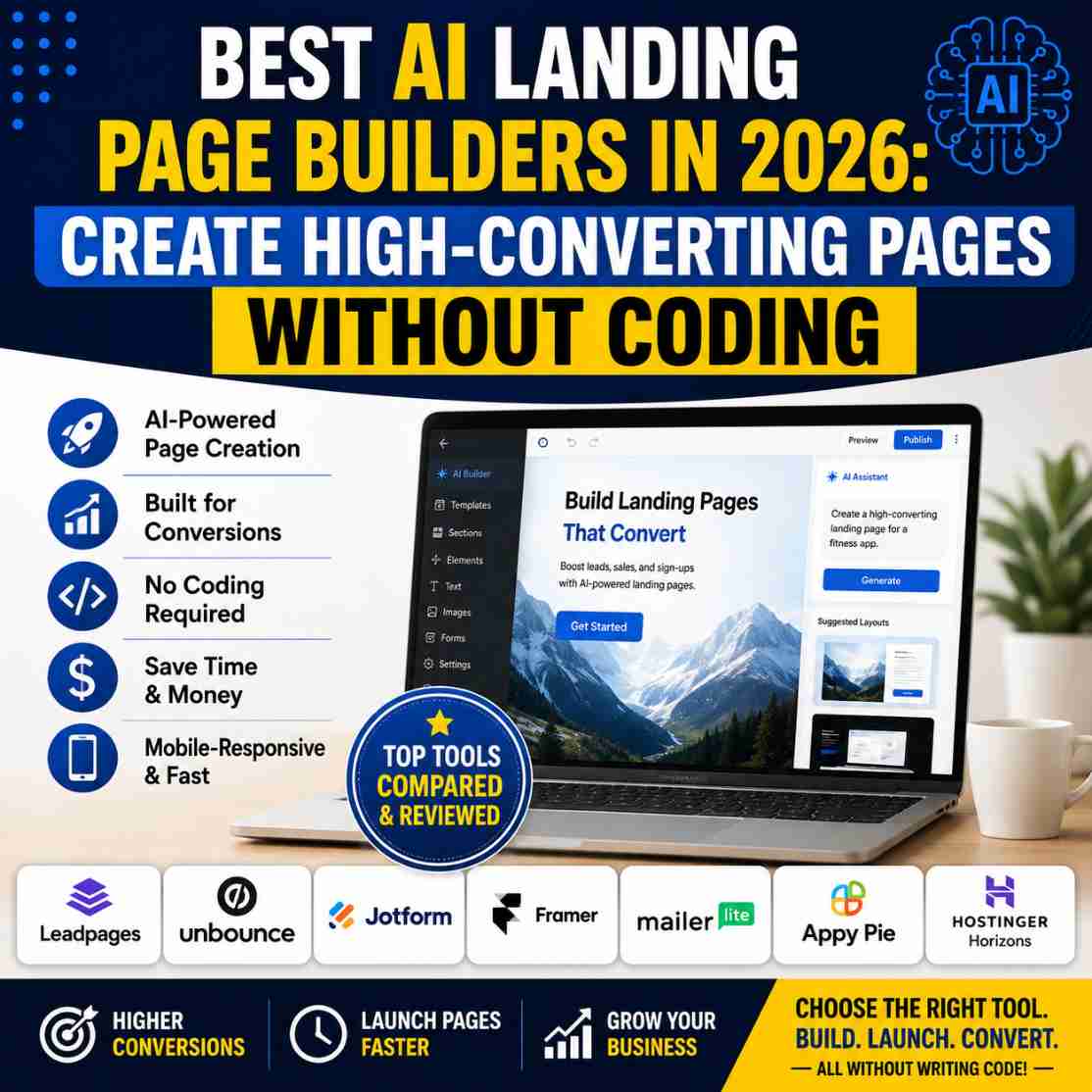
Best AI Landing Page Builders in 2026: Create High-Converting Pages Without Coding
The best AI landing page builder in 2026 depends on what you need to accomplish. Leadpages is particularly strong for marketers who want AI-assisted page creation combined with A/B testing and conversion optimization, while Unbounce is designed around experimentation and AI-powered optimization. Jotform is attractive for businesses that need landing pages combined with forms, payments and lead collection. Other platforms such as Framer, MailerLite and broader AI website builders can be better suited to design, email marketing or complete website creation. The right choice is the platform that combines fast AI generation with the conversion, analytics, integrations and publishing features your business actually needs.
A landing page has one job: move a visitor toward a specific action.
That action might be joining an email list, requesting a consultation, registering for an event, downloading a resource, starting a free trial or purchasing a product.
The problem is that creating a good landing page traditionally requires several skills at once. You need copywriting, design, mobile optimization, calls to action, forms, analytics and often some technical knowledge.
AI is changing that equation.
Today's AI landing page builders can turn a short description of your business, product or campaign into a structured page, often with headlines, sections, calls to action and visual elements already prepared. Some platforms go further by adding A/B testing, personalization, analytics, forms and conversion optimization.
But there is a catch.
An AI-generated page is not automatically a high-converting page.
The best platforms are the ones that help you move beyond generating a pretty page and actually improve what happens after visitors arrive.
This guide looks at the leading options from a buyer's perspective so you can choose an AI landing page builder based on your goals rather than simply choosing the tool with the most impressive AI demo.
Ready to turn your idea into a live landing page? If you already know what you want to promote, start by comparing the AI landing page builders that best fit your goal, budget, and level of technical experience. A good builder can get you from a blank page to a professional campaign much faster—without hiring a developer for every change.
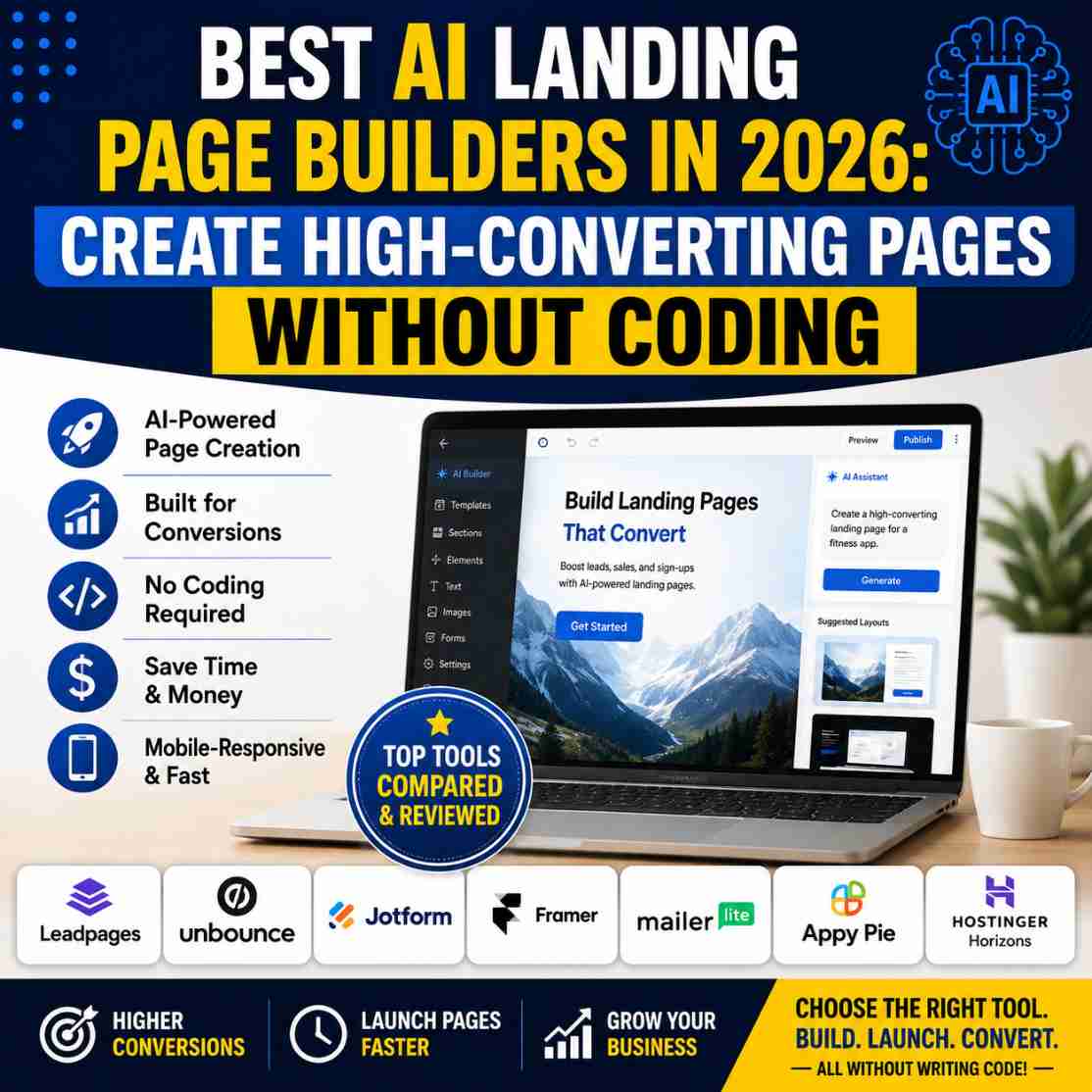
What Is an AI Landing Page Builder?
An AI landing page builder is a no-code platform that uses artificial intelligence to help create, customize and sometimes optimize landing pages from natural-language instructions.
Instead of starting with a blank canvas, you might enter something like:
“Create a landing page for an online accounting service targeting small businesses. The goal is to generate consultation requests.”
The AI can then generate the initial page structure, copy and design direction.
You can normally edit the result using a visual editor rather than writing HTML, CSS or JavaScript.
Modern platforms increasingly combine AI generation with traditional conversion features such as:
- Drag-and-drop editing
- Lead capture forms
- Payment processing
- A/B testing
- Analytics
- Personalization
- SEO controls
- Mobile optimization
- Marketing integrations
- Custom domains
- Conversion tracking
That combination is what makes the category commercially interesting.
If you're completely new to the technology, our earlier guide to creating a high-converting AI landing page in 60 seconds explains how these tools can turn a simple idea into a working page without traditional coding.
Best AI Landing Page Builders in 2026
1. Leadpages — Best for Conversion-Focused Marketing
Best for: Marketers, small businesses, agencies and campaign-driven businesses.
Leadpages is one of the strongest choices when the objective is not simply to create a landing page but to test and improve its performance.
Its current AI landing page builder can generate a branded, responsive page from a plain-language description. Leadpages also combines AI generation with A/B testing, dynamic text replacement, lead enrichment and, on higher plans, Smart Traffic and heatmaps.
That distinction matters.
A page builder helps you launch.A conversion platform helps you learn what converts.
Why consider Leadpages?
- AI-generated landing pages
- No-code visual editing
- A/B testing
- Smart Traffic on higher plans
- Heatmaps on higher plans
- Custom domains
- Lead capture
- Marketing integrations
- Unlimited traffic on its published plans
Leadpages currently offers a 7-day trial, while published plan information shows its paid tiers starting with Grow and moving through Optimize and Scale. Pricing and promotions can change, so buyers should verify the current offer before subscribing.
Best choice if: your landing page is directly connected to lead generation, advertising, sales or conversion optimization.
Potential limitation: it is more marketing-focused than a general-purpose website builder.
2. Unbounce — Best for Advanced Conversion Optimization
Best for: Performance marketers, paid advertising teams and businesses that actively test landing pages.
Unbounce has long focused on conversion optimization rather than simply website design.
Its platform combines no-code landing page creation with A/B testing, AI-powered optimization and Smart Traffic, which can automatically route visitors toward variants predicted to perform better. Unbounce says its optimization technology is informed by data from more than two billion conversions.
Why consider Unbounce?
- Drag-and-drop landing page creation
- AI-assisted functionality
- A/B testing
- Smart Traffic
- Conversion insights
- Personalization capabilities
- Marketing integrations
- Conversion-focused templates
This makes Unbounce particularly interesting for businesses already spending money on advertising.
If you are paying for Google Ads, Meta Ads or other traffic, improving the conversion rate of the destination page can have a direct effect on campaign economics.
Best choice if: you have meaningful traffic and want sophisticated conversion optimization.
Potential limitation: advanced optimization features can require higher-tier plans.
3. Jotform AI Landing Page Generator — Best for Forms, Leads and Payments
Best for: Businesses that want their landing page and data-collection workflow in the same ecosystem.
Jotform takes a slightly different approach.
Its AI landing page generator can create pages from descriptions and then allow users to customize them with a no-code editor. Jotform also brings its established form-building, payment and integration ecosystem into the landing-page workflow.
Jotform's current AI landing page offering is positioned around generating a page quickly and then connecting forms, payments and other business workflows.
Why consider Jotform?
- AI-assisted page creation
- No-code customization
- Forms
- Payment collection
- Lead capture
- 150+ integrations according to Jotform's current comparison material
- Mobile-responsive pages
- Free starting option
Jotform's own 2026 comparison lists its Starter plan as free, with paid plans beginning at a published annual-billing price point of $19.50/month for Bronze at the time of its May 2026 update.
Best choice if: collecting information, registrations, applications, payments or leads is central to your campaign.
Potential limitation: businesses looking for deep, dedicated conversion-rate optimization may prefer a specialist platform.
4. Framer — Best for Design-Led Landing Pages
Best for: Startups, designers, SaaS companies and brands that care heavily about visual presentation.
Framer sits closer to the design-first end of the market.
It is particularly attractive when you want a polished marketing page with strong visual control rather than a purely campaign-oriented funnel.
For design-heavy SaaS launches, startup websites and product pages, Framer can be a strong candidate.
Best choice if: visual quality and brand presentation are major priorities.
Potential limitation: businesses primarily focused on advanced conversion experimentation may prefer platforms such as Leadpages or Unbounce.
5. MailerLite — Best for Landing Pages Plus Email Marketing
Best for: Creators, newsletters, small businesses and marketers who want landing pages connected directly to email campaigns.
MailerLite is particularly useful when the landing page is only one part of a larger lead-generation process.
The platform combines landing pages with email marketing, automation and audience management.
Jotform's current 2026 comparison lists MailerLite among the leading AI landing-page generators and notes its ability to connect landing pages with email nurturing and A/B testing.
Best choice if: your primary goal is to turn landing-page visitors into subscribers and nurture them afterward.
Potential limitation: dedicated CRO teams may want deeper experimentation features elsewhere.
6. Appy Pie — Best for Broader No-Code Business Creation
Best for: Beginners, entrepreneurs and businesses looking beyond a single landing page.
Appy Pie is worth considering differently from specialist landing-page platforms.
Its strength is the wider no-code ecosystem around websites, apps and business solutions. That makes it particularly interesting if your landing page is the starting point for a broader digital project.
Before choosing a plan, you can also compare the latest Appy Pie pricing and plan differences to see which option makes sense for your budget and project size.
Kuruntha Smarket's existing Appy Pie review examines its AI and no-code capabilities for beginners and businesses.
Why consider Appy Pie?
- AI-assisted no-code creation
- Website-building capabilities
- App-building ecosystem
- Beginner-friendly approach
- Broader business use cases
- No traditional coding requirement
Best choice if: you want to move from a marketing page toward a broader no-code digital presence.
Potential limitation: a specialist CRO platform may be a better fit if your only requirement is sophisticated landing-page experimentation.
If you're considering Appy Pie for more than a single landing page, our Appy Pie Review 2026 takes a closer look at its AI-powered app and website-building capabilities, strengths, limitations and suitability for beginners.
7. Hostinger Horizons — Best for AI-Powered Web Projects
Best for: Entrepreneurs and users who want to build more than a single campaign page.
Hostinger Horizons is positioned as an AI web-app builder rather than a traditional landing-page specialist.
Its current offering allows users to describe projects through prompts, create websites and web applications, manage hosting and work toward more advanced digital projects. Current plans also include SEO-oriented functionality and analytics depending on the plan.
This makes it relevant when your landing page is part of a larger website or application strategy.
Best choice if: you want AI-assisted creation plus hosting and broader web-project capabilities.
Potential limitation: it is not as narrowly focused on landing-page CRO as Leadpages or Unbounce.
Quick Comparison: Which AI Landing Page Builder Should You Choose?
| Platform | Best for | AI creation | Conversion tools | Forms/lead capture | Best buyer |
|---|---|---|---|---|---|
| Leadpages | Conversion-focused campaigns | Yes | Excellent | Yes | Marketers & SMBs |
| Unbounce | CRO & paid traffic | Yes | Excellent | Yes | Performance marketers |
| Jotform | Forms, leads & payments | Yes | Good | Excellent | Lead-driven businesses |
| Framer | Design-led pages | Yes/AI-assisted | Good | Via integrations | Startups & designers |
| MailerLite | Email + landing pages | Yes | Good | Yes | Creators & marketers |
| Appy Pie | Broader no-code projects | Yes | Good | Yes | Beginners & entrepreneurs |
| Hostinger Horizons | Websites & web apps | Yes | Developing | Yes | Entrepreneurs & builders |
Important: Features, plan limits and pricing change frequently. Always confirm the current plan before purchasing.
What Should You Look for in an AI Landing Page Builder?
Choosing the tool with the strongest AI demo is the wrong way to make the decision.
Instead, evaluate these factors.
1. AI Page Generation
Can you describe your business and receive a useful first draft?The best systems should save time rather than simply rearrange templates.
2. Conversion Optimization
This is arguably more important than AI generation.
Look for:
- A/B testing
- Smart traffic allocation
- Heatmaps
- Conversion analytics
- Dynamic content
- CTA testing
- Form optimization
The objective is not to create one beautiful page.
The objective is to create a page that produces measurable business results.
3. Mobile Responsiveness
A landing page that looks excellent on a desktop but performs badly on mobile is a liability.
Check the page on:
- Smartphones
- Tablets
- Desktop screens
before sending paid traffic to it.
4. Forms and Lead Capture
If your objective is lead generation, the page needs a frictionless way to collect information.
Look for integration with:
- CRM platforms
- Email marketing systems
- Marketing automation
- Payment processors
- Calendars
- Analytics platforms
5. A/B Testing
A/B testing is where landing-page software starts becoming a serious business tool.
Instead of asking:
“Do I think this headline is better?”
you can test:
“Which headline generates more qualified conversions?”
That shift from opinion to evidence is extremely valuable.
6. Analytics
At minimum, you should understand:
- Visitors
- Conversion rate
- Traffic sources
- Device performance
- Form submissions
- Sales or signups
- Campaign performance
Without measurement, AI optimization is mostly guesswork.
7. Custom Domain
For a serious business, avoid relying permanently on a generic platform URL.
A custom domain strengthens:
- Brand credibility
- Trust
- Campaign consistency
- Professional appearance
8. SEO Controls
Not every landing page needs to rank organically.
However, if organic traffic matters, look for:
- Custom title tags
- Meta descriptions
- Clean URLs
- Image optimization
- Mobile performance
- Indexing controls
- Structured content
Are AI Landing Pages Actually High-Converting?
They can be—but AI does not guarantee conversions.
The quality of the final page still depends on the offer, audience, messaging, proof and user experience.
A technically impressive page can fail if:
- The headline is vague
- The offer is weak
- The CTA is unclear
- The page targets the wrong audience
- There is insufficient trust
- The form asks for too much information
- The page loads slowly
- The visitor does not understand the next step
AI should therefore be treated as an accelerator, not a replacement for marketing judgment.
How to Create a High-Converting Landing Page With AI
A practical workflow looks like this.
Step 1: Define the conversion goal
Choose one primary action.
For example:
- Book a demo
- Start a free trial
- Buy a product
- Download a guide
- Register for an event
- Request a quote
Do not ask one landing page to accomplish ten different jobs.
Step 2: Define your audience
Tell the AI exactly who the page is for.
Instead of:
“Create a business landing page.”
Try:
“Create a landing page for a SaaS accounting platform targeting small business owners who currently manage invoices manually.”
The second prompt gives the AI useful context.
Step 3: Explain the offer
Include:
- Main benefit
- Key features
- Differentiator
- Price or offer
- Customer objections
- Proof
- CTA
Step 4: Generate the first version
Let the AI create the structure.
Don't spend an hour trying to make the first generation perfect.
Step 5: Rewrite the important copy
AI-generated copy should be reviewed carefully.
Your:
- Headline
- Value proposition
- Testimonials
- Statistics
- Pricing
- Claims
- Guarantees
should be factually accurate and aligned with your actual offer.
Step 6: Add proof
Consider:
- Customer testimonials
- Case studies
- Ratings
- Logos
- Certifications
- Results
- Product screenshots
Real proof generally beats generic marketing language.
Step 7: Test the page
Check:
- Mobile layout
- Page speed
- Forms
- Links
- Tracking
- Analytics
- CTA buttons
- Payment flow
Step 8: Run experiments
Once you have enough traffic, test meaningful variables.
For example:
Version A: “Start Your Free Trial”
Version B: “Build Your First Campaign Free”
Don't change five things at once if you want to understand what caused the difference.
AI Landing Page Builders vs Traditional Landing Page Builders
The biggest difference is not necessarily the final visual design.
It is the speed of iteration.
A traditional workflow may look like:
Brief → designer → copywriter → developer → revisions → testing → launch
An AI-assisted workflow can be closer to:
Brief → AI generation → human editing → launch → test → improve
That can dramatically reduce the friction between an idea and a live campaign.
However, traditional design and development still have an important role for highly customized experiences, complex integrations and enterprise requirements.
The smartest approach in 2026 is not necessarily AI versus humans.
It is AI for speed + human judgment for quality + data for optimization.
AI Landing Page Builder vs AI Website Builder: What's the Difference?
This distinction is important.
An AI website builder is normally designed to help create an entire website.
An AI landing page builder focuses on a specific page designed around a particular action.
Choose an AI landing page builder when:
- You are running an advertising campaign
- You need a product launch page
- You need a lead-generation page
- You want to test an offer
- You need a webinar registration page
- You want a focused sales page
Choose an AI website builder when:
- You need multiple pages
- You need a company website
- You need a blog
- You need broader navigation
- You need a complete online presence
This is why platforms such as Appy Pie and Hostinger Horizons can complement rather than directly replace specialized landing-page platforms.
If your project is already moving beyond a single campaign page, our Hostinger Horizons review looks at how AI-powered no-code tools can take an idea toward a functional web app without traditional development.
Are AI Landing Page Builders Good for Small Businesses?
Yes.
Small businesses are arguably among the biggest beneficiaries because AI can reduce the amount of technical work required to launch campaigns.
A local consultant, online educator, startup, agency or ecommerce business can create a campaign page without necessarily hiring a developer for every change.
The more important question is whether the chosen platform provides enough conversion and integration features for the business's next stage of growth.
A cheap builder that cannot handle your marketing workflow may become expensive later.
Which AI Landing Page Builder Is Best for Lead Generation?
For businesses primarily focused on lead generation, I would shortlist:
Leadpages — strong conversion-focused toolkit.
Unbounce — particularly attractive for paid traffic and experimentation.
Jotform — excellent when forms, registrations or payments are central to the workflow.
The right choice depends on what happens after a visitor submits the form.
If the page generates leads but your follow-up process is weak, the landing page alone will not solve the revenue problem.
Which AI Landing Page Builder Is Best for Beginners?
Beginners should prioritize:
- Ease of use
- AI generation
- Templates
- Simple editing
- Forms
- Integrations
- Pricing transparency
- Customer support
Jotform, Leadpages and broader no-code platforms such as Appy Pie are worth considering because they reduce the technical barrier.
The best beginner platform is not necessarily the cheapest.
It is the one that allows you to launch, measure and improve without constantly needing technical help.
What About Free AI Landing Page Builders?
Free plans are useful for testing an idea.
They are less suitable when the page becomes an important revenue channel.
Before choosing a free landing-page builder, check whether it includes:
- Custom domains
- SSL
- Branding removal
- Analytics
- Forms
- Integrations
- Adequate traffic
- A/B testing
- Export options
A free page with platform branding may be perfectly acceptable for experimentation but less appropriate for a serious commercial campaign.
How Much Should You Pay for an AI Landing Page Builder?
There is no universal “right” price.
Instead, compare the software cost with the value of the traffic you are sending to it.
For example, if a landing page is supporting a paid advertising campaign worth thousands of dollars per month, paying more for better testing and optimization can make sense.
If you are validating a small side project with limited traffic, a lower-cost platform may be sufficient.
The right question is:
“What will this platform help me earn, save or test?”
—not simply:
“Which one has the lowest monthly price?”
Our Verdict: Which AI Landing Page Builder Should You Choose?
There is no single winner for every buyer.
Choose Leadpages if:
You want an AI landing page builder with a strong conversion optimization focus and built-in experimentation capabilities. Its current platform combines AI page generation with A/B testing, Smart Traffic and heatmaps on applicable plans.
Choose Unbounce if:
Your business relies heavily on paid campaigns and sophisticated conversion-rate optimization.
Choose Jotform if:
Forms, registrations, payments and lead collection are central to the landing-page experience.
Choose Framer if:
Design and visual presentation are your highest priorities.
Choose MailerLite if:
Your landing page is primarily a gateway into an email marketing and automation strategy.
Choose Appy Pie if:
You want to explore broader AI-powered no-code website and app creation rather than focusing exclusively on landing-page optimization.
Choose Hostinger Horizons if:
You want to move beyond a single landing page into broader AI-assisted website or web-app projects.
Final Buying Advice
The AI landing-page market is moving quickly.
Today's best platform may not remain the best choice for every business six months from now.
So don't buy based on the AI label alone.Before subscribing, ask:
Can it create the type of page I actually need?
Can I connect it to my existing marketing stack?
Can I measure conversions?
Can I run experiments?
Can I publish on my own domain?
Can it scale when my traffic increases?
Does the pricing make sense for my business?
If the answer to those questions is yes, you are much more likely to end up with a platform that contributes to revenue rather than simply producing another attractive webpage.
For most conversion-focused marketers, Leadpages and Unbounce deserve the closest look. For businesses where forms, registrations or payments are central, Jotform is particularly compelling. For broader no-code website and digital-product creation, Appy Pie and Hostinger Horizons belong on the shortlist.
The goal is not to build a landing page faster.
The goal is to build, test and improve a landing page that produces business results.
Frequently Asked Questions
What is the best AI landing page builder in 2026?
The best choice depends on the use case. Leadpages is a strong option for conversion-focused marketers, Unbounce is well suited to advanced experimentation and paid traffic, while Jotform is attractive for businesses that need forms, payments and lead capture alongside the page.
Can AI create a landing page without coding?
Yes. Modern AI landing page builders can generate page structures, copy and layouts from natural-language instructions, after which users can customize and publish the result through no-code interfaces.
Are AI landing page builders worth paying for?
They can be, especially when the landing page supports lead generation, paid advertising, sales or product launches. The value comes from reducing production time and providing tools for testing and optimization—not merely from generating the initial design.
Can I create a landing page with AI for free?
Yes. Several platforms offer free plans or free trials. However, important commercial features such as custom domains, advanced analytics, A/B testing, higher limits and platform-branding removal may require a paid plan.
What is the difference between an AI landing page builder and an AI website builder?
An AI landing page builder is optimized for a focused campaign and usually one primary conversion action. An AI website builder is intended for creating a broader multi-page website or web presence.
Can AI landing pages improve conversion rates?
They can help businesses launch and test pages faster, but AI itself does not guarantee higher conversion rates. Conversion performance still depends on the offer, audience, copy, design, trust signals, traffic quality and user experience.
Which AI landing page builder is best for small businesses?
Small businesses should consider ease of use, pricing, forms, integrations, analytics and scalability. Leadpages and Jotform are strong options for different lead-generation requirements, while Appy Pie and Hostinger Horizons can make sense for broader no-code website projects.
Which AI landing page builder is best for lead generation?
Leadpages, Unbounce and Jotform are strong candidates. Leadpages and Unbounce place significant emphasis on conversion optimization, while Jotform is particularly useful when forms and data collection are central to the campaign.
Do AI landing page builders support A/B testing?
Some do. A/B testing availability varies by provider and plan. Leadpages currently includes A/B testing in its Grow plan, while more advanced optimization features are available on higher tiers. Unbounce also provides A/B testing and Smart Traffic capabilities.
Should I use an AI landing page builder for paid advertising?
It can be an excellent use case because paid traffic makes conversion performance particularly important. However, choose a platform that provides tracking, testing, integrations and sufficient traffic capacity for your campaigns.
Do I still need a designer or developer?
Not necessarily for standard landing pages. AI and no-code tools can handle many routine projects. Designers and developers remain valuable for advanced branding, complex functionality, custom integrations and highly specialized experiences.
Found the right fit? Don't overcomplicate the next step. Choose the platform that matches the way you plan to generate leads, sell, or grow your business, then put it to work on a real campaign. If you're still comparing, revisit the options above and start with the one that solves your biggest bottleneck—not simply the one with the lowest price.
Final Takeaway
AI landing page builders are becoming practical business infrastructure, not just AI experiments.
The strongest platforms now combine AI generation with the things businesses actually need after the page is created: testing, analytics, lead capture, integrations and optimization.
If you are launching a campaign, validating a product, building an email list or generating sales leads, an AI landing page builder can dramatically shorten the distance between idea and live campaign.But don't stop at generation.
Build. Measure. Test. Improve.
That is where the real commercial advantage lies.
Recommended Kuruntha Smarket Reading
For readers who want to explore the wider no-code and AI ecosystem, continue with:
- Appy Pie Review 2026 — for a broader look at AI-powered no-code app and website creation.
- AI Landing Page Builder That Creates High-Converting Pages in 60 Seconds — Kuruntha Smarket's earlier educational guide on the technology and workflow.
- Leadpages: Best Landing Page Builder for High Conversions — for readers specifically interested in Leadpages and conversion-focused landing pages.
- Hostinger Horizons — for readers who want to explore AI-powered website and web-app creation.
- Strikingly — for readers looking for a straightforward no-code website-building option.
- Jotform — for businesses that need forms, lead capture and payments alongside landing pages.
Editorial note: I deliberately made the article comparison-led rather than promotional. That is important for Kuruntha Smarket's evergreen strategy: buyers should feel they are getting an honest purchasing guide, not reading an affiliate sales page. The current market is already crowded with “best AI landing page builders” lists, so the differentiator should be clear buyer criteria, honest limitations, current feature context and useful internal links, not exaggerated claims. Current competitor pages are themselves emphasizing testing, pricing, conversion tools and real-world use cases
#AILandingPageBuilder #AILandingPageBuilders #LandingPageBuilder #AIMarketingTools #NoCodeTools #ConversionOptimization #LeadGeneration #DigitalMarketingTools #SmallBusinessTools #MarketingAutomation #AIToolsForBusiness #OnlineBusinessTools #SaaSTools #EntrepreneurTools #WebsiteBuilder #NoCodeBusiness #GrowthMarketing
Disclosure:
This article may contain affiliate links. If you choose a service through our links, we may earn a commission at no extra cost to you.
This article was created with AI-assisted research and carefully reviewed by our in-house team before publication