Email Deliverability: Why Your Emails Still Go to Spam (Even After SPF, DKIM & DMARC)
Email Deliverability: Why Your Emails Still Go to Spam (Even After SPF, DKIM & DMARC)
Your Email Platform Isn't Always the Problem
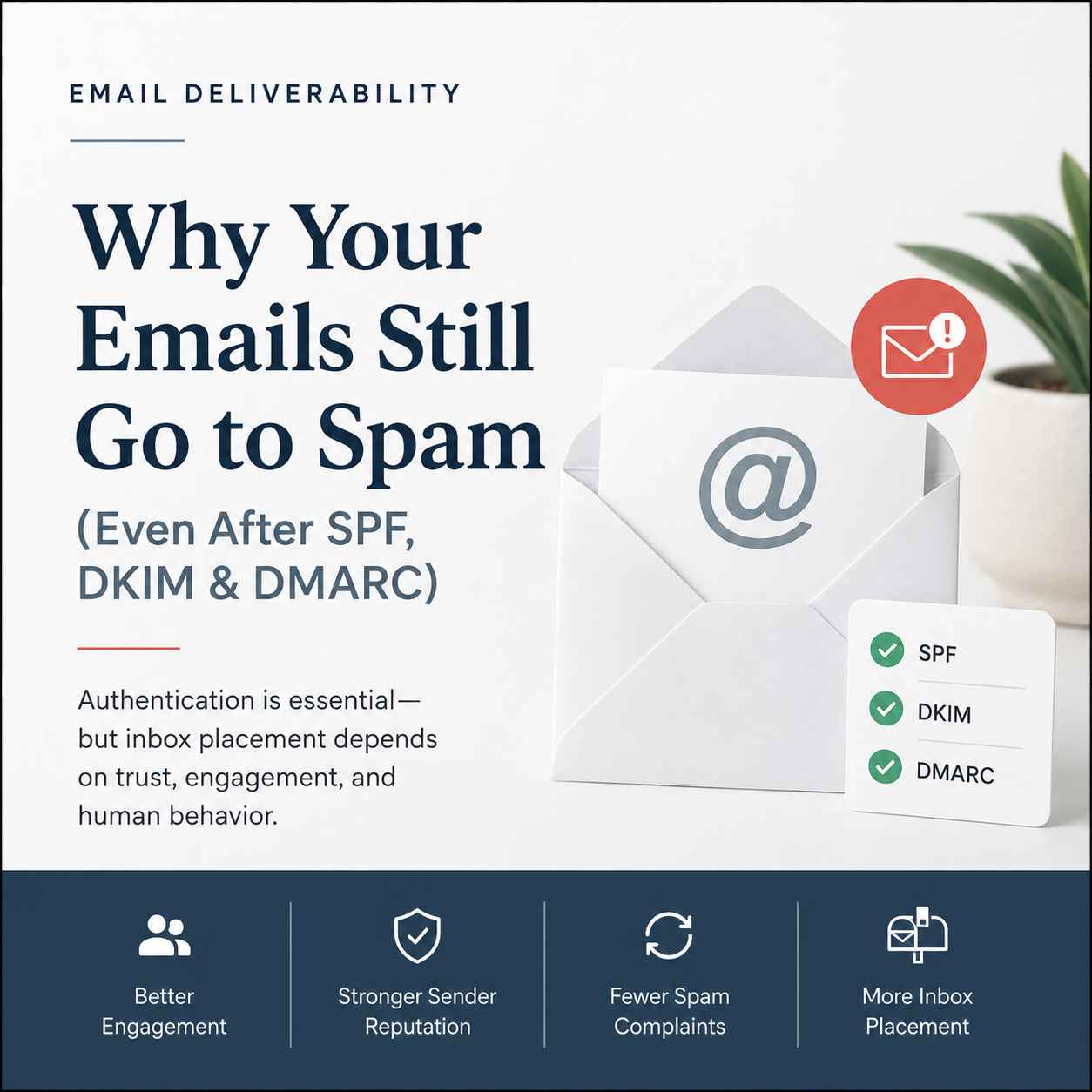
Email deliverability is the ability of your emails to reach subscribers' inboxes instead of spam folders. While SPF, DKIM, and DMARC authenticate your domain, mailbox providers also evaluate sender reputation, subscriber engagement, complaint rates, and list quality. Improving these human-driven signals is essential for better inbox placement and long-term email marketing success.
If you're investing time in email marketing, it makes sense to use a platform that helps you build healthy subscriber relationships from day one. Moosend includes automation, audience segmentation, list management, and analytics designed to improve long-term email deliverability—not just send more emails. If you're comparing email marketing platforms, it's worth taking a closer look before choosing one.
Many businesses experience the same frustrating scenario.
The email campaign is professionally written. The design looks polished. Authentication records have been configured correctly. The email marketing platform reports successful delivery.
Yet open rates decline.
Click-through rates stagnate.
Customers later admit they never saw the email.
At first, it's tempting to blame the email platform. In reality, most inbox placement problems have little to do with whether you're using Moosend, MailerLite, Brevo, ConvertKit, or another provider. Modern mailbox providers have become remarkably sophisticated. They don't simply verify that your domain is legitimate—they evaluate how people interact with your emails over time.
Technical authentication gets your message to the gate. Subscriber trust determines whether it reaches the inbox.
Authentication Is the Starting Point, Not the Finish Line
Authentication helps prove that your emails are legitimate, but choosing an email platform with strong automation, segmentation, and deliverability practices is equally important. Our in-depth Moosend Review 2026 explores how these capabilities work together to improve long-term email performance before you invest in a platform.
Email authentication has become a basic requirement.
Three technologies form the foundation:
- SPF confirms which servers can send email on behalf of your domain.
- DKIM verifies that messages haven't been altered during transit.
- DMARC tells mailbox providers how to handle authentication failures while protecting your domain from impersonation.
These records establish credibility, but they don't guarantee inbox placement.
Mailbox providers such as Gmail, Outlook, Yahoo, and Apple Mail continuously monitor sender behavior. Their objective is simple: deliver emails recipients genuinely want while filtering unwanted messages.
That decision depends far more on user behavior than server configuration.
What Mailbox Providers Actually Measure
Many marketers focus heavily on DNS records while overlooking the metrics that influence sender reputation every day.
Mailbox providers analyze signals including:
- Email opens
- Link engagement
- Reply activity
- Spam complaints
- Unsubscribe behavior
- Bounce rates
- Sending consistency
- List growth patterns
- Recipient interaction history
Collectively, these signals form your sender reputation.
Think of authentication as your business license. It allows you to operate, but your reputation depends on how customers experience your service over time.
Why Good Senders Still End Up in Spam
1. Your Subscriber List Has Gone Stale
Every email list naturally ages.
People change jobs, abandon email addresses, or simply lose interest. Continuing to email inactive subscribers weakens engagement metrics, making future campaigns appear less relevant.
A healthier approach is to identify contacts who haven't engaged within 90 to 180 days. Send a thoughtful re-engagement campaign. If they remain inactive, remove them from your active list.
Although reducing subscriber numbers may feel counterintuitive, a smaller engaged audience often produces stronger business results than a large inactive database.
2. Your Sending Schedule Is Unpredictable
Mailbox providers appreciate consistency.
Sending one newsletter every month and suddenly launching daily promotional campaigns can trigger automated scrutiny.
Predictable sending patterns help establish trust.
For growing businesses, consistency is often more valuable than frequency.
A weekly newsletter delivered on the same day creates recognizable behavior for both subscribers and mailbox providers.
3. Your Content No Longer Matches Expectations
Subscribers remember why they joined.
If someone subscribed for educational resources but receives continuous sales promotions, disappointment follows quickly.
That disappointment rarely results in thoughtful feedback.
Instead, recipients ignore future emails—or worse, click the spam button.
Maintaining alignment between subscriber expectations and your content strategy protects engagement over the long term.
4. Your Brand Identity Changes Too Often
People open emails they recognize.Frequently changing sender names, domains, or branding creates uncertainty.
Instead of constantly switching domains, organize different content categories using subdomains while maintaining consistent branding.
Recognition encourages opens.
Confusion encourages deletion.
5. Unsubscribing Is More Difficult Than Reporting Spam
Some organizations attempt to reduce unsubscribe rates by hiding the unsubscribe option.
This strategy almost always backfires.
When readers cannot easily leave, many simply report the email as spam.
A visible unsubscribe link doesn't weaken your marketing.
It protects your sender reputation.
Subscribers who leave voluntarily are far less damaging than recipients who report abuse.
6. You Ignore Complaint Trends
Spam complaints accumulate gradually.
By the time inbox placement noticeably declines, reputation damage may already be occurring.
Monitor complaint rates every week.Industry guidance generally recommends maintaining spam complaints below 0.1%.
Small increases deserve investigation before they become long-term deliverability issues.
7. Every Subscriber Receives the Same Campaign
Mass broadcasting made sense years ago.
Today's email ecosystem rewards relevance.
Segmenting audiences based on interests, purchase history, engagement, or customer lifecycle improves:
- Open rates
- Click-through rates
- Conversion rates
- Inbox placement
Personalization doesn't require artificial intelligence or complex automation.
Often, simple segmentation delivers substantial improvements.
Audience segmentation becomes even more effective when paired with intelligent automation. If you're looking to move beyond manual campaigns, see how AI email marketing automation helps deliver personalized messages based on subscriber behavior instead of guesswork.
The Workflow Perspective: Deliverability Is an Ongoing Process
One of the biggest misconceptions about email deliverability is treating it as a technical setup project.
In practice, it functions more like ongoing operational maintenance.
A practical workflow might look like this:
- Verify SPF, DKIM, and DMARC.
- Import only permission-based subscribers.
- Segment audiences from the beginning.
- Publish on a predictable schedule.
- Review engagement metrics weekly.
- Run quarterly list-cleaning campaigns.
- Monitor complaint and bounce trends.
- Adjust content based on subscriber behavior.
This routine requires discipline more than technical expertise.
Comparing Different Email Marketing Approaches
Many email platforms provide excellent deliverability tools, but no platform can compensate for poor sending habits.
For example:
- Moosend offers automation and list management features suitable for growing businesses.
- MailerLite emphasizes simplicity for creators and small teams.
- Brevo combines email with CRM and transactional messaging.
- ConvertKit focuses heavily on creators and audience segmentation.
Despite their differences, all rely on the same underlying principle:
Healthy subscriber relationships consistently outperform technical optimization alone.
Honest Limitations Most Guides Ignore
Deliverability isn't entirely under your control.Mailbox provider algorithms change regularly.
Industry benchmarks evolve.
Subscriber behavior shifts.
Even well-managed senders occasionally experience fluctuations.
Additionally, privacy features such as image blocking and mail privacy protection make open rates less reliable than they once were.
Modern email strategy should evaluate multiple indicators rather than relying solely on opens.
These include:
- Click activity
- Website visits
- Replies
- Purchases
- Form submissions
- Revenue generated
Business outcomes matter more than vanity metrics.
Practical Checklist for Better Email Deliverability
Before launching your next campaign, ask yourself:
✔ SPF configured correctly
✔ DKIM enabled
✔ DMARC policy active
✔ Clean subscriber list
✔ Recent inactive contacts removed
✔ Consistent sending schedule
✔ Recognizable sender identity
✔ Visible unsubscribe link
✔ Complaint rate monitored
✔ Audience segmented
Completing this checklist won't guarantee perfect inbox placement, but it dramatically improves your long-term sender reputation.
Ready to put this checklist into practice? The right email platform can simplify audience segmentation, automation, and campaign optimization. Explore our Moosend Review 2026 to see how these features work together in real business workflows before choosing your next email marketing solution.
Why This Matters for Business Growth
Email remains one of the highest-return digital marketing channels.
However, every unread campaign represents wasted effort.
Strong deliverability improves:
- Customer communication
- Product launches
- Newsletter performance
- Affiliate marketing
- Course sales
- SaaS onboarding
- Community engagement
- Customer retention
Businesses often invest heavily in creating better emails while overlooking whether those emails actually reach their audience.
Deliverability deserves equal attention.
Improving inbox placement is only part of the equation. Once your emails consistently reach subscribers, the next challenge is turning engagement into revenue. Our guide on building high-converting email marketing campaigns with Moosend explains the automation workflows, personalization strategies, and reporting features that help convert opens into paying customers.
9. FAQ Section
What is email deliverability?
Email deliverability measures how successfully your emails reach subscribers' inboxes instead of spam folders. It depends on authentication, sender reputation, engagement, and list quality.
Does SPF, DKIM, and DMARC guarantee inbox placement?
No. These protocols verify your identity but do not guarantee inbox placement. Mailbox providers also evaluate engagement, complaint rates, and sending behavior.
How often should I clean my email list?
Review engagement every quarter and consider re-engagement campaigns for subscribers who have been inactive for 90 to 180 days before removing them.
What is a healthy spam complaint rate?
Most email marketing experts recommend keeping spam complaints below 0.1% to maintain a strong sender reputation.
Does sending more emails reduce deliverability?
Not necessarily. Consistent, relevant communication generally performs better than irregular bursts of promotional emails.
Should small businesses worry about email deliverability?
Absolutely. Smaller businesses often rely more heavily on email marketing, making inbox placement critical for customer relationships and revenue generation.
Can segmentation improve email deliverability?
Yes. Sending relevant content to smaller, targeted audiences increases engagement signals that mailbox providers use to assess sender reputation.
Improving email deliverability isn't about chasing algorithms—it's about building trust with both mailbox providers and your subscribers. If you're ready to create more effective email campaigns, explore our in-depth Moosend review and other email marketing guides to find the tools and strategies that best match your business goals.
10. Final Verdict
Technical authentication is no longer a competitive advantage—it is simply the baseline for participating in modern email marketing.
The real differentiator is trust.
Organizations that maintain clean subscriber lists, communicate consistently, respect subscriber expectations, and monitor engagement as an ongoing operational process are far more likely to reach the inbox over time.
If you're investing in email marketing but treating deliverability as a one-time setup task, you're leaving performance to chance. Shift your focus from server configuration alone to subscriber experience, and you'll build a stronger sender reputation that supports sustainable growth.
For creators, SaaS businesses, and growing teams alike, that operational discipline often delivers greater long-term value than switching email platforms.
Disclosure:
This article may contain affiliate links. If you choose a service through our links, we may earn a commission at no extra cost to you.
This article was created with AI-assisted research and carefully reviewed by our in-house team before publication