Katana Inventory Software Review: Features & Pricing
Katana Inventory Software Review: Features & Pricing
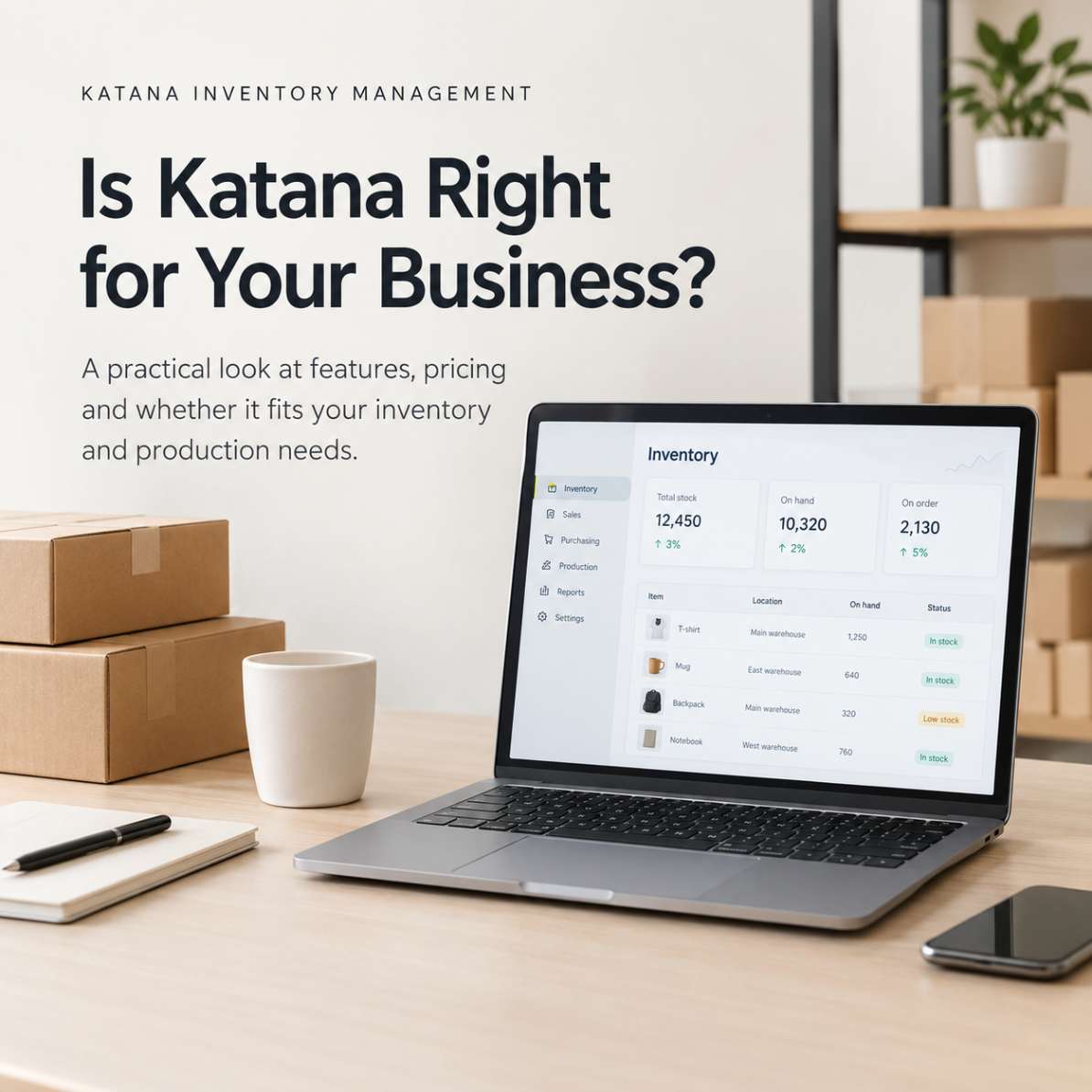
Katana is a cloud-based inventory and manufacturing management platform designed to help product businesses coordinate stock, sales orders, purchasing and production across their operations. It is worth evaluating if your business makes or sells physical products through multiple channels and needs better inventory visibility. Before choosing it, confirm current pricing, required features, integrations and the total cost of the configuration you need.
Managing inventory becomes more complicated when a business sells through multiple channels, purchases materials from different suppliers, and manufactures products in-house. A spreadsheet that worked for a small operation can become difficult to maintain when stock levels, production schedules and customer orders change throughout the day.
Katana is a cloud-based inventory and operations management platform designed for product businesses that need to coordinate stock, sales orders, purchasing and related workflows. It also offers manufacturing management capabilities through an add-on, allowing businesses that produce or assemble physical products to extend the platform beyond standard inventory and order management.. Its potential value lies in connecting these activities rather than managing them through separate spreadsheets and disconnected applications.
But is Katana the right choice for your business? That depends on whether you manufacture products, how many sales channels you operate, which integrations you need and how much you are prepared to spend on inventory software.
This guide examines Katana's intended use, key capabilities, pricing considerations, potential limitations and alternatives to help you make an informed decision.
Product information note: This guide uses Katana's supplied product information and independent market research. Current pricing, plan availability and individual feature entitlements should be confirmed with the vendor before purchasing.What Is Katana Inventory Management Software?
Katana is a software platform for businesses that need better visibility into inventory and the operational workflows surrounding physical products.
Instead of treating stock, purchasing, sales orders and production as entirely separate activities, an inventory management system connects these processes so that changes in one area can inform decisions elsewhere.
For example, a small manufacturer receives an order for 100 finished products. The business needs to know whether it has enough finished goods in stock, whether additional production is necessary, whether raw materials are available and when suppliers need to deliver missing components.
Without connected inventory management, employees may need to check multiple spreadsheets and applications. A suitable integrated system can reduce that administrative burden and make shortages easier to identify.
Katana is particularly relevant to businesses that combine physical inventory with manufacturing or assembly and sales across multiple channels.
Interested in evaluating the platform? Visit Katana's official website to explore the product and confirm its current offerings.
If you're looking for a clearer way to manage stock, customer orders and production in one place, explore Katana's inventory management platform to see whether it fits your business workflow.
Key Katana Features to Evaluate
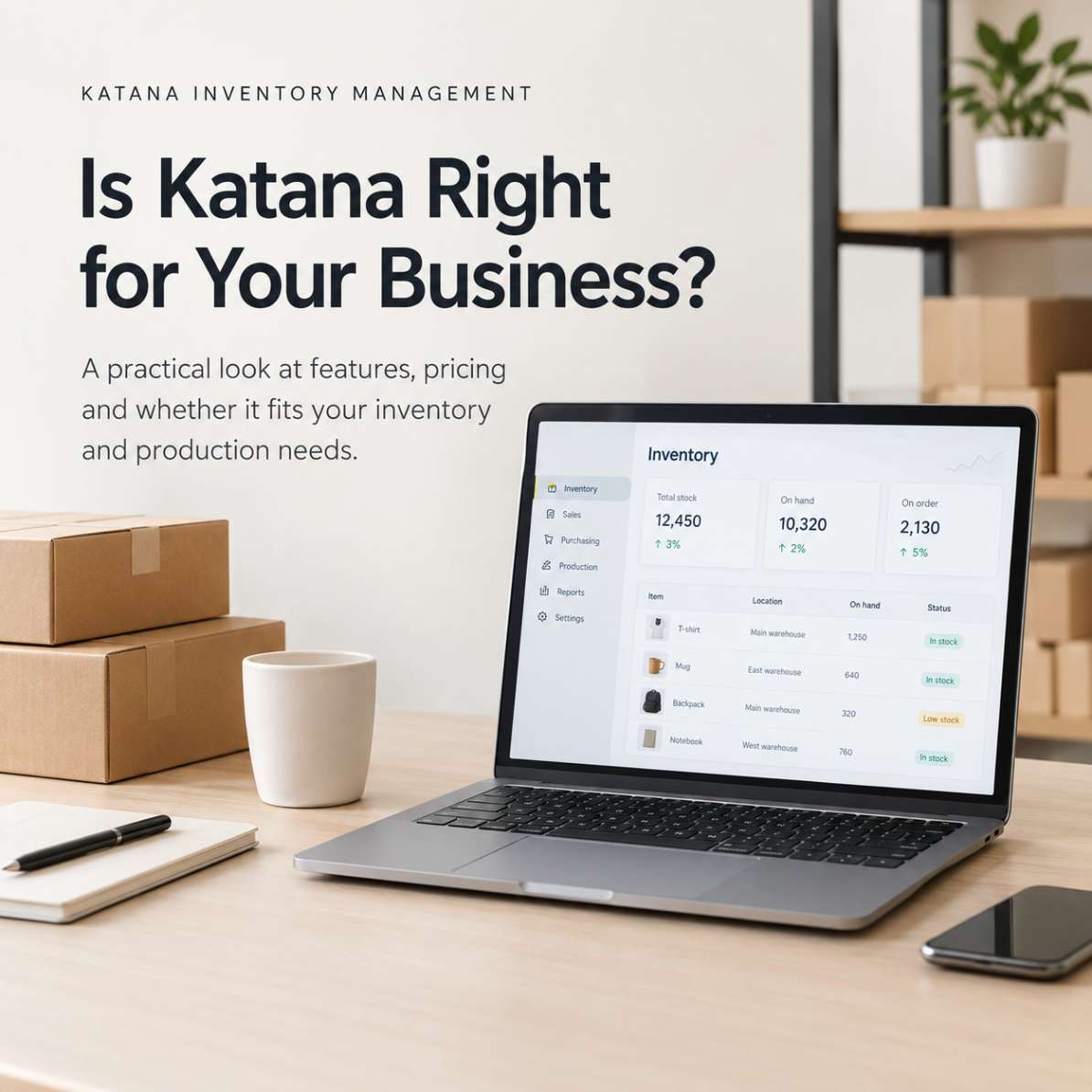
The partner information supplied to Kuruntha highlights inventory visibility, sales-channel synchronization, manufacturing visibility, demand forecasting, stock movement and integrations.
These are useful capabilities to investigate, but the exact functionality available to an individual customer may depend on the current plan and configuration.
1. Inventory Visibility Across Operations
A business needs a reliable picture of what it has available, what has been committed to customer orders and what may be needed for upcoming production.
Katana's stated inventory focus is intended to help product businesses coordinate stock across their operations.
This can be useful when a company manages raw materials, components, work in progress and finished products.
Before purchasing, ask the vendor to demonstrate how the platform distinguishes available stock from reserved stock, how inventory changes are recorded and how quickly updates reach connected sales channels.
A dashboard is only valuable when its numbers accurately reflect the underlying business.
2. Sales and Order Coordination
Businesses selling through multiple channels can face a familiar problem: an item sells on one channel while another channel continues displaying the same unit as available.
Inventory synchronization can help reduce this risk by keeping stock information aligned across supported sales channels.
However, do not assume that every marketplace, ecommerce platform or order workflow is supported. Verify the integrations your business actually uses, including any restrictions, synchronization delays and additional charges.
3. Manufacturing and Production Visibility
Manufacturers have requirements that ordinary stock tracking may not address.
They need to understand whether the materials required for a product are available, which orders are waiting for production and whether the production schedule can meet customer commitments.
Katana provides manufacturing capabilities through its Manufacturing Management add-on. According to its official documentation, this add-on supports manufacturing orders, production scheduling, progress tracking, ingredient availability and manufacturing workflows. Businesses that manufacture products, even partially, should account for this additional requirement when evaluating Katana. The base inventory and sales management functionality alone does not provide the same production-tracking capabilities.
Before choosing a plan, ask Katana to demonstrate how manufacturing orders, production scheduling, material consumption and production progress work in your specific business environment. Also confirm whether advanced manufacturing operations, routing and manufacturing insights require additional functionality or a separate add-on.
If your operation requires detailed bills of materials, production routing, shop-floor tracking or advanced capacity planning, verify the exact functionality included in the proposed configuration.
4. Demand Planning, Forecasting and Purchasing
Inventory planning is important for businesses that need to balance stock availability against purchasing costs. Ordering too early can tie up working capital, while ordering too late can create shortages and disrupt fulfilment.
Katana provides planning and replenishment capabilities, including projected inventory views and suggested purchasing quantities based on factors such as current stock, expected demand, supplier lead times and minimum order quantities.
However, buyers should distinguish between its planning capabilities and AI-powered demand forecasting. Katana's official product roadmap lists AI Forecasting as a beta feature, designed to forecast demand for selected items and suggest purchasing or manufacturing orders.
Availability and plan eligibility should be confirmed directly with Katana before relying on these capabilities.
For businesses evaluating inventory planning, ask which forecasting tools are currently available, whether they are included in the proposed subscription and how the system calculates replenishment recommendations.
Forecasting can support better purchasing decisions, but it cannot eliminate uncertainty caused by changing customer demand or supplier delays..
5. Integrations With Your Existing Technology
Inventory software rarely operates alone. A typical product business may already use an ecommerce platform, accounting software, shipping tools and spreadsheets.
The right integration can reduce duplicate data entry and help keep information consistent across applications.
Before committing to Katana, prepare a list of your existing tools and confirm:
- Whether each required integration is currently supported.
- Which data moves between the applications.
- Whether synchronization is automatic or requires manual steps.
- Whether the integration requires a higher plan or additional payment.
- Whether your team can export essential data if you later switch platforms.
An integration listed on a vendor's website does not necessarily mean every workflow you need is supported.
Inventory software is only one part of a company's technology stack; choosing the right tools for your business operations also means checking how those tools work together.
Who Should Consider Katana?
Katana is worth evaluating when inventory and manufacturing processes are becoming difficult to coordinate manually.
Small and growing manufacturers: Businesses producing their own goods may benefit from better coordination between raw materials, production and finished inventory.
Multi-channel product sellers: Companies selling through several supported channels may want a more consistent view of stock and customer orders.
Product brands with assembly workflows: Businesses assembling products from purchased components should investigate whether Katana supports their specific material and production requirements.
Operations teams outgrowing spreadsheets: When employees repeatedly reconcile stock figures, search for missing orders or manually update multiple systems, connected inventory software may be worth the investment.
Who Might Need a Different Solution?
Katana may be unnecessary for a business that sells only a handful of digital products, maintains very little physical stock or has a simple operation that a spreadsheet can manage reliably.
It may also be unsuitable if the required integrations are unavailable, the proposed configuration exceeds the budget, or the business needs specialized warehouse or manufacturing capabilities that are not included in the selected plan.
The objective should be to solve a real operational problem—not to purchase software simply because a business is growing.
Katana Pricing: Free Plan, Advantage and What Buyers Should Know
Katana currently presents two main options on its official pricing page: a Free plan and the paid Advantage offering.
Katana Free Plan
The Free plan costs $0 and does not require a credit card to get started. It is designed for businesses that want to explore Katana with a relatively small product catalogue.
According to the current official pricing page, the Free plan includes:
- Up to 30 SKUs.
- Unlimited users.
- Unlimited integrations.
- Unlimited inventory locations.
- Access to Katana's listed features.
- API access.
- AI Assistant and Knowledge Base support.
The plan also allows businesses to test unlimited SKUs for 15 days, subject to the applicable account conditions.
This makes the Free plan useful for initial evaluation, although businesses with larger product catalogues will need to consider the paid offering.
Katana Advantage: Custom Pricing
Katana Advantage uses custom pricing rather than a universally advertised monthly subscription price.
The company scopes the customer's technology stack, existing workflows and implementation requirements before providing a price under an annual contract.
The Advantage offering includes:
- Unlimited SKUs, users and integrations.
- A setup tailored to the business's requirements.
- Custom integrations, reports and automations within the agreed scope.
- Guided implementation.
- A dedicated Customer Success Manager.
- Priority support with a service-level agreement.
- Ongoing assistance and inventory consultations.
Because pricing is customized, businesses should request a proposal based on their actual operational requirements.
What About Manufacturing and Advanced Features?
Businesses evaluating Katana should pay particular attention to manufacturing management, traceability, warehouse management, planning and forecasting.
Katana's support documentation describes specific add-ons and additional manufacturing capabilities. However, the current Advantage pricing presentation describes a personalized configuration under one annual contract.
Consequently, buyers should ask the sales team to confirm which capabilities are included in their specific proposal, which require additional configuration and whether any separate charges apply.
How Should You Evaluate the Total Cost?
Before committing to Katana, request a written quotation covering:
- The annual subscription price.
- Manufacturing and production requirements.
- Inventory and warehouse workflows.
- Required integrations and custom development.
- Implementation and onboarding.
- Ongoing support and service terms.
- Renewal and cancellation conditions.
The important distinction is that Katana Advantage is custom-priced. Comparing it with competitors based only on a monthly entry-level subscription could produce a misleading cost comparison.
Check the latest official pricing
For businesses with more complex operations, request a personalized demonstration and quotation before making a purchasing decision.
If you are comparing several business applications, our guide on how to evaluate business software before investing offers a broader framework for assessing cost, integrations and long-term value.
Is Katana Worth It?
Katana deserves consideration when a business needs to coordinate inventory with manufacturing and sales rather than manage stock as a standalone task.
Its potential value depends on four important considerations:
- Whether the Free plan's 30-SKU limit is sufficient for your initial evaluation or whether your business needs Advantage.
- Whether the required inventory, manufacturing, warehouse and planning capabilities are included in your proposed configuration.
- Whether the platform integrates with the applications your business already relies on.
- Whether the custom annual subscription cost, implementation and ongoing support justify the expected operational benefits.
For manufacturers in particular, ask for confirmation of manufacturing functionality and its associated costs before signing an annual agreement.
A business experiencing frequent stock discrepancies, manual reconciliation and production delays may have a stronger case for connected software than a business with a simple inventory process.
However, a feature list cannot establish the financial return on its own. Use a demonstration and a realistic cost estimate to determine whether the platform addresses your most expensive operational problems.
Katana Alternatives: What Else Should You Compare?
Katana is not the only option for inventory management or manufacturing operations. The right alternative depends on whether your primary requirement is manufacturing, general inventory control, warehouse management or a broader business system.
Zoho Inventory
Zoho Inventory is worth investigating if your main priority is inventory and order management, particularly when you already use other Zoho applications. Check its manufacturing capabilities carefully if your business requires complex production workflows.
MRPeasy
MRPeasy is a relevant comparison for small and midsize manufacturers evaluating production planning and manufacturing resource planning software. Compare production scheduling, inventory handling, integrations and the total subscription cost.
Cin7 Core
Cin7 Core is worth evaluating for product businesses with more involved inventory, purchasing, sales and warehouse requirements. Confirm whether its capabilities and implementation requirements fit your business's scale.
Odoo
Odoo may appeal to businesses seeking a broader suite of connected business applications, including inventory and manufacturing. Its flexibility should be weighed against the configuration, implementation and ongoing administration required.
Fishbowl
Fishbowl is another option to investigate for inventory and warehouse workflows, particularly for businesses evaluating manufacturing processes and accounting integrations.
These are comparison candidates, not a definitive ranking. Their suitability and current prices depend on the features, region and configuration required.
For a useful comparison, request demonstrations using the same scenarios and calculate the full cost of each shortlisted system.
Cloud-based operations also depend on reliable connectivity, particularly when staff need access to online orders and inventory records; see our discussion of reliable connectivity for ecommerce operations.
A Practical Checklist Before You Buy
Before choosing Katana or an alternative, work through these questions:
- Can the software represent our actual products, components and inventory locations?
- Does it support our sales channels and accounting tools?
- Can we demonstrate our most important production or fulfilment workflow?
- Do we understand the difference between available, reserved and committed stock?
- Have we confirmed all required features and integrations in writing?
- Have we calculated subscription, setup, training and additional-feature costs?
- Can we export our data if we change platforms?
- Have the employees who will use the system tested it?
- Have we defined measurable outcomes for the first 90 days?
A successful implementation requires accurate product records, sensible processes and employee adoption. Software cannot compensate for unreliable source data or an unclear inventory workflow.
Frequently Asked Questions
What is Katana inventory software used for?
Katana is designed to help product businesses coordinate inventory, orders, purchasing and manufacturing activities. Its suitability depends on the workflows and features required by the business.
Is Katana suitable for small businesses?
It may suit small manufacturers and product businesses whose inventory and production requirements have outgrown spreadsheets. Smaller businesses with straightforward stock needs should compare the cost and complexity against simpler alternatives.
How much does Katana cost?
The price depends on the current offering, selected configuration and applicable usage or feature requirements. Consult Katana's official website for current pricing and request a quote that reflects your business's needs.
Does Katana support ecommerce integrations?
Katana's product positioning includes synchronization across sales channels. Verify that your specific ecommerce platform is supported and confirm which information synchronizes, how frequently it updates and whether additional fees apply.
Is Katana only for manufacturers?
Its manufacturing orientation makes it relevant to businesses that produce or assemble goods, but other product businesses may also find its inventory and order capabilities useful. The decision depends on whether its functionality matches the operation.
What are the main alternatives to Katana?
Alternatives worth comparing include Zoho Inventory, MRPeasy, Cin7 Core, Odoo and Fishbowl. These products serve overlapping but different needs, so compare them against your specific inventory, manufacturing and integration requirements.
Does Katana offer an AI assistant to help choose the software?
Yes. Katana's official website promotes an AI Assistant that helps prospective customers understand how the platform may fit their business requirements. It is positioned as a way to explore Katana's capabilities and identify potentially relevant workflows. However, buyers should independently verify important product, integration and pricing details before making a purchasing decision.
Katana also lists AI-related capabilities such as AI Replenishment and AI integrations. These should not be confused with its AI Assistant or the separate AI Forecasting beta feature. Check the current product documentation for availability and eligibility.
Ready to decide whether Katana is the right fit? Review Katana's current plans and product options against your inventory needs, required integrations and total budget before committing.
Final Verdict
Katana is worth evaluating if your business needs a more connected approach to inventory, orders and manufacturing. It is less compelling when the operational problem is simple enough to solve with a lower-cost tool or when essential features and integrations are unavailable.
The sensible next step is to map your existing workflow, identify the problems that cost your team the most time or money, and request a demonstration using those scenarios. Then compare Katana's full proposed cost against at least one suitable alternative.
Evaluate Katana against your actual business requirements: Visit the official Katana website.
Disclosure: Kuruntha Smarket may earn a commission if you purchase through an eligible affiliate link, at no additional cost to you.Our editorial recommendations should be based on product suitability and buyer needs.This article was generated with the assistance of AI tools and carefully reviewed by our in-house team before publication.#KatanaInventory #InventoryManagement #ManufacturingSoftware #EcommerceOperations #BusinessSoftware