Spocket vs AliExpress Dropshipping: Which Platform Delivers Faster Shipping, Better US/EU Suppliers & Higher Profits in 2026?
Spocket vs AliExpress Dropshipping: Which Platform Delivers Faster Shipping, Better US/EU Suppliers & Higher Profits in 2026?
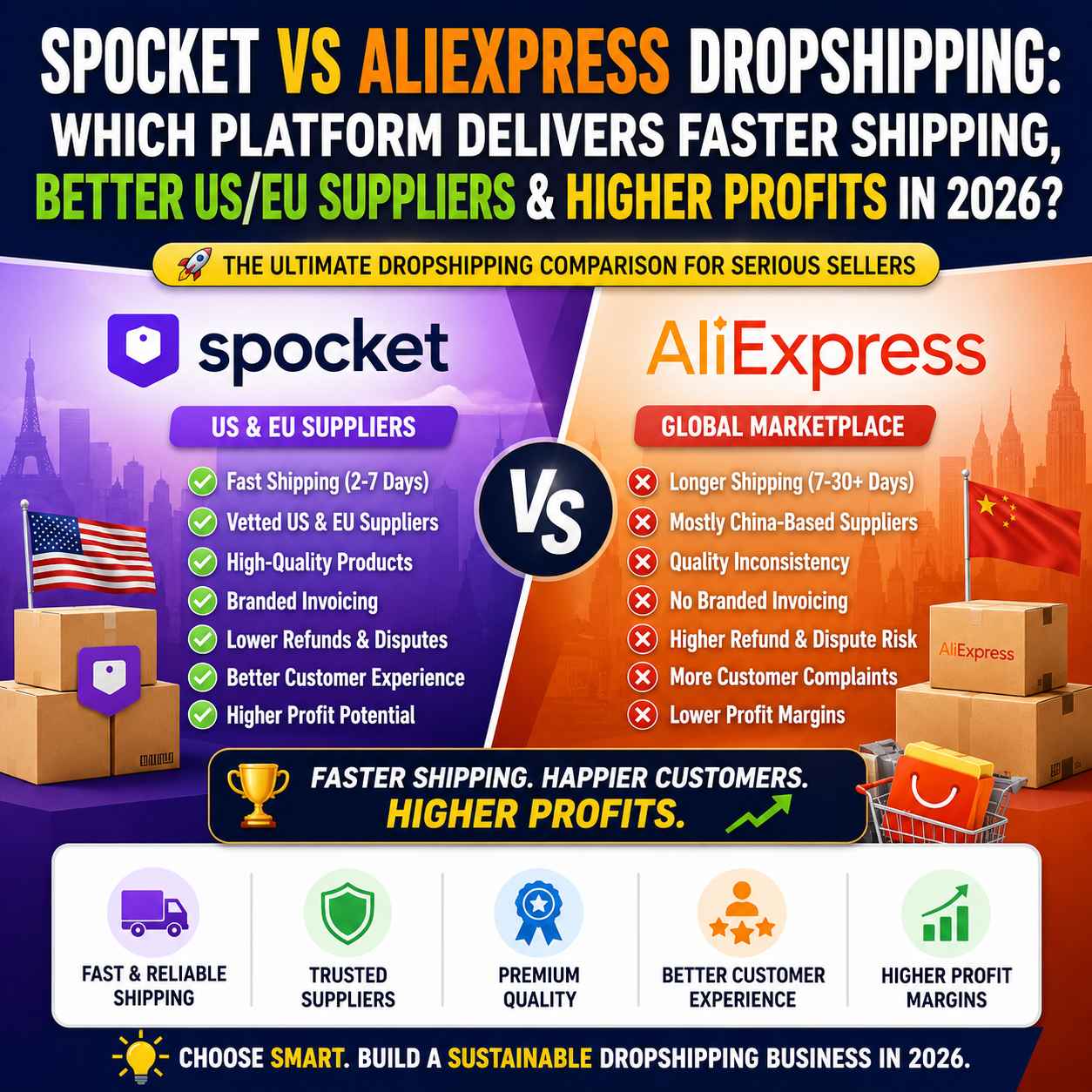
Spocket and AliExpress are two of the most widely used dropshipping platforms, but they serve different business goals. Spocket focuses on US and EU suppliers with faster shipping and stronger customer experiences, while AliExpress offers larger product selection and lower sourcing costs. For businesses prioritizing brand reputation, delivery speed, and long-term customer retention in 2026, Spocket often provides a more scalable workflow.
If you're tired of dealing with long shipping times, inconsistent suppliers, and customer complaints, it may be worth exploring how Spocket's network of US and EU suppliers can help create a faster, more reliable customer experience while keeping your business easier to manage as it grows.
The Real Dropshipping Problem Isn't Finding Products
Most new dropshippers spend countless hours searching for products.
Experienced operators spend their time solving something entirely different.Shipping delays.
Supplier reliability.Customer complaints.
Refund requests.
Margin erosion.
These operational realities determine whether a store becomes a sustainable business or simply another short-lived ecommerce experiment.
Over the past few years, dropshipping has matured. Customers now expect delivery experiences that resemble major online retailers. Waiting three weeks for a package is no longer acceptable in many markets.
That shift has made supplier selection far more important than product selection.
Two platforms frequently dominate this conversation: Spocket and AliExpress.
While both enable dropshipping businesses, they approach sourcing, fulfillment, and operational efficiency from very different perspectives.
The question is no longer which platform has more products.
The real question is which platform helps build a healthier business.
Understanding the Difference in Business Models
AliExpress operates as a massive marketplace connecting buyers to manufacturers and suppliers, primarily located in China.
Its strength lies in scale.
Millions of products.
Countless categories.
Aggressive pricing.
Spocket approaches the market differently.
Rather than focusing on supplier quantity, it emphasizes supplier location and fulfillment quality, particularly across the United States and Europe.
This distinction affects nearly every aspect of daily operations.
Shipping speed.Customer satisfaction.
Return handling.
Inventory consistency.
Brand perception.
Each of these factors becomes increasingly important as a store grows.
Shipping Speed: The Metric That Impacts Everything
Shipping speed influences far more than delivery times.
It affects:
- Conversion rates
- Customer trust
- Repeat purchases
- Refund rates
- Support workload
- Brand reputation
AliExpress suppliers can still provide economical fulfillment, but shipping times remain highly variable depending on supplier quality and destination.
A customer waiting several weeks for delivery may become impatient, generate support tickets, or request refunds before receiving the product.
Those operational costs accumulate quickly.
Spocket's supplier network was built specifically to address this challenge.
By emphasizing US and EU suppliers, many products can reach customers significantly faster than traditional overseas fulfillment models.
For store owners targeting North America or Europe, this creates a noticeably better customer experience.
From a workflow perspective, fewer support tickets often translate into more time spent growing the business rather than managing delivery complaints.
Supplier Quality and Operational Reliability
Not all suppliers create equal business outcomes.
One of the biggest frustrations with large marketplaces is inconsistency.
A supplier can perform well one month and create inventory issues the next.
Product quality can vary.Packaging standards may differ.
Communication quality often depends on individual sellers.
AliExpress offers excellent suppliers, but identifying them requires research, testing, and ongoing monitoring.
Spocket reduces some of this friction through supplier vetting and marketplace curation.
This doesn't eliminate risk entirely.
No supplier ecosystem is perfect.
However, it can reduce the amount of manual investigation required before launching products.
For founders operating lean teams, that reduction in operational overhead has measurable value.
Supplier reliability becomes significantly more important as order volume increases. Our deeper analysis of Spocket's product sourcing ecosystem explains how vetted US and EU suppliers help reduce many of the fulfillment risks that frequently appear in traditional dropshipping workflows.
Product Selection: Where AliExpress Still Dominates
This is one area where AliExpress remains difficult to match.
The platform offers an enormous product catalog covering virtually every consumer niche imaginable.
Trending products often appear on AliExpress before reaching many competing supplier networks.
For product researchers and trend-focused sellers, this remains a major advantage.
Spocket's catalog is growing, but it remains smaller and more curated.
The tradeoff becomes clear:
AliExpress prioritizes product variety.Spocket prioritizes fulfillment quality.
Which matters more depends on business objectives.
If you're exploring whether faster shipping and premium suppliers can actually improve profitability, our free-trial breakdown explains how many store owners use Spocket to test products, validate demand, and improve margins before scaling aggressively.
Profit Margins: The Hidden Tradeoff
Many beginners assume lower product costs automatically create higher profits.In practice, profit margins are more complicated.
AliExpress frequently offers lower wholesale pricing.
On paper, this appears attractive.
However, hidden costs can emerge through:
- Refund requests
- Chargebacks
- Customer support workload
- Delivery complaints
- Lost repeat purchases
Spocket products may carry higher sourcing costs, but faster shipping and improved customer satisfaction can support stronger long-term profitability.
Operators often discover that reducing friction creates more sustainable margins than simply sourcing the cheapest available product.
Before committing to any supplier platform, spend a few minutes comparing shipping speeds, supplier locations, and product quality for yourself. The difference between a profitable store and a refund-heavy store often starts with the suppliers you choose.
Workflow Automation and Store Management
Modern ecommerce increasingly depends on automation.
Manually updating products, tracking inventory, and processing orders becomes unsustainable as stores scale.
Both platforms support integration with major ecommerce ecosystems.
However, Spocket places stronger emphasis on streamlined workflows for independent store owners.
Product imports, inventory synchronization, and order fulfillment tend to fit naturally into modern ecommerce operations.
AliExpress workflows can be highly effective as well, particularly when combined with automation tools.
The difference is often the amount of setup, testing, and monitoring required.
For founders managing multiple responsibilities, simplicity has real value.
Many operators underestimate how much time automation saves until they experience inventory syncing, supplier management, and store setup firsthand. Our breakdown of how Spocket's AI-powered automation can launch a dropshipping store in under 60 seconds shows why workflow speed is becoming a competitive advantage rather than just a convenience.
Customer Experience and Brand Building
Many dropshipping businesses fail because they never evolve into actual brands.
Customers remember experiences.
Not sourcing platforms.
Not supplier dashboards.
Not wholesale costs.
A customer who receives a product quickly, packaged professionally, and exactly as expected is more likely to purchase again.
This is where supplier location becomes strategically important.US and EU suppliers often provide a customer experience more aligned with current ecommerce expectations.
For stores focused on building a recognizable brand rather than chasing short-term product trends, Spocket generally aligns better with long-term objectives.
Fast shipping alone does not build loyalty. Modern ecommerce brands increasingly combine operational efficiency with trust signals, customer reviews, and retention systems because stronger customer experiences often influence repeat purchases more than product pricing alone.
Where AliExpress Still Makes Sense
AliExpress remains a practical option when:
- Testing product ideas
- Exploring emerging niches
- Launching with limited capital
- Conducting market validation
- Running experimental stores
Its extensive product catalog creates opportunities for discovering products before competitors.
For experienced operators willing to invest time into supplier verification, AliExpress can remain highly profitable.
Where Spocket Makes More Sense
Spocket becomes particularly attractive when:
- Customer experience matters
- Faster shipping is required
- Targeting US customers
- Targeting EU customers
- Building a long-term brand
- Reducing support workload
- Improving repeat purchase rates
Businesses focused on operational stability often appreciate the predictability provided by regional suppliers.
For store owners still evaluating whether faster shipping and curated suppliers justify the switch, our hands-on Spocket business analysis explores where the platform performs best, where limitations still exist, and which types of ecommerce businesses benefit most from adopting it.
Honest Limitations of Spocket
No platform is perfect.
Spocket has limitations worth considering.
Some products cost more than equivalent AliExpress alternatives.
Product variety remains smaller.
Certain niche categories may have fewer supplier options.
Businesses focused exclusively on minimizing sourcing costs may find AliExpress more appealing.
The decision ultimately depends on whether operational efficiency or product selection carries greater strategic value.
Honest Limitations of AliExpress
AliExpress presents its own challenges.
Supplier quality varies considerably.
Shipping speed can fluctuate.Inventory consistency requires ongoing monitoring.
Customer support demands often increase.
As stores scale, these issues can become more significant than product pricing advantages.
The platform rewards operators willing to actively manage supplier relationships.
FAQ Section
Is Spocket better than AliExpress in 2026?
For businesses prioritizing faster shipping, customer satisfaction, and brand growth, Spocket is often the stronger option. For extensive product variety and lower sourcing costs, AliExpress remains highly competitive.
Does Spocket have US suppliers?
Yes. Spocket specializes in suppliers located across the United States and Europe, making it attractive for businesses targeting those markets.
Can beginners use Spocket?
Yes. The onboarding process is generally easier for beginners compared to managing supplier selection manually through AliExpress.
Is AliExpress still profitable for dropshipping?
Yes. Many successful stores continue using AliExpress, particularly for product testing and niche discovery. Success depends heavily on supplier selection and operational management.
Which platform offers faster shipping?
Spocket generally provides faster shipping for customers located in North America and Europe due to its supplier network.
Can I use both Spocket and AliExpress together?
Yes. Many experienced store owners test products using AliExpress and later transition successful products to higher-quality suppliers when available.
At the end of the day, successful dropshipping isn't about finding the cheapest product—it's about creating a customer experience people trust. If you're serious about building a long-term ecommerce brand with faster delivery and more dependable suppliers, take a closer look at what Spocket offers before launching your next store.
Final Verdict
For operators building a serious ecommerce business in 2026, the decision comes down to priorities.
If your objective is product experimentation, maximum catalog access, and low sourcing costs, AliExpress remains one of the strongest marketplaces available.
If your objective is operational efficiency, customer satisfaction, faster fulfillment, and long-term brand development, Spocket offers a stronger foundation.
My assessment is straightforward:
AliExpress is excellent for discovering opportunities.
Spocket is better for scaling them.
Businesses focused on sustainable growth, repeat customers, and professional customer experiences will likely extract greater long-term value from Spocket's supplier ecosystem.