SpringVerify Review 2026: Features, Pricing, Pros, Cons & Is It Worth Choosing?
SpringVerify Review 2026: Features, Pricing, Pros, Cons & Is It Worth Choosing?
Hiring Faster Shouldn't Mean Hiring Blind
Finding the right background verification software can significantly improve hiring efficiency and reduce compliance risks. In this SpringVerify Review 2026, we examine its features, verification services, integrations, pricing model, security, user experience, and overall value to help businesses determine whether SpringVerify is the right platform for streamlining employee background checks.
Recruitment has become faster than ever, but verifying a candidate's background remains one of the most time-sensitive parts of the hiring process. HR teams today often juggle applicant tracking systems, interview scheduling, document collection, reference checks, and compliance requirements—all while trying to provide a smooth candidate experience.
Manual verification methods can slow hiring decisions, create inconsistent processes, and increase administrative effort. As organizations scale, these challenges become even more difficult to manage across multiple locations, roles, and compliance requirements.
This is where background verification platforms like SpringVerify aim to simplify the process. Rather than relying on scattered emails, spreadsheets, and third-party coordination, the platform centralizes verification workflows into a single dashboard designed for recruiters and HR professionals.
At Kuruntha Smarket, we believe software should be evaluated beyond feature lists. A product may offer an impressive range of capabilities, but its real value lies in how well it fits into everyday business operations. That means looking at implementation, workflow efficiency, transparency, security, integration capabilities, and long-term usability—not just marketing claims.
Because recruitment requirements differ across industries and jurisdictions, no single background verification platform is the right choice for every organization. The goal of this review is to help you evaluate where SpringVerify fits—and where another solution may be more appropriate.
This review takes an independent look at SpringVerify from an operational perspective. Instead of asking whether the platform offers background verification, we'll explore how it supports modern hiring workflows, where it performs well, where limitations remain, and which types of organizations are likely to benefit most.
Before investing in any background verification platform, it's worth exploring how SpringVerify approaches automation, compliance, and hiring workflows firsthand. If it aligns with your recruitment goals, you can explore the SpringVerify platform to review its latest capabilities and request a personalized demo for your organization.
What is SpringVerify?
SpringVerify is a cloud-based background verification platform that helps organizations automate and manage employee screening throughout the hiring process. It provides businesses with a centralized system for conducting various verification checks, reducing the reliance on manual coordination between HR teams, candidates, and verification agencies.
The platform is designed to support organizations ranging from startups and growing businesses to larger enterprises seeking to improve hiring efficiency while maintaining compliance with internal policies and applicable regulations.
Instead of treating verification as a standalone administrative task, SpringVerify positions it as an integrated part of the recruitment lifecycle. Recruiters can initiate verification requests, monitor progress, collect candidate information, and review completed reports from a unified interface.
One notable aspect of the platform is its API-first approach, allowing businesses to integrate verification workflows into existing HR ecosystems rather than forcing teams to adopt entirely new operational processes. This flexibility can be particularly valuable for organizations that already use applicant tracking systems (ATS), HR management software, or custom recruitment workflows.
While SpringVerify offers a broad range of verification services and emphasizes automation, prospective buyers should still evaluate whether its geographic coverage, verification requirements, and integration capabilities align with their specific hiring needs—especially for organizations recruiting across multiple countries.
Core Features
SpringVerify combines multiple verification services into a single platform, helping organizations standardize their hiring workflows while reducing manual follow-ups and administrative overhead. Rather than focusing solely on individual checks, the platform emphasizes process management, automation, and visibility throughout the verification lifecycle.
Centralized Verification Dashboard
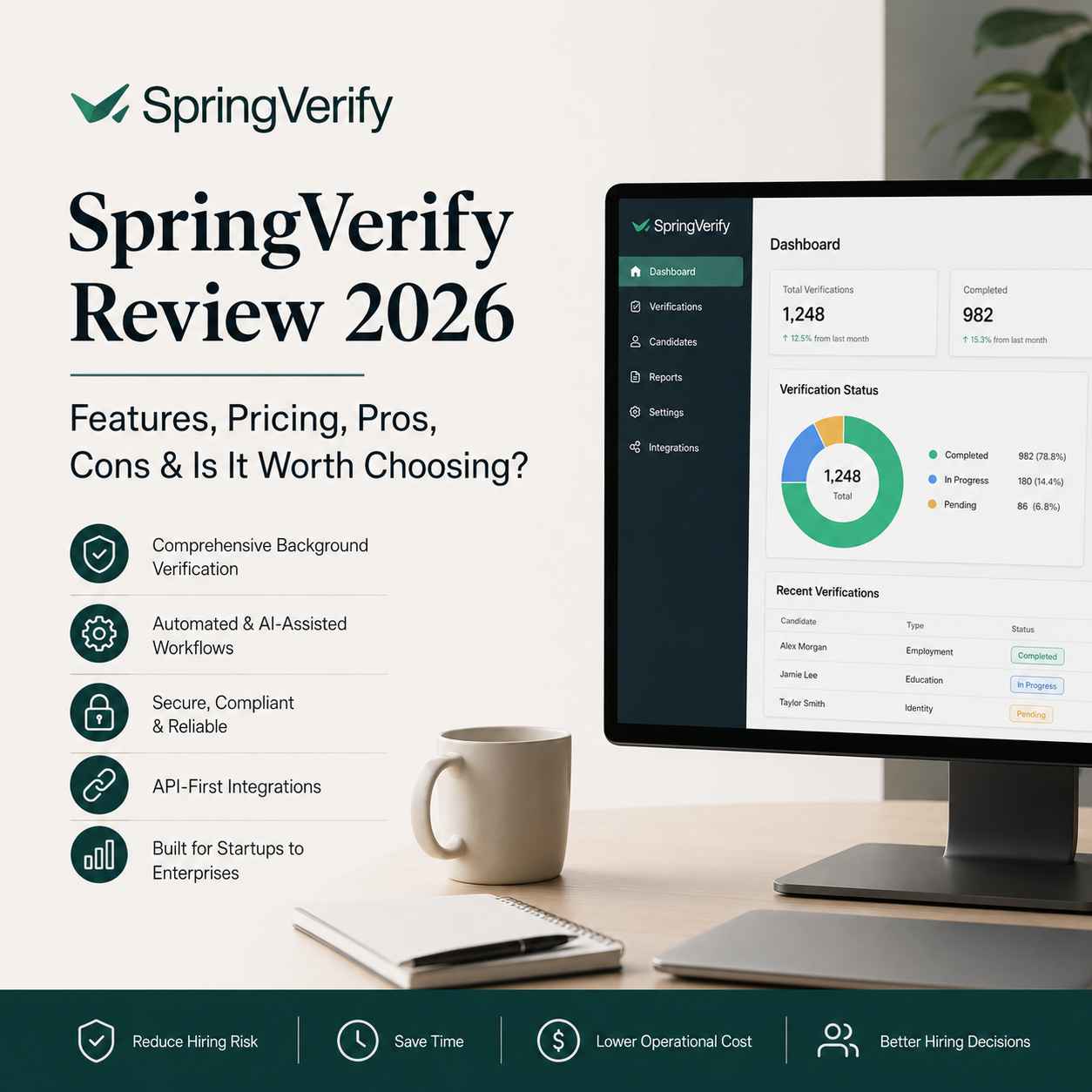
Managing multiple candidates through email threads or spreadsheets can quickly become inefficient, particularly for growing recruitment teams. SpringVerify addresses this by providing a centralized dashboard where recruiters can initiate, monitor, and track verification requests in one place.
This unified view helps HR teams understand the status of each verification without switching between multiple communication channels, making it easier to prioritize hiring decisions and identify potential bottlenecks.
Automated Verification Workflows
Automation is one of SpringVerify's strongest operational advantages. Instead of manually coordinating every verification stage, recruiters can automate request initiation, candidate communication, document collection, and status updates.
For organizations processing a high volume of candidates, this can reduce repetitive administrative work and improve consistency across hiring cycles.
Candidate Self-Service Portal
Candidates can securely upload documents, provide required information, and monitor the progress of their verification requests through a dedicated portal.
This approach minimizes back-and-forth communication and helps maintain a more structured verification process while giving applicants greater visibility into outstanding requirements.
API-First Architecture
Modern HR ecosystems often rely on multiple software platforms working together. SpringVerify's API-first architecture allows businesses to integrate verification workflows with existing recruitment and HR systems, reducing duplicate data entry and enabling more automated hiring processes.
For organizations with custom HR technology stacks, this integration capability can become a significant operational advantage.
Real-Time Status Tracking
Instead of waiting for periodic updates from verification partners, recruiters can monitor verification progress through real-time status tracking.
This visibility supports better hiring planning, especially when recruitment timelines are tight or multiple stakeholders need access to verification updates.
Configurable Verification Workflows
Different roles require different levels of screening. SpringVerify allows organizations to configure verification workflows based on hiring requirements, helping businesses avoid unnecessary verification steps while maintaining internal compliance standards.
This flexibility is particularly useful for companies hiring across diverse departments with varying risk profiles.
Reporting and Audit Trails
Verification activities generate detailed records that can assist HR teams during internal audits, compliance reviews, or policy evaluations.
Maintaining a structured audit trail also improves accountability by documenting verification progress and completed checks within a centralized system.
Supported Verification Types
One of the platform's strengths is the breadth of verification services it brings together under a single operational workflow. Rather than requiring organizations to coordinate multiple providers independently, SpringVerify supports a range of commonly requested employment screening checks.
Depending on business requirements and regional availability, organizations may be able to conduct:
- Employment verification
- Education verification
- Identity verification
- Address verification
- Criminal record checks (where legally applicable)
- Reference verification
- Document verification
- Candidate database checks
- Professional credential verification
- Additional customized verification workflows
It's important to note that the availability of specific verification services may vary by jurisdiction and regulatory requirements. Businesses with complex international hiring needs should confirm supported countries, turnaround times, and verification capabilities before implementation rather than assuming global coverage.
For many startups, SMEs, and organizations with regional hiring requirements, however, the available verification portfolio is likely to cover the majority of standard pre-employment screening needs.
User Experience
Software adoption often depends less on the number of available features and more on how easily teams can incorporate those features into existing workflows. A platform with extensive capabilities can still create operational friction if everyday tasks become unnecessarily complicated.
From our evaluation of SpringVerify's publicly available product information, documentation, and platform design, the user experience appears to prioritize simplicity over excessive complexity.
The interface presents a modern SaaS design with organized navigation and a workflow-oriented layout that should feel familiar to HR professionals accustomed to cloud-based business applications. Key actions—such as initiating verification requests, monitoring candidate progress, and reviewing completed reports—are structured around the hiring process rather than isolated system modules.
This process-oriented design can reduce the learning curve for recruitment teams, particularly those transitioning from manual verification methods.
The candidate experience also deserves attention. By allowing applicants to submit required documents through a dedicated portal, organizations can reduce repetitive email exchanges and improve communication throughout the verification process.
That said, user experience extends beyond interface design. The overall implementation experience will depend on factors such as integration with existing HR systems, internal workflow configuration, user training, and organizational change management. Businesses adopting the platform should allocate time for initial setup and process alignment to ensure they realize the expected operational benefits.
Another consideration is how pricing aligns with your organization's hiring needs. While SpringVerify publishes standard verification packages, businesses with higher hiring volumes, specialized verification requirements, or enterprise deployments may still need to consult the sales team for customized pricing and implementation details. As with many business software platforms, comparing overall value should involve more than the starting price—factors such as verification coverage, integrations, support, and scalability are equally important when evaluating long-term suitability.
Integrations & API
One of the strongest indicators of modern SaaS maturity isn't the number of features listed on a pricing page—it's how well the product fits into an existing technology ecosystem. Most organizations already use an Applicant Tracking System (ATS), Human Resource Information System (HRIS), payroll software, or internal HR tools. A background verification platform should complement those systems rather than becoming another isolated application.
SpringVerify appears to recognize this need through its API-first architecture, making integration a core part of its platform rather than an afterthought.
Background verification is only one part of an efficient hiring workflow. Once candidate screening is complete, businesses also need an Applicant Tracking System (ATS) to organize recruitment pipelines, collaborate with hiring managers, and automate candidate management. If you're evaluating the complete hiring technology stack, our Manatal: Best AI Recruitment Software for Smarter Hiring review explores how AI-powered recruitment software complements verification platforms like SpringVerify.
Explore how AI recruitment software and background verification work together to create a faster, more structured hiring process.
API-First Design
Instead of expecting recruiters to manually transfer candidate information between multiple systems, SpringVerify provides APIs that allow organizations to automate verification workflows.
In practical terms, this means businesses can potentially:
- Initiate verification requests directly from their ATS.
- Automatically send candidate information for screening.
- Receive verification status updates without manual follow-ups.
- Synchronize completed verification reports with HR records.
- Reduce duplicate data entry across platforms.
For organizations processing hundreds or thousands of applicants annually, this automation can significantly reduce repetitive administrative work and improve operational consistency.
HR Ecosystem Compatibility
While integration requirements differ across organizations, SpringVerify is designed to fit into modern recruitment workflows rather than replace them entirely.
Businesses evaluating the platform should confirm compatibility with their existing HR technology stack, particularly if they rely on:
- Applicant Tracking Systems (ATS)
- Human Resource Information Systems (HRIS)
- Recruitment automation platforms
- Enterprise HR software
- Custom recruitment portals
Organizations with highly customized hiring processes should also evaluate API documentation and implementation requirements before deployment.
Implementation Considerations
API availability does not automatically translate into rapid deployment.
Successful integration depends on:
- internal technical resources,
- workflow planning,
- system compatibility,
- implementation timelines,
- and ongoing maintenance.
Small organizations without dedicated technical teams may rely more heavily on SpringVerify's support resources during setup, whereas enterprises with internal development teams can often build deeper workflow automation.
From an operational perspective, the API-first philosophy is a positive sign because it supports long-term scalability instead of locking businesses into isolated processes.
Security & Compliance
Employee background verification involves handling highly sensitive personal information. That means security isn't simply another product feature—it is one of the primary evaluation criteria.
Organizations considering any verification platform should assess not only what data is collected but also how that data is processed, stored, accessed, and protected throughout its lifecycle.
Based on publicly available information, SpringVerify emphasizes secure handling of candidate information and compliance-oriented workflows.
Data Protection
The platform is designed to manage confidential candidate information through centralized digital processes instead of fragmented email exchanges or manual document handling.
This centralized approach generally offers several operational advantages:
- reduced document duplication,
- improved access control,
- better audit visibility,
- lower administrative risk.
Audit Trails
Verification activities generate records that help organizations understand:
- who initiated requests,
- when verifications were completed,
- what actions occurred,
- and how workflows progressed.
This level of visibility can support both internal governance and regulatory reviews.
Compliance Considerations
Employment verification requirements vary significantly across countries and industries.
Businesses operating internationally should independently verify:
- supported jurisdictions,
- applicable regulatory coverage,
- local verification practices,
- document retention policies,
- privacy obligations.
Rather than assuming worldwide compliance capabilities, organizations should evaluate SpringVerify against their own legal and operational requirements.
Operational Security Perspective
One encouraging aspect is that security appears to be integrated into workflow design rather than treated as an isolated technical feature.
According to SpringVerify's published security information at the time of publication, the platform maintains certifications including ISO/IEC 27001:2022, ISO 27701, and PCI DSS. Organizations with industry-specific regulatory or compliance requirements should still conduct their own due diligence to ensure the platform aligns with their internal policies and applicable legal obligations.
Pricing
Pricing is an important consideration when evaluating any background verification platform, particularly for organizations planning to scale their hiring operations.
According to SpringVerify's publicly available pricing information at the time of publication, SpringVerify publishes standard verification packages starting from ₹799 per person, while also offering customized pricing for businesses with specific verification requirements, higher hiring volumes, or enterprise implementation needs. Because package contents and pricing may change over time, it's advisable to confirm the latest plans directly with SpringVerify before making a purchasing decision.
For organizations with complex hiring workflows, custom pricing can provide flexibility by tailoring verification services, integrations, and support to operational requirements rather than relying on predefined plans.
That said, prospective buyers should evaluate more than just the per-person cost. Factors such as supported verification types, turnaround times, implementation assistance, API integration, and ongoing support often have a greater impact on the platform's long-term value than pricing alone.
Requesting a product demonstration and discussing your hiring requirements with the SpringVerify team can help determine which package best fits your organization's recruitment workflow.
Workflow Analysis
Software succeeds when it reduces operational friction—not simply because it includes more features.
Looking beyond marketing pages, SpringVerify appears designed around one central objective:
Standardizing background verification without creating additional administrative complexity.
That distinction matters.
Many organizations still coordinate hiring verification through spreadsheets, email chains, document requests, and multiple external vendors.
While these methods may work for occasional hiring, they become increasingly inefficient as recruitment scales.
Completing background verification is only the beginning of a compliant hiring journey. Organizations hiring international contractors should also establish structured onboarding, contract management, and payment workflows. Our Deel Contractor Management 2026 guide explains how businesses can continue that process after verification while reducing global compliance risks.
Discover how to transition from verified candidates to legally compliant contractor onboarding without adding unnecessary administrative complexity.
Example Workflow
A typical hiring process might involve:
- Candidate accepts conditional offer.
- HR initiates verification.
- Candidate uploads required documents.
- Verification begins.
- Recruiters monitor progress.
- Reports are completed.
- Hiring decision proceeds.
Without automation, every stage requires manual coordination.
SpringVerify attempts to consolidate these activities into one operational workflow.
Productivity Impact
The biggest productivity improvements are likely to come from:
- standardized processes,
- reduced manual follow-ups,
- centralized reporting,
- workflow visibility,
- automated status updates.
Recruiters spend less time chasing documentation and more time evaluating candidates.
Learning Curve
The platform appears approachable for HR professionals familiar with modern SaaS applications.
Organizations already using digital recruitment systems are unlikely to encounter significant usability challenges.
The more complex aspect will generally involve:
- defining verification policies,
- configuring workflows,
- integrating existing HR software,
- training internal teams.
These implementation activities are common across enterprise HR technology.
Long-Term Maintenance
Once workflows are established, operational maintenance appears relatively manageable.
Routine tasks primarily involve:
- monitoring integrations,
- updating verification policies,
- onboarding new HR users,
- adjusting workflows as hiring needs evolve.
This suggests that the platform's long-term administrative burden should remain relatively low compared to manual verification processes.
Pros
SpringVerify offers several strengths that make it an attractive option for organizations modernizing recruitment workflows.
✔ Modern SaaS Experience
The platform presents a clean, organized interface that aligns with current business software expectations.
✔ Workflow Automation
Automating repetitive verification tasks reduces administrative overhead and improves consistency across hiring processes.
✔ API-First Architecture
Organizations seeking integrated HR ecosystems benefit from automation opportunities instead of isolated verification workflows.
✔ Broad Verification Coverage
The platform supports many of the verification services businesses commonly require during recruitment.
✔ Candidate Self-Service
Allowing applicants to upload documentation directly helps reduce communication delays while improving overall transparency.
✔ Centralized Management
Recruiters gain better visibility into verification progress through a single operational dashboard.
✔ Suitable Across Multiple Business Sizes
The platform appears capable of supporting startups, growing companies, and larger enterprises with scalable workflows.
Cons
No software platform is perfect, and SpringVerify has several areas prospective buyers should consider carefully.
✘ Enterprise Pricing Requires Consultation
While SpringVerify publishes standard verification package pricing, organizations with complex hiring requirements or enterprise deployments may still need to contact the sales team for customized pricing and implementation details..
✘ International Coverage Should Be Confirmed
Businesses hiring globally should verify supported countries rather than assuming universal verification capabilities.
✘ Smaller Global Presence
Compared with long-established providers, SpringVerify currently has a smaller international footprint.
Organizations operating across numerous jurisdictions may wish to evaluate multiple vendors before making a decision.
✘ Independent User Reviews
Although the company has built a growing reputation, publicly available independent reviews remain fewer than those of several larger competitors.
This doesn't necessarily indicate lower quality, but it does mean buyers may have fewer external experiences to reference during evaluation.
Best Suited For
SpringVerify appears particularly well suited for organizations seeking structured hiring workflows rather than simply purchasing another HR tool.
Ideal users include:
Growing Startups
Companies transitioning away from manual verification processes.
Small and Medium Businesses
Organizations looking to improve hiring consistency without building complex internal systems.
HR Teams
Recruitment departments managing recurring hiring cycles and seeking better operational visibility.
Technology Companies
Businesses that value API integration and workflow automation.
Enterprises
Larger organizations that require configurable verification workflows and centralized process management.
For organizations hiring internationally, background verification is only one aspect of workforce management. Our Deel Review for Remote Teams (2026) explores how global payroll, Employer of Record (EOR), and contractor management fit into the broader hiring lifecycle after candidate verification.
See how global hiring platforms extend the recruitment process beyond candidate verification.
Who Should Avoid It
Despite its strengths, SpringVerify will not be the ideal choice for every organization.
It may be less suitable for:
Businesses Seeking Fixed, One-Size-Fits-All Pricing
Organizations with complex hiring requirements or enterprise-scale deployments may need to discuss customized pricing and implementation details with the SpringVerify team. Businesses that prefer fully standardized pricing for every deployment should consider this during their evaluation.
Organizations with Highly Specialized Global Verification Requirements
Multinational enterprises operating in numerous jurisdictions should carefully validate international verification capabilities before committing.
Very Small Businesses with Minimal Hiring
Organizations hiring only occasionally may find manual verification sufficient and may not realize the full operational value of a dedicated verification platform.
SpringVerify vs Competitors
Choosing a background verification platform isn't simply about comparing the longest feature list. The right choice depends on factors such as hiring volume, geographic coverage, integration requirements, compliance needs, budget, and how well the platform fits into your existing recruitment workflow.
Feature availability, pricing, integrations, and international verification capabilities may vary by provider and can change over time. Businesses should evaluate each platform against their own hiring requirements and verify the latest information directly with the vendor before making a final decision.
Here's how SpringVerify compares with several well-known alternatives at a high level.
| Platform | Best For | Strengths | Considerations |
|---|---|---|---|
| SpringVerify | Startups, SMEs, growing enterprises | Modern interface, workflow automation, API-first architecture, configurable verification workflows | International verification capabilities should be confirmed based on hiring requirements; enterprise implementations may require customized pricing.based on hiring requirements |
| Checkr | High-volume recruitment | Extensive automation, mature integrations, broad ecosystem | Pricing may vary, strongest presence in selected markets |
| HireRight | Large enterprises | Long-established reputation, global verification services | Enterprise-focused implementation may be more complex |
| First Advantage | Large organizations | Wide verification portfolio, multinational experience | May be more suitable for enterprise-scale deployments than smaller businesses |
| Sterling | Compliance-driven industries | Strong enterprise capabilities and broad screening services | Smaller organizations may not require its full feature set |
Our Perspective
SpringVerify's competitive advantage isn't necessarily having the largest international footprint or the longest history in the background verification industry. Instead, its strengths lie in offering a modern, automation-focused platform that aligns well with today's digital recruitment workflows.
Organizations prioritizing API integrations, configurable processes, and a contemporary user experience are likely to appreciate its operational design. On the other hand, businesses with extensive multinational hiring requirements or highly specialized compliance needs may find it worthwhile to compare SpringVerify alongside more established global providers before making a final decision. Organizations with enterprise-scale deployments should also evaluate customized implementation, integration, and pricing options based on their specific operational requirements.
Frequently Asked Questions (FAQs)
1. What is SpringVerify used for?
SpringVerify is a cloud-based background verification platform that helps organizations streamline pre-employment screening. It enables HR teams to manage candidate verification, monitor progress, collect documents, and centralize verification workflows from a single platform.
2. Is SpringVerify suitable for small businesses?
Yes. SpringVerify can be a practical choice for startups and small to medium-sized businesses that hire regularly and want to replace manual verification processes with a more structured workflow. Companies with very occasional hiring, however, may not fully benefit from a dedicated verification platform.
3. Does SpringVerify support international background verification?
SpringVerify offers a range of verification services, but businesses hiring across multiple countries should confirm the platform's supported regions, verification capabilities, and compliance requirements before implementation. International verification needs can vary depending on local regulations and data availability.
4. Does SpringVerify provide API integrations?
Yes. SpringVerify follows an API-first approach, allowing organizations to integrate verification workflows with existing HR systems, Applicant Tracking Systems (ATS), and other recruitment software. Businesses should review the available API documentation to determine compatibility with their existing technology stack.
5. Is SpringVerify easy to implement?
For organizations already using modern HR software, the platform's interface appears intuitive and workflow-oriented. Implementation complexity generally depends on factors such as workflow customization, integration requirements, internal policies, and user training rather than the software itself.
6. Does SpringVerify publish its pricing?
Yes. At the time of publication, SpringVerify publishes standard verification package pricing, with plans starting from ₹799 per person. In addition to these standard packages, organizations with higher hiring volumes, specialized verification requirements, or enterprise deployments can request customized pricing and implementation support. Because pricing, package features, and service offerings may change over time, it's advisable to confirm the latest details directly with SpringVerify before making a purchasing decision.
7. What types of background verification does SpringVerify support?
Depending on organizational requirements and regional availability, SpringVerify can support various verification services, including:
- Employment verification
- Education verification
- Identity verification
- Address verification
- Reference checks
- Criminal record checks (where legally applicable)
- Document verification
- Professional credential verification
Organizations should verify service availability based on their hiring locations and compliance obligations.
8. How does SpringVerify compare with larger competitors?
SpringVerify differentiates itself through a modern SaaS experience, workflow automation, and API-driven architecture. Larger providers such as Checkr, HireRight, First Advantage, and Sterling generally have a longer market presence and broader international operations. The better choice depends on an organization's hiring scale, geographic footprint, and integration needs.
9. Is SpringVerify a good choice for enterprise businesses?
It can be. Enterprises that value configurable workflows, automation, and system integrations may find SpringVerify a strong option. However, organizations with highly specialized global compliance requirements should conduct a detailed evaluation of international coverage, service-level agreements, and implementation capabilities.
10. Is SpringVerify worth considering in 2026?
Based on our evaluation, SpringVerify presents a well-designed and operationally focused background verification platform. Its strengths lie in workflow automation, user experience, and integration capabilities. Businesses should, however, assess pricing, geographic coverage, and specific compliance needs before making a purchasing decision.
SpringVerify is one component of a modern business technology stack. If you're also evaluating recruitment software, global hiring platforms, creator tools, and AI-powered business solutions, we've curated them in our Best Online Business Tools in 2026 guide to help you compare the platforms that best match your operational needs.
Compare the software businesses are using to streamline hiring, operations, and long-term growth before making your final investment.
Editorial Rating
Rather than assigning a score based solely on feature count, our evaluation considers how effectively SpringVerify supports real-world hiring operations, implementation, and long-term usability.
| Category | Rating | Comments |
|---|---|---|
| Features | 9.2/10 | Comprehensive verification capabilities with practical workflow tools. |
| Ease of Use | 9.0/10 | Clean interface and process-oriented navigation reduce day-to-day complexity. |
| Workflow Automation | 9.3/10 | Automation helps minimize repetitive HR tasks and improves hiring efficiency. |
| Integrations & API | 9.2/10 | API-first architecture supports modern HR technology ecosystems. |
| Security & Compliance | 9.0/10 | Strong emphasis on secure data handling, though organizations should verify compliance for their specific regions. |
| Pricing Transparency | 8.5/10 | Standard verification package pricing is publicly available, while enterprise implementations may require customized pricing based on business requirements.. |
| Scalability | 9.1/10 | Suitable for growing businesses as well as larger organizations with evolving recruitment needs. |
| Overall Value | 9.0/10 | Delivers a balanced combination of automation, usability, and operational efficiency for modern hiring teams. |
Overall Editorial Score
★★★★☆ 4.5/5 (9.0/10)
Final Verdict
Background verification often becomes a bottleneck not because organizations lack the right intentions, but because they rely on fragmented processes that consume valuable time and introduce unnecessary administrative work. As hiring volumes increase, spreadsheets, email chains, and manual follow-ups quickly become difficult to manage.
SpringVerify approaches this challenge with a workflow-first mindset rather than treating verification as a standalone task. Its modern interface, automation capabilities, configurable workflows, and API-first architecture demonstrate an understanding of how contemporary HR teams operate.
One of its greatest strengths is the emphasis on operational efficiency. Recruiters can manage verification requests, monitor candidate progress, and maintain visibility through a centralized platform, reducing repetitive manual work and supporting more consistent hiring processes.
That said, no platform is without trade-offs. While SpringVerify publishes standard verification package pricing, organizations with enterprise-scale hiring requirements should evaluate customized pricing, implementation, and integration options based on their operational needs. Businesses with extensive multinational hiring requirements should also carefully validate geographic coverage and compliance capabilities before making a long-term commitment.
Overall, SpringVerify appears well-positioned for startups, small and medium-sized businesses, technology companies, and enterprises seeking to modernize their background verification workflows without introducing unnecessary complexity.
If your hiring process has outgrown manual verification methods and your organization values automation, integration, and operational visibility, SpringVerify deserves a place on your shortlist.
At the same time, businesses with highly specialized global screening requirements or those seeking fully transparent pricing should compare it alongside established international providers to ensure the platform aligns with their operational and compliance objectives.
For many organizations, the decision will not be about finding the platform with the longest feature list—it will be about choosing the one that best fits existing workflows, scales with future hiring needs, and enables HR teams to spend more time evaluating talent rather than managing administrative processes.
Build Your Modern Hiring Stack:
Background verification is just one piece of an efficient hiring process. Businesses looking to modernize recruitment should also consider the technologies that support candidate sourcing, applicant tracking, contractor onboarding, and workforce management. The resources below explore complementary solutions that can help create a more connected and scalable hiring workflow.
- Manage recruitment more efficiently: Explore our Manatal review to see how AI-powered applicant tracking complements background verification.
- Hire and manage global contractors compliantly: Learn how Deel Contractor Management extends your hiring workflow after candidate verification.
- Compare more business software: Browse our Best Online Business Tools in 2026 guide to evaluate additional AI and SaaS platforms for growing businesses.
Our Recommendation
Recommended for:
- Growing startups
- Small and medium-sized businesses
- HR and recruitment teams
- Technology companies
- Organizations adopting automated hiring workflows
Consider alternatives if you:
- Require highly customized procurement processes with enterprise-specific pricing and implementation requirements..
- Operate across numerous international jurisdictions with highly specialized compliance requirements.
- Hire infrequently and have minimal background verification needs.
Editorial Independence
This review reflects Kuruntha Smarket's independent editorial evaluation based on publicly available documentation, product information, market positioning, and available user feedback. Every product we review is evaluated independently. We highlight both strengths and limitations to help readers make informed decisions. Partnerships or affiliate relationships, where applicable, do not influence our editorial conclusions.
If your team is looking to reduce manual verification work, improve hiring consistency, and integrate background checks into a modern recruitment workflow, SpringVerify is worth evaluating. Explore its features, discuss your verification requirements with their team, and compare the available options to determine whether it fits your hiring process.
#SpringVerify #BackgroundVerification #HRTech #Recruitment #Hiring #HiringAutomation #BusinessSoftware #SaaS #WorkflowAutomation #DigitalTransformation #BusinessOperations #HumanResources #FutureOfWork #OperationalEfficiency #RecruitmentTechnology
Disclosure:
This article may contain affiliate links. If you choose a service through our links, we may earn a commission at no extra cost to you.
This article was created with AI-assisted research and carefully reviewed by our in-house team before publication