AI-Powered Virtual Workplace: How NexGen Solutions Are Transforming Hybrid Teams in 2026
AI-Powered Virtual Workplace: How NexGen Solutions Are Transforming Hybrid Teams in 2026
What Is an AI-Powered Virtual Workplace?
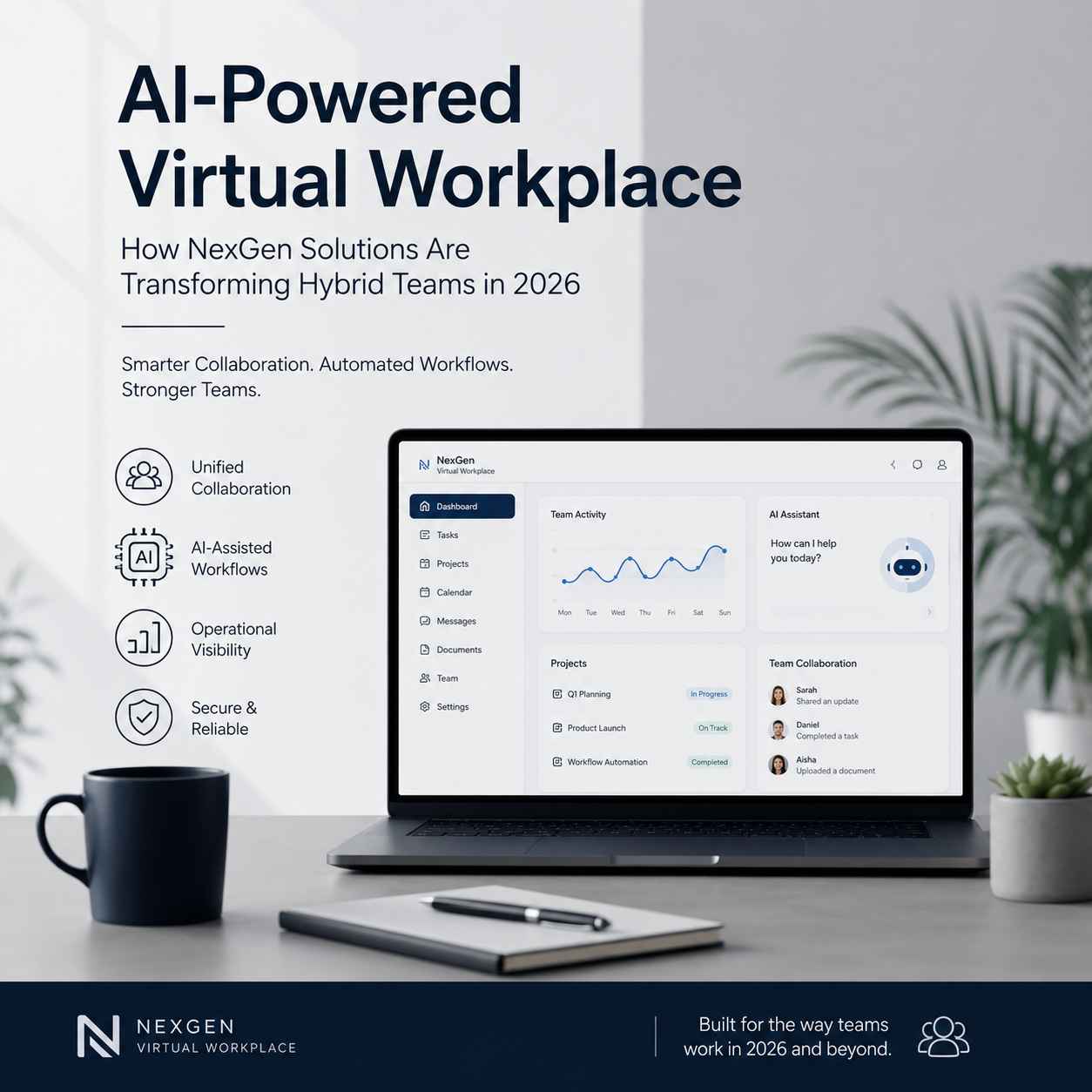
An AI-powered virtual workplace is a digital collaboration environment that combines communication, workflow automation, AI assistance, and operational management into a centralized system for hybrid teams. In 2026, businesses are adopting AI workplace platforms to reduce operational friction, improve remote collaboration, automate repetitive work, and increase team productivity across distributed environments.
Hybrid work did not fail because employees were remote.
It failed because most companies attempted to replicate physical office processes inside disconnected software ecosystems.
One team used Slack for communication. Another depended on email chains. Project tracking lived somewhere else. Documentation became fragmented. Meetings multiplied because operational visibility disappeared. Employees spent more time navigating tools than executing meaningful work.
That operational drag became one of the largest hidden productivity costs of the post-remote era.
Now the conversation is changing.
The most forward-thinking organizations are moving toward AI-powered virtual workplace systems that consolidate collaboration, automation, workflow orchestration, and operational intelligence into a more cohesive environment.
The difference is significant.
This is no longer just about remote work. It is about building a sustainable operational infrastructure for distributed execution.
And that distinction matters.
The Real Problem Hybrid Teams Are Trying to Solve
Most hybrid teams are not struggling with communication anymore.
They are struggling with coordination.
That sounds subtle, but operationally it changes everything.Communication tools solved messaging years ago. The modern bottleneck is workflow fragmentation:
- tasks spread across platforms
- duplicated project updates
- repetitive administrative work
- scattered documentation
- meeting overload
- inconsistent onboarding
- weak operational visibility
The result is decision fatigue at scale.
Managers lose situational awareness. Employees lose focus. Founders lose execution speed.
AI-powered virtual workplace platforms emerged because traditional collaboration stacks became operationally expensive to maintain.
Platforms like NexGen Virtual Workplace are gaining traction because they centralize communication, workflow visibility, automation, and operational coordination into a more unified environment for hybrid teams.
What Actually Defines an AI-Powered Virtual Workplace?
Many vendors market themselves as “AI workspaces,” but most are simply layering chatbots on top of existing SaaS tools.
A true AI-powered virtual workplace integrates several operational layers together:
- communication
- project coordination
- workflow automation
- knowledge management
- AI assistance
- analytics
- asynchronous collaboration
- process orchestration
The strongest platforms are not merely productivity tools.
They function more like operational systems.
That distinction becomes obvious once teams scale beyond 10 to 20 active contributors.
What Changes Operationally After Adoption?
The most noticeable shift is not speed.It is cognitive clarity.
Teams spend less energy searching for context.
AI systems begin handling repetitive coordination tasks automatically:
- meeting summaries
- task extraction
- workflow reminders
- documentation indexing
- progress reporting
- onboarding assistance
- deadline tracking
- internal search
This reduces operational noise dramatically.
One of the biggest workflow improvements appears inside asynchronous collaboration.
Traditional remote work created constant interruptions because information retrieval was inefficient. AI-enhanced workspaces reduce that dependency by making organizational knowledge searchable, contextual, and actionable.
That directly impacts productivity.
Employees stop asking repetitive operational questions because the system surfaces relevant information proactively.
For creators, startups, and lean operational teams, that can remove hours of administrative friction weekly.
Businesses extending AI workplace automation into customer interaction workflows may also benefit from AI agent systems capable of handling repetitive support and onboarding tasks automatically.
Where NexGen Virtual Workplace Systems Stand Out
The newer generation of AI workplace platforms differs from legacy collaboration suites in several important ways.
1. Context-Aware Workflows
Older systems depended heavily on manual organization.Modern AI workspaces increasingly understand workflow context automatically.
For example:
- meetings generate tasks automatically
- documents connect to projects dynamically
- AI assistants summarize discussions
- timelines update based on activity patterns
- recurring operational bottlenecks become visible
This creates operational continuity that older tools never achieved effectively.
2. Reduced Tool Fragmentation
Most hybrid teams suffer from SaaS sprawl.
A typical remote stack may include:
- Slack
- Zoom
- Notion
- Trello
- ClickUp
- Google Workspace
- Calendars
- CRM systems
- automation platforms
Maintaining those ecosystems becomes an operational burden itself.
Teams exploring AI-powered virtual workplaces should also evaluate how their broader digital infrastructure connects together. Our breakdown of modern creator and business ecosystems in The Digital Stack 2026 explains why fragmented software stacks are quietly becoming one of the biggest operational liabilities for remote-first businesses.
NexGen workplace platforms increasingly consolidate these workflows into fewer environments.
That improves:
- onboarding
- documentation consistency
- searchability
- employee adoption
- operational visibility
It also reduces subscription fatigue.
3. AI-Assisted Operational Management
This is where things become genuinely useful.
AI is most valuable when it reduces low-value operational coordination.
Not when it writes motivational emails.
The strongest implementations currently focus on:
- workflow summaries
- intelligent scheduling
- project status extraction
- operational analytics
- meeting compression
- internal knowledge retrieval
- cross-team visibility
That creates measurable productivity improvements without dramatically changing employee behavior.
Good systems adapt to workflows.
For teams evaluating practical workflow implementation instead of theoretical AI hype, our SmartSuite workflow automation analysis shows how centralized collaboration and operational visibility improve once repetitive coordination work is automated properly.
Bad systems force workflows to adapt to them.
The Friction Nobody Talks About
Most AI workplace articles avoid discussing implementation pain.
That is a mistake.
The onboarding complexity of modern workplace platforms remains significant.
Especially for non-technical organizations.
Here are the common friction points:
Workflow Migration
Migrating operational processes from fragmented systems into centralized environments takes time.
Teams underestimate:
- data cleanup
- permission management
- documentation restructuring
- process standardization
Without operational discipline, AI only amplifies organizational chaos.
AI Reliability Gaps
AI assistants still hallucinate context occasionally.
Task extraction errors happen.
Summaries can miss nuance.
Internal search quality depends heavily on documentation quality.
Organizations expecting “fully autonomous workplace AI” are going to be disappointed.
Human oversight still matters.
Employee Resistance
This remains one of the biggest barriers.
Not because employees dislike AI.
Because many teams already feel overloaded with software transitions.
If implementation becomes overly complicated, adoption rates collapse quickly.
The best workplace systems succeed because they reduce complexity immediately.
Not because they advertise futuristic capabilities.
Comparing AI Workplace Platforms vs Traditional Collaboration Stacks
Traditional Stack Model
The traditional approach still works reasonably well for smaller teams.
But operational fragmentation increases rapidly as organizations scale.
Advantages:
- flexibility
- specialized tools
- lower switching risk
Disadvantages:
- integration maintenance
- inconsistent workflows
- duplicated information
- subscription overload
- poor cross-platform visibility
AI-Powered Workplace Platforms
The newer unified model improves operational cohesion substantially.
Advantages:
- centralized workflows
- reduced coordination friction
- AI automation
- improved knowledge management
- stronger asynchronous execution
Disadvantages:
- migration complexity
- vendor lock-in concerns
- evolving AI reliability
- learning curve for teams
For most operationally mature businesses, the benefits increasingly outweigh the disadvantages.
Especially for remote-first companies.
Businesses moving away from fragmented collaboration ecosystems are increasingly evaluating centralized operational platforms such as NexGen Virtual Workplace to simplify distributed execution and improve workflow continuity.
The Sustainability Angle Most Businesses Ignore
Remote work discussions often focus exclusively on flexibility.
But operational sustainability matters too.
AI-powered virtual workplaces can reduce:
- unnecessary commuting
- excessive meetings
- duplicate operational effort
- server redundancy through platform consolidation
- hardware dependency through cloud-based workflows
There is also a growing Linux compatibility advantage emerging among open productivity ecosystems.
That matters for:
- privacy-focused organizations
- sustainable infrastructure initiatives
- developer-heavy teams
- operational cost reduction
Open standards and browser-based workplace systems are becoming increasingly attractive compared to closed enterprise ecosystems.
Best Use Cases for AI-Powered Virtual Workplaces
These platforms perform exceptionally well in:
Creator Businesses
Content operations, editorial workflows, collaborative publishing, sponsorship coordination, and asset management become easier to centralize.
Creator teams building AI-assisted publishing systems should also evaluate unified content execution environments. Our MaleRun workflow analysis explores how creators are consolidating scripting, publishing, AI agents, and content automation into centralized operational pipelines.
Remote Startups
Lean teams benefit from operational visibility without hiring additional management layers.
Agencies
Cross-client coordination improves substantially when workflows, communication, and documentation remain connected.
Distributed Technical Teams
Engineering, DevOps, Linux-focused infrastructure teams, and asynchronous developer environments align naturally with AI-assisted coordination systems.
Operationally lean teams often benefit the most from environments like NexGen Virtual Workplace because centralized collaboration reduces coordination overhead without requiring enterprise-level infrastructure complexity.
Who Should Avoid These Platforms?
Not every organization benefits equally.
These systems may be excessive for:
- very small local businesses
- low-digital environments
- highly traditional offline teams
- organizations unwilling to standardize workflows
AI workplace systems reward operational discipline.
If processes are already disorganized, technology alone will not solve the problem.
The Competitive Landscape in 2026
Several ecosystems are competing aggressively in this category.
The market currently includes:
- Microsoft Copilot ecosystems
- Google Workspace AI integrations
- Notion AI workflows
- ClickUp AI
- Slack AI enhancements
- emerging no-code AI collaboration platforms
However, no single platform dominates entirely yet.
That creates opportunity for businesses willing to experiment early.
The winners will likely be platforms that balance:
- automation
- usability
- workflow flexibility
- operational simplicity
rather than simply offering the most AI features.
The Bigger Shift Happening Behind the Scenes
AI-powered virtual workplaces are not replacing employees.
They are replacing operational inefficiency.
That is the real transition happening now.
Businesses that adapt successfully are not necessarily the ones using the most AI.
They are the ones reducing coordination friction most effectively.
That operational advantage compounds over time.
Faster execution.
Lower administrative overhead.
Better organizational memory.
Reduced burnout.
Improved decision velocity.
Those are meaningful business advantages.
Especially in distributed operational environments.
FAQ Section
What is an AI-powered virtual workplace?
An AI-powered virtual workplace is a digital collaboration environment that combines communication, automation, project coordination, and AI-assisted workflows into a centralized operational system for hybrid or remote teams.
Are AI workplace platforms suitable for small businesses?
Yes, but adoption depends on operational complexity. Small creator teams, agencies, and startups often benefit the most because centralized workflows reduce coordination overhead significantly.
Which industries benefit most from AI-powered workplaces?
Technology companies, agencies, remote startups, creator businesses, distributed service teams, and digital-first organizations tend to gain the highest operational efficiency improvements.
Can AI virtual workplace systems replace project managers?
No. AI can reduce administrative coordination work, but strategic decision-making, leadership, and organizational management still require human oversight.
What are the biggest risks of AI workplace adoption?
The biggest risks include poor onboarding, workflow migration complexity, excessive dependence on automation, fragmented documentation quality, and low employee adoption.
Are AI-powered workplace platforms Linux compatible?
Many modern platforms are browser-based and function well on Linux systems. Open standards and cloud-first architectures increasingly improve Linux compatibility.
Do AI workplace systems improve productivity immediately?
Not always. Productivity improvements usually appear after workflow standardization and onboarding stabilization. Poor implementation can initially reduce efficiency.
What should businesses evaluate before adopting an AI workplace platform?
Businesses should evaluate:
- workflow complexity
- integration requirements
- onboarding effort
- pricing scalability
- AI reliability
- security considerations
- long-term operational sustainability
Teams serious about reducing operational fragmentation and improving hybrid execution efficiency should evaluate whether platforms like NexGen Virtual Workplace align with their long-term collaboration and workflow automation strategy.
Final Verdict
AI-powered virtual workplaces are becoming operational infrastructure rather than optional productivity software.
That shift matters.
The strongest platforms are not simply adding AI features for marketing purposes. They are reducing coordination friction, simplifying operational visibility, and helping distributed teams execute with less administrative overhead.
But implementation quality determines success.
Organizations expecting instant automation without operational discipline will struggle.
Teams willing to standardize workflows, improve documentation practices, and embrace asynchronous execution will benefit substantially.
For creator businesses, remote-first startups, agencies, and digital operators, the long-term operational upside is increasingly difficult to ignore.
The category is still evolving.
The onboarding friction still exists.The tooling ecosystem is still maturing.
But the direction is clear.
AI-assisted operational environments are becoming the default architecture for modern distributed work.
Disclosure:
This article may contain affiliate links. If you choose a service through our links, we may earn a commission at no extra cost to you.
This article was created with AI-assisted research and carefully reviewed by our in-house team before publication