HubSpot Starter Customer Platform Review 2026: Is the 65% Discount Worth It for Startups?
HubSpot Starter Customer Platform Review 2026: Is the 65% Discount Worth It for Startups?
The Real Startup Problem Isn't Lack of Software
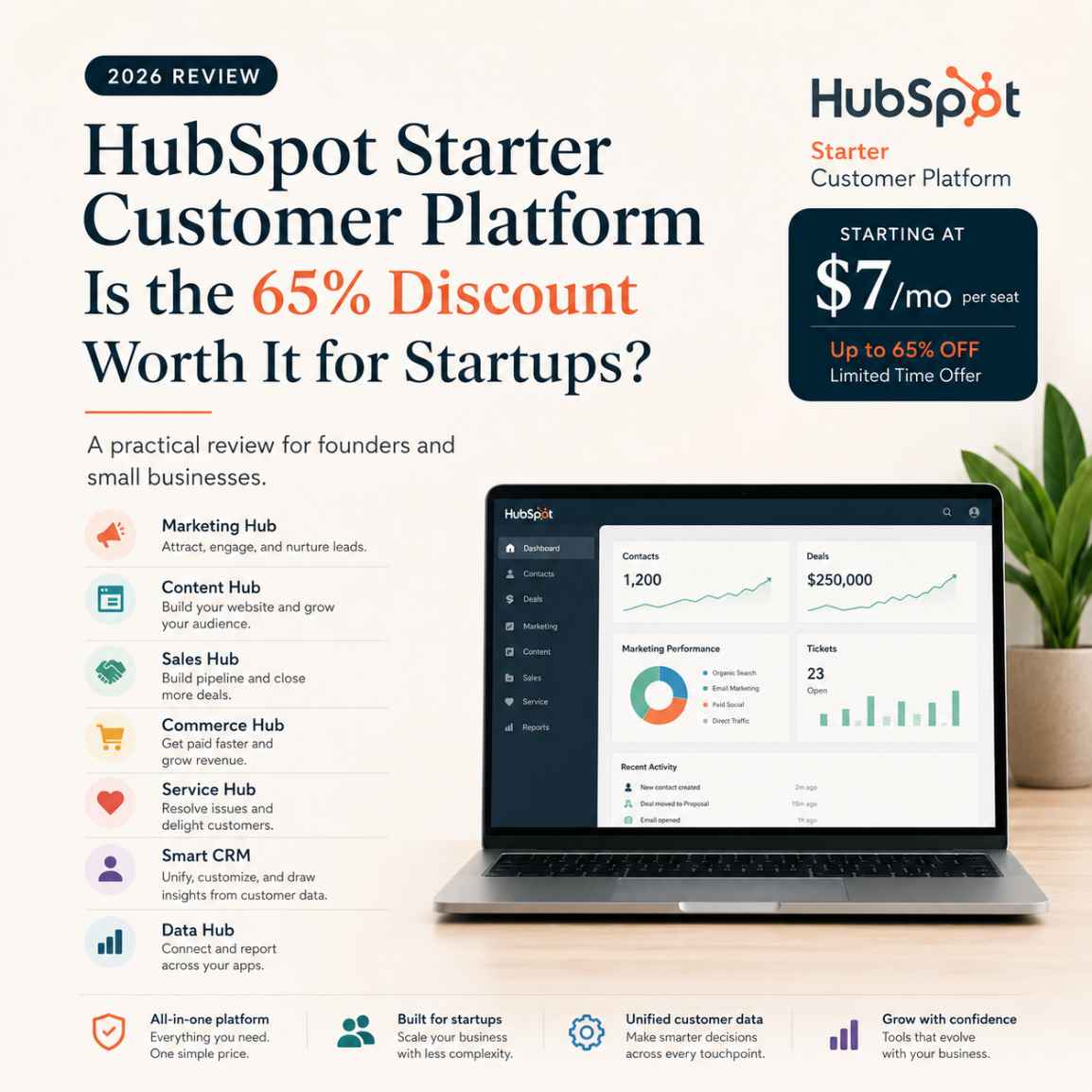
HubSpot Starter Customer Platform combines Marketing Hub, Content Hub, Sales Hub, Commerce Hub, Service Hub, Smart CRM, and Data Hub into a single subscription designed for startups and small businesses. With promotional pricing starting at $7 per seat per month, it offers an affordable way to centralize customer acquisition, sales management, service operations, and business reporting without investing in multiple disconnected tools.
Most early-stage companies don't struggle because they lack tools.They struggle because they have too many.
A typical startup might run:
- One CRM
- One email marketing platform
- One website builder
- One customer support tool
- One invoicing system
- Multiple spreadsheets holding everything together
At first, this feels manageable.
Then leads start falling through cracks.
Marketing data stops matching sales data.Customer support operates independently from revenue teams.
Reporting becomes a weekly detective exercise.
The operational cost isn't software.
It's fragmentation.
This is the problem HubSpot's Starter Customer Platform attempts to solve.
Instead of selling individual products, HubSpot now packages its entire Starter-level ecosystem into a single platform aimed directly at founders, startups, agencies, consultants, and growing small businesses.
The question is whether the current 65% promotional pricing makes it genuinely worthwhile—or simply easier to justify buying more software.
After analyzing the platform from a workflow perspective, the answer is more nuanced than most reviews suggest.
What Is HubSpot Starter Customer Platform?
The Starter Customer Platform bundles together the Starter editions of:
- Marketing Hub
- Content Hub
- Sales Hub
- Commerce Hub
- Service Hub
- Smart CRM
- Data Hub
Instead of purchasing each module separately, users gain access to the complete starter ecosystem through one subscription.
Conceptually, HubSpot is moving beyond CRM software.
It is positioning itself as a customer operating system.
Every customer interaction—from first website visit to paid invoice to support request—can theoretically live within a unified environment.
For startups with limited operational resources, this approach has significant advantages.
If you're currently paying for separate tools for email marketing, CRM, customer support, and lead management, it's worth comparing your monthly software costs against the Starter Customer Platform. Many small businesses discover they can simplify operations and reduce tool sprawl while gaining better visibility into the entire customer journey.
👉 Explore the current HubSpot Starter Customer Platform pricing and available discounts before this promotional offer changes.
The Biggest Benefit: Operational Simplicity
Most reviews focus on features.
Founders should focus on friction.
The strongest argument for HubSpot Starter isn't automation.It's reduction.
Reduction of:
- software subscriptions
- integration headaches
- duplicate data entry
- reporting inconsistencies
- team training requirements
When sales, marketing, customer support, and customer records live in separate applications, operational complexity compounds rapidly.
HubSpot reduces this complexity by centralizing workflows.
For many startups, that centralization creates more value than any individual feature.
Many founders focus on organizing contacts, but the bigger opportunity is becoming visible where customers are making decisions. As AI search continues to reshape software discovery, businesses should understand how HubSpot AEO helps companies get discovered in ChatGPT, Perplexity, and Google AI results
Workflow Analysis: What Changes After Implementation?
Marketing and Lead Capture
A common startup workflow looks like this:
Website → Form Submission → Email Platform → CRM → Spreadsheet
Every transfer creates risk.
With HubSpot Starter:
Website → CRM → Automated Follow-Up → Pipeline
The workflow becomes shorter.
More importantly, visibility improves.
A founder can see:
- where leads came from
- what pages they visited
- whether they opened emails
- whether sales followed up
- whether revenue was generated
This level of visibility is often unavailable in fragmented startup stacks.
Sales Pipeline Management
Sales Hub Starter introduces enough structure to move beyond spreadsheet-based selling.
For small teams, the value isn't advanced forecasting.
It's consistency.
Tasks can be tracked.
Deals become visible.
Follow-ups stop relying entirely on memory.
For founders who still manage sales personally, this often becomes the first operational system that scales beyond individual effort.
Customer Support Operations
Many startups underestimate support until growth creates pressure.
Service Hub helps centralize:
- support tickets
- customer inquiries
- service history
- communication records
The benefit appears later rather than immediately.
As customer volume increases, having support integrated with CRM records becomes increasingly valuable.
Commerce and Revenue Tracking
Commerce Hub remains one of the more overlooked components.
For service businesses, consultants, agencies, and B2B startups, having quotes, payment requests, and revenue activity tied directly to customer records improves visibility significantly.
It is not a full enterprise billing platform.
But it reduces operational fragmentation.
Where HubSpot Delivers Exceptional Value
Startup Teams Under 20 Employees
This is arguably HubSpot's strongest segment.
Small teams often need:
- CRM
- email marketing
- website management
- lead generation
- support tools
Buying separate solutions frequently costs more than expected.
The Starter bundle consolidates those requirements into one environment.
Agencies and Service Businesses
Agencies often juggle:
- prospecting
- proposals
- onboarding
- support
HubSpot provides enough structure to standardize these processes without introducing enterprise-level complexity.
Founder-Led Sales Organizations
When founders are still responsible for closing deals, visibility matters more than advanced automation.
HubSpot's unified dashboard approach helps founders maintain awareness across the entire customer journey.
Where HubSpot Still Falls Short
No platform deserves blind praise.
Several limitations remain.
Feature Gating
HubSpot's pricing strategy has always involved gradual upgrades.
Many advanced capabilities remain locked behind Professional and Enterprise plans.
Startups should evaluate future costs—not just entry pricing.
A platform that feels inexpensive today can become significantly more expensive as requirements evolve.
Customization Constraints
Smaller teams may never notice this.
More operationally mature companies will.
Complex workflows, advanced automation logic, and highly customized reporting eventually hit limitations inside Starter plans.
Data Migration Can Be Tedious
Migrating:
- contacts
- deals
- forms
- email campaigns
- support history
requires planning.
HubSpot onboarding is easier than many enterprise systems, but it is not entirely frictionless.
Expect setup work.
Learning Curve Exists
HubSpot is often marketed as intuitive.
That's partially true.
However, because the platform combines multiple business functions, there is still a learning curve.
Founders expecting instant mastery may be disappointed.
The platform rewards investment.
HubSpot vs Traditional Startup Tool Stacks
A common alternative stack might include:
- WordPress
- Mailchimp
- Zoho CRM
- Freshdesk
- Stripe
- Google Sheets
This can work well.It can also become operationally fragmented.
HubSpot's advantage isn't necessarily having the best individual module.
Competitors often outperform HubSpot in specific categories.
Its advantage comes from integration.
The more disconnected your current workflow feels, the more attractive HubSpot becomes.
Not every business needs a full customer platform on day one. Teams exploring lower-cost alternatives can first explore free CRM tools that work directly inside Gmail before committing to a larger CRM ecosystem.
HubSpot vs Zoho CRM
Zoho generally wins on raw affordability.
HubSpot generally wins on usability and ecosystem consistency.
Startups prioritizing budget above everything else may prefer Zoho.
Startups prioritizing operational clarity often gravitate toward HubSpot.
HubSpot vs Salesforce Starter Solutions
Salesforce remains stronger for complex enterprise environments.
HubSpot remains more approachable for startups.
Many early-stage founders simply do not need Salesforce-level complexity.
Sustainability and Long-Term Operational Considerations
One overlooked benefit of platform consolidation is resource efficiency.
Fewer applications mean:
- fewer integrations
- fewer maintenance tasks
- fewer vendor relationships
- lower training overhead
Operational sustainability matters.
Every tool added to a business creates long-term management responsibilities.
HubSpot's strongest argument is not feature depth.
It is reducing operational sprawl.
Who Should Buy HubSpot Starter Customer Platform?
Excellent Fit For:
- startups
- agencies
- consultants
- founder-led businesses
- small B2B teams
- growth-stage service providers
Probably Not Ideal For:
- enterprise organizations
- highly regulated industries
- companies requiring advanced customization
- businesses already heavily invested in another CRM ecosystem
Is the 65% Discount Actually Worth It?
At standard pricing, the answer becomes more dependent on your workflow needs.
At promotional pricing starting around $7 per seat monthly, the calculation changes significantly.
For many startups, replacing multiple subscriptions with one platform can justify the cost quickly.
The discount itself is attractive.
The larger value comes from operational consolidation.
If HubSpot removes even a few hours of administrative friction each month, the return on investment becomes easy to justify.
The key is adopting it as a business operating platform rather than simply another CRM.
Promotional pricing can change over time, which is why founders should always compare the current offer against long-term operational value. Businesses evaluating adoption may want to compare today's HubSpot Starter pricing, discounts, and startup savings opportunities before making a decision.
FAQ Section
What is HubSpot Starter Customer Platform?
It is an all-in-one business platform that combines Marketing Hub, Content Hub, Sales Hub, Commerce Hub, Service Hub, Smart CRM, and Data Hub under a single subscription.
Is HubSpot Starter Customer Platform worth it for startups?
For many startups, yes. The platform reduces tool fragmentation and provides a centralized environment for managing customers, marketing, sales, and support.
How much does HubSpot Starter Customer Platform cost?
Promotional pricing can start as low as $7 per seat per month when paid annually, though pricing may vary based on region and current offers.
Is HubSpot better than Zoho CRM?
HubSpot generally offers a more polished user experience and stronger ecosystem integration, while Zoho often provides lower-cost options and deeper customization.
Can startups use HubSpot without technical expertise?
Yes. Most startup teams can implement HubSpot without developers, although onboarding and workflow design still require planning.
Does HubSpot Starter include marketing automation?
Yes. Marketing Hub Starter includes foundational marketing automation features designed for lead nurturing and campaign management.
Is HubSpot suitable for agencies?
Yes. Agencies can benefit from centralized lead management, sales tracking, onboarding workflows, and customer support operations.
What happens when a startup outgrows HubSpot Starter?
Businesses can upgrade to Professional or Enterprise plans, though costs increase significantly compared to Starter pricing.
After reviewing the workflows, pricing, and limitations, the real question isn't whether HubSpot has enough features—it's whether your current software stack is helping or slowing your growth. If you're spending more time connecting tools than serving customers, now may be the right time to evaluate whether an all-in-one platform can simplify the way your business operates.
👉 See what's included in HubSpot Starter Customer Platform and check the latest startup pricing before making a decision.
Final Verdict
HubSpot Starter Customer Platform is not the cheapest option available to startups, nor is it the most feature-rich CRM on the market.
What makes it compelling is its ability to reduce operational complexity.
Many growing businesses eventually reach a point where managing separate tools for marketing, sales, customer support, content, and reporting becomes more expensive in time and effort than the software itself. HubSpot addresses that challenge by bringing those functions together within a single ecosystem.
For founders, agencies, consultants, and small teams that want better visibility across the customer journey without investing in enterprise software, the Starter Customer Platform offers a practical path forward. The current promotional pricing makes that proposition even more attractive, particularly for businesses still building their operational foundation.
That said, companies with highly customized processes, advanced automation requirements, or enterprise-level reporting needs may eventually outgrow the Starter tier and need to evaluate higher plans or alternative platforms.
For most startups, however, the bigger question is not whether HubSpot has enough features. It's whether your current collection of disconnected tools is helping your business scale efficiently.
If reducing software sprawl, improving team visibility, and creating a more organized growth system are priorities, HubSpot Starter Customer Platform is one of the strongest all-in-one options available at its current entry price.
Disclosure:
This article may contain affiliate links. If you choose a service through our links, we may earn a commission at no extra cost to you.
This article was created with AI-assisted research and carefully reviewed by our in-house team before publication