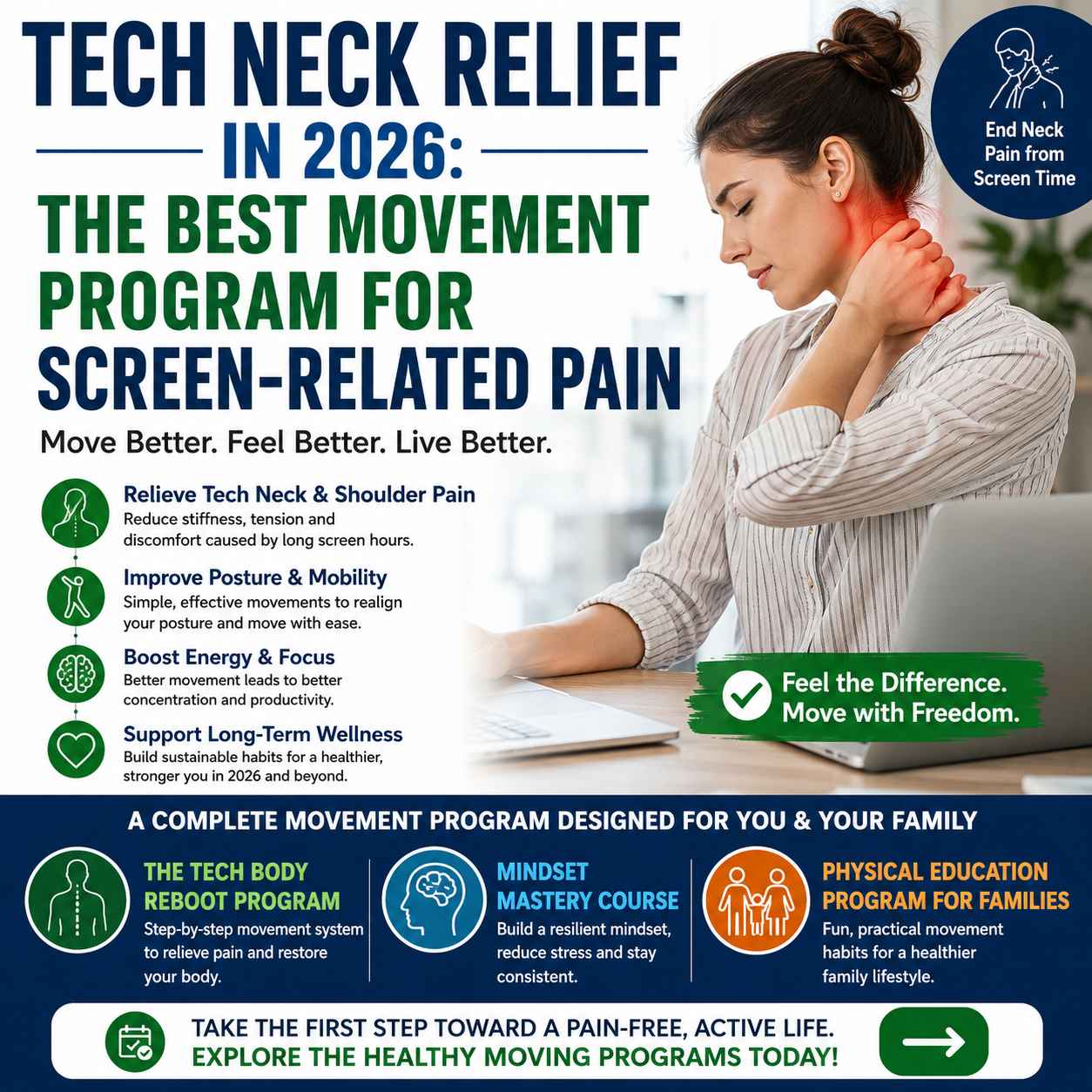
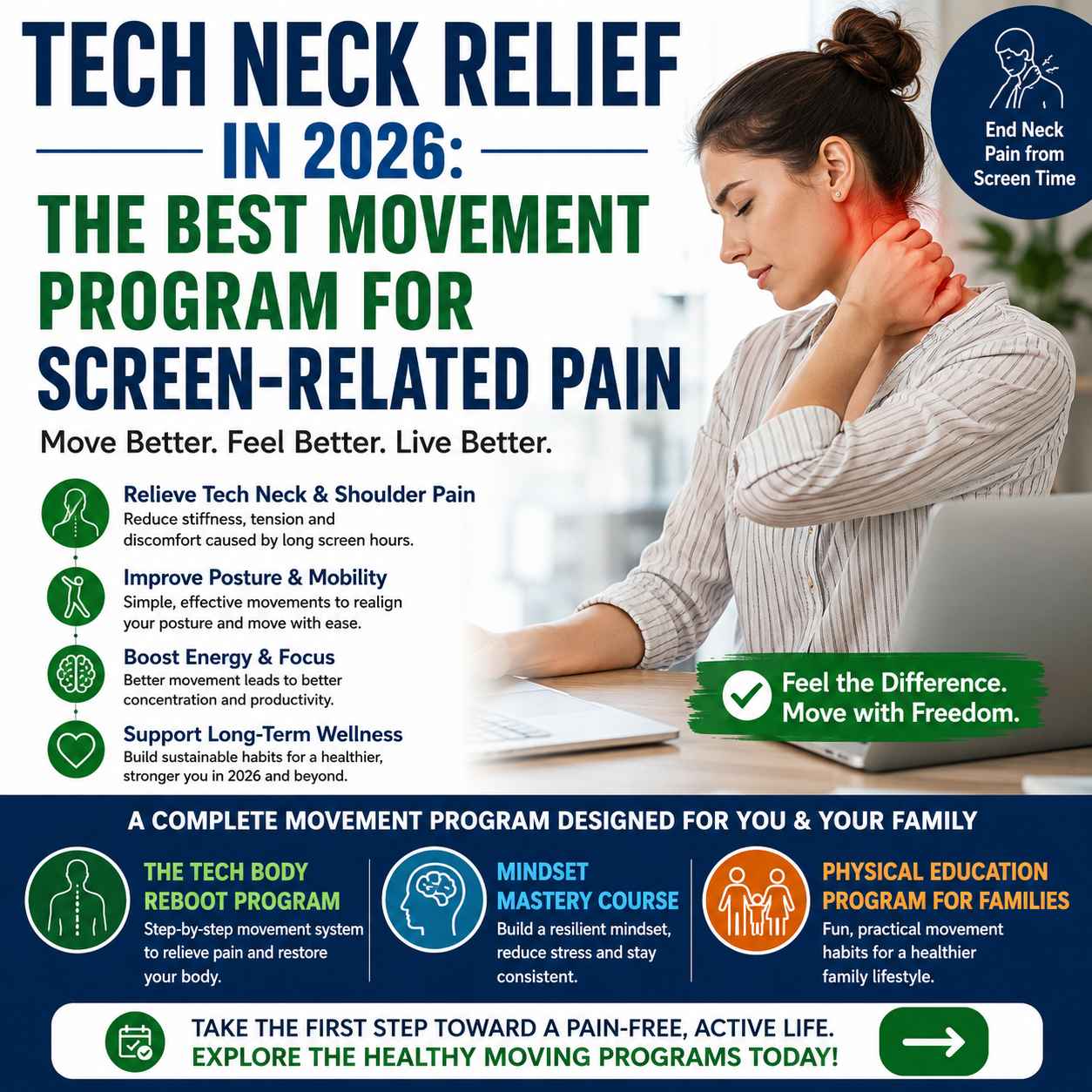
Tech Neck Relief in 2026: The Best Movement Program for Screen-Related Pain
Tech Neck Relief in 2026: The Best Movement Program for Screen-Related Pain
Tech neck relief means using healthier movement, posture awareness and regular changes of position to address the physical strain associated with prolonged phone, tablet and computer use. For people who spend much of the day sitting at a desk or looking at screens, a structured movement program can be more sustainable than relying on occasional stretches alone. In 2026, programs such as Healthy Moving’s Tech Body Fix are particularly relevant for digital workers who want a guided approach to movement, alignment and healthier everyday habits.
The modern workplace has changed dramatically.
You can work from a laptop, manage a business from your phone, attend meetings from your kitchen table, create content from a bedroom and run an entire operation without leaving your chair.
That flexibility is valuable.
But your body still has to deal with the physical consequences of spending hours in relatively fixed positions.
Neck stiffness.
Shoulder tension.
Upper-back discomfort.
Reduced mobility.
Constant fatigue from sitting.
For many digital workers, these problems have become part of everyday life.
This is where tech neck relief deserves more attention.
The answer isn't simply buying another ergonomic gadget or doing one stretch whenever your neck starts complaining.
The bigger opportunity is to build better movement habits into the way you live and work.
And that is precisely why structured movement programs are becoming increasingly relevant for people who spend much of their day connected to technology.
If prolonged computer and phone use has changed the way your body feels, explore the current Healthy Moving programs and see whether a structured movement approach fits your lifestyle. Explore Healthy Moving's movement programs
What Is Tech Neck?
“Tech neck” is a popular term used to describe discomfort and physical strain associated with prolonged device use, particularly when people remain in static positions for extended periods.
It commonly comes up in discussions about:
- Smartphones
- Laptops
- Desktop computers
- Tablets
- Gaming
- Remote work
- Long periods of sitting
- Repetitive screen-based tasks
The important point is that the technology itself isn't necessarily the problem.
The bigger issue is how we use it.
A person who spends eight hours working at a computer but regularly changes position, walks, moves and takes appropriate breaks has a very different movement pattern from someone who remains almost completely stationary for those eight hours.
That distinction matters.
Why Screen-Heavy Work Can Become a Movement Problem
Digital work rewards stillness.
You sit down to answer emails.
Then you open a browser.
Then you attend a meeting.
Then you write a document.
Then you check your phone.
Before you realize it, several hours have passed.
The problem isn't one individual session.
It is the accumulation of static time.
Your body is designed for movement. Modern digital workflows, however, can encourage long periods of repetition and limited positional variety.
This is why the goal shouldn't be to eliminate technology.
That isn't realistic.
The smarter objective is to create a healthier relationship between technology and movement.
Common Signs You May Need Better Movement Habits
Everyone experiences occasional stiffness or discomfort.
But if you regularly notice physical discomfort after long periods of screen use, it may be worth reviewing how much you move during your day.
Common complaints associated with prolonged sedentary work can include:
- Neck stiffness
- Shoulder tightness
- Upper-back discomfort
- Reduced range of movement
- General physical fatigue
- Feeling stiff after sitting
- Discomfort after extended computer sessions
- Tension associated with prolonged device use
These symptoms can have many possible causes, so they should not automatically be attributed to “tech neck.”
Persistent, severe or worsening pain deserves appropriate professional evaluation rather than an online exercise solution.
That is an important distinction.
A movement program can support healthier habits.
It is not a substitute for medical diagnosis or treatment.
Why Stretching Alone Isn't the Complete Answer
Search for “tech neck relief” and you'll find endless lists of stretches.
Some are useful.
But stretching once a day doesn't necessarily fix a lifestyle dominated by prolonged sitting.
Imagine spending eight hours barely moving and then doing five minutes of stretching.
The five minutes may feel good.
But the larger movement pattern hasn't changed.
A stronger strategy is to combine:
- Regular movement
- Position changes
- Alignment awareness
- Mobility work
- Strength and control where appropriate
- Better daily habits
- A sustainable routine
This is where a structured movement program can have an advantage over collecting random exercises from social media.
Instead of asking:
“Which stretch should I do?”
Ask:
“How can I change the way I move throughout the day?”
That is a much better long-term question.
Tech Neck Relief for Remote Workers and Digital Professionals
Remote workers face a particular challenge.
The office used to create natural interruptions.
You walked to a meeting.
You went to another room.
You spoke to a colleague.
You walked to lunch.
You moved between different workstations.
Working from home can eliminate many of those movements.
A laptop can remain open on the same desk for hours.
For entrepreneurs and digital professionals, the situation can be even more extreme.
If your income depends on:
- Blogging
- Software
- Social media
- Digital marketing
- Online education
- Freelancing
- E-commerce
- AI tools
- Content creation
your screen may effectively be your workplace.
That makes movement part of your productivity infrastructure.
You wouldn't deliberately run a business using unreliable infrastructure.
Your body deserves the same level of attention.
For entrepreneurs and digital professionals, movement is more than a wellness goal—it is part of building a sustainable digital lifestyle, which is why we included health systems alongside business infrastructure in our Digital Stack 2026 guide.
A Better Tech Neck Relief Strategy
Rather than searching endlessly for the “perfect” exercise, build a simple movement framework.
1. Change Position Regularly
Don't treat your chair as a permanent location.
Stand.
Walk.
Change your sitting position.
Move your shoulders.
Look away from the screen.
The objective is not perfection.
It is more movement variety throughout the day.
2. Create Movement Interruptions
Long blocks of uninterrupted screen work can become a habit.
Introduce deliberate interruptions.
For example:
- Walk while taking a phone call.
- Stand during selected meetings.
- Walk around after completing a major task.
- Use natural pauses to move.
- Avoid treating every break as another opportunity to look at a second screen.
Small changes compound.
3. Improve Movement Quality
Movement isn't simply about quantity.
How you move matters too.
A structured program can help you become more aware of alignment, mobility and controlled movement rather than simply telling you to “move more.”
4. Make the Routine Sustainable
This is where many fitness plans fail.
If your movement routine requires an hour every day and your schedule cannot support it, you will eventually stop.
A sustainable routine is usually more valuable than an ambitious routine that lasts two weeks.
Should You Buy a Tech Neck Relief Program?
This is where the decision becomes more interesting.
You can absolutely find free exercises online.
You can watch videos.
You can save social-media posts.
You can create your own routine.
So why pay for a program?
Because information isn't the same thing as implementation.
A paid program can make sense when you want:
- Structured lessons
- Guided exercises
- Progressive instruction
- A defined routine
- Better movement education
- A system rather than random videos
- Long-term access
- Accountability or additional support
Healthy Moving's current program structure is particularly interesting because its site provides progressive instruction, step-by-step implementation for its programs and access across internet-connected devices.
That is the difference between buying another collection of videos and buying a system you can actually follow.
Healthy Moving: A Structured Approach to Screen-Related Movement
Healthy Moving is particularly relevant to this conversation because its programs are built around movement, alignment and practical implementation.
The current Healthy Moving support information lists Tech Body Fix, Mindset Mastery, and Physical Education Program for Families among its lifetime courses and programs.
This creates three different angles.
Tech Body Fix — Best Fit for the Screen-Heavy Worker
If your primary concern is the physical impact of prolonged technology use, this is the program I would investigate first.
It is the most closely aligned with the tech neck relief search intent.
Healthy Moving currently lists Tech Body Fix as one of its lifetime-access programs.
Best for:
- Digital workers
- Computer-heavy professionals
- Remote workers
- Entrepreneurs
- People who spend substantial time using devices
- Anyone wanting a more structured approach to movement
Mindset Mastery: Because Knowing Isn't Doing
There is another side to movement that often gets ignored.
Knowledge.
You can know that sitting all day isn't ideal.
You can know that you should move more.
You can know that your posture deserves attention.
And still spend eight hours in the same chair.
That's a behavior problem.
Healthy Moving also lists Mindset Mastery among its lifetime programs.
That makes it a useful complementary concept for people who struggle not with knowing what to do, but with consistently doing it.
The strongest wellness strategy isn't necessarily the one with the most exercises.
It is the one you can actually maintain.
Physical Education for Families: Making Movement a Household Habit
Movement doesn't have to be an individual project.
Families can establish healthier habits together.
Children learn from what adults do.
If adults spend every evening sitting behind screens, it becomes difficult to make movement feel like a normal part of family life.
Healthy Moving also lists a Physical Education Program for Families among its lifetime programs.
That makes it a different proposition from Tech Body Fix.
Instead of focusing primarily on the digital worker's physical routine, the family program broadens the idea of movement into the household.
This is particularly relevant for families trying to create a healthier relationship with technology.
If your family is also trying to create healthier boundaries around devices, our Qustodio review looks at practical ways to manage screen time while encouraging better digital habits at home.
How This Fits Into Your Broader Digital Wellness Strategy
Tech neck shouldn't be treated in isolation.
It belongs inside a broader digital wellness strategy.
Your technology environment affects:
- How long you sit
- How often you move
- How much you sleep
- How frequently you look at screens
- How you spend family time
- How much mental downtime you get
That is why physical movement and digital wellbeing increasingly belong in the same conversation.
For example, families concerned about excessive device use may also want stronger screen-time management.
Our Qustodio Review 2026 explores how families can manage screen time, device usage and digital wellbeing from a centralized system.
And for digital entrepreneurs, our Digital Stack 2026 takes the broader view: health should not be treated as an afterthought to business infrastructure. It argues that sustainable performance is part of building a durable digital operation.
This creates a useful philosophy:
Better technology + better workflows + better movement = a more sustainable digital lifestyle.
If you want to see how movement, mindset and family wellness fit together in a broader approach, our Healthy Movement Program guide takes that conversation beyond tech neck and into everyday wellbeing.
Tech Neck Relief vs. Random Online Exercises
Here's the honest comparison.
| Approach | Best For | Main Limitation |
|---|---|---|
| Random online exercises | Quick ideas | No coherent progression |
| Occasional stretching | Short-term movement breaks | Doesn't change the broader routine |
| Ergonomic equipment | Workspace improvement | Doesn't replace movement |
| Self-created routine | Independent users | Requires discipline and planning |
| Structured movement program | People wanting guidance | Requires financial investment and commitment |
There is no reason to pretend a paid program is necessary for everyone.
It isn't.
If you're disciplined, knowledgeable and comfortable building your own routine, free resources may be enough.
But if you've repeatedly searched for exercises, saved them and still haven't created a consistent movement habit, structure may be worth paying for.
That's the real buying decision.
What Makes a Movement Program Worth Paying For?
Before purchasing any online movement program, ask five questions.
1. Is it structured?
A collection of unrelated videos isn't necessarily a program.
2. Does it teach rather than simply demonstrate?
Understanding why you're doing an exercise can make implementation more meaningful.
3. Can you realistically follow it?
A brilliant program that doesn't fit your lifestyle isn't useful.
4. Does it address your actual problem?
For a digital worker, a program designed around screen-related movement challenges is more relevant than a generic fitness course.
5. Does the purchase have a reasonable safety and refund framework?
Healthy Moving currently states that its lifetime courses and programs have a 10-day money-back guarantee, while its a-la-carte bundles have a 30-day money-back guarantee. Always check the current terms before purchasing because program conditions and pricing can change.
Who Should Consider Healthy Moving?
Healthy Moving may be worth investigating if you:
- Spend several hours a day at a computer
- Work remotely
- Run an online business
- Create content professionally
- Want structured movement education
- Prefer guided programs to random exercise videos
- Want to develop better movement habits
- Want a family-oriented movement option
It may be less compelling if you're looking for:
- A medical diagnosis
- Treatment for persistent pain
- Emergency care
- A replacement for physical therapy
- A completely personalized clinical rehabilitation plan
The distinction is important.
Healthy Moving itself states that its information and exercise programs are not substitutes for medical counseling and advises people to consider their physical limitations and consult a doctor before beginning an exercise program.
My Verdict: Is a Tech Neck Relief Program Worth It in 2026?
Yes — but only if you buy the solution to the real problem.
If your problem is simply that you occasionally feel stiff after using a laptop, you probably don't need another subscription or expensive program.
Start moving more.
Change positions.
Take breaks.
Walk.
Improve your workspace.
But if you've built your career around screens and repeatedly struggle to maintain healthier movement habits, a structured program becomes much more interesting.
That's where I see the strongest case for Healthy Moving.
For the screen-heavy digital worker, the current Tech Body Fix program is the most directly aligned option.
For someone struggling with consistency and behavior, Mindset Mastery adds another dimension.
For households wanting to make movement a shared habit, Physical Education Program for Families is the more natural fit. Healthy Moving currently lists all three within its lifetime-course ecosystem.
The bigger lesson is simple:
Don't wait until your body forces you to change your digital lifestyle. Build movement into it now.
Ready to move beyond random stretches? Explore Healthy Moving's current programs and choose the approach that best matches your screen-heavy lifestyle, movement goals and household needs.
Explore Healthy Moving
Frequently Asked Questions About Tech Neck Relief
What is the fastest way to get tech neck relief?
There isn't one universal “fastest” solution. A sensible starting point is to reduce prolonged static positioning, change positions regularly, incorporate appropriate movement and review your workstation. Persistent or worsening pain should be evaluated by a qualified healthcare professional.
What exercises are good for tech neck?
Exercises that encourage appropriate neck, shoulder, upper-back and general body movement may be useful, but the right exercises depend on the individual. A structured program can help provide progressive instruction rather than relying on random exercises found online.
Can screen time cause neck pain?
Prolonged screen use can contribute to sustained positions and reduced movement, which may be associated with neck and shoulder discomfort. However, neck pain has many potential causes, so it should not automatically be attributed to screen use.
Is tech neck the same as poor posture?
Not exactly. “Tech neck” is a popular term rather than a precise medical diagnosis. Screen-related discomfort can involve prolonged positioning, limited movement, workstation setup and individual factors rather than one simple posture problem.
Can tech neck be prevented?
You can reduce risk by avoiding long periods of uninterrupted static positioning, moving regularly, varying your working positions and creating a healthier daily movement routine.
Is an online movement program better than free YouTube exercises?
Not automatically.Free videos can be perfectly useful.The advantage of a paid program is structure, progression and a defined learning path. If you already have the knowledge and discipline to create your own routine, you may not need to pay for one.
Is Healthy Moving suitable for beginners?
Healthy Moving states that its classes are taught progressively, beginning with basic alignment information before adding more complexity for experienced students.
Does Healthy Moving offer lifetime access?
Yes. Healthy Moving's current support information states that its lifetime courses can be accessed repeatedly and lists Tech Body Fix, Mindset Mastery and Physical Education Program for Families among those programs.
Does Healthy Moving offer a refund?
Healthy Moving currently states that lifetime courses and programs have a 10-day money-back guarantee. Its a-la-carte bundles have a 30-day money-back guarantee. Check the current terms before purchase because commercial terms can change.
Is a movement program a substitute for medical treatment?
No. A movement program should not be treated as a substitute for professional medical assessment or treatment. Healthy Moving itself explicitly states that its information is not medical advice and recommends consulting a doctor before beginning an exercise program.
Which Healthy Moving program is most relevant to screen-related discomfort?
For someone specifically looking for a technology-focused movement solution, Tech Body Fix is the most directly relevant of the three programs discussed here. Mindset Mastery and Physical Education Program for Families address broader behavioral and family movement needs.
Related Kuruntha Smarket Reading
If you're building a healthier digital lifestyle rather than solving one isolated problem, these Kuruntha Smarket articles fit naturally with this guide:
- Healthy Movement Program for Screen-Related Pain, Mindset Growth & Family Wellness in 2026 — the broader Healthy Movement pillar for screen-related pain, mindset and family wellness.
- Qustodio Review 2026 — useful for families looking at healthier screen-time management and digital wellbeing.
- The Digital Stack 2026 — explores why health, productivity and sustainable systems belong alongside the modern digital-business stack.
Final Takeaway
Tech neck is not really a technology problem.
It is a movement problem created by the way modern technology is used.
You don't need to abandon computers, smartphones or digital work.You need a better system for living with them.
For some people, that system will be simple: move more, take breaks and change positions.
For others, the missing piece will be structure.
If you're repeatedly struggling with screen-related discomfort and want a guided movement framework, Healthy Moving is worth evaluating — particularly its current Tech Body Fix program. Its broader ecosystem also includes Mindset Mastery and Physical Education Program for Families, allowing the movement conversation to extend beyond the individual.
The goal isn't to spend less time living. It's to stop letting the screen dictate how your body moves.
#TechNeckRelief #TechNeck #ScreenRelatedPain #NeckPainRelief #DeskWorkerWellness #RemoteWorkerWellness #DigitalWellness #HealthyMovement #MovementProgram #DeskJobHealth #WorkFromHomeWellness #DigitalHealth #HealthyMoving #WorkplaceWellness #HealthyLifestyle #Wellness2026 #ScreenTimeWellness #PostureHealth #MovementMatters #KurunthaSmarket
Disclaimer
This content is for informational purposes only and does not constitute medical advice. Always consult a qualified healthcare professional before making decisions related to your health, fertility, or treatment options.This article was created with AI-assisted research and carefully reviewed by our in-house team before publication
This article may contain affiliate links. If you choose to purchase through these links, we may earn a commission at no additional cost to you.