5 Best Tools for Digital Businesses in 2026: Circle, ThriveCart, SaneBox & More Reviewed
5 Best Tools for Digital Businesses in 2026: Circle, ThriveCart, SaneBox & More Reviewed
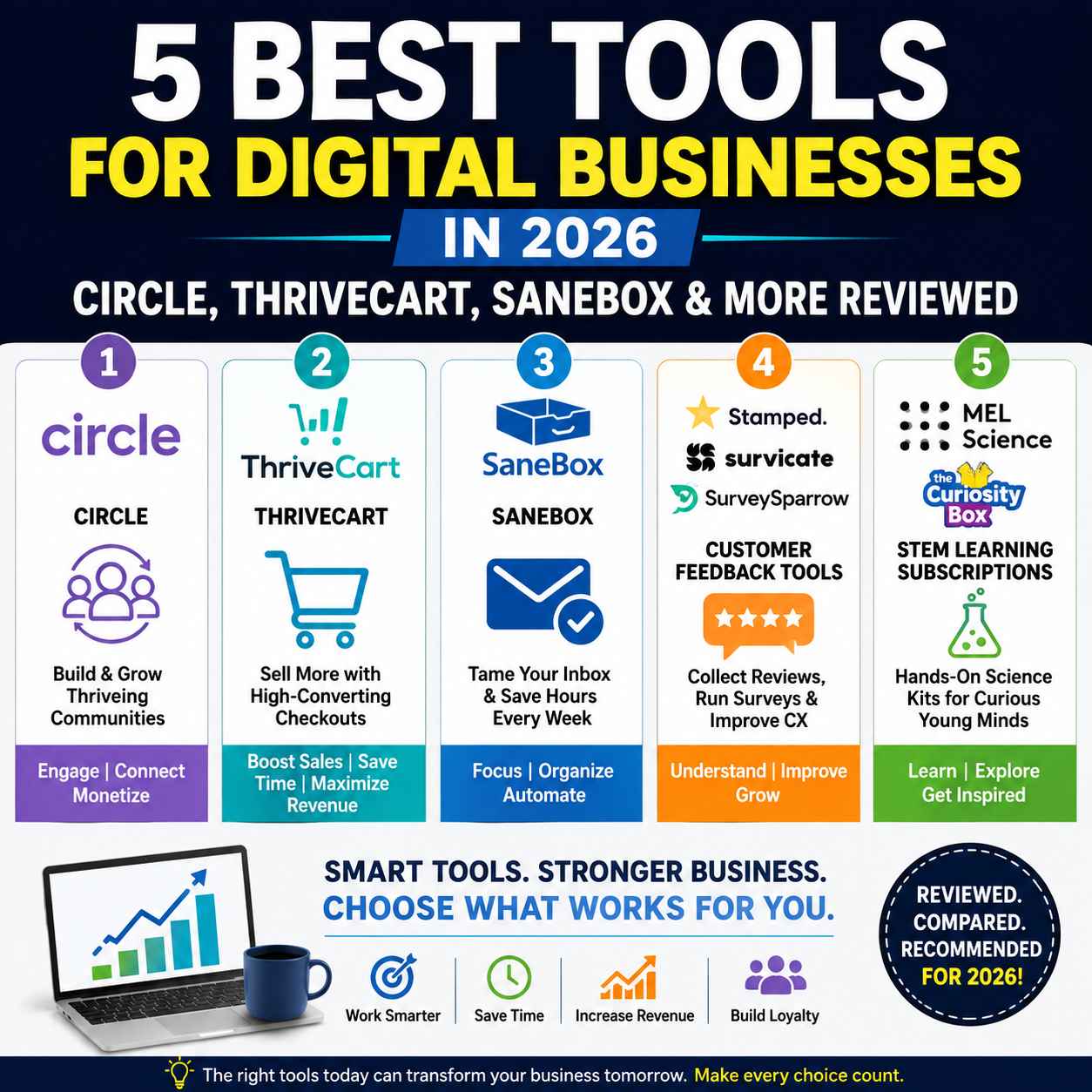
The best tools for digital businesses in 2026 depend on what you need to improve first. Circle is a strong choice for building and monetizing an online community, ThriveCart is designed around selling products and improving checkout and conversion workflows, SaneBox helps reduce email overload, and Stamped, Survicate and SurveySparrow address customer feedback and experience. For families and educators looking for hands-on learning rather than business software, MEL Science and The Curiosity Box offer STEM subscription experiences. The right choice is therefore less about finding one “best” tool and more about selecting the platform that solves your biggest business or learning problem.
Running a digital business in 2026 does not necessarily require dozens of complicated applications.
It requires the right tools for the right jobs.
A creator may need a community platform. A digital-product seller may need a better checkout system. A busy entrepreneur may need to regain control of an overflowing inbox. A growing company may need better customer feedback. And parents or educators may be looking for a practical STEM subscription that makes learning more engaging.
That is why this week's Kuruntha Smarket roundup brings together five different tools and platforms that solve five very different problems.
Instead of simply listing features, this guide focuses on the question buyers actually care about:
Is this tool worth paying for?
We look at Circle, ThriveCart, SaneBox, Stamped/Survicate/SurveySparrow, and MEL Science/The Curiosity Box from a practical buying perspective.
Quick Comparison: Which Tool Is Best for What?
| Tool or Platform | Best For | Main Buying Reason | Best Fit |
|---|---|---|---|
| Circle | Online communities | Bringing community, content and engagement together | Creators, educators, membership businesses |
| ThriveCart | Digital-product selling | Checkout, offers and sales workflows | Creators, course sellers, digital entrepreneurs |
| SaneBox | Email management | Reducing inbox distraction | Entrepreneurs, professionals, small teams |
| Stamped / Survicate / SurveySparrow | Customer feedback | Reviews, surveys and customer insights | Ecommerce, SaaS and customer-focused businesses |
| MEL Science / The Curiosity Box | STEM learning | Hands-on science education | Families, children and educators |
The key point is that these products are not direct competitors.
They belong to different categories.
The value of this roundup is understanding where each one fits into a modern digital ecosystem.
If you're building a broader technology stack, our Best Online Business Tools in 2026 guide covers complementary platforms for digital sales, global hiring, SEO, creator commerce and business growth.
1. Circle: Best for Building an Online Community
If your business depends on an audience, membership, education, networking or recurring engagement, community can become one of your most valuable assets.
That is where Circle comes in.Circle is built around creating an online community where members can interact, access content and participate in discussions rather than simply consuming content from a traditional website.
For creators and digital businesses, this can be an important distinction.
A social-media audience can be useful, but you do not control the platform.
A dedicated community gives you a more structured environment for relationships, conversations and recurring engagement.
Why consider Circle?
Circle is particularly interesting for:
- Creators
- Coaches
- Course businesses
- Membership websites
- Consultants
- Educators
- Professional communities
- Paid communities
- Businesses building customer communities
The attraction is not simply having another place to publish posts.
The bigger opportunity is bringing content and community closer together.
That can make sense when your business model depends on recurring participation rather than one-time transactions.
What makes Circle different?
Traditional social networks are optimized around feeds and public engagement.
A dedicated community platform can instead be structured around specific groups, discussions, members and content.
That distinction matters when your audience becomes valuable enough to deserve a dedicated experience.
Who should consider Circle?
Circle makes the most sense if:
- You already have an audience.
- You want to create a paid community.
- You sell courses or educational content.
- You want deeper customer engagement.
- You want more ownership over the community experience.
Who may not need it?
If you only need a simple discussion area for a small group, paying for a sophisticated community platform may be unnecessary.
Our verdict: Circle is worth investigating for creators and digital businesses where community itself is part of the product.
Read the detailed Kuruntha review: Circle Community Platform Review 2026: Features, Pricing & Is It Worth It for Digital Businesses?
If community is becoming part of your revenue model, our Circle Community Platform Review 2026 takes a closer look at the platform's features, pricing and whether it makes sense for a growing digital business.
Before committing your audience to another platform, see whether Circle has enough value to justify becoming part of your long-term business stack.
2. ThriveCart: Best for Selling Digital Products and Improving Checkout
Getting someone interested in your product is only half the job.
You still have to turn that interest into a completed purchase.
That makes checkout infrastructure an important part of a digital business.
ThriveCart is aimed at businesses that sell products, courses, subscriptions and other digital offers and want more control over their checkout and sales processes.
Why checkout optimization matters
A visitor can:
- Find your content.
- Read your offer.
- Decide they are interested.
- Click the purchase button.
- Abandon the transaction.
The last step is where many businesses lose potential revenue.
A platform that helps structure checkout and sales workflows can therefore have a direct commercial role.
ThriveCart may be useful for:
- Course creators
- Digital-product sellers
- Coaches
- Membership businesses
- Affiliate marketers
- Online educators
- Entrepreneurs selling recurring offers
What should buyers evaluate?
Do not choose a checkout platform simply because it has a long feature list.
Instead, consider:
- What are you selling?
- How many products do you have?
- Do you need subscriptions?
- Do you need upsells or order bumps?
- How important are conversion-focused checkout pages?
- Does the platform fit your existing payment and marketing workflow?
- Will the cost make sense at your current sales volume?
Is ThriveCart worth it in 2026?
For a creator or digital business that already sells products, the answer can be yes if the platform's features genuinely improve the selling workflow.
For someone who has no product, no audience and no established sales process, purchasing sophisticated checkout software too early may be unnecessary.
The best time to invest is when the checkout process has become an actual business bottleneck.
Our verdict: ThriveCart is particularly relevant to creators and digital entrepreneurs who are serious about selling digital products and optimizing the path from visitor to customer.
Read the detailed Kuruntha article: ThriveCart Monthly Pricing 2026: New Plans, 30-Day Free Trial & Is It Worth It for Creators?
If you're already selling courses, memberships or digital products and want to understand whether the latest pricing makes financial sense for your business, our ThriveCart Monthly Pricing 2026 guide breaks down the plans, trial option and buying considerations before you commit.
3. SaneBox: Best for Reducing Email Overload
Email is one of those business problems that appears harmless until it starts consuming hours every week.
For entrepreneurs, freelancers and small-business owners, an overloaded inbox can become a productivity problem.
SaneBox approaches the problem differently from a conventional email client.
Instead of expecting you to manually process every message, it helps organize incoming email so that less-important messages do not constantly compete for attention.
Why email management matters
Consider how many times you check email during a normal working day.
Five minutes here.
Ten minutes there.
A notification interrupts another task.
You open a newsletter.
You answer one message.
Then another email arrives.
The problem is not necessarily the amount of time spent reading one email.
It is the constant interruption.
That is where intelligent email organization can provide value.
Who can benefit from SaneBox?
SaneBox can be particularly useful for:
- Entrepreneurs
- Freelancers
- Consultants
- Executives
- Small-business owners
- People managing multiple email accounts
- Professionals receiving large volumes of non-urgent messages
What makes SaneBox attractive?
Its strongest proposition is simple:
Spend less attention managing email.
That is a better way to evaluate it than counting features.
If it helps separate important messages from lower-priority communication, its value is measured in reclaimed attention.
Is SaneBox worth paying for?
For someone who receives only a handful of emails every day, probably not.
For a professional who loses substantial time sorting newsletters, notifications and less-urgent messages, the calculation can be very different.
If a paid email-management service saves meaningful time every week, the productivity return can outweigh the subscription cost.
Our verdict: SaneBox is one of the more practical tools in this roundup for professionals whose inbox has become a daily productivity problem.
Read the full Kuruntha guide: 12 Powerful SaneBox Features That Will Save You Hours Every Week (2026 Guide)
If email is quietly eating into your working week, our 12 Powerful SaneBox Features guide shows exactly which capabilities can help you decide whether the subscription is worth adding to your productivity stack.
If your inbox is costing you hours every week, see what SaneBox can actually automate before you keep paying for lost productivity.
4. Stamped vs Survicate vs SurveySparrow: Best for Customer Feedback
A digital business cannot improve what it does not understand.
Customer feedback provides one of the most direct ways to discover:
- What customers like
- What frustrates them
- Why people leave
- What products need improvement
- Which features customers actually want
- How customers perceive your brand
But "customer feedback" is a broad category.
Reviews, surveys and customer-experience research are not exactly the same thing.
That is why comparing Stamped, Survicate and SurveySparrow makes sense.
Stamped
Stamped is particularly relevant when reviews and user-generated customer feedback are important to an ecommerce or product-oriented business.
Reviews can reduce uncertainty for prospective buyers.
Someone considering a purchase often wants to know:
Did other customers actually like this product?
That makes social proof a commercial asset.
Survicate
Survicate focuses more heavily on collecting customer feedback and survey responses.
This makes it useful when the business wants to understand customers rather than simply display reviews.
For example, you might want to ask:
- Why did you cancel?
- What nearly stopped you from buying?
- Which feature do you value most?
- What should we improve?
- How satisfied are you with the product?
Those answers can influence product, marketing and customer-experience decisions.
SurveySparrow
SurveySparrow is another option for organizations that want structured survey and feedback capabilities.
It can be relevant when customer research is becoming a recurring business process rather than an occasional questionnaire.
Which customer feedback tool should you choose?
Think about the outcome first.
Want more visible customer reviews?
Consider a review-focused solution such as Stamped.
Want to collect targeted customer insights?
Survicate may be more relevant.
Want broader survey and feedback workflows?
SurveySparrow deserves consideration.
There is no universal winner because the underlying business requirements are different.
Our verdict: Choose the platform based on whether your priority is social proof, customer research or broader survey management—not simply which platform has the longest feature list.
Read the detailed Kuruntha comparison: Stamped vs Survicate vs SurveySparrow: Which Customer Feedback Platform Is Best for Reviews, Surveys & Customer Experience in 2026?
If customer reviews, surveys and customer-experience insights are becoming important to your growth strategy, our Stamped vs Survicate vs SurveySparrow comparison can help you identify the platform that best matches your feedback goals.
Before investing in another feedback platform, compare the three approaches side by side and find the one that fits how your customers actually buy and respond.
5. MEL Science vs The Curiosity Box: Best for Hands-On STEM Learning
This final category is different from the others.
MEL Science and The Curiosity Box are not business productivity platforms.
They belong to the world of STEM subscription learning.
That makes them relevant to families, children, educators and anyone looking for a more hands-on approach to science education.
Why STEM subscription boxes matter
Children can learn science from textbooks and videos.
But physical experimentation creates a different experience.
Instead of simply reading about a scientific concept, children can interact with materials, follow instructions and observe results.
That can make science more memorable.
MEL Science
MEL Science is focused heavily on hands-on science experimentation and educational kits.It can appeal to families looking for structured science activities rather than another screen-based learning experience.
The Curiosity Box
The Curiosity Box takes a broader science-and-discovery approach, combining educational content and science-themed products designed to encourage curiosity.
MEL Science vs The Curiosity Box: Which should you choose?
The answer depends on the learner.
Choose MEL Science if hands-on experimentation and structured science activities are your main priority.
Consider The Curiosity Box if you want a broader discovery-oriented STEM experience with an emphasis on curiosity and science-related exploration.
Parents should also consider:
- Child's age
- Educational level
- Interest in experimentation
- Available supervision
- Frequency of activities
- Overall subscription value
Our verdict: Both can be interesting options, but the better choice depends on whether your priority is structured experimentation or broader science discovery.
Read the detailed Kuruntha comparison: MEL Science vs The Curiosity Box (2026): Which STEM Subscription Box Is Worth Buying?
If you're buying a STEM subscription for a child rather than simply researching science kits, our MEL Science vs The Curiosity Box comparison looks more closely at educational value, hands-on learning and overall subscription value.
Compare the two STEM experiences before you spend your money—especially if you're looking for a subscription your child will genuinely use rather than abandon after one box.
How These Five Tools Fit Into a Digital Business Ecosystem
At first glance, these five products may appear to have little in common.
They actually demonstrate an important principle:
A successful digital ecosystem is built around business problems, not software categories.
Consider a creator business.
You could use:
Circle → build the community.
ThriveCart → sell the offer.
SaneBox → reduce email distraction.
Survicate → understand customers.
Then, if the business also creates educational content for children or families, a STEM platform such as MEL Science or The Curiosity Box becomes relevant to that audience.
The lesson is simple:
Do not buy software because it is popular. Buy it because it removes a bottleneck.
That principle can save a digital business a surprising amount of money.
Which Tool Should You Buy?
Choose Circle if...
You are building a community, membership business, course community or creator-led network and want a dedicated environment for members.
Choose ThriveCart if...
You already sell digital products and want a more sophisticated checkout and sales workflow.
Choose SaneBox if...
Email consumes too much of your working day and you want to spend less time manually sorting messages.
Choose Stamped if...
Customer reviews and social proof are central to your ecommerce strategy.
Choose Survicate if...
You need targeted customer feedback to understand what people think about your product or service.
Choose SurveySparrow if...
You need broader survey and feedback workflows across your customer or organizational processes.
Choose MEL Science if...
You are looking for structured, hands-on science experimentation.
Choose The Curiosity Box if...
You prefer a broader science-discovery experience designed around curiosity and exploration.
Are These Tools Worth Paying For?
The answer depends on whether the tool produces measurable value.
A useful way to evaluate any subscription is:
Value created − cost of the tool = actual business value
For a community platform, value might come from additional memberships.
For a checkout platform, it might come from additional conversions.
For email software, value could come from hours recovered.
For customer-feedback software, value might come from better products and lower customer churn.
For a STEM subscription, value is measured differently: educational engagement, convenience and the quality of the learning experience.
This is why comparing subscription prices alone can be misleading.
The cheapest tool is not automatically the best value.
The most expensive tool is not automatically the best either.
The right tool is the one that solves an important problem well enough to justify its cost.
How to Choose Digital Business Tools Without Wasting Money
Before buying another SaaS subscription, ask these five questions.
1. What problem am I solving?
If you cannot answer this in one sentence, you probably do not need the tool yet.
2. How frequently will I use it?
A tool used every day has a much easier value proposition than one used once a month.
3. Can my existing tools already do this?
Many businesses accumulate overlapping subscriptions.Before adding another platform, check what your current stack already provides.
4. Will this tool make or save money?
Ideally, a business tool should either increase revenue, reduce costs or save enough time to justify its expense.
5. Can I scale with it?
The right tool today should not necessarily be the right tool forever.Consider what happens when:
- Your customer base grows.
- Your email volume increases.
- You launch more products.
- Your community expands.
- Your team becomes larger.
A little planning now can prevent an expensive migration later.
Our Overall Verdict
There is no single winner among these five products because they solve different problems.
Circle is the community-focused choice.
ThriveCart is the sales and checkout-focused choice.
SaneBox is the productivity choice for email-heavy professionals.
Stamped, Survicate and SurveySparrow address different sides of customer feedback and experience.
MEL Science and The Curiosity Box are the learning-focused choices for STEM enthusiasts and families.
For digital entrepreneurs, the strongest combination is not necessarily buying all of them.
It is identifying your biggest bottleneck and choosing the tool that addresses it.
That is the approach Kuruntha Smarket recommends: build a lean technology stack first, then add software when the business has a clear reason to use it.
Frequently Asked Questions
What are the best tools for digital businesses in 2026?
The best tool depends on the business problem. Circle is useful for communities, ThriveCart for digital-product sales and checkout, SaneBox for email management, and customer-feedback platforms such as Survicate and SurveySparrow for collecting customer insights.
What is the best digital business tool for creators?
There is no single best tool for every creator. Circle can be useful for creators building communities, while ThriveCart can be more relevant to creators selling digital products, courses or memberships.
Is ThriveCart worth it in 2026?
ThriveCart can be worth considering for businesses that already sell digital products and need more control over checkout and sales workflows. The value depends on sales volume, required features and how well it fits the existing technology stack.
Is SaneBox worth paying for?
SaneBox can be worthwhile for professionals who receive enough email that manual inbox management consumes significant time. Someone with a light inbox may not receive enough benefit to justify another subscription.
What is the best customer feedback platform in 2026?
The answer depends on the type of feedback required. Stamped is relevant to customer reviews and social proof, while Survicate and SurveySparrow are more appropriate for structured surveys and customer research.
Is Circle good for creators?
Circle can be a strong option for creators whose business depends on community, membership, education or recurring engagement. It is less compelling if a creator only needs a simple website or basic discussion area.
What is the difference between MEL Science and The Curiosity Box?
Both are STEM subscription experiences, but they approach science learning differently. MEL Science emphasizes hands-on experimentation, while The Curiosity Box focuses more broadly on science discovery and curiosity.
Are digital business tools worth paying for?
They can be, provided the tool solves a meaningful problem. A business should evaluate software based on the time saved, revenue generated, operational improvement or customer value it creates rather than looking only at the subscription price.
How many SaaS tools should a small business use?
There is no ideal number. A lean technology stack with a small number of tools that are used consistently is generally better than accumulating dozens of overlapping subscriptions.
What should I consider before buying business software?
Look at the problem being solved, frequency of use, integration with your current stack, total cost, scalability, customer support and the measurable value the software could create.
Final Takeaway
The best digital businesses in 2026 will not necessarily be the ones using the most software.
They will be the ones using the right software at the right time.
If community is your growth engine, look at Circle.
If selling is your bottleneck, evaluate ThriveCart.
If email is consuming your attention, SaneBox deserves a closer look.
If customer understanding is the problem, compare Stamped, Survicate and SurveySparrow.
And if your goal is hands-on STEM learning, compare MEL Science and The Curiosity Box before choosing a subscription.
Before purchasing, read the detailed Kuruntha Smarket reviews and comparisons linked throughout this guide. A few minutes of research can prevent months of paying for software that does not actually fit your needs.
Choose the problem first. Choose the tool second.
Related Kuruntha Smarket Guides
- Circle Community Platform Review 2026: Features, Pricing & Is It Worth It for Digital Businesses?
- ThriveCart Monthly Pricing 2026: New Plans, 30-Day Free Trial & Is It Worth It for Creators?
- 12 Powerful SaneBox Features That Will Save You Hours Every Week (2026 Guide)
- Stamped vs Survicate vs SurveySparrow: Which Customer Feedback Platform Is Best for Reviews, Surveys & Customer Experience in 2026?
- MEL Science vs The Curiosity Box (2026): Which STEM Subscription Box Is Worth Buying
#DigitalBusiness #DigitalBusinessTools #OnlineBusiness #OnlineBusinessTools #BusinessTools2026 #EntrepreneurTools #SmallBusinessTools #CreatorTools #SaaSTools #BusinessSoftware #CircleCommunity #ThriveCart #SaneBox #CustomerFeedback #CustomerExperience #Survicate #SurveySparrow #Stamped #STEMLearning #MELScience #CuriosityBox #EdTech #OnlineEntrepreneur #DigitalEntrepreneur #CreatorBusiness #BusinessGrowth #ProductivityTools #SaaS2026 #KurunthaSmarket
Disclosure:
This article may contain affiliate links. If you choose a service through our links, we may earn a commission at no extra cost to you.
This article was created with AI-assisted research and carefully reviewed by our in-house team before publication